








April 27, 2026 Alex Woodie
IBM i shops that need to quickly move data from their database to other systems for AI, analytics, or operational uses may be interested in recent news out of CData. The company announced that it’s now supporting Db2 for i with Sync, its real-time change data capture (CDC) product.
CData Software is a Cherry Hill, North Carolina-based company that has been building data integration software since it was founded in 2010. In addition to database drivers (ODBC, JDBC, OLE DB), database connectors, and embedded solutions, the company develops a data integration platform dubbed Sync that provides a range of CDC, ETL, and reverse ETL capabilities.
CData Sync enables customers to build their own data pipelines that connect to a variety of data sources living on-prem and in the cloud. The company’s website lists 211 sources of data, including various relational databases, NoSQL databases, file systems, applications frameworks, and cloud and on-prem applications. It supports 40 destinations, including cloud and on-prem databases and data lakes, such as Postgres, Teradata, Snowflake, and Amazon S3.
The software enables customers to apply their own custom business logic and filtering, including column expressions, joins and lookups, and schema remapping, to transform source data so it conforms with downstream systems. It features “SQL-driven change detection” to automatically detect changes in source schemas, which is a common cause of broken data pipelines.
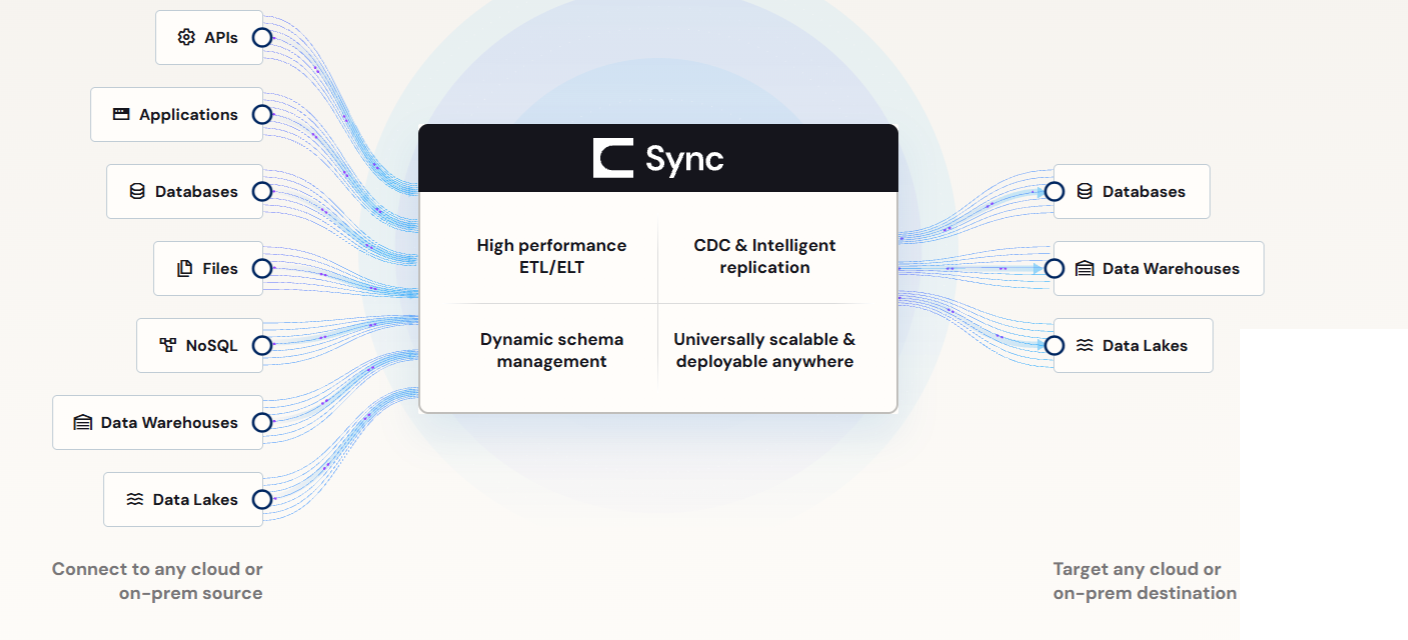
Source: CData
CData Sync, which runs on-prem or in cloud Kubernetes environments, works in several modalities, including basic ETL/ELT, reverse ETL (where enriched data from data warehouses is uploaded back to the operational database), as well as real-time CDC. Customers can deploy Sync on-prem and use it to replicate data into the cloud, if they like.
CDC works more like a streaming data system, and has become the preferred method for tapping into operational databases when batch-oriented ETL jobs introduce too much latency to the data operation. The technology works by tapping straight into the transaction log of the database to detect and grab database changes as soon as they hit the system. CDC also has the benefit of minimizing impact to source systems compared to full table scans.
(The transaction log is called different things on different databases. On Postgres, it’s called the write-ahead log, while on Oracle it’s called the redo log. MySQL calls it the binary log, while SQL Server calls it the transaction log. For Db2 on IBM i, CDC taps into the database journal.)
Last month, CData announced that its Sync CDC capability has been upgraded to support several new data sources, including IBM Db2 for i as well as Db2 for Linux, Unix, and Windows (LUW). It’s also now supporting the SAP HANA database with CDC capabilities.
“Organizations can now stream incremental changes from core systems of record directly into cloud analytics and AI platforms without impacting production workloads,” the company said, adding that it’s enabling “near-real-time replication” from these platforms.
“The era of batch-and-hope data pipelines is over,” stated Manish Patel, CData’s general manager of data integration. “Enterprises need data flowing continuously from core systems to AI platforms, and they need to coordinate those flows without duct-taping together multiple tools. CData Sync gives teams the control and flexibility to operate data infrastructure the way modern businesses actually work.”
CData also announced that it has added a new feature called Pipelines that enables teams to orchestrate multi-step workflows directly within Sync. The company, which claims more than 10,000 customers, says Pipelines allows data engineers to sequence replication jobs, transformations, and events without external orchestration tools, which reduces complexity while maintaining full visibility and control over dependencies.
It also announced a new API 2.0 designed to help customers manage Sync at scale. The new API allows users to programmatically configure pipelines, trigger executions, and monitor operations across distributed deployments.
CData Synch pricing starts at $8,999 per year, which provides up to five standard connections for incremental replication (i.e. ETL/ELT) and coverage for up to 100 million rows per month. Db2 is considered a standard data source for CData, as opposed to a premium source that requires a premium connector, as do IBM Informix, SAP HANA, Workday, Netsuite, Salesforce, and others.
However, IBM i shops that want to use Sync to implement CDC will need to get a more expensive custom configuration from CData, since the standard pricing doesn’t cover CDC. Other optional features that require a custom quote include the API connector, support for REST-based API access, flexible transformation (i.e. moving from ETL to ELT), role-based access control (RBAC), and single sign-on (SSO).
For more information on CData Sync, see www.datadata.com.