









As AI adoption shifts from experimental tools to the business core, enterprises are deploying AI agents and assistants across every department. Developers are accelerating software delivery with Claude Code and business functions are collaborating in Claude.ai, Claude Cowork, and Claude Design, using Anthropic's Claude to fundamentally rewire how they operate and drive complex, autonomous workflows across their most critical tasks.
Broad AI adoption has forced enterprise security into a difficult paradox: secure the business without stalling innovation. Today, security teams must answer three critical questions: How do we prevent sensitive data from leaking into AI models? How do we intercept runtime attacks, like prompt injection, before they execute? And how do we enforce these guardrails consistently across every AI interaction, in real-time?
We are thrilled to announce that Palo Alto Networks Prisma AIRS API now directly integrates with Claude Enterprise via inference hooks.
Key Takeaways:
How It Works
Setting up zero-trust governance for your Claude Enterprise environment takes just a few clicks:
Prisma AIRS securely stores the signing secret in an encrypted edge Key-Value Map (KVM) to cryptographically verify the authenticity of every incoming request before processing.
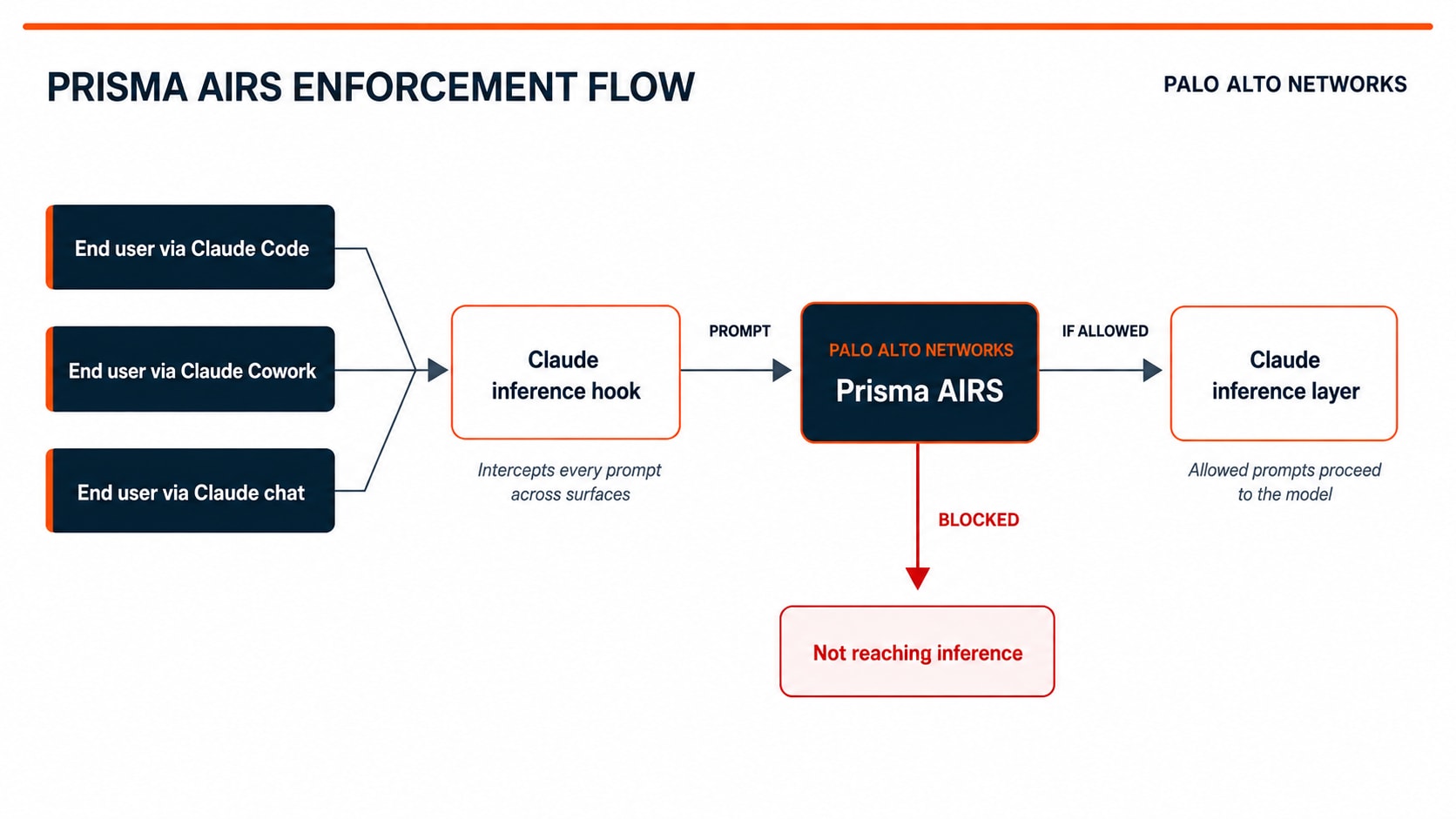
Unified Governance Across All Claude Surfaces
Before Claude reads a prompt, Claude POSTs the payload to Prisma AIRS, which evaluates the input against the configured security profile and returns a synchronous allow or deny verdict back to Claude.
Removing the Data Inspection Blind Spot
This Prisma AIRS integration natively leverages the Palo Alto Networks Enterprise DLP engine your organization already runs. Your current policies, custom definitions of "confidential," and compliance dashboards now instantly govern Claude. No redundant rule creation, and no new management overhead. Every prompt is classified in real-time, before anything reaches the model. Data Policy updates reach Claude the moment they reach everything else, and Claude events land in the same dashboards and audit reporting as every other channel. AI stops being the exception to your data protection strategy and becomes just another channel that is covered.
In practice, this helps prevent:
AI Safety & Runtime Threat Protection
Simultaneously, Prisma AIRS inspects payloads for operational risks specific to large language models:
If a prompt violates your security policy, Prisma AIRS issues a deny verdict. Claude immediately blocks the prompt, optionally presenting a user-facing explanation while returning a unique audit correlation code to your security telemetry dashboards.
Deploy Claude Without the Risk
The Prisma AIRS integration with Claude transforms security from a deployment bottleneck into a business enabler. You no longer have to choose between the operational control of Palo Alto Networks and the cognitive velocity of Claude.
Choose Your Path Forward:
Forward-Looking Statements
This blog contains forward-looking statements that involve risks, uncertainties and assumptions, including, without limitation, statements regarding the benefits, impact, or performance or potential benefits, impact or performance of our products and technologies or future products and technologies. These forward-looking statements are not guarantees of future performance, and there are a significant number of factors that could cause actual results to differ materially from statements made in this blog. We identify certain important risks and uncertainties that could affect our results and performance in our most recent Annual Report on Form 10-K, our most recent Quarterly Report on Form 10-Q, and our other filings with the U.S. Securities and Exchange Commission from time-to-time, each of which are available on our website at investors.paloaltonetworks.com and on the SEC's website at www.sec.gov. All forward-looking statements in this blog are based on information available to us as of the date hereof, and we do not assume any obligation to update the forward-looking statements provided to reflect events that occur or circumstances that exist after the date on which they were made.
此内容由惯性聚合(RSS阅读器)自动聚合整理,仅供阅读参考。 原文来自 — 版权归原作者所有。