









NASA's Curiosity mission has found so many simple carbon-based molecules on Mars over the years that the discoveries may now seem altogether routine.
Scientists know those ingredients matter because life on Earth depends on carbon, but the discoveries have often felt limited, like finding a few breadcrumbs without the loaf.
Now a new lab result from the rover suggests those earlier "crumbs" may have been fragments of something bigger: much more complex carbon material. That means a record of the planet's ancient, long-gone chemistry is locked inside Martian rocks, and scientists have a way to tap into it.
You May Also Like
Curiosity ran a unique experiment on a rock sample it collected six years ago, using a special chemical and heat. The technique revealed 21 different organic molecules, the largest set found on the Red Planet so far, said Charles Malespin, the space agency's lead scientist for the rover’s chemistry lab.
The findings, published this week in Nature Communications, raise the stakes in the search for life on Mars. The study suggests the planet didn't just have scattered ingredients for biology on its surface. Mars actually managed to retain that material inside rocks for billions of years. That preservation doesn't prove the Red Planet was habitable, but it does point to past conditions gentle enough to protect complex carbon compounds — perhaps the same mild environment needed to support life itself.
"Before you can have life, you need an environment where that life can get what it needs to survive," Amy Williams, the paper's lead author from the University of Florida, told Mashable. "Our discovery not only expands the catalog of known molecules, but tells us that some of the building blocks for life as we know it on Earth were also present on Mars in the ancient past."
Among the cache were seven never-before-seen molecules on Mars, including a nitrogen heterocycle, a ring-shaped structure more complex than a simple carbon chain. Nitrogen stands out because it plays a central role in DNA and RNA on Earth, the molecules that carry genetic information for every organism.
Mashable Light Speed
These nitrogen heterocycles haven’t just been absent from previous Mars measurements — they've also never been found in Martian meteorites that fell to Earth, Williams said. She has called the discovery "profound."
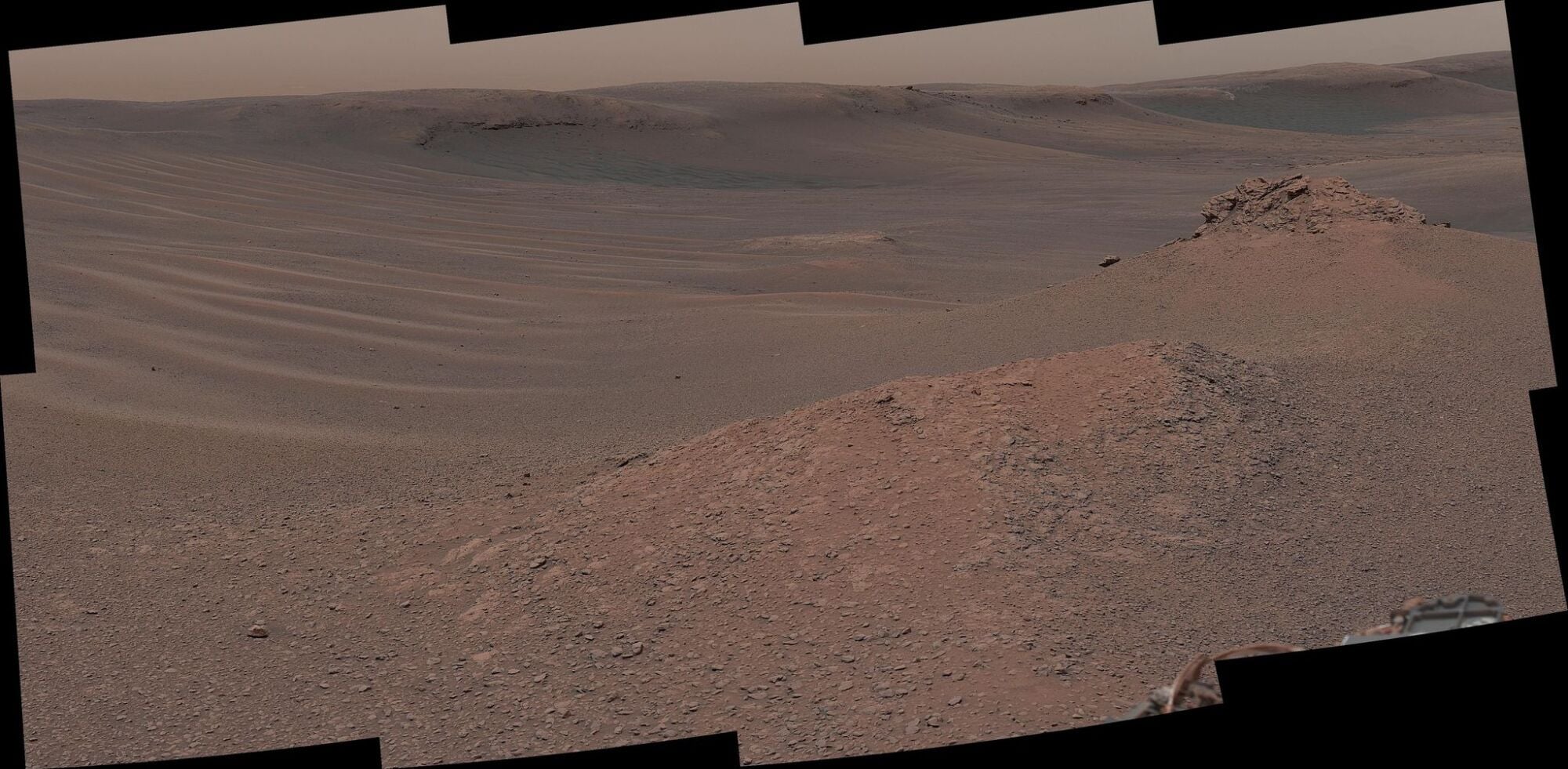
NASA's Curiosity rover explores a clay-enriched area in Gale Crater on Mars. Credit: NASA / JPL-Caltech / MSSS
Other detections included naphthalene and benzothiophene. Those compounds typically form when larger carbon structures break down, supporting the idea that the original material inside the rock was complex.
Living things could have produced these organic molecules, but scientists can't say that yet. Chemical reactions between water and rock can also create them. Still, researchers are encouraged because the detections show Mars' radiation, climate, and other harsh conditions didn't completely erase this raw material. That resilience bodes well for future experiments and missions: If life ever emerged on Mars, scientists may be able to detect molecules made by long-extinct alien microorganisms.
The sampled rock formed about 3.5 billion years ago in Gale Crater, a basin that once held water. If Mars ever developed life, or even came close, this kind of preserved material is where scientists would expect to find chemical traces of that attempt. The specimen came from a location nicknamed Mary Anning, after the English paleontologist.
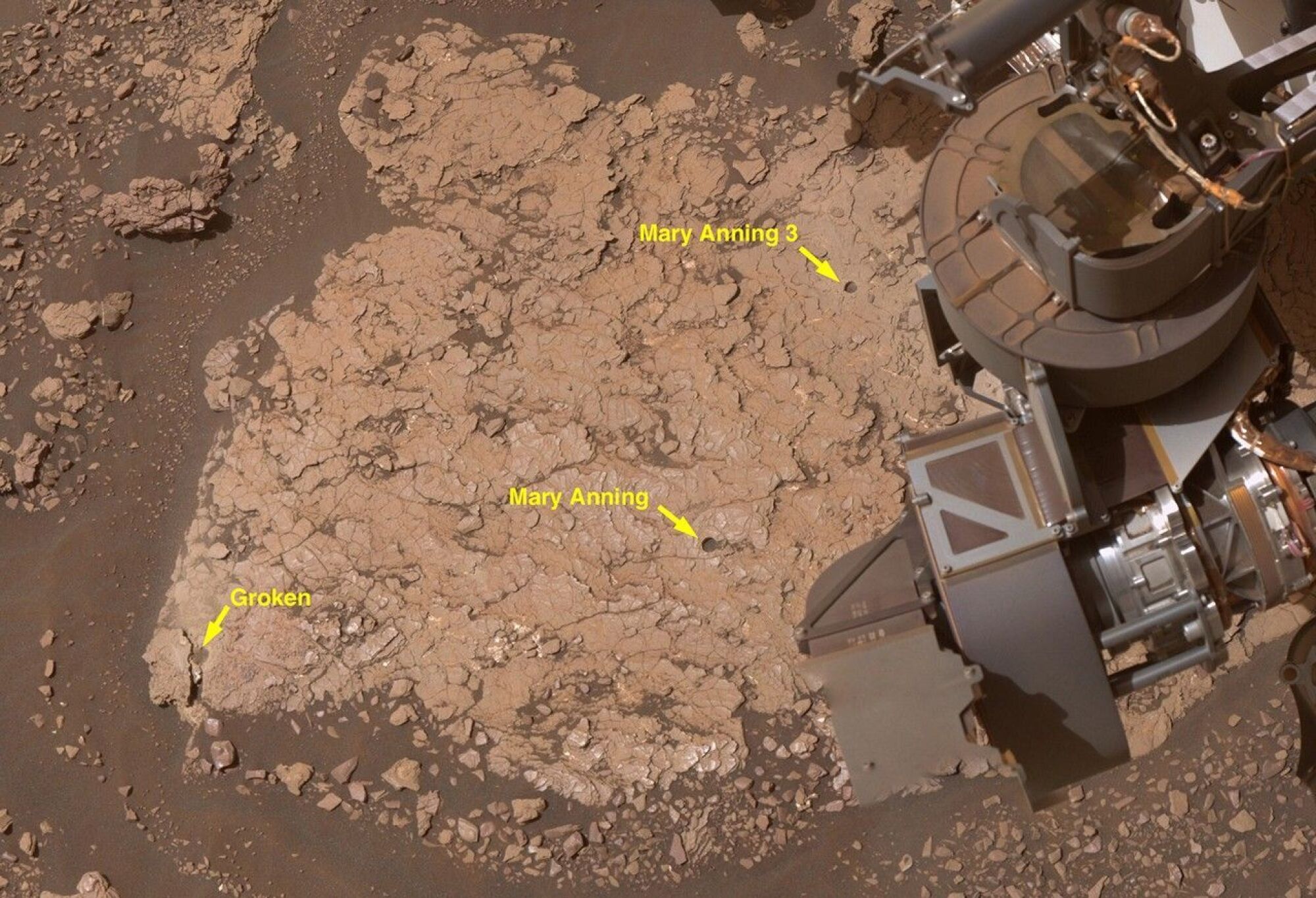
The actual drill hole where Curiosity took the rock sample for the chemistry test is labeled Mary Anning 3 in this annotated image. Credit: NASA / JPL-Caltech / MSSS
The rock’s clay-rich setting may explain how the chemicals survived. On Earth, clay can trap and protect organic material from breaking down. The same process appears to have worked on Mars.
For NASA to run the experiment, Curiosity used a solvent called tetramethylammonium hydroxide, or TMAH, in methanol. The rover mixed the liquid with powdered rock, allowing its instruments to more easily spot certain carbon-based compounds. The powerful testing technique gives scientists a closer look at subtle hints of life that standard tests might miss.
Curiosity’s onboard lab has carried only two small containers of this chemical for its entire mission. The team recently used the second and final cup, as Mashable previously reported. Between the first test in 2020 and the second one this year, scientists at NASA's Goddard Space Flight Center redesigned the experiment into a three-stage process to better mirror lab techniques used on Earth.
"We're really excited about seeing the results," Vasavada told Mashable in February. "These are quite complex analyses to interpret and understand, so it will take a few months for the team to be confident in knowing what they've found."