惯性聚合 高效追踪和阅读你感兴趣的博客、新闻、科技资讯
阅读原文 在惯性聚合中打开

推荐订阅源

P
Proofpoint News Feed
GbyAI
GbyAI
MongoDB | Blog
MongoDB | Blog
人人都是产品经理
人人都是产品经理
A
About on SuperTechFans
Microsoft Security Blog
freeCodeCamp Programming Tutorials: Python, JavaScript, Git & More
量子位
腾讯CDC
Google DeepMind News
Vercel News
Vercel News
Blog — PlanetScale
Blog — PlanetScale
The Register - Security
博客园 - Franky
M
MIT News - Artificial intelligence
C
CERT Recently Published Vulnerability Notes
B
Blog RSS Feed
www.infosecurity-magazine.com
Simon Willison's Weblog
Attack and Defense Labs
L
Lohrmann on Cybersecurity
S
Schneier on Security
MyScale Blog
MyScale Blog
The Last Watchdog
The Last Watchdog
cs.CV updates on arXiv.org
PCI Perspectives
PCI Perspectives
博客园 - 聂微东
Exploit-DB.com RSS Feed
T
Troy Hunt's Blog
Threat Intelligence Blog | Flashpoint
T
Threat Research - Cisco Blogs
K
Kaspersky official blog
F
Fortinet All Blogs
Application and Cybersecurity Blog
D
Docker
Security Latest
Security Latest
P
Privacy & Cybersecurity Law Blog
T
Tenable Blog
B
Blog
有赞技术团队
有赞技术团队
TaoSecurity Blog
TaoSecurity Blog
C
Check Point Blog
Latest news
Latest news
H
Hackread – Cybersecurity News, Data Breaches, AI and More
让小产品的独立变现更简单 - ezindie.com
Help Net Security
Help Net Security
D
DataBreaches.Net
Google DeepMind News
N
News and Events Feed by Topic
J
Java Code Geeks

Lohrmann on Cybersecurity

From Principles to Practice: Actionable Blueprints for Ethical AI On AI Ethics: Why Prompt Engineering Needs a Moral Compass Navigating NIST’s New Cybersecurity AI Frontier AI at Work: Employees Aren’t Waiting for Permission AI, Mind Reading and Microchip Brain Implants The Global State of Technology Risk in 2026 The Mythos Race: Trump’s New EO and Glasswing’s Expansion No Longer Invisible: When Cyber Attacks Go Physical How New College Grads Can Succeed in an AI Economy Protecting People and Infrastructure: A 2026 World Cup Security Preview ‘CI Fortify’ Is the New Road Map for State and Local Resilience A Tale of Two States: The 2026 Cybersecurity Paradox The Great Stay: Why Tech Talent Is Choosing Stability Over Salary A History of Global Hacking — and Where It’s Going Next Why Anthropic’s Mythos Is a Systemic Shift for Global Cybersecurity Post-Quantum Cryptography: Moving From Awareness to Execution What Is Physical AI, and What Does It Mean for Government? New Federal Strategies, Rising Risk From Iran Top Cyber Themes Securing Critical Infrastructure in a Time of War From Michigan to Silicon Valley: A Conversation With Mohamad Yassine Defending Your Castle: Best Practices for Smart Home Security Your Smart Home Is Watching You: Privacy in the Age of AI Robots How Global Power Struggles Are Rewriting Cyber Defense After TikTok: Navigating the Complex Web of Foreign Tech Bans
RSAC 2026 Highlights: From Agentic AI to Active Defense
Dan Lohrmann · 2026-03-29 · via Lohrmann on Cybersecurity

Another RSA Conference in San Francisco ended on Thursday, March 26, 2026, and the top themes on the show floor and in keynote and breakout presentations included: securing agentic AI, identity security, physical AI and the (seemingly never-ending) rise in cyber threats globally, which is increasing exponentially with AI agents.

The physical security at the Moscone Center in San Francisco was high this past week, with RSAC 2026 attendees and bags being checked in similar ways to airport security checkpoints. Even the lines reminded me of long airport security waits.

And while attendees from across the globe came to RSAC to talk and learn about cybersecurity, this year's conference occurred with the backdrops of the U.S. military fighting battles in the Middle East, U.S. federal agencies pulling out of this year’s RSAC and cyber attacks occurring in the U.S. impacting critical infrastructure — including the recent cyber attacks against Stryker.


Some of the top product launches that occurred at RSAC are presented in this <i class="rte2-style-italic">Help Net Security</i> article.

I also really like this human-focused article from PC Magazine (based on an RSAC session) on the surprising reason why phishing still works in 2026. As we have discussed numerous times in this blog over the years, humans remain your biggest strength and also biggest weakness in cybersecurity. The key to stopping scammers is slowing down. Here's an excerpt from that article:

“Perhaps most importantly, he referenced the work of Nobel Prize winner Daniel Kahneman. Kahneman identified two systems the brain uses to make decisions. ‘System 1 is fast, automatic, emotional, and intuitive,’ noted Rose, ‘while System 2 is slow, effortful, logical and deliberate. We live in System 1 all day, every day.‘ Rose explained that System 2 thinking literally uses more of your body’s energy, and that having evolved through periods of scarcity, we’re inclined to avoid expending that energy.”


TOP RSAC 2026 SESSIONS

Many of the top main stage sessions from RSAC 2026 are available for free at their YouTube channel, and I urge you to take the time to watch a few of these fascinating presentations of interest. There are many great sessions on securing AI through various means.

Some of the top RSAC keynotes included:

Reimagining Security for the Agentic Workforce by Jeetu Patel, president and chief product officer, Cisco

Key quotes:

  • “We should NOT think of these agents as tools. They are more like digital co-workers.”
  • “With chatbots, you worry about getting the wrong answer. With agents, you worry about taking the wrong action.”
  • “Beware of the ‘oops phase.’” (Watch the video to see what that means.)

Activate Industry!: Moving Beyond Defense to Disruption and Active Defense by Sandra Joyce, vice president of Google Threat Intelligence, Google Security

Key quotes:

  • “We found that the time between initial access [from threat actors] to the hand-off has collapsed from eight hours in 2022 to 22 seconds in 2025.”
  • “Threats in the AI era include speed, scale and sophistication.”
  • “We must move to active defense, but not hacking back.”

AI vs. AI: How to Reshape Defense Faster Than Attackers Reshape Offense by Nadir Izrael, CTO and co-founder, Armis

CNBC live from RSAC show floor - Databricks CEO: AI will kill the security, information and event management systems - Ali Ghodsi, Databricks CEO

Key quote: “AI will kill the SIEM in 2026.”

WHAT CAUGHT MY EYE AT RSAC 2026

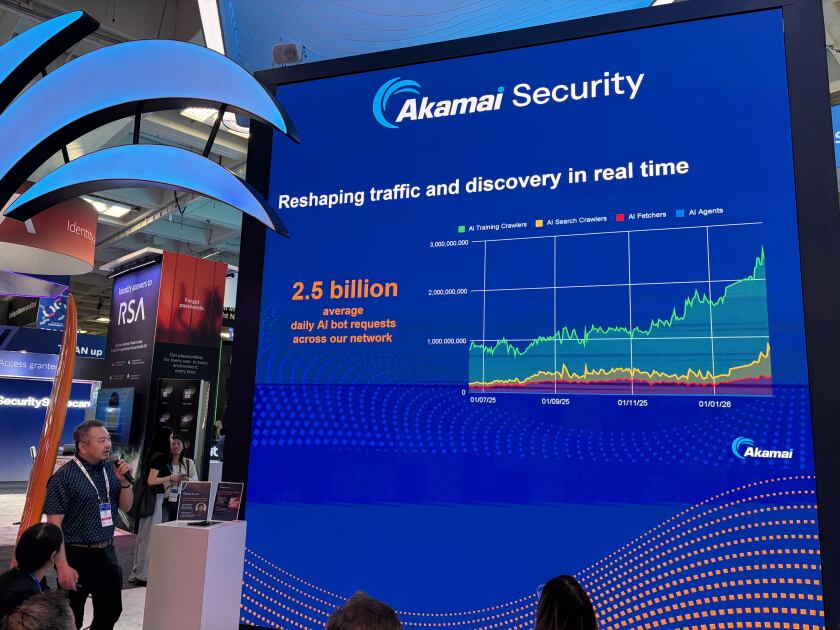
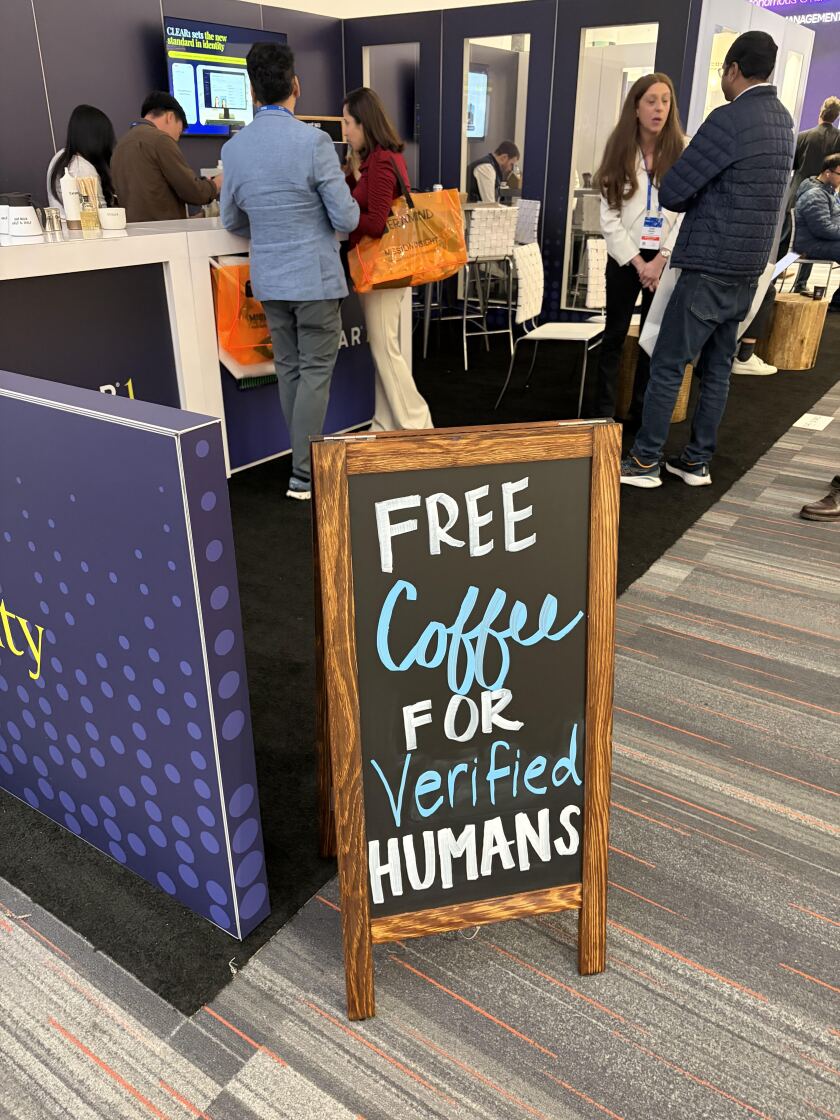
As I walked the RSAC show floor, the pictures below show some of the excitement, surprising numbers and activity that is still alive at one of the world’s largest annual cyber events.

Crowds walking around booths on the RSAC 2026 show floor.
Two people and an announcer standing in a small boxing ring for Commvault at RSAC 2026.

Dan Lohrmann

A billboard for Akmai Security at RSAC 2026.
A chalkboard sign that says "Free Coffee for Verified Humans" in front of a small barista stand at RSAC 2026.

Dan Lohrmann

FINAL THOUGHT

I also had the chance to describe what I was seeing to several media outlets, and here is one of those interviews I did with Expert Insights covering my views on trends for governments in cybersecurity.

Meanwhile, outside the Moscone Center, I was also shocked by the gas prices in California, which are a solid $3-plus higher per gallon than in Michigan — and a reminder of the impact of current global events.

A sign in front of a Chevron gas station in California showing prices above $6 a gallon in March 2026.

Daniel J. Lohrmann is an internationally recognized cybersecurity leader, technologist, keynote speaker and author.