







In the last two installments in our series on phishing resistance, we discussed phishing resistant authenticators and how to gather signals about phishing lures directly from your users. Now let’s drill down into detection and response: what signals does Okta’s System Log provide that are indicative of in-flight phishing campaigns?
Okta’s Defensive Cyber Operations team routinely identifies phishing infrastructure configured to imitate an Okta sign-in page and proactively notify Okta customers when suspicious infrastructure we detect appears to be targeting their users. Since March 2020, we have delivered over 1000 notifications to customers.
Proactive alerts provides customers opportunities to:
Deny outbound requests to phishing infrastructure from managed devices,
Request takedowns when the infringing site goes live, and
Adjust access policies accordingly.
There are no guarantees, however, that every phishing domain will be detected in advance of a campaign. And even when they are, there is often a short window of exposure before takedowns take effect.
So the harder problem for defenders is how to quickly identify threat actor activity and remediate any exposure while users are under attack.
Okta’s passwordless solution, FastPass, offers strong resistance against real-time phishing attacks.
When your users are enrolled in FastPass, Okta can provide defenders a high-fidelity signal for when user applications are being targeted by attackers wielding real-time (AiTM) proxies.
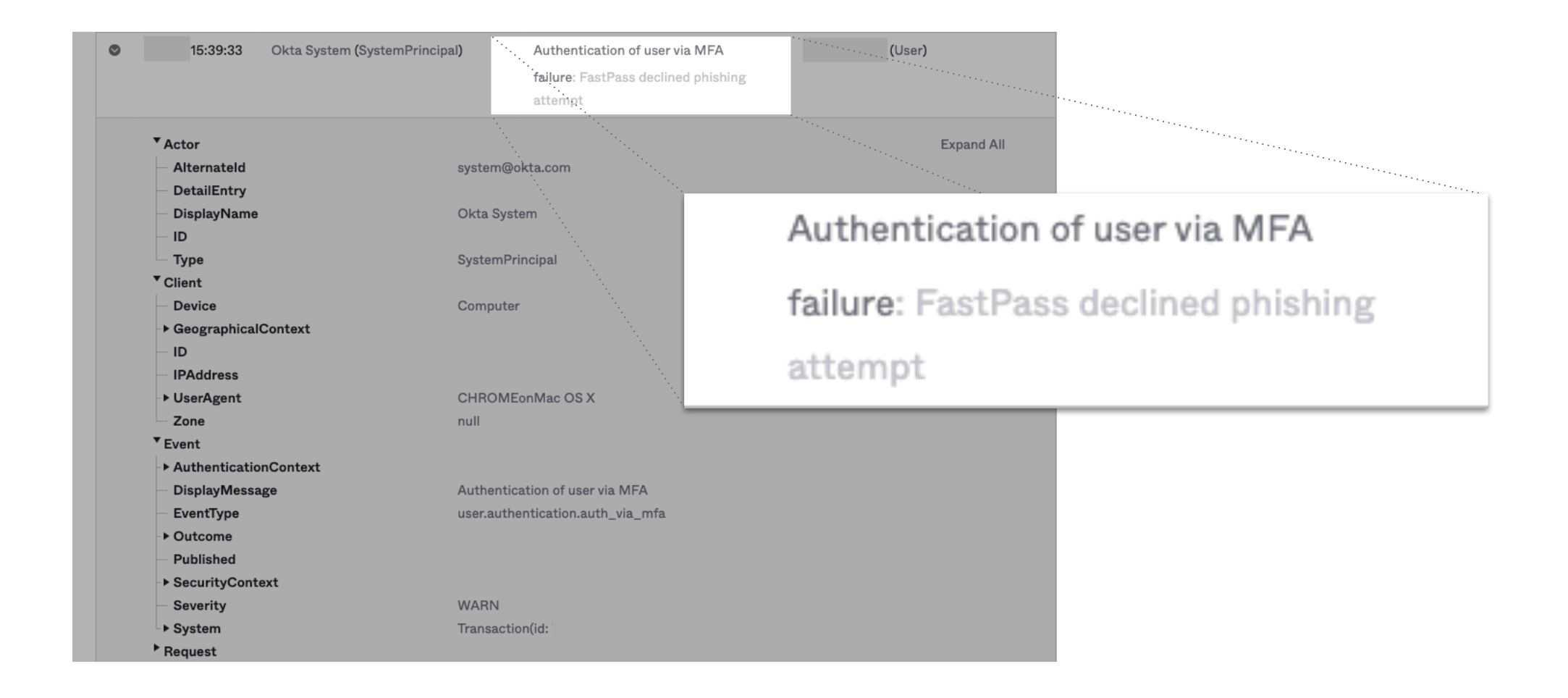
This Early Access feature is available for self-service on Okta Identity Engine - select "Phishing Resistance for FastPass" under Settings > Features in the Admin Console.
If one or more users enrolled in FastPass is targeted using AiTM phishing kits, Okta Identity Engine identifies the failed origin check and generates a unique event in Okta System Log:
eventType eq "user.authentication.auth_via_mfa" AND outcome.result eq "FAILURE" AND outcome.reason eq "FastPass declined phishing attempt"
The utility of that single system log event can’t be understated. In many scenarios, it’s likely to be the earliest available signal about an in-flight attack, and includes key details about the phishing infrastructure used by the adversary.
Why are those details so important? As we previously discussed in this series, there are relatively few organizations today that are 100% passwordless. Even in organizations where a majority of users are protected by phishing resistant factors, there are often groups of users with little choice but to rely on authenticators that are less resistant to phishing.
In our experience, opportunistic threat actors can’t or don’t discern between what authenticators are available to any given user. They rely on harvesting or enumerating large numbers of usernames from public sources during the reconnaissance phase of an attack. If an adversary sends a phishing email to ~100 users, their lures are likely to reach targets enrolled in a broad variety of factors.
So any early detection offers opportunities to:
Prevent other users from accessing (or authenticating via) the attacker’s infrastructure,
Evaluate if other users were previously targeted via the same infrastructure,
Evaluate if other users have entered credentials, and
Evaluate if any of the phishing activity resulted in an account takeover.
Many of these actions can be automated using Okta Workflows (or using a third-party SOAR solution).
Okta Workflows can be used, for example, to:
Extract the IP of the attacker’s proxy server.
Assess the reputation of the IP (by checking the ratio of successful to unsuccessful authentication events from that IP over the weeks or months prior to the incident).
Search System Log to check whether any other users successfully authenticated via a suspicious IP. If any value is returned, the flow can automatically clear the user’s sessions.
If users entered a password as part of the authentication flow (irrespective of whether they successfully authenticated), the flow can call System Log to check whether the user’s corporate email application was accessed during the session in question. This can help determine whether to reset the user’s password.
Raise a request to add the IP to an org-wide blocklist (network zone) to prevent future authentication requests via the attacker’s infrastructure.
To see these ideas in action, we recommend catching up on the recorded sessions delivered on FastPass phishing resistance at this week's Oktane22 conference [Registration Required]:
1.1 - May 26, 2024
Updated detection query to include the missing outcome required in the outcome.result field.
1.0 - Nov 20, 2022
Original Version Published
Brett Winterford is Vice President of Okta Threat Intelligence. Okta Threat Intelligence delivers timely, highly relevant and actionable insights about the threat environment, with a focus on identity-based threats. Brett was previously the regional Chief Security Officer for Okta in the Asia Pacific and Japan, and advised business and technology leaders in the region on all things identity.
Prior to Okta, Brett held a senior security leadership role at Symantec, and helmed security research, awareness and education at Commonwealth Bank. Brett is also an award-winning journalist, editor-in-chief of iTnews Australia and a contributor to the Risky Business podcast and newsletter, to ZDNet, the Australian Financial Review and the Sydney Morning Herald.
The Defensive Cyber Operations (DCO) team is responsible for detecting and responding to cyber threats that impact Okta or our customers via the Okta platform. Our intelligence-driven capability identifies the adversaries most likely to impact Okta and our customers, and prioritises our defensive capabilities based on the threats most likely to be realised.
此内容由惯性聚合(RSS阅读器)自动聚合整理,仅供阅读参考。 原文来自 — 版权归原作者所有。