

Don't settle for half the story
Demyst gives you access to all of the data you need. Evaluate thousands of data attributes from hundreds of possible data connectors all pulled into your own custom-built APIs for instant data deployment.






Small businesses (“SMBs”) are the world’s primary economic engine. According to World Bank estimates these firms represents 90% of businesses globally, and more than 50% of employment worldwide. During economic upswings, these enterprises multiply, grow, and provide vital sources of revenue not just for their employees, but also for utilities and telcos, advertising, lending, insurance, and a host of other large corporate entities. During downswings, small businesses are the first to get pinched, as consumers have less discretionary income and immediately trim their spending (with panic buying as an exception during crises). In both cycles, the ripple effects to small businesses have massive outsized impact.
So far during 2020, small businesses have suffered through a unique set of circumstances: virtually zero walk-in customers, an accelerated transition to online deliveries (which many were not prepared for), and public health fears that curtailed employee availability and supply chains. Those fortunate to operate within high-income countries, such as the United States and Australia, have benefitted from stimulus relief and debt restructuring with their upstream creditors. Pre-pandemic, the average cash-on-hand for small businesses in the US was approximately 27 days, a woefully inadequate amount for the prolonged closures we’ve seen to date.
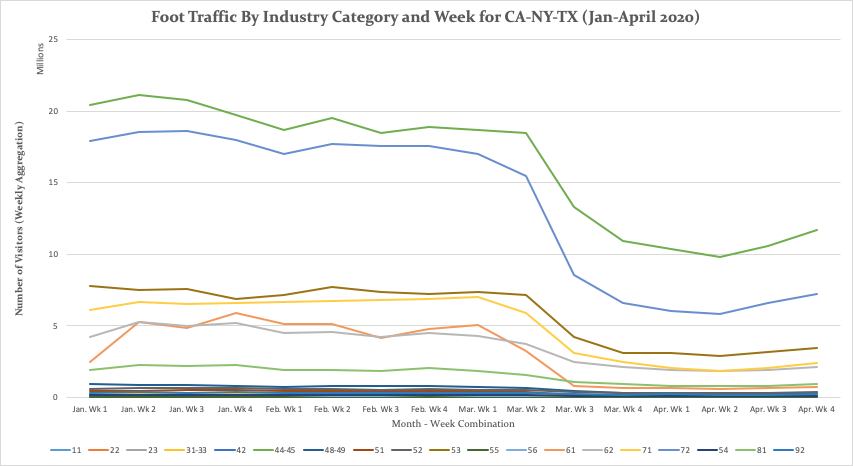
Source: Safegraph Footfall Data, analyzed and structured by Demyst Data
Yet there is some light at the end of the tunnel. The graph above shows analysis of footfall traffic across major states and industries in the US. The drop is clear, but there is a clear upward trajectory forming as well. Vaccines are being developed, the spread of the virus is slowing in certain geographies (not all by a long shot), and many large corporates and nations are looking to the future. As they plan for the next 6–18 months, there is an increasing need to distinguish “Breakout SMBs” relative to the rest of their portfolios. The recovery from Covid-19 is unlikely to be v-shaped. In these turbulent periods many businesses will struggle — but many will also grow and thrive due to the following:
Entities underwriting and marketing to small businesses in this environment must learn how to identify these “breakout SMBs.” Traditionally these companies have leveraged best-in-class business data products from Experian, Equifax, and D&B to fuel small commercial marketing, underwriting, and verification. Most of these bureaus update their files monthly or quarterly, and they focus on traditional business firmographic metrics such as sales revenue, age, the number of tradelines, and credit attributes (risk scores derived from past payment experience). There are two key shortfalls here.
First, there is an imperative to identify “breakout SMBs” now, and monitor them continuously over the next few months. Using bureau data from last month is less relevant as new virus hotspots are found, supply chain vulnerabilities are exposed, and governments are tightening and loosening restrictions from week-to-week. The stock market may be up, but unemployment continues to increase, which also put downward pressure on consumer spending. As consumers return to the marketplace, their spending patterns will also be demonstrably different.
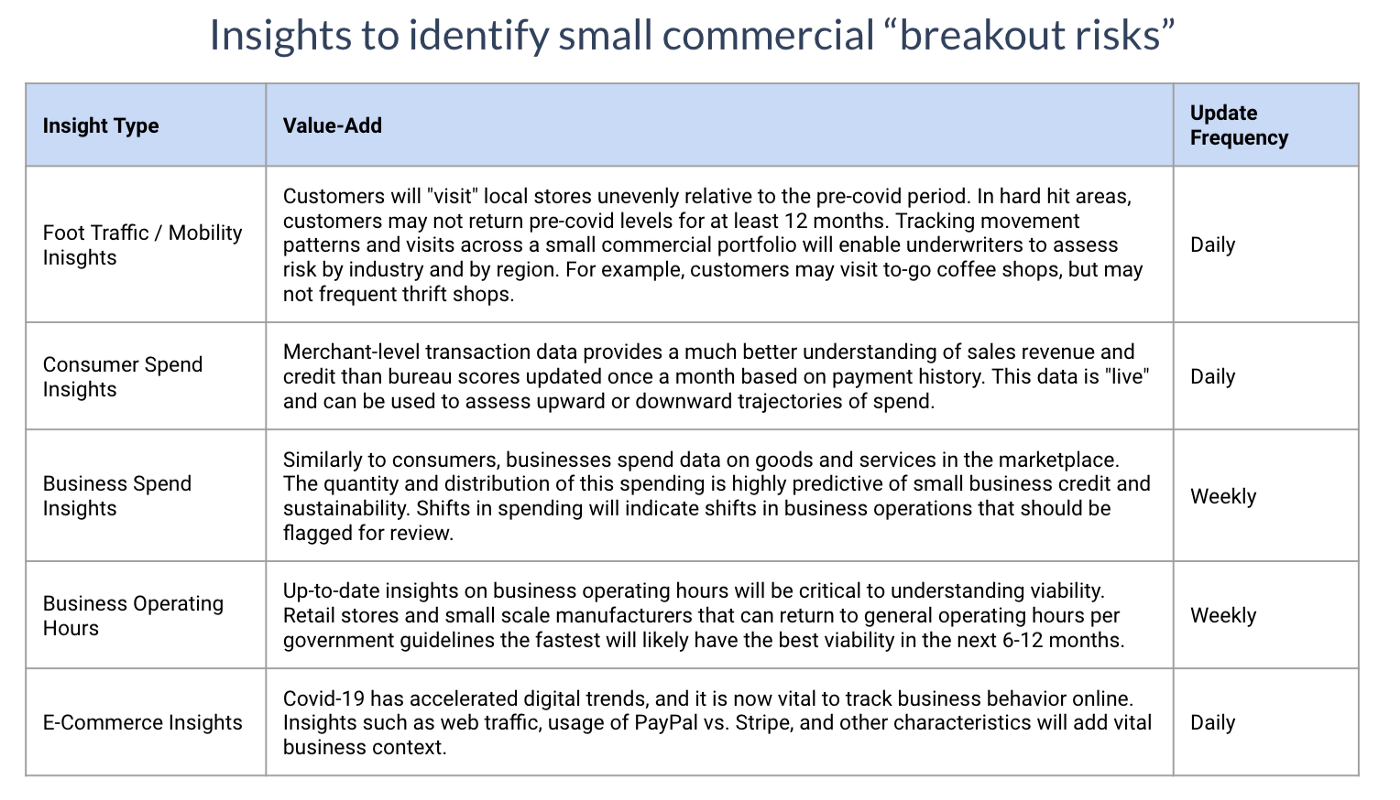
Second, the attributes themselves will be less relevant to understanding business operations. A small business credit score trained on historical payment experiences is valuable data to be sure, but if that business has taken on a cash infusion via PPP, hasn’t paid any tradelines since March’20, and is a retailer with locations in Charlotte, Austin, and Manhattan, is it still relevant? We need to broaden our understanding of small business operations with new types of insights that signal how consumers are interacting them and how they are interacting with their suppliers. Below, we’ve identified a few such insights:
At Demyst, we recognize that it can be difficult for organizations to test and integrate these new insights into their processes. As such, in the coming weeks we’ll be launching several small commercial solutions that will be focused on managing and updating these insights across full-files of small businesses. Initially, we’ll be focusing on the United States, Australia, and Asia.
Stay tuned for the product launch, and please feel free to reach out in-advance to support@demystdata.com or via demyst.com to get a head start!
Don't settle for half the story
Demyst gives you access to all of the data you need. Evaluate thousands of data attributes from hundreds of possible data connectors all pulled into your own custom-built APIs for instant data deployment.
External data can be easy to discover and deploy

此内容由惯性聚合(RSS阅读器)自动聚合整理,仅供阅读参考。 原文来自 — 版权归原作者所有。