





Physics
A device that relies on quantum effects and oversized atoms may be a more reliable way to measure temperature that doesn't require calibration
26 March 2026
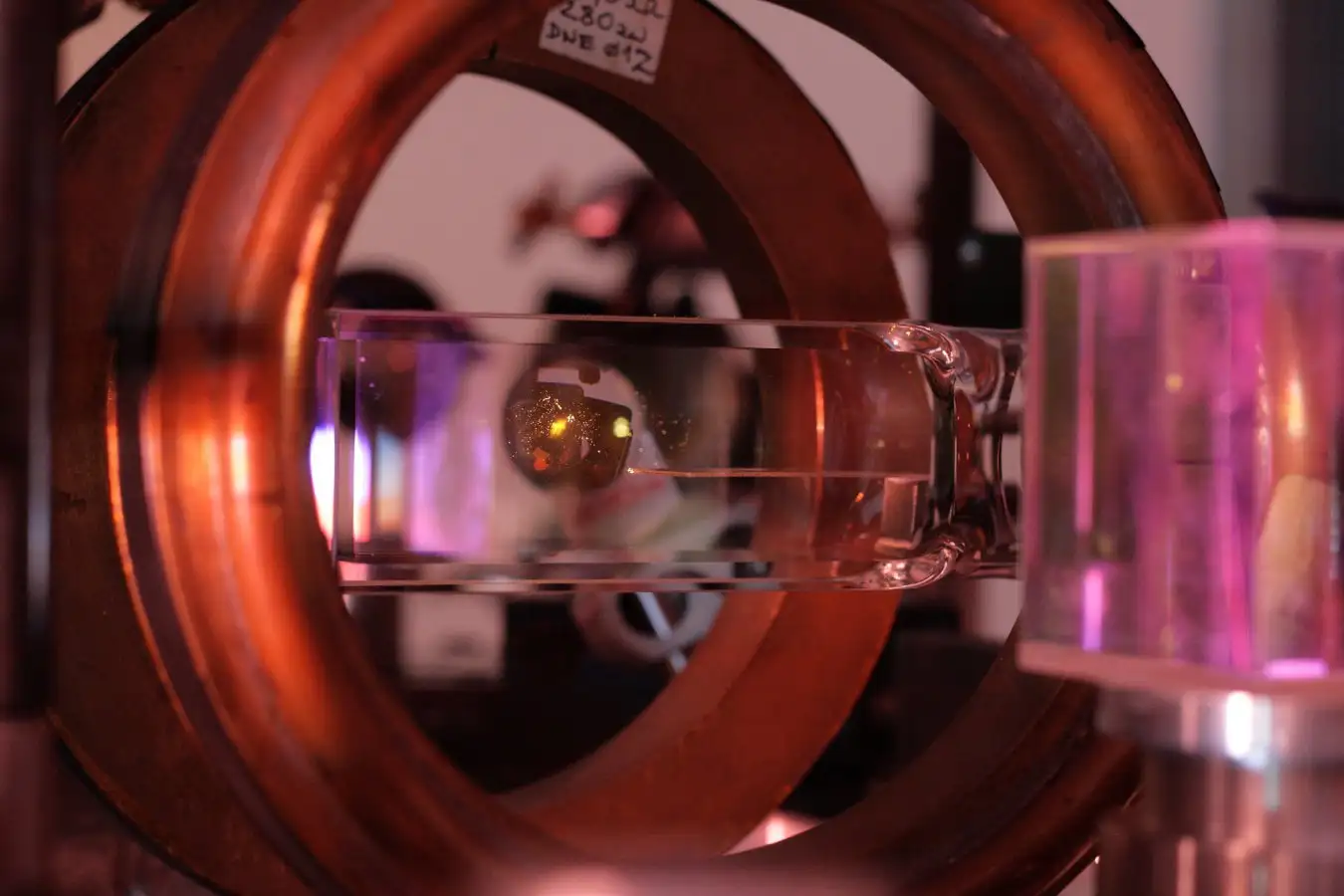
The main part of the new set-up for cooling and trapping rubidium atoms
Tomasz Kawalec CC BY-SA 4.0
A better, more reliable definition of temperature could come from a quantum device full of giant atoms.
While some countries measure temperatures in Celsius and others use Fahrenheit, physicists everywhere use a unit called kelvin. Zero kelvin denotes the absolute coldest temperature allowed by the known laws of physics, so kelvin is said to measure “absolute temperature”. In practice, however, making sure that when you measure a single kelvin, it really is a single kelvin is a laborious process.
“If you want to make an absolute temperature measurement, you buy a commercial temperature sensor, which was calibrated by another commercial temperature sensor, which was calibrated by another commercial temperature sensor, and so on. And one of those sensors was, at some point, sent to the National Institute of Standards [and Technology],” says Noah Schlossberger at NIST in Colorado.
He and his colleagues have now built a device that uses quantum effects to measure kelvin, which researchers could use instead of having to get someone else to calibrate their sensors.
The device is a small box made from metal and glass containing trapped rubidium atoms. The researchers push these atoms to an extreme size, using lasers to move the outermost electrons unusually far from the nucleus, and to an extreme temperature by using both lasers and electromagnetic fields to grab onto and chill the atoms to about half a millikelvin, a temperature roughly a 600,000th that of room temperature.
As a result, the outermost electrons in the rubidium atoms become extremely sensitive to even a small increase in temperature and “jump” into a different quantum state when exposed to one. These jumps are what makes the device a great temperature sensor, because there are well-established mathematical models that can determine the temperature differences needed to make them – effectively allowing for a redefinition of kelvin in these terms.
The International Bureau of Weights and Measures defines the kelvin in a similar way – as a product of several quantum constants – but, in practice, even institutions like NIST use non-quantum devices for calibration. The hope is that the new device gives a quantum definition of kelvin where calibration wouldn’t be needed.
“Every rubidium atom in the world is exactly the same, and they will behave in exactly the same way in the same environment. I can rebuild the device on the other side of the world, and it will be exactly the same,” says Schlossberger. He says this is especially important for keeping high-precision devices functioning correctly, such as atomic clocks, which can only work at very low-kelvin temperatures.
But the new device is still a prototype and so it still has imperfections in how quantum states are detected, for example. It is also too bulky to leave the lab and took more than six months to build. The researchers are now working on optimising its design to make it more practical and to increase its accuracy.
Schlossberger presented the work on 16 March at the American Physical Society Global Physics Summit in Colorado.
Topics: