






Josie Ford
Feedback is New Scientist’s popular sideways look at the latest science and technology news. You can submit items you believe may amuse readers to Feedback by emailing feedback@newscientist.com
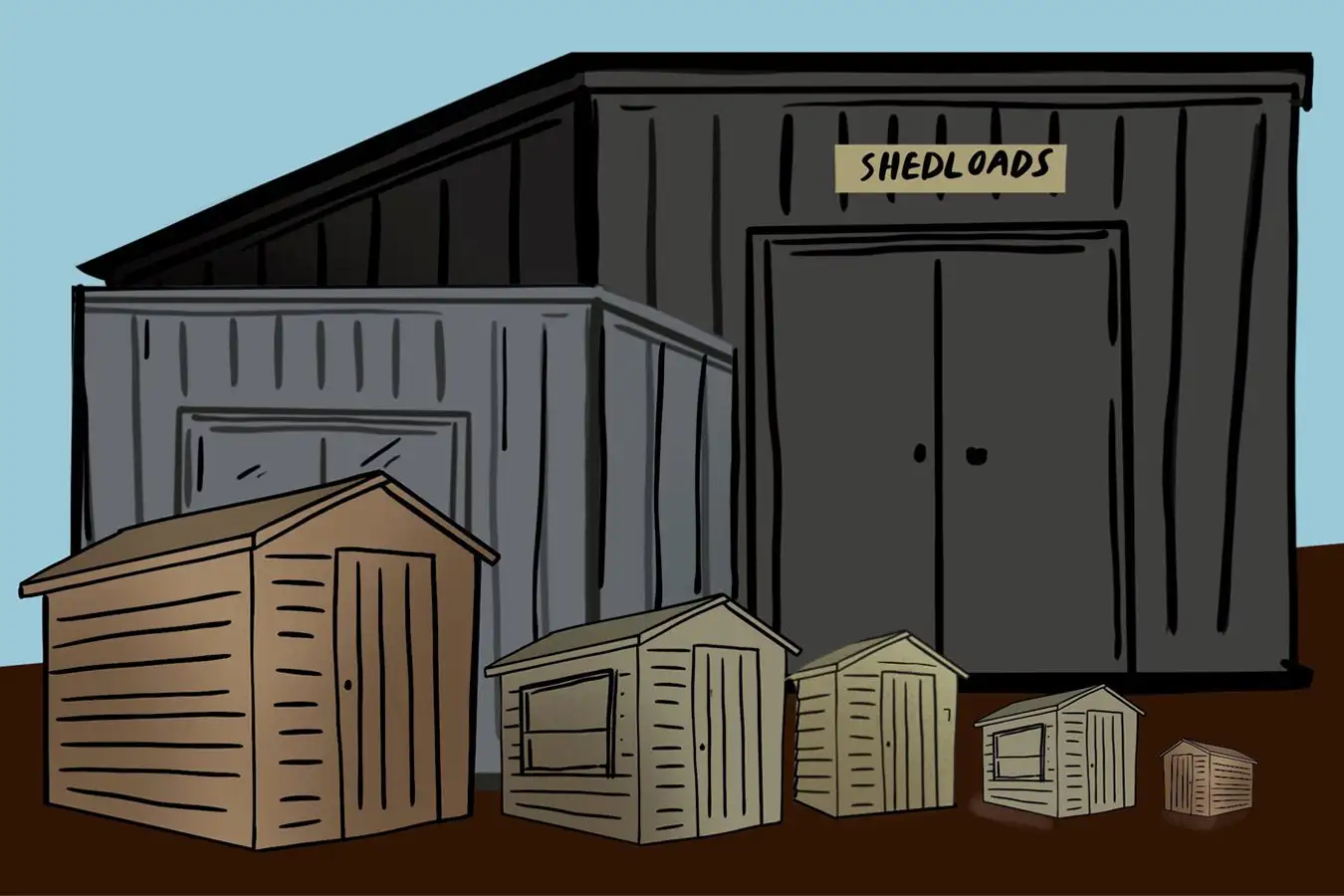
In a previous instalment of our ongoing crusade to identify the weirdest units of measurement in the world (7 March), Feedback made a throwaway remark. At the end of an extended bit about using polar bears as a unit of snow mass, we quoted reader Steve Tees, who wondered quite how big the titular shed was in the term “shedload”, as in ” ‘shedload of xxxx’ causing tailbacks on various motorways”.
Email after email has come charging into our inbox ever since. If only there were a word we could use to convey the concept of an inordinate quantity of something.
Two readers independently offer a possible etymology for the word. Bryn Glover and John Newton have both made the same connection with motorway accidents: “The lorry had obviously shed its load”.
F. Ian Lamb suggests we should consider a “shedload” to be “an endogenous relative scaling (ERS) unit”. This means that one person’s perception of big may differ from someone else’s, depending on past experience. For instance, for a person living in poverty, £1000 might be a shedload, but a billionaire might drop the same sum just to eat in a fancy restaurant. “I am sure there must be other units with these properties,” says Ian. Readers can send any examples of ERS units to the usual address.
But maybe the solution lies in some fairly fundamental physics. William Croydon writes to tell us that shed is a unit that has been used in nuclear physics. This may take a little explaining. In particle physics, researchers spend a lot of time shooting infinitesimal particles at each other and seeing what happens if they collide. Consequently, they needed a label for very small cross-sectional areas.
Hence the unit “barn”, which, as William explains, is 100 square femtometres, or 10-28 square metres. This is the approximate cross-sectional area of the nucleus of a uranium atom, which, of course, is what you are trying to hit if you want to set off a nuclear reaction. Apparently, this ridiculously small area is, in nuclear physics speak, the equivalent of the broad side of a barn in terms of being easy to hit.
William adds that, in the past, “the smaller ‘shed’ was also used”, but he confesses to being “hazy” on quite how much smaller it is. Feedback looked online and discovered two smaller derivates of the barn. The first, defined as 1 millionth (10-6) of a barn, is apparently called an outhouse. The far tinier yoctobarn, defined as 10-24 of a barn, is a shed.
Feedback isn’t sure what the physicists were thinking when they decided that a shed would be orders of magnitude smaller than an outhouse. Regardless, William is clearly right when he says that even a very large load of sheds indeed would be “too small to cause problems on a motorway”.
Finally, Tony Lewis offers a solution that creates a whole new problem: “Steve Tees wants to know the size of the sheds involved in the shedloads of xxxx blocking the motorway. I cannot give him the dimensions, but it must be a xxxxload of shed.”
Feedback has been enjoying former New Scientist puzzle adviser Rob Eastaway’s book Much Ado About Numbers, which explores how William Shakespeare was influenced by the maths of his time.
No legacy is so rich as honesty, so Feedback will confess to feeling a bit Shakespeared out, having encountered not one, but three Hamlet-adjacent films in the past couple of months: Riz Ahmed’s modern-day adaptation; Scarlet, a gender-swapped Hamlet set in what appears to be the afterlife; and the Oscar-winning Hamnet. We can’t think why a story about a corrupt state in terminal decline led by the morally bankrupt would be so in vogue.
Still, we were interested to learn from Rob’s book that “black lead”, otherwise known as graphite, was already being used to make writing implements during Will’s lifetime, and therefore that he may have used a pencil instead of a quill when scribbling down at least some of his skirmishes of wit.
This was covered in Stationery News under the headline “2B or not 2B?”, which is very good. However, the article does quietly admit that any pencils used by the Bard would have been pure graphite, meaning that “the pencil would have been 9B, not 2B”.
Reader Joseph Olechno forwarded us a marketing email extolling the benefits of “hexagonal water” – which is apparently “10 Times Healthier Than Lemon Water“.
Hexagonal water, if this weren’t obvious, is water that has been put through an unspecified treatment that causes the molecules to align themselves into hexagonal arrays. A passing acquaintance with the behaviour of molecules in a liquid will tell you that any such arrangements are unlikely to last longer than a fraction of a second.
Nevertheless, it seems this idea has enduring appeal. A glance through our archives reveals an attempt to make wine from hexagonal water, not to mention adjacent concepts like “vibrationally charged interactive water” and “sexy water” (don’t ask).
Feedback’s main question is: why hexagons? Surely, if you wanted to maximise the magical potential of your water, you would arrange the molecules into pentagrams. But maybe that would be tempting fate. After all, a careless drinker could create a Satanic inverted pentagram by the simple expedient of turning their water bottle upside down.
Got a story for Feedback?
You can send stories to Feedback by email at feedback@newscientist.com. Please include your home address. This week’s and past Feedbacks can be seen on our website.
此内容由惯性聚合(RSS阅读器)自动聚合整理,仅供阅读参考。 原文来自 — 版权归原作者所有。