









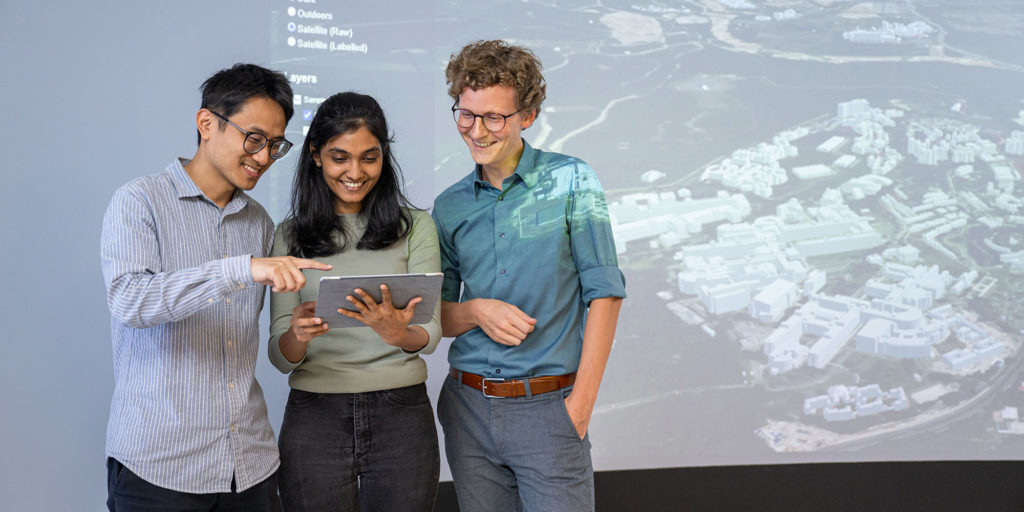
The World Avatar project aims to create a digital ‘avatar’ of the real world. The avatar is composed of computational concepts and data that describe the world, simulate its behaviour and update so that the digital world remains current in time. Using this technology, it is possible to create digital twins that can describe the behaviour of complex systems, and in doing so provide the ability to make data-driven decisions about how to optimise these systems.
Some of these systems include the electrical power and gas grids, renewable energy (eg biomass, solar and wind), the transport system and temperature control in buildings.
The World Avatar is making use of data from Singapore and the UK to find new ways of increasing energy efficiency and reducing carbon emissions. Singapore’s Jurong Island, an industrial park that powers one of Singapore’s key economic sectors, is a useful model for identifying opportunities to save power and make use of resources that would otherwise be wasted (eg chemicals or heat energy). As the UK is exploring the shift from gas to renewable electric power in many areas, the World Avatar can test out numerous scenarios and find the best path towards a clean energy future.
Although Singapore and UK face different energy challenges, the World Avatar’s adaptability allows for a range of test scenarios that can inform industry, government and policymakers as they tackle the energy transition in these and other regions.
World Avatar technology has already been deployed in Pirmasens, Germany, by spin-off company Computational Modelling Pirmasens GmbH (CMPG). By using digital technologies for optimisation, CARES and Cambridge researchers discovered a way to use 45% less gas for district heating production, lowering the costs of heat generation by 23% and reducing annual CO2 emissions by 3,500 tonnes. The cost savings made by this optimisation will be passed on to Pirmasens’ district heating customers in the form of stable tariffs.
Optimising infrastructure in Pirmasens is only the beginning for CMPG. It will soon expand to the entire German market and the digital technologies it develops could be applied in Singapore, the UK and worldwide.
The dynamic knowledge graph technology used to develop the World Avatar can be advanced with new projects in new domains. One such example is the third research phase of Cooling Singapore 2.0 which now aims to develop a Digital Urban Climate Twin of Singapore to identify potential heat mitigation measures in the country.
CARES’ contribution is to evaluate anthropogenic heat emissions from Jurong Island by developing computations energy models using the World Avatar and for it to be fed back into the digital twin. As CARES continues to participate in new projects, so does the capability of the World Avatar, which has no limitation to country or system provided adequate data is available.