

惯性聚合 高效追踪和阅读你感兴趣的博客、新闻、科技资讯
阅读原文 在惯性聚合中打开

推荐订阅源

Cyberwarzone
Cyberwarzone
Hacker News - Newest:
Hacker News - Newest: "LLM"
T
The Exploit Database - CXSecurity.com
有赞技术团队
有赞技术团队
cs.CL updates on arXiv.org
GbyAI
GbyAI
A
Arctic Wolf
Simon Willison's Weblog
美团技术团队
Recent Announcements
Scott Helme
Scott Helme
NISL@THU
NISL@THU
C
Cybersecurity and Infrastructure Security Agency CISA
H
Hacker News: Front Page
MyScale Blog
MyScale Blog
N
News and Events Feed by Topic
M
MIT News - Artificial intelligence
T
Tenable Blog
爱范儿
爱范儿
Stack Overflow Blog
Stack Overflow Blog
S
Security Affairs
T
Troy Hunt's Blog
月光博客
月光博客
SecWiki News
SecWiki News
PCI Perspectives
PCI Perspectives
V
V2EX
OSCHINA 社区最新新闻
OSCHINA 社区最新新闻
F
Fortinet All Blogs
IT之家
IT之家
F
Full Disclosure
博客园_首页
C
CERT Recently Published Vulnerability Notes
T
Threatpost
Last Week in AI
Last Week in AI
C
Cisco Blogs
H
Heimdal Security Blog
大猫的无限游戏
大猫的无限游戏
Webroot Blog
Webroot Blog
www.infosecurity-magazine.com
K
KPMG report finds enterprise disconnect between AI and its ROI | CIO
Attack and Defense Labs
Vercel News
Vercel News
aimingoo的专栏
aimingoo的专栏
量子位
Know Your Adversary
Know Your Adversary
V
Vulnerabilities – Threatpost
I
InfoQ
P
Proofpoint News Feed
Y
Y Combinator Blog
Recent Commits to openclaw:main

NASA Science

Cosmic Origins at AAS 248, June 2026 - NASA Science Cosmic Structure SIG Seminar, 30 April 2026 - NASA Science CMB SAG Meeting, 24 April 2026 - NASA Science BBX SAG Meeting, 30 April 2026 - NASA Science Early Career Investigator Program – Earth Science (ROSES A.11) - NASA Science XR SIG Seminar, 1 May 2026 - NASA Science Night and (Earth) Day - NASA SWERV: High-Impact Historical Case Study - NASA Science AAS Meeting 248, June 2026 - NASA Science Earth Day 2026: Posters and Virtual Backgrounds - NASA Science Advancing Earth Observation at NASA since Release of Earthrise Photo - NASA Science X-59 Adds Freedom 250 Logo - NASA Belts of Green in the Washington Suburbs - NASA Science Artemis II Mission Milestones: An Image and Video Recap Curiosity Blog, Sols 4867-4872: Sand Fill In Antofagasta Crater and Finding Our Next Drill Target NASA Invites Media to Jordan Artemis Accords Signing Ceremony New NASA Views of Earth, From (S)PACE - NASA Science Crew Studies Biotech on Tuesday to Advance Health and Space Economy NASA Invests in Small Businesses Innovating for Space and Earth NASA at SXSW: Johnson Director Vanessa Wyche on Why Artemis Changes Everything Researchers: How Would You Extract Meaningful Insights from Just Four Astronauts? BBX SAG Meeting, 23 April 2026 - NASA Science Thailand’s Krabi Coast - NASA Science AI/ML STIG Lecture Series, 20 April 2026 - NASA Science SWERV: Training Overview and Agenda - NASA Science SWERV: REAL-TIME CAPABILITIES AND IONOSPHERIC DISRUPTIONS OF COMMUNICATIONS - NASA Science SWERV: Operationally Significant Phenomena and Impacts for Ground Operations - NASA Science SWERV: Space Weather Impacts on Satellites - NASA Science SWERV: Space Weather Chain of Events - NASA Science CSDA Quality Assessment Report Evaluates Satellogic NewSat Data - NASA Science NASA Shuts Off Instrument on Voyager 1 to Keep Spacecraft Operating - NASA Science Webinar 4/29: NASA CSDA Program Vendor Focus- MDA Space - NASA Science Testing Begins for Katalyst-NASA Swift Boost Mission - NASA Science Robert Maiberger - NASA William Vantine - NASA Holly Stevens - NASA Dennis McSweeney - NASA Mark T. Vande Hei - NASA Nicole Stott - NASA William Shepherd - NASA Josef Schmid - NASA NASA, OPM Announce New NASA Force Website, Open Job Applications  - NASA Frank Groen - NASA Ginger Kerrick - NASA Daniel Heimerdinger - NASA Michael Greenfield - NASA Kevin Ford - NASA Charles Daniel - NASA Capt. Frank L. Culbertson, Jr., USN (Ret.) - NASA Spring Rains Saturate Michigan - NASA Science NASA CubeSat Begins Mission to Study Radio Waves in Space - NASA Correction to F.5 FINESST, SMD’s Graduate Student Research Opportunity - NASA Science Restoring NASA's Core Competencies - NASA Small Steps, Giant Leaps: Episode 171: How NASA's Pandora Mission Unboxes Distant Worlds - NASA Physics of the Cosmos PAG Meetings - NASA Science NASA Science Veg-06: How plants and beneficial bacteria work together in microgravity Virtual Engineering & Spacecraft Flight Applications (VESFA) - NASA NASA Heliophysics Spacecraft Witness Comet’s Demise - NASA Science BBX SAG Meeting, 16 April 2026 - NASA Science NASA Invites Media to Latvia Artemis Accords Signing Ceremony - NASA Weak Lensing  - NASA Science At the Edge of Light - NASA NASA’s Mobile Launcher Rolls Ahead of Artemis III Preparation - NASA XR SIG Meeting, 27 April 2026 - NASA Science CRN SIG Meeting, 27 April 2026 - NASA Science GW SIG Seminar, 28 April 2026 - NASA Science Eyeing the Richat Structure - NASA Science I Am Artemis: Rebekah Tolatovicz - NASA NASA Selects Voyager for Seventh Private Mission to Space Station - NASA NASA Launches Six CubeSats to International Space Station Odyssey Celebrates 25 Years - NASA Science Crew Begins New Space Research and Installs New Science Gear - NASA NASA’s X-59 Completes First Wheels-Up Flight 2026 NSTA Hyperwall Schedule - NASA Science Update: Artemis II Crew Comes Home - NASA GW SIG Seminar, 14 April 2026 - NASA Science GR SIG Seminar, 17 April 2026 - NASA Science NASA's Webb Redefines Dividing Line Between Planets, Stars - NASA Science Vianni Ricano Cadenas Super Typhoon Sinlaku - NASA Science DGCE SIG Seminar, 23 April 2026 - NASA Science AI/ML STIG Lecture Series, 13 April 2026 - NASA Science NASA Night-light Imagery Tracks US Energy Transition, Global Volatility - NASA Science Hubble Completion Study 2012 - NASA Science Hubble Spies an Active Spiral - NASA Science Science with the Hubble and James Webb Space Telescopes VIII: Enriching the Universe: From Primordial Megaberg Ends Its Long Odyssey at Sea - NASA Science Artemis II Astronauts Back in Houston, Reunite with Families  - NASA Cygnus XL Cargo Craft Solar Arrays Deploy Powering Flight to Station - NASA Cygnus XL Cargo Craft Launches to Resupply Expedition 74 Crew - NASA La NASA da la bienvenida a la Tierra a los exploradores lunares de Artemis II, quienes batieron récords - NASA NASA Science, Cargo Launch Aboard Northrop Grumman CRS-24 - NASA Artemis II Splashes Down - NASA Artemis II Flight Day 10: Crew Completes Final Burn Before Splashdown  - NASA NASA Welcomes Record-Setting Artemis II Moonfarers Back to Earth  - NASA Human Perception and Performance Laboratory - NASA Artemis II Splashdown and Recovery - NASA Crew Preps for Cygnus XL Cargo Mission Targeted for Saturday Launch - NASA New Perspective of Home - NASA Artemis II Flight Day 10: Crew Sets for Final Burn, Splashdown - NASA
Hubble Captures Galaxy Cluster - NASA Science
Andrea Giano · 2026-05-22 · via NASA Science

2 min read

The headshot image of NASA Hubble Mission Team

NASA Hubble Mission Team

Goddard Space Flight Center

May 22, 2026

Article

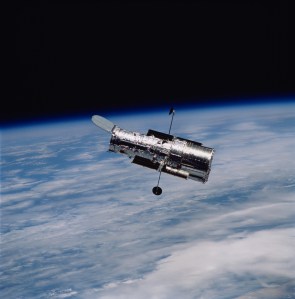
Look closely at this image from NASA’s Hubble Space Telescope and you’ll see galaxies of various shapes and sizes clustered together toward the center-left of the image. A few foreground stars shine brightly and are easily distinguished by the spikes that appear to extend outward from each star. These spikes, called diffraction spikes, are the result of how point sources of light (such as stars) bend, or diffract, around the supports for Hubble’s secondary mirror.

Hubble captured this scene of MACS J1141.6-1905 in visible and infrared light. The image includes data from two Hubble observing programs that looked at massive galaxy clusters that shine very brightly in X-rays. Both programs were looking for distant galaxies gravitationally lensed by the cluster. They also wanted to better understand the physical nature of interactions at each cluster’s core. An extra bonus was the addition of Hubble’s visible and infrared observations of these very bright X-ray clusters to its archive.

Hubble’s archive of 1.7 million observations, and counting, is a valuable tool for current and future astronomers. They can mine Hubble’s 36 years of observations and examine the data with new tools, enabling researchers to make new discoveries.

MACS J1141.6-1905 is around four billion light-years away in the constellation Crater (the Cup).

Media Contact:

Claire Andreoli
NASA's Goddard Space Flight CenterGreenbelt, MD
claire.andreoli@nasa.gov

Share

Details

Last Updated

May 22, 2026

Editor

Andrea Gianopoulos

Location

Keep Exploring

Discover More Topics From Hubble