



惯性聚合 高效追踪和阅读你感兴趣的博客、新闻、科技资讯
阅读原文 在惯性聚合中打开

推荐订阅源

C
Cisco Blogs
The Cloudflare Blog
云风的 BLOG
云风的 BLOG
Recorded Future
Recorded Future
F
Fortinet All Blogs
Microsoft Azure Blog
U
Unit 42
博客园 - 三生石上(FineUI控件)
Threat Intelligence Blog | Flashpoint
N
Netflix TechBlog - Medium
C
Check Point Blog
Security Latest
Security Latest
MongoDB | Blog
MongoDB | Blog
P
Proofpoint News Feed
J
Java Code Geeks
The GitHub Blog
The GitHub Blog
V
Vulnerabilities – Threatpost
阮一峰的网络日志
阮一峰的网络日志
P
Palo Alto Networks Blog
C
CERT Recently Published Vulnerability Notes
F
Full Disclosure
C
Cyber Attacks, Cyber Crime and Cyber Security
雷峰网
雷峰网
T
The Blog of Author Tim Ferriss
T
Threat Research - Cisco Blogs
Cisco Talos Blog
Cisco Talos Blog
V
V2EX
Latest news
Latest news
Engineering at Meta
Engineering at Meta
A
About on SuperTechFans
Cyberwarzone
Cyberwarzone
The Hacker News
The Hacker News
A
Arctic Wolf
CTFtime.org: upcoming CTF events
NISL@THU
NISL@THU
腾讯CDC
P
Privacy & Cybersecurity Law Blog
G
GRAHAM CLULEY
罗磊的独立博客
S
Schneier on Security
C
Cybersecurity and Infrastructure Security Agency CISA
博客园 - 司徒正美
K
Kaspersky official blog
L
Lohrmann on Cybersecurity
C
CXSECURITY Database RSS Feed - CXSecurity.com
月光博客
月光博客
cs.CL updates on arXiv.org
Project Zero
Project Zero
奇客Solidot–传递最新科技情报
奇客Solidot–传递最新科技情报
I
InfoQ

Megaport Blog

A Guide to NAT Gateway A Guide to Cloud Storage How the Data Center Is Evolving in 2026 What to Expect When Attending Your First Network Operator Group (NOG) Nine Ways to Connect to Cloud Using Private Connectivity Migrate Your On-premises to the Cloud: A Step-by-Step Guide How to Lower Your Egress Fees in 2026 How to Achieve Data Sovereignty in Europe Cisco and Megaport: Redefining the Edge of Modern Networking How to Reduce Latency in Your Multicloud Environment Introducing Megaport High-Speed Cross-Cloud Encryption Are Businesses Leaving the Cloud? Using Meraki and Megaport Virtual Edge for Multicloud Networking Equinix Metal® is Going Away: Here’s What You Can Do Introducing Megaport On-ramp as a Service Megaport’s Full Solution Portfolio Is Coming to India New Bare-metal GPU Instance Now Available with NVIDIA RTX Pro 6000 A Look Back at 2025: Megaport's Biggest Updates Megaport Expands Into India With Strategic Acquisition of Extreme IX Your 2026 Predictions From AWS re:Invent 2025 What’s Next for NaaS? Top Trends for 2026 What is IPsec? When to Move From Public Internet to Private Connectivity Megaport and Latitude.sh: Bringing Compute and Connectivity Together How to Improve Your Microsoft ExpressRoute Resilience with Megaport Connectivity Comparing Ways to Connect to AWS What is API-First Networking? The Hidden Cost of Running Cloud-Hosted SD-WAN for IaaS How to Overcome NaaS Integration Challenges Introducing SCION with Anapaya and Megaport How You Can Use Network as a Service (NaaS) to Future-Proof Your Network Introducing 400G Ports All the As-a-services, Compared Introducing Megaport IPsec Tunnels High Score: Megaport Hits 1,000 Locations A Guide to Colocation Data Centers Maximizing Peering Through Flow Analysis How to Build Resilient Networks for AI Production Workloads Introducing Packet Filtering on Megaport Cloud Router Building Resilient Government IT: Strategies for Secure, Compliant, and Scalable Connectivity Future-Proofing Government IT: Balancing Innovation, Security, and Sovereignty in a Changing World Telstra Programmable Network Is Being Discontinued. Here’s How to Migrate The Future of WAN Design Depends on Network as a Service (NaaS) Cisco Webex Edge Connect Launches on Megaport Voice and Video Exchange How to Prepare for APRA CPS 230 Regulations Comparing the SD-WAN Licensing Needs of Major Vendors A Guide to Improving Network Performance How Latitude.sh, Wasabi, and Megaport Unlock Cost-Effective Multicloud Four Ways to Connect Your Clouds SD-WAN and MPLS: Weighing the Similarities, Differences, and Benefits What is Network as a Service (NaaS)? How to Arrange Bilateral Peering Sessions Comparing Major SD-WAN Vendors Software Defined Networking in the Healthcare Industry Deploying A Global Network in Minutes With Megaport AWS Direct Connect Gateway (DGW) Data Transfer Outbound Rules Bilateral and Multilateral Peering: What’s the Difference? Multi-Region SD-WAN: Why Megaport SDCI is the Right Choice Microsoft Azure is Going Secure by Default. Are You Ready? Building Production-Ready AI Infrastructure: How Megaport and Vultr Are Solving the Enterprise Challenge Introducing Megaport NAT Gateway A Guide to AWS Security Tools How to Deploy Amazon Bedrock Using AWS Direct Connect and Megaport Azure Private Link, Explained Introducing 100G MCRs Your Questions Answered on Simplifying Hybrid and Multicloud Network Connectivity How to Fix Poor AWS Latency A Look Back at 2024: Megaport’s Biggest Updates Your 2025 Predictions From AWS re:Invent 2024 Six Ways to Get a More Resilient Network in 2025 Multicloud Security: Challenges and Solutions The Real Cost of High Network Latency Why Brazil is Your Key to Unlocking Business Growth in Latin America Why You Need Integrated Network Security Six Key Differences Between Major Cloud Providers How to Automate Your Megaport Infrastructure With APIs Why Italy is Europe’s Next Cloud Expansion Hotspot How to Lower Your Cloud Costs Peering: How Local Is Local? Introducing Megaport AI Exchange Two Scenarios for Hybrid Multicloud Deployment With IBM Cloud and Microsoft Azure How to Connect Equinix and Digital Realty Megaport Enables Microsoft Azure ExpressRoute Metro for More Resilient Network Connectivity Executives, Here’s What Your Network Team Wants You to Know Easy Ways to Interconnect Your Network The Role of the Data Center in Your Network 100G VXC Expansion: Now Available From 597 Data Centers Worldwide Top 10 How-To Guides To Improve Your Network Comparing Encryption in Transit Options A Sustainable Business Strategy Starts With Your Network Solutions to Common API Issues With Megaport Transforming Financial Connectivity: Introducing Megaport Financial Services Exchange (FSX) Megaport Enhancing Connectivity in Adelaide Megaport’s Latest Portal Features and Functionalities Automate Your Network Deployments With The New Megaport Terraform Provider A Recap of the Megaport World Tour 2024 Top 5 Cloud and Networking Announcements From Cisco Live 2024 Megaport Enhancing Connectivity in Canberra AWS PrivateLink, Explained How Megaport and Wasabi Are Simplifying Cloud Storage
Creating a High-Performance Backup Architecture with Azure Site Recovery
Megaport · 2019-03-18 · via Megaport Blog

How direct connectivity to Azure’s built-in Disaster Recovery as a Service (**DRaaS**) could solve your business continuity and availability issues.

Business Continuity. Disaster Recovery. Backup and Availability. Do these phrases keep you awake at night? Many enterprise businesses face various challenges when thinking about implementing these strategies. Some think they’re only for organisations with huge IT budgets available. Others have failing or out-of-maintenance on-premises infrastructure and need a quick solution for migrating to the cloud. And, many have issues with connectivity. Whatever your barriers to getting a Business Continuity and Disaster Recovery (BCDR) plan in place may be, it’s now easier than ever to create a high-performance backup architecture with direct connectivity to Azure Site Recovery.

There are many reasons why you would consider moving your disaster recovery (DR) to the cloud, however, there are often a few roadblocks that come up too. These include:

  • Your internet being too slow
  • Your on-premises architecture being too difficult to replicate in the cloud
  • Not having enough capacity to implement your strategy in the cloud

Azure Site Recovery, Microsoft’s Disaster Recovery as a Service actually addresses most of these roadblocks, and together with direct connectivity from Megaport, adopting a fast, secure, and scalable BCDR strategy is more simple than you think.

Azure Site Recovery service was first given general availability back in October 2014 and has made numerous improvements to better support Hyper-V, VMware, as well as non-virtualised servers. Some feature highlights include:

Impressively, with Azure Site Recovery, you can be replicating your on-premises environment in under 30 minutes. Did you know that with Megaport, and an additional 10 minutes, you could have your first virtual machine (60GB), replicated, protected, and operational? 

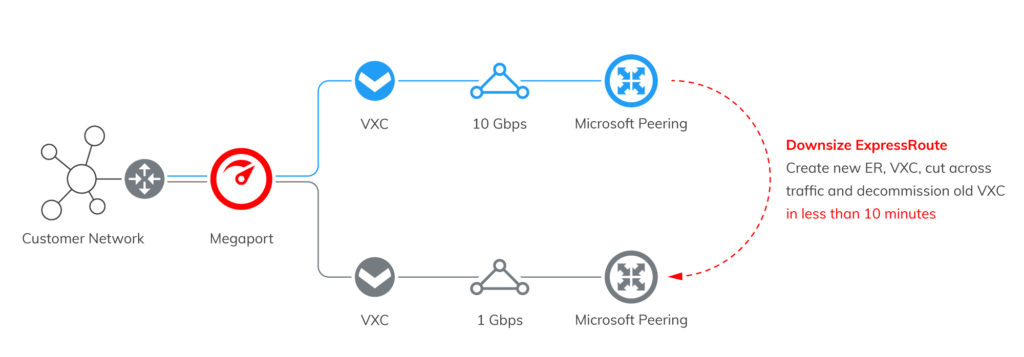
Although once an Azure ExpressRoute circuit is in place, you can’t reduce the bandwidth of that circuit, there is a clever way to get around this. Megaport’s VXCs are billed by the second with no lock-in contract, so you can easily provision a new VXC, cutover the traffic seamlessly, and decommission the old VXC once you’re done.
Azure-Site-Recovery

In our previous blog post, Leveraging Veeam Cloud Tier Storage for Backup and Replication, we discussed how traditional internet connection data transfer speeds affect archiving, and how Megaport solves the bandwidth issue, public IP address challenges, and other challenges more in-depth.

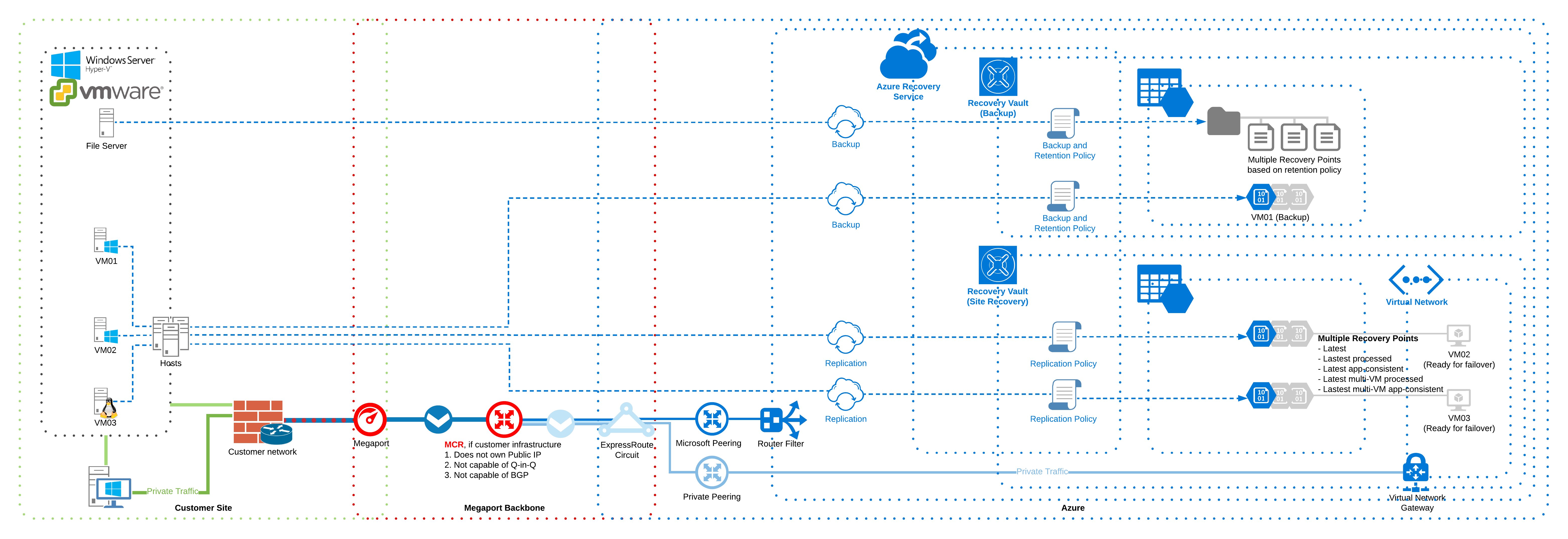
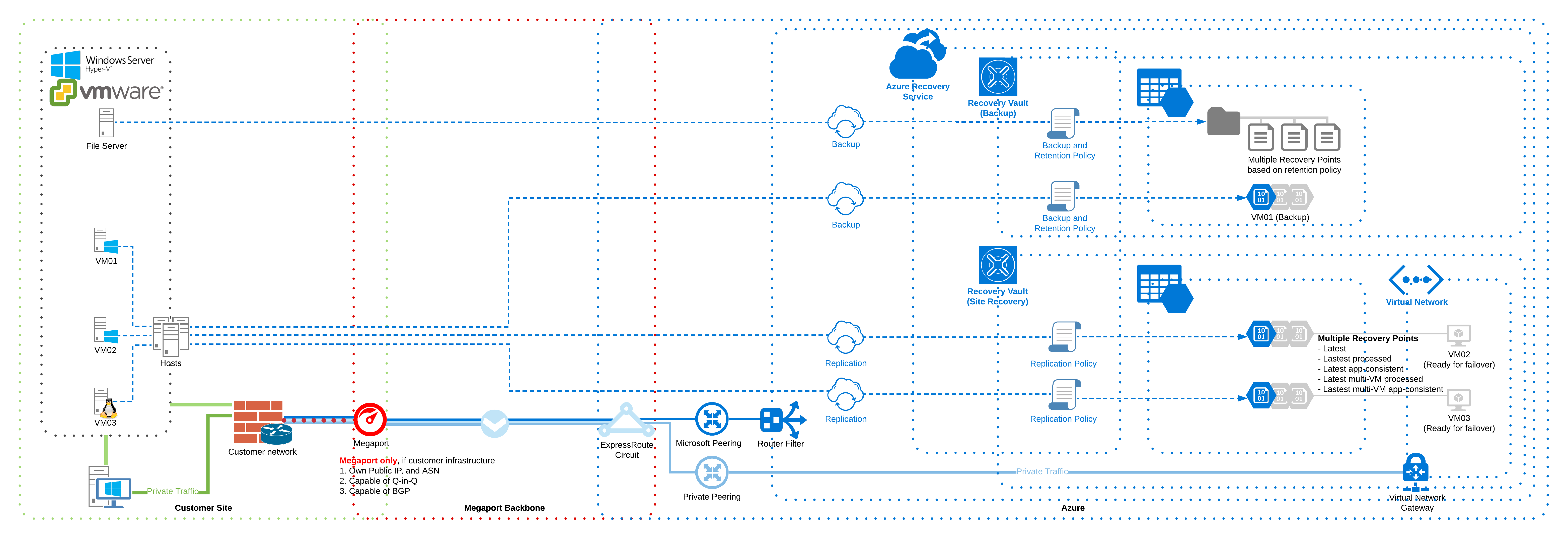
So what does an Azure Site Recovery and Azure Backup service look like with Megaport connectivity? The following example takes into consideration these requirements:

  1. Protect all the files from file server using Azure Backup, with specific retention policy
  2. Protect VM01 (a VM which isn’t critically required to be recovered if there is an incident) using Azure Backup
  3. Protect VM02 (Windows Server) and VM03 (Linux Server) which are business-critical servers with a short RTO (Recovery Time Objective) selecting from different Recovery Points using Azure Site Recovery
  4. Connect to Azure Virtual Network environment ready to consume failover VMs

Scenario 1

Business doesn’t own any public IP or their on-premises infrastructure doesn’t support BGP or doesn’t support IEEE 802.1ad (Q-in-Q). Megaport Cloud Router will assign Megaport owned public IP address and AS number and configure Azure ExpressRoute circuit automatically.

Prerequisites

  • Customer (on-premises) network equipment supports LX Optical 1Gbps or LR Optical 10Gbps Ports

Megaport Technology Required

How many?

Megaport

1 or (2 in a Link Aggregation/LAG)

Megaport Cloud Router (MCR)

1

Virtual Cross Connect (VXC)

1 or 2 (HA Design) VXC to Azure and 1 Private VXC
Scenario 2

Business owns public IP that can assign and advertise, on-premises infrastructure also supports BGP, and on-premises infrastructure also support IEEE 802.1ad (Q-in-Q)

Prerequisites

  • Customer (on-premises) network equipment supports LX Optical 1Gbps or LR Optical 10Gbps Ports
  • Customer (on-premises) network equipment supports BGP
  • Customer (On-premises) network equipment supports IEEE 802.1ad (Q-in-Q) – If 802.1ad not supported, use MCR (Scenario 1)
  • Customer owns public IP address and AS number that they can advertise via BGP

Megaport Technology Required

How many?

Megaport

1 or (2 in a Link Aggregation/LAG)

Megaport Cloud Router (MCR)

0

Virtual Cross Connect (VXC)

1 or 2 (HA Design) VXC
More and more enterprises are creating smart BCDR strategies to secure and future-proof their critical workloads. Although, it may seem like there are too many complexities in building these types of architectures, these can be easily overcome with the right connectivity and cloud services.

For more information on how Megaport can help you establish a BCDR strategy quickly using Azure Site Recovery, feel free to get in touch here.