惯性聚合 高效追踪和阅读你感兴趣的博客、新闻、科技资讯
阅读原文 在惯性聚合中打开

推荐订阅源

T
Tailwind CSS Blog
C
CERT Recently Published Vulnerability Notes
P
Proofpoint News Feed
Vercel News
Vercel News
博客园 - 三生石上(FineUI控件)
IT之家
IT之家
Help Net Security
Help Net Security
月光博客
月光博客
N
News and Events Feed by Topic
Cloudbric
Cloudbric
博客园 - 司徒正美
L
LangChain Blog
Recent Commits to openclaw:main
freeCodeCamp Programming Tutorials: Python, JavaScript, Git & More
T
Tenable Blog
The Register - Security
The Hacker News
The Hacker News
I
InfoQ
The Last Watchdog
The Last Watchdog
MyScale Blog
MyScale Blog
Schneier on Security
WordPress大学
WordPress大学
小众软件
小众软件
Threat Intelligence Blog | Flashpoint
宝玉的分享
宝玉的分享
CTFtime.org: upcoming CTF events
K
Kaspersky official blog
L
LINUX DO - 热门话题
N
News | PayPal Newsroom
F
Fortinet All Blogs
Exploit-DB.com RSS Feed
S
Security @ Cisco Blogs
Recorded Future
Recorded Future
大猫的无限游戏
大猫的无限游戏
H
Help Net Security
Google Online Security Blog
S
Schneier on Security
C
Cisco Blogs
N
News and Events Feed by Topic
V2EX - 技术
V2EX - 技术
Latest news
Latest news
PCI Perspectives
PCI Perspectives
T
The Blog of Author Tim Ferriss
P
Palo Alto Networks Blog
T
Tor Project blog
Project Zero
Project Zero
云风的 BLOG
云风的 BLOG
Webroot Blog
Webroot Blog
Attack and Defense Labs
cs.CL updates on arXiv.org

Megaport Blog

A Guide to NAT Gateway A Guide to Cloud Storage How the Data Center Is Evolving in 2026 What to Expect When Attending Your First Network Operator Group (NOG) Nine Ways to Connect to Cloud Using Private Connectivity Migrate Your On-premises to the Cloud: A Step-by-Step Guide How to Lower Your Egress Fees in 2026 How to Achieve Data Sovereignty in Europe Cisco and Megaport: Redefining the Edge of Modern Networking How to Reduce Latency in Your Multicloud Environment Introducing Megaport High-Speed Cross-Cloud Encryption Are Businesses Leaving the Cloud? Using Meraki and Megaport Virtual Edge for Multicloud Networking Equinix Metal® is Going Away: Here’s What You Can Do Introducing Megaport On-ramp as a Service Megaport’s Full Solution Portfolio Is Coming to India New Bare-metal GPU Instance Now Available with NVIDIA RTX Pro 6000 A Look Back at 2025: Megaport's Biggest Updates Megaport Expands Into India With Strategic Acquisition of Extreme IX Your 2026 Predictions From AWS re:Invent 2025 What’s Next for NaaS? Top Trends for 2026 What is IPsec? When to Move From Public Internet to Private Connectivity Megaport and Latitude.sh: Bringing Compute and Connectivity Together How to Improve Your Microsoft ExpressRoute Resilience with Megaport Connectivity Comparing Ways to Connect to AWS What is API-First Networking? The Hidden Cost of Running Cloud-Hosted SD-WAN for IaaS How to Overcome NaaS Integration Challenges Introducing SCION with Anapaya and Megaport How You Can Use Network as a Service (NaaS) to Future-Proof Your Network Introducing 400G Ports All the As-a-services, Compared Introducing Megaport IPsec Tunnels High Score: Megaport Hits 1,000 Locations A Guide to Colocation Data Centers Maximizing Peering Through Flow Analysis How to Build Resilient Networks for AI Production Workloads Introducing Packet Filtering on Megaport Cloud Router Building Resilient Government IT: Strategies for Secure, Compliant, and Scalable Connectivity Future-Proofing Government IT: Balancing Innovation, Security, and Sovereignty in a Changing World Telstra Programmable Network Is Being Discontinued. Here’s How to Migrate The Future of WAN Design Depends on Network as a Service (NaaS) Cisco Webex Edge Connect Launches on Megaport Voice and Video Exchange How to Prepare for APRA CPS 230 Regulations Comparing the SD-WAN Licensing Needs of Major Vendors A Guide to Improving Network Performance How Latitude.sh, Wasabi, and Megaport Unlock Cost-Effective Multicloud Four Ways to Connect Your Clouds SD-WAN and MPLS: Weighing the Similarities, Differences, and Benefits What is Network as a Service (NaaS)? How to Arrange Bilateral Peering Sessions Comparing Major SD-WAN Vendors Software Defined Networking in the Healthcare Industry Deploying A Global Network in Minutes With Megaport AWS Direct Connect Gateway (DGW) Data Transfer Outbound Rules Bilateral and Multilateral Peering: What’s the Difference? Multi-Region SD-WAN: Why Megaport SDCI is the Right Choice Microsoft Azure is Going Secure by Default. Are You Ready? Building Production-Ready AI Infrastructure: How Megaport and Vultr Are Solving the Enterprise Challenge Introducing Megaport NAT Gateway A Guide to AWS Security Tools How to Deploy Amazon Bedrock Using AWS Direct Connect and Megaport Azure Private Link, Explained Introducing 100G MCRs Your Questions Answered on Simplifying Hybrid and Multicloud Network Connectivity How to Fix Poor AWS Latency A Look Back at 2024: Megaport’s Biggest Updates Your 2025 Predictions From AWS re:Invent 2024 Six Ways to Get a More Resilient Network in 2025 Multicloud Security: Challenges and Solutions The Real Cost of High Network Latency Why Brazil is Your Key to Unlocking Business Growth in Latin America Why You Need Integrated Network Security Six Key Differences Between Major Cloud Providers How to Automate Your Megaport Infrastructure With APIs Why Italy is Europe’s Next Cloud Expansion Hotspot How to Lower Your Cloud Costs Peering: How Local Is Local? Introducing Megaport AI Exchange Two Scenarios for Hybrid Multicloud Deployment With IBM Cloud and Microsoft Azure How to Connect Equinix and Digital Realty Megaport Enables Microsoft Azure ExpressRoute Metro for More Resilient Network Connectivity Executives, Here’s What Your Network Team Wants You to Know Easy Ways to Interconnect Your Network The Role of the Data Center in Your Network 100G VXC Expansion: Now Available From 597 Data Centers Worldwide Top 10 How-To Guides To Improve Your Network Comparing Encryption in Transit Options A Sustainable Business Strategy Starts With Your Network Solutions to Common API Issues With Megaport Transforming Financial Connectivity: Introducing Megaport Financial Services Exchange (FSX) Megaport Enhancing Connectivity in Adelaide Megaport’s Latest Portal Features and Functionalities Automate Your Network Deployments With The New Megaport Terraform Provider A Recap of the Megaport World Tour 2024 Top 5 Cloud and Networking Announcements From Cisco Live 2024 Megaport Enhancing Connectivity in Canberra AWS PrivateLink, Explained How Megaport and Wasabi Are Simplifying Cloud Storage
How Virtual Routing Solves BGP Challenges for Hybrid Cloud
Megaport · 2018-08-09 · via Megaport Blog

Remove the complexities of connecting your on-premises and public cloud environments with Megaport Cloud Router’s virtual networking capabilities.

Like many other enterprise companies, you have probably made significant investments in your on-premises technologies. But as cloud adoption continues to grow significantly, you might be exploring ways to up your cloud game to stay competitive. It’s time to embrace the benefits of both public and private cloud, and get the two working together. Hybrid cloud is the obvious choice. However, it’s the integration between your on-premises resources and public cloud resources that makes up that critical step to achieving a powerful overall cloud strategy – it’s the part you need to get right.

Considerations for Connecting to Hyperscalers from On-Premises

Most hyperscale cloud providers offer dedicated interconnection services, for example, AWS Direct Connect, Google Cloud Partner Interconnect, Microsoft Azure ExpressRoute, and Oracle FastConnect, etc. These services will enable you with direct access to your cloud environments to reach the resources you need. This makes it easy to establish a connection between your network and a cloud PoP nearby. One key tenet for direct access to hyperscalers is that they require you to run BGP between your network or autonomous system (AS) and their network or AS. This can be a challenge if you have firewalls at the edge of your network that aren’t running BGP (which is common and often a good decision seeing as a firewall’s primary job is to provide security between network zones and not manage a full BGP routing table). With 724,222 IPv4 prefixes and 51,824 IPv6 prefixes in the global internet routing table, your firewall might not be capable of holding this many depending on its memory capacity. In this case, a static route could be configured.

Virtual Routing for Hybrid Cloud

When you’re moving mission-critical workloads to the cloud, the most effective solution is one that fits into your current network architecture without difficulty and scales with your business when you want to increase workloads. Through Megaport Cloud Router (MCR), we’ve created a way to virtualise routing for Layer 3 connections. In doing so, we’ve removed some of the complexities that have typically restricted network operations, and made hybrid cloud connectivity easy. Complexities like managing BGP routing, obtaining a public Autonomous System Number (ASN) and allocation of public IP Address space for cloud connectivity. MCR acts as your BGP speaking virtual router. By combining it with a physical Megaport in your data centre, you can establish a hybrid cloud architecture that takes full advantage of both on-premises technologies and public cloud resources – with or without firewalls at the edge of your network.

Designing a Hybrid Network Architecture with Megaport Cloud Router

There are a few steps involved in setting up a hybrid network architecture using a Megaport and an MCR. You can read more detailed technical information in Megaport Documentation. For now, let’s run through the key points:

  • If you don’t have one already, order and create a Megaport in any of our global enabled data centre locations.

  • From your firewall, you’ll get a cross connect to your physical Megaport via your Data Center Operator.

  • Provision your MCR and create a Virtual Cross Connect (VXC) from your Megaport to your MCR from our Portal.

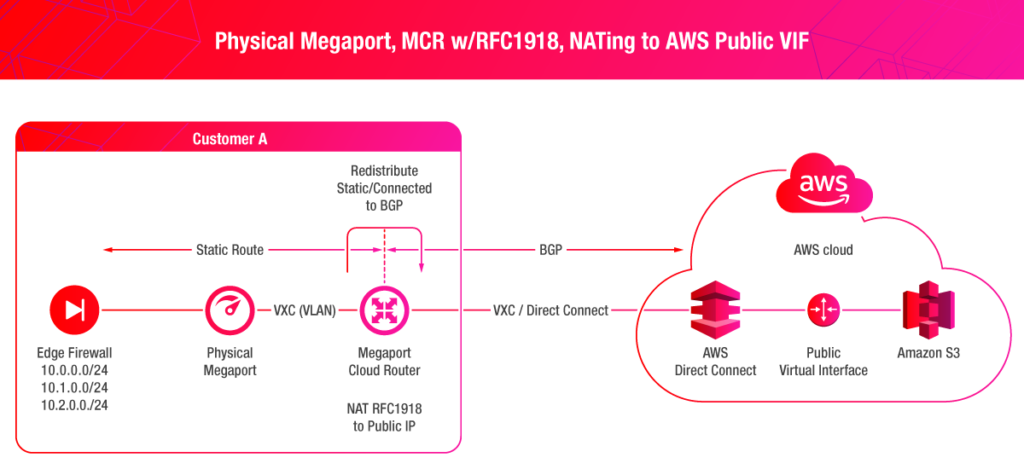
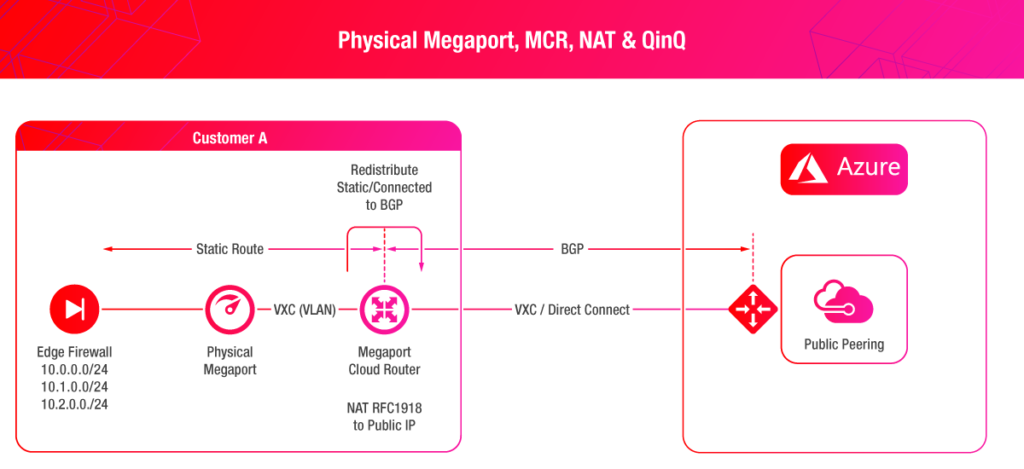
  • Create a static route on your firewall pointing at the MCR, and on the MCR, create a static route facing your firewall. This will enable your firewall to MCR connection – pretty simple!

  • By default, your MCR will redistribute static and connected routes into BGP, so no further configuration is required on your part to make this happen.

  • You can then provision a VXC from your MCR to the cloud provider of your choice.

  • Once the Layer 2 portion of the connectivity is up, BGP will come up between the MCR and cloud provider, and BGP will be in an ‘Established’ state.

  • Connectivity details vary depending on which cloud provider you are connecting to, however, there is no requirement for you to have a publicly registered Autonomous Systems Number (ASN) or publicly routable IP space – we take care of this for you.

    • If you’re routing RFC1918 space to the MCR, the MCR will NAT this IP address space to a public IP address facing the cloud provider making it possible for you to consume public or private cloud resources.

Technical Solution Defined

Our connectivity models illustrate how your network could be configured when provisioning an MCR firstly to AWS, and then Azure, on the Megaport Network. In the first model, a firewall with an 802.1q trunk is connecting to a Megaport in one of our enabled locations. An MCR has also been provisioned with a VXC facing the Megaport. Connectivity to AWS is established by provisioning a VXC to your Public Virtual Interface to reach Amazon S3 resources. The second model shows a similar connectivity model as above, however, the difference is that Azure supports Q-in-Q via ExpressRoute. The Q-in-Q tunnel terminates on the MCR, giving you the ability to configure your VLANs in your VNets with ease. Creating a high-performance hybrid cloud network architecture is key to taking advantage of both on-premises and public cloud resources. Virtual routing can help to overcome some of the challenges you might typically face when setting up your network. For more information, feel free to reach out to me or fill in the form below and we’ll get in touch.