








Gartner® mentions that “by 2025, 35% of companies that use multiple cloud providers will use a single network stack, an increase of more than 10 times from 2021.” What does that mean for you?
“Gartner’s 2020 Cloud End-User Buying Behavior Study was conducted to understand how technology leaders approach buying, renewing, and using cloud technology. The survey was conducted online in July and August 2020 with respondents from the U.S., Canada, the U.K., Germany, Australia, and India. The study surveyed 850 respondents, of whom 724 respondents reported that their organization was using the public cloud, hybrid cloud, or multicloud infrastructure. Of these 724 respondents, 24% use one provider only, 13% use multiple providers with no primary, and 63% use multiple providers with one as the primary provider.”
If there’s one thing that we took from this study, it’s that multicloud has well and truly become the norm. As multicloud comes to mean many more clouds than just two or three, cloud networking only gets more complex. As Gartner cites in its “Predicts 2022: Connecting the Digital Enterprise” report, Gartner “client interest in public cloud networking and multicloud networking has increased dramatically in the last 15 months,” in part because the native networking capabilities of public cloud providers vary greatly and are, for some use cases, insufficient.
Download the Gartner Predicts 2022: Connecting the Digital Enterprise.
Networking challenges “in the cloud”
The infrastructure and services offered by the major cloud providers weren’t originally designed to work seamlessly together in a multicloud world. Only in recent years have providers like Google Cloud, Oracle Cloud, and others focused their sales and productization efforts on winning the secondary or tertiary cloud provider business of the IT department’s IaaS portfolio. As multicloud becomes more common, multicloud use cases also proliferate.
Think about having storage for data sets in two different cloud providers in support of an application that calls on both data sets. The native networking offered by one cloud provider might not be consistent with that of the second cloud provider, causing issues with performance and reliability. As Gartner notes, “virtual routers and appliances offered by established networking vendors (with large on-premises installed bases) often don’t meet the requirements of cloud and DevOps teams, particularly around programmability, cloud integration, and licensing.”
These issues with getting strong multicloud networking performance has led to a new market of cloud networking offerings that are built like the cloud, with flexible consumption-based pricing, open APIs, and easy programmability, usually via software-defined networking.
Megaport Cloud Router (MCR) is our virtual cloud router offering which helps companies connect cloud environments to each other, reducing the need to hairpin traffic back to an on-premises data center. As the user of an MCR, you don’t need to own any physical infrastructure, and the routing, as well as the deployment, is all handled from the Megaport portal.
Gartner expects this emerging market of multicloud networking technology to be “dynamic, with new entrants and a high level of change and innovation.” The firm recommends that companies make flexible, short-term investments in these new technologies (one to three years, rather than the three to five of a typical network planning cycle) to address an ever-changing business environment that requires greater network agility.
One of the ways we see our customers dealing with complex multicloud deployments across a distributed network that spans numerous regions is to create standardization, consistency, and cost control through a Cloud Center of Excellence (CCoE).
A CCoE provides a governance model for scalable cloud adoption and migration planning. It often includes reusable architectural standards and best practices, which would include areas such as multicloud networking and cybersecurity, designed to make migrations easier, faster, and more cost-effective.
Among our customers, NXP is an excellent example of a company that used a CCoE, powered by Megaport connectivity, to accelerate cloud adoption and innovation at the billion-dollar company.
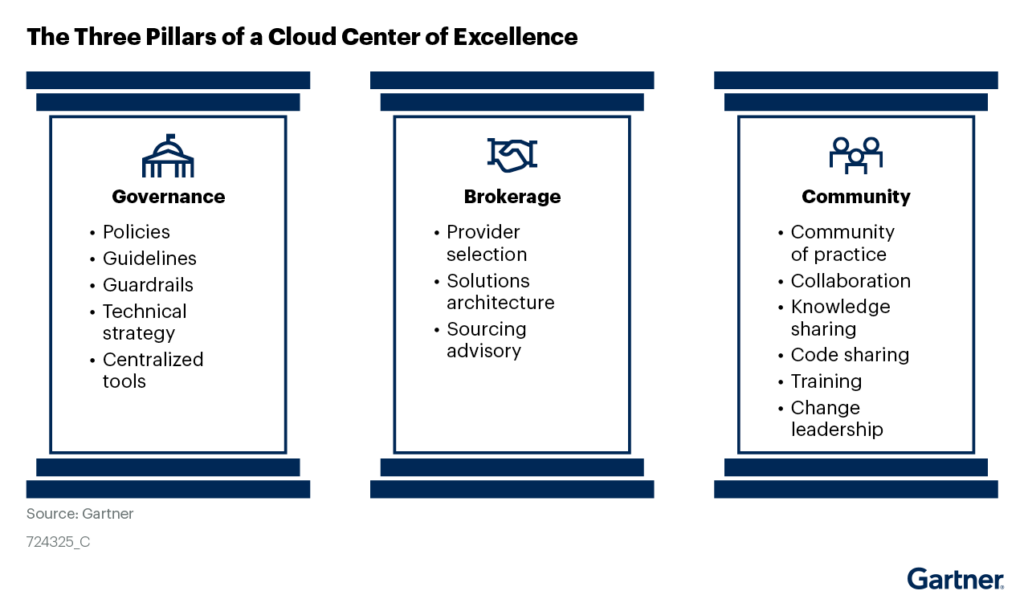
From “How to Deploy a Cloud Center of Excellence”2
Integrating your cloud networking stack
Per our view, Gartner believes that the demand for cloud networking is set to grow rapidly to fulfill the emerging and increasing complex networking requirements of multicloud. They expect new technology to enable the design, deployment, and operation of a network inside multiple cloud environments to allow for consistent security policies, governance, and visibility.
Solving for the issues of getting reliable, predictable, and consistent network connectivity between and inside clouds in the multicloud new normal will be one of the many exciting developments in the coming year.
Want to read more about integrating your cloud stack? Download the Gartner Predicts Report for the ultimate how-to guide.

Multicloud connectivity solutions, all in one place – find the one best for you here.
1 Gartner®, Predicts 2022: Connecting the Digital Enterprise, By Andrew Lerner, John Watts, Joe Skorupa, 2 December 2021.
2Gartner®, How to Deploy a Cloud Center of Excellence, By Maggie Schroeder-O’Neal, Lydia Leong, 21 January 2021.
GARTNER is a registered trademark and service mark of Gartner, Inc. and/or its affiliates in the U.S. and internationally, and is used herein with permission. All rights reserved.
This graphic was published by Gartner, Inc. as part of a larger research document and should be evaluated in the context of the entire document. The gartner document is available upon request from Megaport.
此内容由惯性聚合(RSS阅读器)自动聚合整理,仅供阅读参考。 原文来自 — 版权归原作者所有。