



惯性聚合 高效追踪和阅读你感兴趣的博客、新闻、科技资讯
阅读原文 在惯性聚合中打开

推荐订阅源

博客园 - 叶小钗
O
OpenAI News
V
V2EX
大猫的无限游戏
大猫的无限游戏
博客园 - 聂微东
S
Schneier on Security
C
CXSECURITY Database RSS Feed - CXSecurity.com
小众软件
小众软件
L
LINUX DO - 热门话题
C
Cybersecurity and Infrastructure Security Agency CISA
博客园 - Franky
Security Latest
Security Latest
S
SegmentFault 最新的问题
Project Zero
Project Zero
Spread Privacy
Spread Privacy
K
Kaspersky official blog
J
Java Code Geeks
V
Vulnerabilities – Threatpost
C
Cisco Blogs
C
CERT Recently Published Vulnerability Notes
月光博客
月光博客
T
The Exploit Database - CXSecurity.com
L
Lohrmann on Cybersecurity
人人都是产品经理
人人都是产品经理
博客园 - 三生石上(FineUI控件)
Scott Helme
Scott Helme
WordPress大学
WordPress大学
量子位
T
Threat Research - Cisco Blogs
OSCHINA 社区最新新闻
OSCHINA 社区最新新闻
宝玉的分享
宝玉的分享
Hugging Face - Blog
Hugging Face - Blog
AWS News Blog
AWS News Blog
Help Net Security
Help Net Security
Application and Cybersecurity Blog
Simon Willison's Weblog
S
Secure Thoughts
博客园 - 【当耐特】
cs.CV updates on arXiv.org
V
Visual Studio Blog
Last Week in AI
Last Week in AI
T
Tailwind CSS Blog
腾讯CDC
Cyberwarzone
Cyberwarzone
IT之家
IT之家
GbyAI
GbyAI
Exploit-DB.com RSS Feed
云风的 BLOG
云风的 BLOG
T
Troy Hunt's Blog
D
Docker

Megaport Blog

A Guide to NAT Gateway A Guide to Cloud Storage How the Data Center Is Evolving in 2026 What to Expect When Attending Your First Network Operator Group (NOG) Nine Ways to Connect to Cloud Using Private Connectivity Migrate Your On-premises to the Cloud: A Step-by-Step Guide How to Lower Your Egress Fees in 2026 How to Achieve Data Sovereignty in Europe Cisco and Megaport: Redefining the Edge of Modern Networking How to Reduce Latency in Your Multicloud Environment Introducing Megaport High-Speed Cross-Cloud Encryption Are Businesses Leaving the Cloud? Using Meraki and Megaport Virtual Edge for Multicloud Networking Equinix Metal® is Going Away: Here’s What You Can Do Introducing Megaport On-ramp as a Service Megaport’s Full Solution Portfolio Is Coming to India New Bare-metal GPU Instance Now Available with NVIDIA RTX Pro 6000 A Look Back at 2025: Megaport's Biggest Updates Megaport Expands Into India With Strategic Acquisition of Extreme IX Your 2026 Predictions From AWS re:Invent 2025 What’s Next for NaaS? Top Trends for 2026 What is IPsec? When to Move From Public Internet to Private Connectivity Megaport and Latitude.sh: Bringing Compute and Connectivity Together How to Improve Your Microsoft ExpressRoute Resilience with Megaport Connectivity Comparing Ways to Connect to AWS What is API-First Networking? The Hidden Cost of Running Cloud-Hosted SD-WAN for IaaS How to Overcome NaaS Integration Challenges Introducing SCION with Anapaya and Megaport How You Can Use Network as a Service (NaaS) to Future-Proof Your Network Introducing 400G Ports All the As-a-services, Compared Introducing Megaport IPsec Tunnels High Score: Megaport Hits 1,000 Locations A Guide to Colocation Data Centers Maximizing Peering Through Flow Analysis How to Build Resilient Networks for AI Production Workloads Introducing Packet Filtering on Megaport Cloud Router Building Resilient Government IT: Strategies for Secure, Compliant, and Scalable Connectivity Future-Proofing Government IT: Balancing Innovation, Security, and Sovereignty in a Changing World Telstra Programmable Network Is Being Discontinued. Here’s How to Migrate The Future of WAN Design Depends on Network as a Service (NaaS) Cisco Webex Edge Connect Launches on Megaport Voice and Video Exchange How to Prepare for APRA CPS 230 Regulations Comparing the SD-WAN Licensing Needs of Major Vendors A Guide to Improving Network Performance How Latitude.sh, Wasabi, and Megaport Unlock Cost-Effective Multicloud Four Ways to Connect Your Clouds SD-WAN and MPLS: Weighing the Similarities, Differences, and Benefits What is Network as a Service (NaaS)? How to Arrange Bilateral Peering Sessions Comparing Major SD-WAN Vendors Software Defined Networking in the Healthcare Industry Deploying A Global Network in Minutes With Megaport AWS Direct Connect Gateway (DGW) Data Transfer Outbound Rules Bilateral and Multilateral Peering: What’s the Difference? Multi-Region SD-WAN: Why Megaport SDCI is the Right Choice Microsoft Azure is Going Secure by Default. Are You Ready? Building Production-Ready AI Infrastructure: How Megaport and Vultr Are Solving the Enterprise Challenge Introducing Megaport NAT Gateway A Guide to AWS Security Tools How to Deploy Amazon Bedrock Using AWS Direct Connect and Megaport Azure Private Link, Explained Introducing 100G MCRs Your Questions Answered on Simplifying Hybrid and Multicloud Network Connectivity How to Fix Poor AWS Latency A Look Back at 2024: Megaport’s Biggest Updates Your 2025 Predictions From AWS re:Invent 2024 Six Ways to Get a More Resilient Network in 2025 Multicloud Security: Challenges and Solutions The Real Cost of High Network Latency Why Brazil is Your Key to Unlocking Business Growth in Latin America Why You Need Integrated Network Security Six Key Differences Between Major Cloud Providers How to Automate Your Megaport Infrastructure With APIs Why Italy is Europe’s Next Cloud Expansion Hotspot How to Lower Your Cloud Costs Peering: How Local Is Local? Introducing Megaport AI Exchange Two Scenarios for Hybrid Multicloud Deployment With IBM Cloud and Microsoft Azure How to Connect Equinix and Digital Realty Megaport Enables Microsoft Azure ExpressRoute Metro for More Resilient Network Connectivity Executives, Here’s What Your Network Team Wants You to Know Easy Ways to Interconnect Your Network The Role of the Data Center in Your Network 100G VXC Expansion: Now Available From 597 Data Centers Worldwide Top 10 How-To Guides To Improve Your Network Comparing Encryption in Transit Options A Sustainable Business Strategy Starts With Your Network Solutions to Common API Issues With Megaport Transforming Financial Connectivity: Introducing Megaport Financial Services Exchange (FSX) Megaport Enhancing Connectivity in Adelaide Megaport’s Latest Portal Features and Functionalities Automate Your Network Deployments With The New Megaport Terraform Provider A Recap of the Megaport World Tour 2024 Top 5 Cloud and Networking Announcements From Cisco Live 2024 Megaport Enhancing Connectivity in Canberra AWS PrivateLink, Explained How Megaport and Wasabi Are Simplifying Cloud Storage
Q and A for Q-in-Q part 1
Henry Wagner · 2016-09-13 · via Megaport Blog

By Henry Wagner, Chief Marketing Officer

The basics around double-stacked VLAN tagging, otherwise known as Q-in-Q, or by it’s formal IEEE definition, 802.1ad. Part one.

What is VLAN tagging?

There are two types of ports on network switches. Most vendors use terms such as “Trunk Port” and “Access Port” to differentiate them. Access ports define a port where a single VLAN ID is carried whereas Trunk ports carry traffic destined for multiple VLANs. Trunk Ports require a policy to determine which traffic is to be sent within which VLAN identifier. For these purposes, a technical standard defining VLAN tagging 802.1q was developed. These VLAN tags contains information such as VLAN ID and other information that is specified by the 802.1q standard.

What does the technical outline of 802.1q (single tagged VLAN frames) look like?

An Ethernet frame (a physical layer communications transmission unit) that belongs to a VLAN which is carried through a Trunk Port will have a 802.1q header added. See the following diagram:
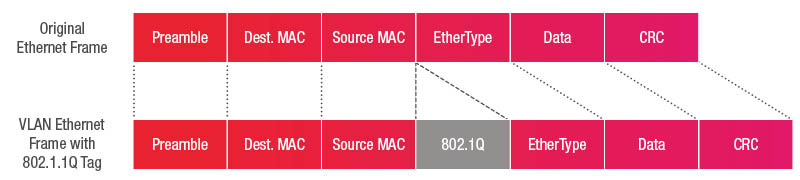
diagram

What is Q-in-Q?

Q-in-Q (formally defined as 802.1ad) is developed based around 802.1q (VLAN tagging) to provide an additional layer of flexibility when dealing with Layer 2 networking. It was originally designed to allow Network Service Providers (NSPs) flexibility in handling trunk port capability but spanning multiple customer connections that may wish to re-use the same VLAN. Q-in-Q tunnelling allows NSPs to consolidate all VLAN traffic into a single VLAN by adding an additional VLAN tag to already tagged traffic sent to and from customers. The additional tag helps NSPs to identify and separate different customer traffic.

Within an Ethernet Frame, these two tags are often known as “Inner tag” and “Outer tag”. “Inner tags” contain VLAN information that belong to the traffic of the NSP’s customers. The “Outer tags” contains information relating to the NSP’s VLAN networks. Though Q-in-Q/ 802.1ad was designed originally for NSPs to add/remove transparently to a customer (so called ‘pushing’ and ‘popping’ of outer tags) it is routinely utilised to carry a range of VLANs across a single VXC. This would allow for example a partner utilising Megaport to aggregate traffic on behalf of multiple customer networks and carry them transparently as a single VXC between two network locations, even where other customers using the same aggregator may utilise a similar group of VLAN identifiers.
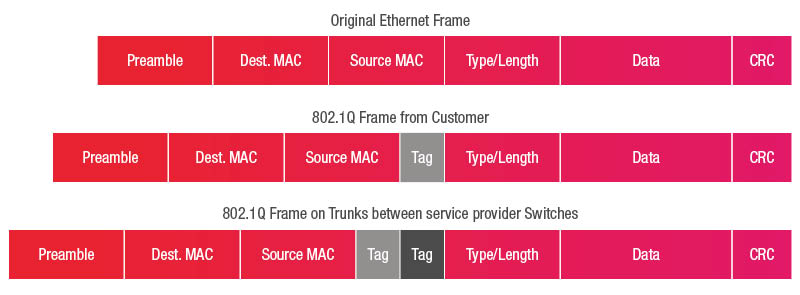
What is a Q-in-Q Frame Build (802.1ad)?

diagram

Tag in light grey = Outer Tag

Tag in dark grey = Inner Tag

How can I differentiate the inner tag from the outer tag? Does it matter?

As you can imagine there is a definite need to isolate the double stacked tags. You might have heard the story about the great thing about standards – there’s a few of them so pick the one that suits you best! To differentiate the different tags under the 802.1ad standard the inner commonly uses EtherType 0x8100 and outer 0x88a8 whilst the Cisco definition of Q-in-Q is for both inner and outer EtherTypes to be 0x8100. It is important to note that the Megaport specification of double-tagged frames is for both inner and outer tags to be 0x8100.

This double tagged VLAN concept is also frequently used in direct connectivity to cloud computing resources such as that presented by the Microsoft ExpressRoute product offering. In this specific instance “Inner tags” (or C-TAGs) belong to the Microsoft customer’s multiple VLANs (Azure private, Azure public and Microsoft peering) and “Outer tags” (Service Provider tags, or S-TAGs) belong to the Megaport customer’s A-end VLAN that is requested to be set on their Megaport.

In part two of this series we will explore further the use of this concept for Microsoft ExpressRoute and how to configure redundant connectivity to Azure primary and secondary router presentations. Click here to read part 2.