







Establishing network-level perimeters with VPC Service Controls (VPC-SC) is a critical step that can help you protect your cloud environment against data exfiltration, compromised accounts, and insider threats.
Today, Google Cloud is excited to share new policy intelligence capabilities in VPC-SC that can help drive even greater operational simplicity. With our latest release of the VPC-SC violation analyzer and violation dashboard, we have simplified policy management and troubleshooting, to make managing and optimizing your security perimeter more efficient and straightforward than ever.
BlackLine, a leader in financial operations management, adopted the VPC-SC policy intelligence solution to maintain strict security perimeters. Chosen by over half of Fortune 500 companies, BlackLine uses Google Cloud's full suite of managed services and built-in security capabilities to protect sensitive customer financial data.
VPC Service Controls are the foundation of BlackLine's preventative compliance and security controls in our Google Cloud environment, helping us to mitigate data exfiltration risks and ensure clear separation between our higher and lower environments by establishing strong security perimeters.
Managing these complex perimeters is a continuous process. VPC Service Controls violation analyzer helps BlackLine cloud infrastructure administrators adapt to changing API connection requirements of the business by adjusting security perimeters through approved access levels, ingress policies, and egress policies.
With only the troubleshooting token or unique ID from any VPC-SC violation error message, we can produce a detailed report identifying the principals and target resources involved in a failed API request, and explaining why and how that API request violated BlackLine's service perimeters. We don’t need to write a Cloud Logging SQL query to extract the data.
The clear access context and actionable insights in the violation details report are an invaluable starting point as we collaborate to resolve violations, significantly reducing our mean-time-to-resolution (MTTR) for service perimeter issues, and helping BlackLine maintain our focus on our customers and continue to innovate on their behalf.
Our new policy intelligence tools — the VPC-SC Violation analyzer and Violation dashboard — simplify real-time monitoring and active incident response. These tools provide clear, actionable insights in the Google Cloud Console, offering greater speed and automation to help you confidently enforce least-privilege perimeters, and quickly resolve access denials.
Violation Dashboard aggregates and visualizes all service perimeter violations across your entire Google Cloud organization in a single pane of glass, helping your team identify trends, spot spikes in access denials, and shareable filters on violations by specific perimeters, projects, or identities.
Violation Analyzer streamlines investigating violations, eliminating the need to query Cloud Logging and manually piece together the details. When you click a troubleshooting token from the dashboard (or input a unique denial ID), the analyzer maps out the identity, source, target, and VPC-SC rule triggered, creating a report telling you why that specific request was blocked. This helps your team more quickly take action to determine whether to modify existing policy rules or create a new one, and resolve incidents more quickly.
Together, the new VPC Service Controls policy intelligence tools go beyond automated log analysis to provide unified visibility of violations and actionable insights to investigate them, making your perimeter deployment and management simpler and lower-risk.

Streamlining the VPC Service Controls lifecycle, from deployment to policy refinement.
With the new VPC-SC troubleshooting tools you can more easily:
Test new perimeters (deployment): Use the violation dashboard to visualize the impact of a service perimeter during your initial dry run phase, helping to verify that enforcement is accurate and predictable before it affects production traffic. Filter violations to track and resolve with prebuilt contextual filters for principals, service perimeters, enforcement type, and more.
Track perimeter denials (monitor): The violation dashboard offers a unified view of your perimeter health, allowing your security operations team to monitor status in real time, including dynamic agentic access denials.
Triage an event (investigate): Violation analyzer provides the identity, source, target, and operations for any violation. It cross-references identity and access management (IAM) permissions, resource ancestry, and context evaluation to identify which rule was triggered, reducing manual effort.
Fix the rule (refine policy): Instead of searching through configuration files, violation analyzer maps violations directly to the relevant line in your VPC-SC policy, allowing you to make updates more quickly and with less manual overhead.
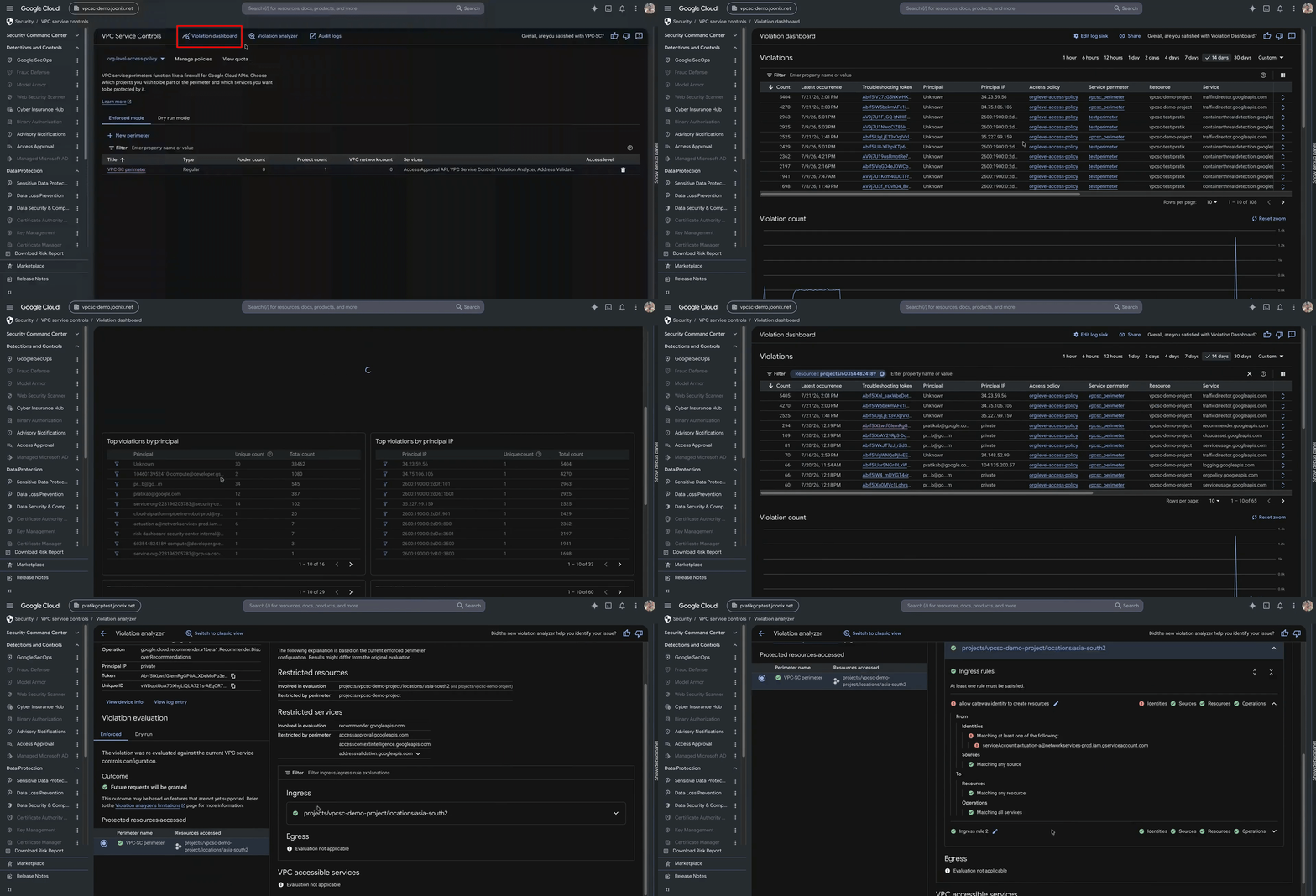
The VPC Service Controls violation dashboard produces detailed reports to jump-start perimeter access investigations that are simplified using the violation analyzer.
Our new troubleshooting capabilities build on VPC Service Controls’ foundational simplicity for designing, enforcing, and managing strong perimeters.
By using dry run mode, your teams can build precise, contextual ingress and egress rules based on observed traffic — without disrupting vital business workflows. Once you validate these access patterns, moving to full enforcement becomes a more confident, data-driven process. To keep perimeter maintenance more efficient and straightforward, scoped policies allow you to delegate management directly to project-level administrators, empowering the teams closest to the workload.
Simplify data security with VPC Service Controls. With the new Violation Analyzer and Violation dashboard, you can spend less time investigating incidents and more time safely scaling your cloud initiatives. Your data is your most valuable asset — protect it with a perimeter that’s as simple to manage as it is effective in enforcing controls.
Learn more and get started with the VPC-SC violation analyzer and violation dashboard in our documentation.
此内容由惯性聚合(RSS阅读器)自动聚合整理,仅供阅读参考。 原文来自 — 版权归原作者所有。