


2013-11-04 19:26 Clingingboy 阅读(921) 评论() 收藏 举报
1.定义预处理命令_ATL_ATTRIBUTES
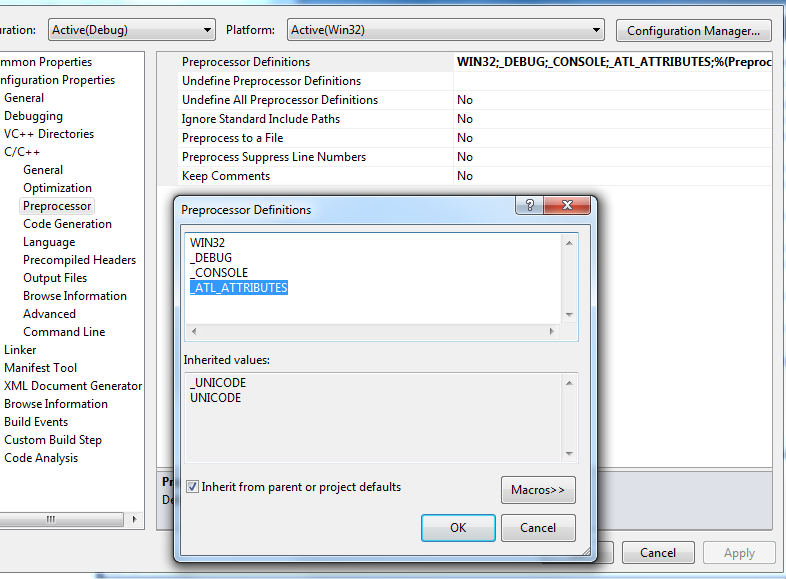
2.在一个全局的Cpp文件里面配置module的attribute
[module(dll, uuid = "{3845951F-15B8-4286-8E7D-E9D4F5C7B6CE}",
    name = "TestApp")]
3.定义接口
[
    object,
    uuid("9F414A8A-1D5E-4aff-A60E-CFD65155ABB6"),
    dual, helpstring("IGFCursorMgr Interface"),
    pointer_default(unique)
]
__interface IEmployee : IDispatch
{
    HRESULT DoWork(BSTR bstrTask);
};

[
    coclass,
    default(IEmployee),
    threading(free),
    vi_progid("TXGF.CGFCoCursorMgr"),
    progid("TXGF.CGFCoCursorMgr.1"),
    version(1.0),
    uuid("20BB9542-E499-4618-9E2D-079A06FD99B1"),
    helpstring("CGFCoCursorMgr Class")
]
class ATL_NO_VTABLE CManager:public IEmployee
{
public:

    CManager()
    {
        //InternalAddRef();
    }

    DECLARE_PROTECT_FINAL_CONSTRUCT()

    HRESULT FinalConstruct()
    {
        return S_OK;
    }

    void FinalRelease()
    {}

    HRESULT DoWork(BSTR bstrTask)
    {
        CComObject<CManager> * pObj = NULL;
        CComObject<CManager>::CreateInstance(&pObj);
        return S_OK;
    }
};
4.引用ATL命名空间
如遇编译错误error C3358: 'IDispatchImpl': symbol not found
需要添加ATL的命名空间using namespace ATL;
关于使用的参考资料:http://msdn.microsoft.com/en-us/magazine/cc301337.aspx
The generated code in Figure 6 shows that the [coclass] attribute makes the compiler derive a class from CComObjectRootEx<> and this provides QueryInterface through the interface map. The compiler generates this map by looking at the interfaces that the class is derived from. If you want to add your own entries to this map, you can use the [com_interface_entry()] attribute. The parameter to this attribute is the COM_INTERFACE_ENTRY macro that you want to add to the top of the map. For example:
此内容由惯性聚合(RSS阅读器)自动聚合整理,仅供阅读参考。 原文来自 — 版权归原作者所有。