



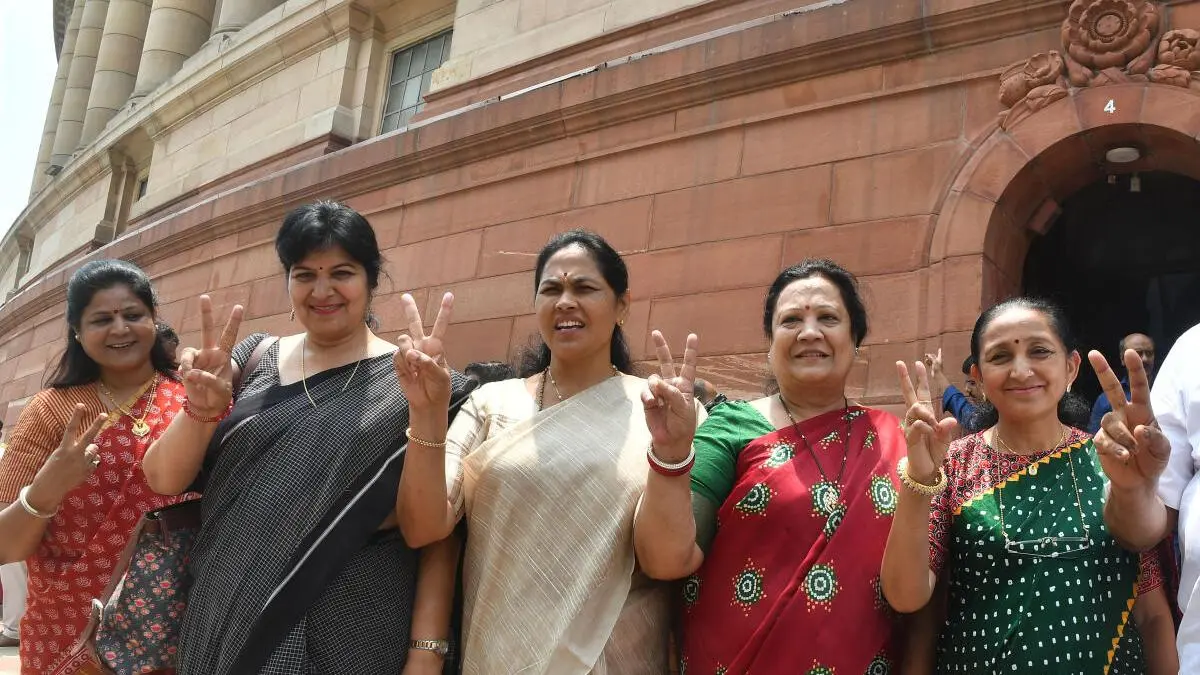
In most large States, including Maharashtra (8.8 per cent), Gujarat (8.5 per cent), and Karnataka (7.1 per cent), women remained below the 10 per cent threshold
Ahead of a special three-day Parliamentary session to advance the women’s reservation bill, recent election results show that women remain significantly under-represented, both as candidates and as elected lawmakers.
In Parliament, the share of women MPs in the Lok Sabha has risen gradually over the past two decades, though gains remain modest. Women accounted for 7.98 per cent of Lok Sabha MPs in 2004. The proportion increased to 10.7 per cent in 2009, 11.46 per cent in 2014, and peaked at 14.39 per cent in 2019. In 2024, women comprised 13.63 per cent of Lok Sabha MPs.
Analysis of recent Assembly elections shows that women constituted 9.5 per cent of total MLAs. Of the 4,099 MLAs examined, only 388 were women. The data suggest that even when women contest, their success rate remains limited relative to overall representation.
On the candidature front, the picture is similarly constrained. Only four States/UTs crossed the 13 per cent mark in women’s share among total candidates. Odisha (13.9 per cent) topped the list, followed by Puducherry (13.7 per cent), Delhi (13.7 per cent), and Chhattisgarh (13.1 per cent).
At the lower end, Nagaland recorded the lowest share at 2.2 per cent. Arunachal Pradesh and Jammu & Kashmir were at 4.9 per cent each, while Himachal Pradesh stood at 5.8 per cent.
In most large States, including Maharashtra (8.8 per cent), Gujarat (8.5 per cent), and Karnataka (7.1 per cent), women remained below the 10 per cent threshold.
Party-wise data based on the 18th Lok Sabha and sitting MLAs in current Assemblies show that most major political parties have around 10 per cent women legislators.
The Bharatiya Janata Party has 10.34 per cent women among its MPs and MLAs combined, while the Indian National Congress stands at 9.52 per cent. The All India Trinamool Congress leads with 18.07 per cent. The Telugu Desam Party (13.91 per cent) and the Samajwadi Party (12.58 per cent) are also above the 10 per cent mark.
Women’s representation is significantly higher at the grassroots level due to constitutional mandates. Article 243D provides reservation for women in Panchayats, and 21 States and two UTs have raised this quota to 50 per cent.
As a result, several States report women accounting for over half of elected representatives in Panchayati Raj Institutions (2024), including Uttarakhand (56 per cent), Andhra Pradesh (55.5 per cent), and Chhattisgarh (55 per cent).
In contrast, some regions remain near the one-third mark, such as Uttar Pradesh (33.3 per cent) and Jammu & Kashmir (33.2 per cent).
Aleena Rose Jose is an intern at businessline
Published on April 15, 2026
此内容由惯性聚合(RSS阅读器)自动聚合整理,仅供阅读参考。 原文来自 — 版权归原作者所有。