


惯性聚合 高效追踪和阅读你感兴趣的博客、新闻、科技资讯
阅读原文 在惯性聚合中打开

推荐订阅源

GbyAI
GbyAI
小众软件
小众软件
The Last Watchdog
The Last Watchdog
Latest news
Latest news
P
Palo Alto Networks Blog
C
Cisco Blogs
C
Cyber Attacks, Cyber Crime and Cyber Security
L
Lohrmann on Cybersecurity
P
Privacy International News Feed
NISL@THU
NISL@THU
T
Threat Research - Cisco Blogs
T
Threatpost
T
The Exploit Database - CXSecurity.com
S
Schneier on Security
Spread Privacy
Spread Privacy
T
Tor Project blog
Cyberwarzone
Cyberwarzone
C
Cybersecurity and Infrastructure Security Agency CISA
AWS News Blog
AWS News Blog
S
Securelist
奇客Solidot–传递最新科技情报
奇客Solidot–传递最新科技情报
Simon Willison's Weblog
P
Privacy & Cybersecurity Law Blog
Hugging Face - Blog
Hugging Face - Blog
freeCodeCamp Programming Tutorials: Python, JavaScript, Git & More
C
CERT Recently Published Vulnerability Notes
V
Visual Studio Blog
酷 壳 – CoolShell
酷 壳 – CoolShell
让小产品的独立变现更简单 - ezindie.com
月光博客
月光博客
博客园 - 司徒正美
钛媒体:引领未来商业与生活新知
钛媒体:引领未来商业与生活新知
罗磊的独立博客
A
Arctic Wolf
腾讯CDC
WordPress大学
WordPress大学
IT之家
IT之家
Last Week in AI
Last Week in AI
博客园 - 聂微东
P
Proofpoint News Feed
Y
Y Combinator Blog
Apple Machine Learning Research
Hacker News: Ask HN
Hacker News: Ask HN
Help Net Security
Help Net Security
Blog — PlanetScale
Blog — PlanetScale
爱范儿
爱范儿
美团技术团队
cs.AI updates on arXiv.org
Cyber Security Advisories - MS-ISAC
T
Tailwind CSS Blog

Corporate File Specials, Corporate News & Insights | The HinduBusinessLine

Eating together at work How TAFE is driving Technology and Talent Transformation? Cars24 flattens out Corporate trust in AI declines If you are reachable, you’re breachable: Zscaler’s Jay Chaudhry Global funds snap Indian stock selling streak as oil shock ebbs Monday Motivation: A vine of help is always there Why FMCG giants buy D2C brands Market leaders outpace the auto pack Horiba India’s growing yen for tests India dominates skilled migration flow Future of work Narasu’s Coffee’s besh! besh! rejuvenation RITES of passage to hyper-competition Corporate ‘austerity’ can’t cut it Freedom does not create failure or excellence - it reveals character The Art of Letting Go - at every stage, not just when we retire Fiduciary feuds threaten Tata’s legacy How Diageo’s doubled investment is scaling up Sober AI and office space Air India: Flying from turbulence to turnaround How India’s ethanol hedge is paying back How Indian IT majors are decoding AI When we are starstruck! Fire me if I fail: Pirojsha Godrej Tech giant Adobe opens seventh office in India Costly, but AI is not yet a bubble JAL insolvency sees corporate titans cross swords New hope at HOEC These old reunions – Quo Vadis? GST reform is sweet news for Perfetti Van Melle India What an Oracle foretells about jobs and careers in the AI era Less engaged workforce TVS Motor bikes into global third spot Building Lalit hotels with emotion Lupin goes for bigger bites of innovation Does greater online penetration destroy profitability? From 200 hotels to 500: Radisson’s blueprint for growth in India AI talent transformation at LTM Ikea’s DIY plans for India How should CEOs respond to the West Asian crisis Finding a niche in air, water and carbon The Pygmalion effect on cricket and work! The hidden hub transforming rural livelihoods From agarbatti to aerospace — the radiating scent of success ‘We have to start thinking of AI as a public good’ How Suzlon’s ‘decoupling’ gambit is paying dividends ‘Biz leaders must find ways of using AI to deliver value for consumers’ Tariff-driven exim: Access does not guarantee success Behind the hype of Indian CEOs dominating global corporate giants Rane group looks for a resurgence Where can you find new jobs today? Gig workers and the cost of speed Profitability of start-ups is a measure of their efficiency: Kanwal Rekhi, founder of TiE ITC reaches Cloud: Get Biryani & Makhana delivered to your door! How InMobi’s Naveen Tewari got inspired by Mukesh Ambani Global opportunities ahead, but China is a competitive threat The shape of biz and trade blocs to come Right to disconnect: A bridge too far? How Shailesh Chandra put the spark back in Tata Motors Indian arms of MNCs find place in the sun How Sunil Munjal is ‘Heroing’ arts, culture and education Rise in fair pay perception Ageing as a corporate barrier BKT wheels into consumer segment How Balaji Wafers feeds Gujarat’s growth into a snack powerhouse Storytellers for the new age Temporary lull in hiring Nadir Godrej — the Renaissance man Hatsun earns its place in the sun Leadership is about hope and resilience Sandeep Goyal’s art of the audacious deal Motivation and career moves A fifth-gen scion steers a born-again conglomerate Exit dialogue: What would you consider a decent severance pay? From Matunga’s chawl to Crisil’s corner office Rebranded, TSF group lays road for future Wanted: A country without job fears! Lack of reliable tech a big pain point for Indians A guide to second innings Behind the rise and rise of SME IPOs on BSE A tale of two sisters, two States, two chains Vedanta holds course on bumpy demerger process How Bharat Kaushal is leading Hitachi India through its character change Schwing Stetter India has concrete plans in place The visual disconnect Real money gaming: Down but not out, and taking new bets Tyre to tech: Inside Anant Goenka’s leadership journey Weighing the rewards balance of a risky job Age of AI: It’s still human-first in corporate corridors ‘Minding’ its own business Google’s silver move Firing up venture capital ‘Colombo can be a good location for Indian corporate events’
Can Rapido play spoilsport in the food delivery party?
By Karan Taurani · 2025-10-13 · via Corporate File Specials, Corporate News & Insights | The HinduBusinessLine
Karan Taurani, EVP, Elara Capital

Karan Taurani, EVP, Elara Capital

Despite being a decade-old journey, India’s $10 billion online food delivery business presents a delicious opportunity as its penetration is just 12 per cent compared to the 14-25 per cent in the US and China. A deep-rooted home-cooked meal culture places India’s food order frequency at just 4 per month, half of that in the US and China, where order frequency ranges between 8 and 9 a month.

But order frequency is expected to increase riding on the back of trends like protein-conscious menus, lower lead time between order and delivery (thanks to the advent of quick delivery services), and more affordable menu options.

Yet, all said and done, food delivery in India is practically a duopoly led by Swiggy and Zomato, after a red ocean battle in 2015-2020, as most smaller players (Foodpanda, Scootsy and UberEats) were either gobbled up or shut shop due to poor unit economics.

Multiple attempts by even larger platforms such as ONDC, Ola Foods, Uber Eats, Thrive and DotPe failed to create a dent for the incumbents in food tech due to a number of factors. These ranged from weak last-mile connectivity, lack of menu depth, fragmented operations, poor consumer experience to limited access to capital. Thus, Swiggy and Zomato have continued to rule the roost as efficient aggregators in the food delivery space. In this milieu, enter Rapido via Ownly. Will it prove to be different from past competitors? 

Pros and cons

Rapido has a large, dedicated 3-4 million registered rider base that gives it strong last-mile connectivity; it is in talks for a potential $300 million fundraise from Prosus and Westbridge (the last big round of $200 million was in 2024), and it also has some experience (from its ONDC experiment). With its zero-commission model for restaurants, it can successfully attract smaller outlets burdened by Swiggy and Zomato’s high commission rates of 18-30 per cent (across different categories of restaurants).

However, managing consumer experience in a hyper competitive landscape to capture even a 4-5 per cent marketshare will require Rapido to cross-utilise its fleet whereas Zomato and Swiggy enjoy a dedicated network of riders for delivery.

More challengingly, the recent preference for under 30-minute deliveries such as Swiggy’s BOLT and Zomato’s Quick (though it shut down), demands a stronger grip over rider availability. Food tech is highly sensitive to delivery experience, and so parallel management of ride hailing and food transportation service would be a tall task.
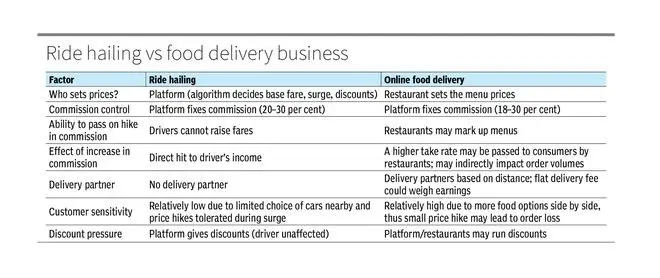
While food menus are almost similar on all platforms, the sector can be disrupted by either lower prices or better lead time for consumers.

However, while consumers may benefit from Rapido’s model, the menu prices of large chains are lower on Swiggy and Zomato, given the discounts that chains offer. Moreover, highly in-demand global QSR brands are yet to be available on Rapido due to its smaller scale.

Meanwhile, lowering the lead time of delivery could be a tall ask for the newcomer as Ownly will have to cross utilise the fleet, thus putting more pressure on Rapido, against a dedicated fleet of Zomato/Swiggy.

There are two levers at play here. First, Rapido with a zero -commission model is in a position to share some delivery costs with restaurant chains, and as a result may pass on the price benefit to consumers via menu pricing. Second, a wide supply side adoption like we saw in the Rapido cab story may not be possible in the food delivery business as menu pricing is flexible and restaurant chain operators are the price setters (see chart). Nonetheless, Ownly can emerge as a strong challenger to the duopoly by taking a grip on key pockets of cities, though execution remains a question mark.

(The writer is EVP, Elara Capital)

Published on October 13, 2025