









One can spot the ready-mix concrete trucks trundling around town, large drums constantly churning, headed to construction sites in most major cities in the country. You can’t really call them below-the-radar as they are big, bustling and noisy trucks, but the brand name on the mixers may not be evident to many. Inevitably, they will be Schwing Stetter India (SSI) mixers which are playing a key role in the building boom in the country’s towns and cities.
While a stolid concrete equipment manufacturing company such as SSI, a subsidiary of a German company (and now Chinese owned by the construction major XCMG), may not be top of mind for the lay public, the company plays a key role behind the scenes. As VG Sakthi Kumar, Chairman & Managing Director, SSI, explains, “If you look at the segments where our machines go: expressways, concrete roads, flyovers, retaining walls, high-speed rail, dedicated freight corridors, hydropower plants, nuclear power plants, windmills, even solar panels need concrete foundations. So, concrete touches every part of infrastructure growth.” As he adds, with pride, Schwing machinery was present at all the major edifices built round the country, from the Chenab bridge to the Statue of Unity to the new Indian Parliament, among many others. Needless to say, all the major cement companies, which have ready-mix concrete plants, are customers of SSI.
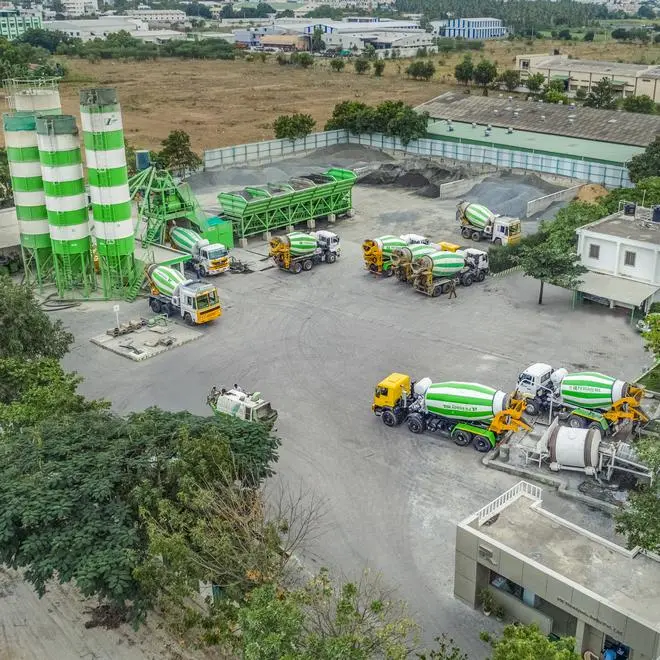
For Sakthi Kumar it’s been some journey, starting off from a small two-room office way back in 1998, importing Schwing Stetter equipment for use in the country. From its first factory kicked off in 2001 at Sriperumbudur on the outskirts of Chennai, SSI has today expanded to five factories, with a global manufacturing hub at Cheyyar in TN, around 100 kms from Chennai city. Across five factories, SSI makes a range of concreting machinery from concrete batching plants, mixers, pumps, truck-mounted boom pumps, shortcrete pumps (where material is sprayed at high velocity onto a surface, useful in tunnel construction or slopes). “What started as just an outpost for the group has now become our biggest business centre in the world —in terms of capacity, manpower, turnover and profit margin. We are number one globally,” says Sakthi Kumar.
Booming exports
In the recent past, it has exported around 1,600 units to the Philippines, Thailand, Indonesia and Vietnam, mostly mixers, pumps and batching plants. More recently, in South Africa, after trying European, Japanese, Korean and Chinese sources, customers there have settled for SSI over the last year. The company has exported to around 60 countries. “Last year, our exports were around ₹140 crore, out of ₹2,400 crore total business, that’s about 5 per cent. But this year, we have already crossed that in six months. So, we could end the year with about ₹300 crore in exports, more than double the previous year. But, while exports are growing, domestic business is also booming. So, export share as a percentage may not grow substantially, but in absolute value, it is doubling,” he explains.
At the company’s plant in Cheyyar, a group of around 20 girls are sitting for a theory class on welding equipment. At the rear of the large room a few girls are simulating welding; the training is before they get on to the shop floor, explain company officials. Most of the girls in this class are from West Bengal and a few from Odisha, far away from their homes and working in interior TN. Almost all are from polytechnics. If they write an exam and get selected, they get to study for an engineering degree from VIT, sponsored by the company.
Garbita Sen, 24, who is now a quality control junior engineer from West Bengal, says she joined as a machine operator after training in drilling, plasma cutting machines and double column boring machines for around one-and-a-half years. After that she moved to quality control to inspect machining components and cut parts. It’s far away from home, she admits, but she loves the work, and, importantly, has gotten used to south Indian cuisine! Garbita is studying at VIT in the second year for a mechanical engineering degree.
As Sakthi Kumar explains, the women are employed for their competence and skills in precision welding. “30 per cent of the shop floor workforce comprises women from pan-India. In the assembly line the women work force is more than 55 per cent vis-à-vis the male work force on the shop floor of our global manufacturing unit. They not only perform welding but are also inducted into sub-assembly line and also in the main assembly line along with the others.” he says.
The adoption of ready-mix concrete (RMC) in India is on the rise, particularly in urban areas, but it still constitutes a relatively small portion of the country’s total concrete consumption. “While RMC’s usage has been growing, estimates suggest it still only accounts for approximately 20 per cent of total concrete usage nationally. This is a stark contrast to developed countries where the market share can be as high as 70-80 per cent,” explains Kumar. Also, the usage of RMC is heavily concentrated in major metropolitan areas, where it contributes to 30-60 per cent of the concrete usage, driven by constraints on construction space, the need to control pollution and the demand for rapid, large-scale construction. In the relatively small market for RMC, SSI’s concrete mixers would have 85-90 per cent share, dominating the market.
Complete concrete solutions
However, SSI is present in all segments of the market. As Kumar explains, “We are the only company which provides complete concrete solutions, supplying equipment used for production of concrete (concrete batching plant), transport of concrete (truck mixers) and placement of concrete (concrete pumps).” While none of the competitors provide the entire range of equipment, the major competition comes from firms such as Amman, Ajax Engineering, Apollo, Conmat, Aquarius, Putzmeister and Venus Techno Equipment to name a few.
Sakthi Kumar says there are still technologies that are absent in construction equipment, which SSI is bringing in. “For example, while we found a solution for concrete, plastering is still being done manually. So, recently, we introduced a plastering pump. Also, our batching plant for concrete was adapted into a dry mortar plant. That plant handles stone, cement and sand mixed in the right proportions to produce plaster,” he explains.
SSI has also got into brick-making plants and concrete blocks. Making concrete blocks is low tech, but making the machines to manufacture those blocks is high technology. “That’s what we want to get into,” he adds. It is also now making stone crushers for quarry owners. “Given our reputation as a quality supplier of machinery and a strong after-sales support company, why not get into that as well,” he adds. Meanwhile, its Cheyyar unit is also now a Global Capability Centre and it’s exporting designs and earning revenue from the US and Europe by designing products for those markets as well.
The other big trend he points to is the making of precast floors to walls. Many construction companies are looking at precast components to complete a building quickly. “Normally, if you pour concrete floor by floor, you have to wait 28 days for curing before adding the next floor. But here, precast floors are manufactured elsewhere, brought to the site and then lifted by a crane and placed in position,” explains Kumar.
Ice concrete
Precast also requires temperature control, so SSI also makes ice plants to cool the concrete. Ice for concrete, one asks incredulously. As Kumar explains, “When concrete is poured in very large volumes — say 10,000 cubic metres in a single shift — temperature control becomes critical. If the ambient temperature is high, the concrete sets too quickly, leading to weak structures. To prevent this, the temperature of concrete must be reduced before pouring!”
The investment so far in the new initiatives has been around ₹350 crore and another ₹125 crore will be the tab for expansions. Once done, SS plans an additional ₹300 crore on further initiatives.
SSI, IIT Madras and Chennai Metro worked together during the first phase of metro construction. Whenever a metro column is built, the top one metre is chipped away and discarded so the reinforcement rods can be exposed. That waste concrete, which takes 600 years to degrade, was ending up in dump yards. The three entities worked together to see how to recycle that waste into fresh concrete. Their research proved that 25 per cent of recycled aggregate could be safely used.
This was adopted by the government which had released an order that every city with one million population should have a construction and demolition waste yard for recycling and make it available commercially. “Chennai has a yard and C&D waste recycling is happening and this recycled concrete is available commercially but yet to be marketed vigorously. We are recommending that the tenders should have a clause to use this C&D waste mandatorily which is being looked into,” says Kumar.
SSI’s aim, Sakthi Kumar says, is to deliver world-class technology at a lower cost than global players. “That’s why our exports are growing. Our experience in India has enabled us to be price-competitive, even against Chinese products. This advantage will only increase because costs in China are likely to rise faster than in India.” Clearly, he has concrete plans for the future.
Published on September 12, 2025