








Anant Goenka may have been born into a business dynasty more than two centuries old, but leadership was never something he assumed would come naturally. Growing up in Mumbai as the grandson of Rama Prasad Goenka and son of Harsh Goenka, he always knew he would one day take up the mantle of the family empire. Yet, when the time came, it wasn’t instinct or charisma that defined him. He had to build his confidence step by step, particularly when speaking in front of others.
“I always had this huge fear of public speaking,” he recalls, “I remember once, when I was Deputy MD, we had organised our first town hall. At noon, the then MD told me he wasn’t feeling well and left, asking me to take over. It was my worst nightmare — I had to go on stage, answer questions I wasn’t fully sure of, but I managed. Each of these incidents built my confidence bit by bit, like peeling an onion, until speaking became a part of life.”
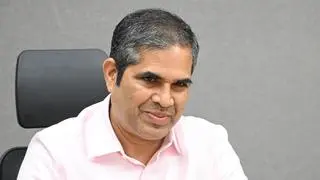
We meet Goenka over lunch at RPG House, the imposing headquarters of the $5.2 billion conglomerate with interests spanning technology to tyres, in Worli. The walls of the executive dining room, true to the Goenkas’ well-known love for art, are lined with striking paintings. Compared to his early days, now Goenka, the Vice Chairman of RPG Group, is a study in quiet confidence, a leader who appears more a thoughtful innovator than a traditional industrialist.
Our conversation starts off with him reflecting on his childhood — a period he describes as “very normal” but deeply shaped by the quiet influence of his grandfather. “My granddad was a big inspiration, particularly how he treated people — with humility and respect,” Goenka recalls. Always dressed in simple kurta-pyjamas, his grandfather’s small rituals left a lasting impression. “When we were kids, he would open the car door for us instead of sitting first himself. It’s those little gestures of respect, whether towards staff or family, that I really looked up to.”
Campus reflections
After studying in two of Mumbai’s top schools — Campion and Cathedral — he pursued economics at the Wharton School of the University of Pennsylvania, where he also met his wife, Radha. Goenka’s face lights up as he describes her passion for social work. She has founded three NGOs focusing on education and heritage revival.
At Wharton, he was captivated by the sheer breadth of the curriculum. “I did fine arts, photography, for example,” he reveals, “I did appreciation of art, I did psychology, I did history, and I did the impact of technology on warfare.” This multidisciplinary approach, he feels, had a “larger-than-life impact” on him as a leader. It wasn’t about learning a direct business lesson, but rather learning how to think.
He went on to earn his MBA from the Kellogg School of Management. The experience shaped his understanding of leadership in profound ways, he says. “At Kellogg, there was a professor by the name of Harry Kramer. He taught a class called managerial leadership. And I think he had a huge influence on me, as to how to lead.” The core lesson from Kramer was simple yet profound: ‘Use your common sense. Common sense is not so common.’ It gave him the confidence to trust his gut and do what he believed was right, even when faced with disagreement.
Learning the ropes
Before stepping into the family business, Goenka sought out stints in other companies. He worked with Hindustan Unilever, Accenture, and Morgan Stanley, gaining exposure to marketing, finance, and strategy. While he found the banking culture to be “a lot of face time” and “less purposeful”, consulting at Accenture familiarised him with supply chain dynamics. He describes his work with HUL, in rural Madhya Pradesh, as “incredible”. It pushed him out of his comfort zone and provided a “real feel of what real India is”.
That preparation was put to the test when he took over as Managing Director of CEAT Tyres at just 31. The company was struggling with inconsistent product quality and sagging market share. “We didn’t have that long-term vision, clear sense of direction, of where we want to go, what differentiates us,” he says. His strategy, informed by the Pareto principle he learned from the company’s TQM (total quality management) journey, was to focus on “the three bold moves”. For CEAT, this meant focusing on the two-wheeler segment; using outsourcing for growth; and building a new, differentiated distribution network.
This shift was a masterstroke. The tyre company re-envisioned the brand with the “idiot-safe campaign”, emphasising grip and safety. Most importantly, it revolutionised its distribution. By creating a new layer of distributors to sell its two-wheeler tyres in smaller towns, it mirrored the FMCG model and reached a new customer base. This strategy, Goenka explains, was the “strong differentiator versus the competition”. As a result, CEAT’s market share in the two-wheeler segment soared from 11 per cent to nearly 29 per cent. The profitability saw a dramatic turnaround.
He also addressed a deeper, more systemic problem: lack of trust between management and workers. By focusing on simple things like improving factory infrastructure and empowering workers through concepts like “autonomous maintenance”, the company built a new culture.
Learning from missteps
The lunch arrives as we settle in: a light and vibrant soba noodle and tofu salad, followed by a roasted vegetable and avocado sandwich on sourdough, with a blueberry-and-vanilla panna cotta waiting in the wings. Goenka is candid about his missteps, too. At the start of CEAT’s TQM journey, the company struggled with its first truck radial tyres. It was a completely new technology, new factory, and new systems, and the team assumed that while bias tyres suited overloaded vehicles, the more expensive radial tyres would be used only for normal loads. That proved wrong, and when customers began reporting failures, CEAT was slow to respond.
“Our R&D team kept insisting the product was good, that it was the sales team’s fault for selling to the wrong application,” he recounts. But the lack of customer-centricity cost dearly: “If customers say the product isn’t good and we can’t control the application, we should have re-engineered much faster.” The delay damaged the brand’s reputation, and it took nearly eight years to rebuild trust — given the long timelines of tyre development, road testing, and convincing wary customers to try again.
Today, as group Vice Chairman, Goenka is looking beyond tyres to shape the future of the conglomerate. He sees the engineering arm, KEC International, as a powerhouse in the making. “We want KEC to become the next L&T,” he says with quiet confidence, outlining ambitious plans for growth in transmission, semiconductors and civil infrastructure.
A future with tech
Technology and innovation are equally important pillars of his strategy. RPG’s IT arm, Zensar Technologies, is embedding artificial intelligence deeply into its offerings, both for clients and internal processes.
Another bet is Taabi Mobility, a data-driven fleet management platform, which Goenka sees as a symbol of the group’s willingness to experiment with new-age businesses. By using cheap sensors and data analysis, Taabi helps truck owners prevent fuel theft and optimise driving habits for better efficiency. It’s a new business that is run like a startup within the company, with an independent CEO and a separate investment committee to oversee its progress.
Despite overseeing a business empire that spans tyres, engineering, IT, and emerging ventures, Goenka shows no signs of the stress often associated with high-stakes leadership. But he admits that balancing ambition and peace of mind is a constant challenge. “Sometimes you want to do 10 things, but you also lose peace of mind. We’re lucky to be where we are, but there’s always the question — do you want to expand into everything?” he says. The trade-off, he reflects, is between growth and life: choosing not to chase every opportunity can mean more time for family and health, while aggressive expansion might mean years of stress and missed moments with his children. “I don’t have an answer,” he says candidly, “but those thoughts are always there,” adding that he relaxes by playing badminton with his children, who are 14 and 12.
As we finish lunch, there is no air of urgency or flourish. Instead, there’s the quiet confidence of a leader who knows that empires are built not in leaps, but in layers.
More Like This


Published on September 1, 2025