








Just three letters: TVS. Infused in it is over a century of trust, ethics, values and integrity, with the brand stretching across a variety of businesses, ranging from automotive components to finance. Now, retaining two of those letters and fusing one more to it, the TSF group is looking to reinforce the same brand values that has stood the group in good stead over the years.
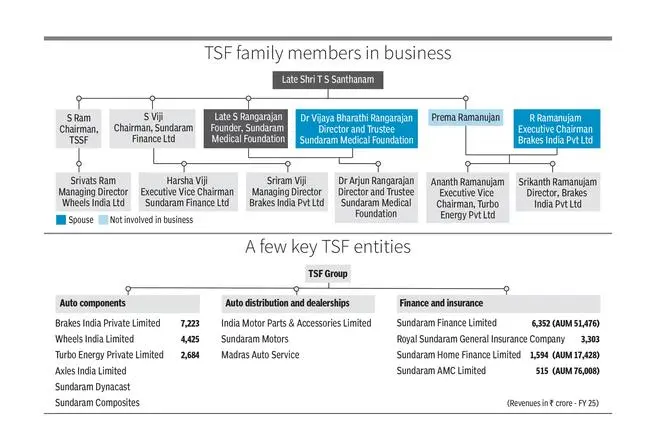
As Srivats Ram, Managing Director of Wheels India, says with a grin, “For 27 years of my life, if you had asked me who I worked for, I would say the TVS group.” From 2022, descendants of the late TS Santhanam, erstwhile Chairman of Sundaram Finance, have rebranded themselves as the TSF group (see chart).
The venerable TVS Group began its formal split and restructuring in late 2020 with a Memorandum of Family Arrangement that was legally completed by early 2022, aligning business ownership with specific family branches. “And in that family arrangement, we aligned the ownership and the management. So in line with that, the Santhanam family, and both of us grandchildren (Harsha Viji & Ram), decided to be together,” he explains. As part of the agreement, this branch of the family cannot use the TVS brand name.
Values are everything
In an over two-hour conversation with businessline, Harsha Viji, Executive Vice Chairman of flagship Sundaram Finance, and Srivats Ram spoke eloquently about the performance of the TSF group, the rebranding efforts and plans for the future. Trust, ethics and the importance of values was a leitmotif of their presentation.
“Values permeate everything we do,” declares Viji. Referring to Sundaram Finance, he says, “If you look at our business, as an NBFC we are competing against banks, which have a lower cost of funds than we do. We are able to compete as customers see that we are ethical and transparent. They see that we are very fast in the way in which we turn around contracts. And that gives us an edge in the marketplace.”
He stresses that values is not an old-world phenomenon. “We aren’t a bunch of old people talking about yesteryear values. Values are very much current and a large part of our workforce is young – 50-60 per cent have come in the last three years. I violently disagree when people say this generation has no values. I would say values matter more to the current generation than they did to us. They have a very clear idea of right and wrong,” elaborates Viji. This translates to having one of the lowest attrition rates in the industry, one-fifth that of the competition. “We believe in long-term relationships with the employees, And, that is the way our companies are built,” he adds.
Nor does this detract from the manufacturing edge its group companies such as Wheels India, Brakes India and Axles India have. Viji points out that all these companies are known for very high quality of operations and have secured Deming awards as well.
Viji and Ram explain that the TSF Group has set out an ambitious five-year roadmap aligned with its journey towards completing 120 years in 2031. By 2030, the group aims to double its manufacturing revenue from ₹16,000 crore to ₹32,000 crore, expand global exports, and grow Sundaram Finance Group’s assets under management from ₹1.5 lakh crore to ₹4 lakh crore. This vision will involve a planned capital expenditure of ₹2,500 crore in manufacturing facilities, new products, and digital transformation.
Ram is bullish about doubling manufacturing revenue by 2031, when the TSF group completes 120 years. He sees various growth opportunities to achieve this, including a growing Indian economy, the localisation push among his global customers, and the robust overseas markets despite all the geopolitical risks.
The supply chain relationships between India and the US are too closely linked to be disrupted for long, Ram says. “Many of our customers today have an India strategy, where they create separate offices within that organisation. So, hopefully all this mist and fog will clear up within a year,” he adds, dwelling on the US tariffs.
On the manufacturing side, the Group has bought out JV partners in Wheels India, Brakes India, and Axles India by consolidating its holdings in the past. It also increased stakes in Transenergy and IMPAL, strengthening control and operational independence.
Southern conservatism
TSF Group has three holding companies – Sundaram Finance, Sundaram Finance Holdings Ltd (a listed entity), and TSSFPL (Trichur Sundaram Santhanam Family Pvt Ltd). To align with the broader TSF identity, SFHL is now being renamed as TSF Investments Ltd.
Flagship Sundaram Finance is the 800-pound gorilla of the group. In FY25, its assets under management (AUM) grew 17 per cent to ₹51,476 crore; disbursements grew by 9 per cent to ₹28,405 crore, while profit after tax closed at ₹1,543 crore, up by 6 per cent over FY24.
Despite the 71-year-old Sundaram Finance’s stellar performance, even on the bourses, it would still be regarded as a conservative South Indian company. “I bear that badge with honour. I don’t have a problem with that. People may talk about how others have grown faster than us. But our share price return is not very different from, say, Berkshire Hathaway. If you look at it over a 20–25-year time period, our long-term return is about 23 per cent compounded over decades. So, we have delivered value to shareholders,” elaborates Viji.
But, he’s quick to add that what they articulate as its vision is not about size or profitability but about three things. “We say we want to be the most respected NBFC in the country. That is our stated goal, and I think we are there. And our business philosophy is growth with quality and profitability. GQP is what we say! So, this is a triangle which we are always juggling. And we believe that is the best way to deliver long-term growth,” he elaborates.
Over the last 20 years, SFL has grown at about 16 per cent CAGR. “Now, what that number will be – 18 to 22 per cent – we’ll have to see, because that depends critically on execution. I do see peers growing at 30 per cent plus, and I salute them. I think they’re doing an exceptional job. But with the SFL way of doing business, we will end up in the range of growth that I am talking about, but the trick is to do it consistently decade over decade and that compounding effect is where the benefit comes from,” he adds.
The growth for SFL is coming from new businesses’ acceleration in certain segments where it believes there’s a lot of headroom. While it’s known as a commercial vehicle financier, SFL also has a very large car book. Its car target customer is in tier-2 to tier-4 towns, chiefly self-employed professionals.
“There is huge headroom for market share growth in the retail business. Used vehicles are another area of growth. We are traditionally focused on the sale of new vehicles but our used vehicle proportion over time has grown from 8 per cent of disbursement to about 27 per cent. I would like that to be 50 per cent. That’s not a target we can achieve in a few years, but it’s a target we can move towards,” explains Viji.
Keeping credit costs low
As he explains, the reason SFL keeps credit costs and operating profits low is to also quote lower rates to its customers. “There is a very strong belief in the company that we must give the customer a fair deal. And the reason the used vehicle business fits nicely inside this is because whereas we are not able to offer the best rates in some of the other new vehicle segments, as banks are competing, in the used vehicle segment, where our competitors are priced significantly higher, we have an opportunity with the right clients to quote a rate that is lower than the competition. So, it fits very well with the sense of mission that we have that we are doing something for the welfare of the transport operator,” elaborates Viji.
Ask Viji on succession planning in the group, he explains that given the expanse of the group and the number of entities, over time it will need to move to a model where family members are not 100 per cent involved in running the businesses day-to-day, but are professionalising and running with a wider span.
“How that happens, over what period it happens, I think, is unclear. But if you look over the next 10 years, I think the very simple mathematics is that the number of people in the family is much less than the number of companies that there are. So, we’ll have to move to a different model of governance.”
Published on October 13, 2025