








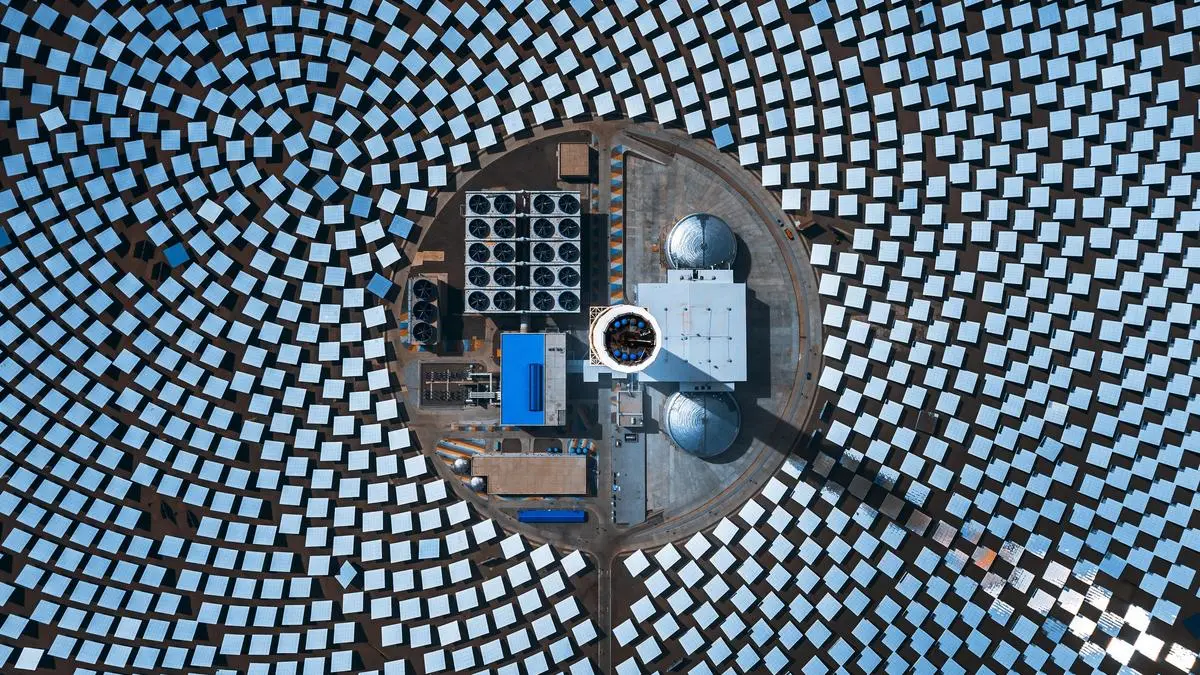
RADIATING ENERGY. India’s solar capacity will nearly triple by 2035-36 | Photo Credit: AerialPerspective Works
The Central Electricity Authority (CEA) has released its national generation adequacy plan for the decade from 2026-27 to 2035-36. The detailed technical document synthesises results from Monte Carlo simulations — thousands of “what-if” scenarios with varying demand, renewable output and plant outages — to assess how reliable the power system would be under real-world uncertainties.
At its core are the numbers India needs to reach by 2035-36. Electricity demand is projected to rise to 3,365 billion units, from about 2,000 BU in 2025-26. Installed generation capacity must increase from around 520 GW to about 1,121 GW, including 335 GW of fossil fuel-based capacity and 786 GW of non-fossil capacity. Energy storage capacity is expected to reach 174 GW/888 GWh.
Beyond these numbers, the document offers several insights.
The first, and perhaps most striking, is coal’s defiance. Coal-based capacity is projected to rise by only 78 GW, and its share in total capacity will fall from 41.5 per cent in 2026-27 to 28 per cent in 2035-36. Yet, in terms of actual electricity generation, coal will still dominate, accounting for 51 per cent in 2035-36. Solar capacity will nearly triple — from 176 GW to 509 GW — but contribute only 27 per cent of generation, with other sources trailing further behind. Coal, in effect, is saying: “You may hate me, but you cannot ignore me.”

The second insight is the growing importance of pumped storage projects (PSPs). From a modest 5 GW in 2026-27, PSP capacity is projected to surge to 94 GW by 2035-36, outpacing the projected growth of battery energy storage systems (BESS) from 9 GW to 80 GW over the same period.
The CEA clearly thinks highly of PSPs, describing them as “a critical component of India’s evolving power system”.
These plants provide long-duration storage — typically six hours or more — helping manage peak demand. The document also notes their relatively lower environmental impact, a claim that environmentalists may contest. It adds that the technological maturity of PSPs enhances investor confidence and enables long-term financing, making them viable for large-scale deployment, compared to alternatives that rely heavily on imported components.
The authority points out that BESS depends on cell supplies from “one of the Asian countries”, exposing India to geopolitical risks, trade frictions and price volatility. While battery costs are declining, the “actual cost” depends on factors such as depth of discharge, round-trip efficiency, degradation, number of cycles, land requirement and the provision of free charging power.

A third takeaway is that the demand projections appear achievable, given what the CEA describes as “complete visibility” of capacity additions by 2035-36. The “visibility” is across the board.
Coal-based power plants: 41 GW under construction; 22.4 GW to be taken up for construction soon; and 16 GW in the planning stage.
Hydro: 13 GW under construction; 17 GW more under planning.
Nuclear: 6.6 GW under construction; 7 GW under planning.
Renewable energy: 155 GW under construction; 48 GW under tendering.
Pumped hydro: Sites for 100 GW identified; 7.2 GW commissioned; 13 GW under construction; and 9.5 GW at “advanced stage of planning”.
BESS: 11 GW under construction; 22 GW under tendering.
Finally, the document underscores the importance of planning reserve margin (PRM) as a reliability metric. PRM refers to the extra capacity available beyond peak demand. The CEA estimates that India will need a PRM of 13–14 per cent by 2035-36 to ensure the system “remains resilient even with high levels of renewable energy.”
Published on March 30, 2026
此内容由惯性聚合(RSS阅读器)自动聚合整理,仅供阅读参考。 原文来自 — 版权归原作者所有。