



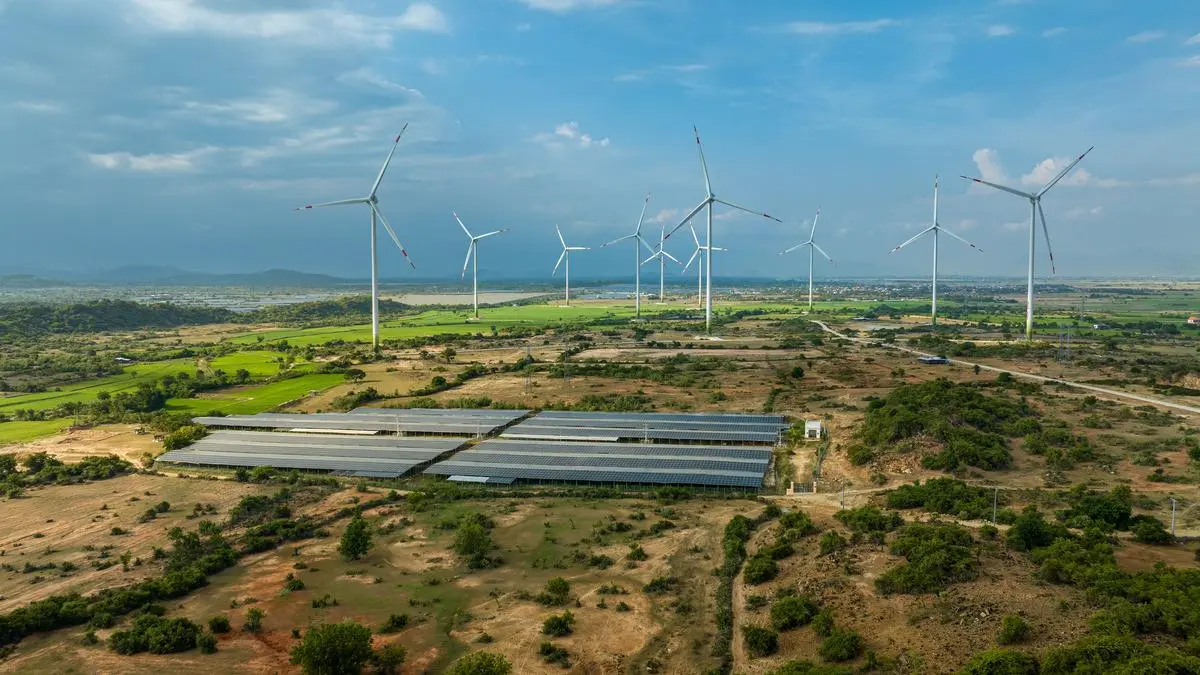
Between September 2023 and September 2025, India added 55 GW of renewable energy | Photo Credit: Getty Images
For years, renewable energy (RE) in India has been running on a treadmill — working hard but staying in the same place. Until 2024-25, despite rapid capacity additions, the needle on RE’s share in total electricity generation has barely moved: from 21.56 per cent in 2020-21 to 22.06 per cent in 2024-25.
Industry experts, such as Raj Pratap Singh, former Chairman of the UP Electricity Regulatory Commission, argue that India cannot escape coal anytime soon. Singh noted in a LinkedIn post — based on data up to 2024-25 — that renewables were not displacing fossil fuels. An economy running at 7 per cent GDP growth is energy-hungry, and the rise in RE generation over the past decade simply wasn’t large enough to dent coal’s dominance. Of the 451 TWh (Terawatt-hour) increase in the total generation between 2020-21 and 2024-25, coal alone contributed 351 TWh — 78 per cent, he notes.
So, the conclusion seemed clear: renewable energy was expanding, but fossil fuels were not losing ground.

Come 2025-26, where something decisively different is happening, a new trend is unmistakable. In April–October 2025, RE’s share of total generation jumped to 28.26 per cent, far above 22.13 per cent the previous year. Including nuclear power, ‘non-fossil’ contribution hits 31.17 per cent. Since no large thermal power additions are expected — and with solar and wind typically peaking in the second half — RE’s share will only rise further.
What explains this shift? Massive capacity addition. Between September 2023 and September 2025, India added 55 GW of RE. In Jan–March 2025 alone, 7 GW came up, followed by 12 GW more in the next quarter. These capacities are now showing up in generation numbers.
RE additions are accelerating faster than that of fossil fuels. In April–October period this year, India added just 3 GW of coal capacity (net thermal capacity actually fell by 1.3 GW due to gas plants’ shutdown). In contrast, RE additions hit 28 GW. India may add 80 GW of coal through the decade — but is adding 35–40 GW of renewables every year. Moreover, new coal plants will run at lower PLFs — 55-60 per cent — because coal power is expensive. Adani Power’s 2,400 MW Bihar plant, for instance, has a tariff of ₹6.07/kWh, whereas Firm and Dispatchable Renewable Energy (FDRE) projects from Hexa Climate, ACME and Avaada have discovered tariffs of ₹4.69-₹4.70.
RE is also benefiting from converging tailwinds. FDRE tariffs are now lower than new coal and on a par with the average cost of coal generation (₹4.78/kWh) — this will fall further as storage prices decline.
Regulatory changes will strengthen the trend. CERC is framing rules to divide the day into ‘solar’ and ‘non-solar’ hours, allowing transmission capacity allocated to solar to be freed up for others during non-solar hours. As Suzlon CEO JP Chalasani notes, many solar sites are also good wind sites; co-located wind turbines can use this capacity at night. This optimal utilisation will push FDRE tariffs even lower.
Tightening of ‘deviation settlement mechanism’ (DSM) rules, narrowing the band between predicted and actual generation for avoiding penalty, is a challenge in the short term, but will help RE — especially wind — better integrate into the grid. (Chalasani says that improvement in forecasting is technically possible.) This would help increase RE’s contribution to total energy generation.
Further, the growing demand from the lucrative Commercial and Industrial (C&I) market and measures like virtual power purchase agreements (VPPAs) put further tailwind behind RE.
All this strengthens the view that non-fossil generation, now at 31.17 per cent, can realistically rise to 40 per cent by 2032 — and perhaps even reach 75 per cent by 2047. The year 2025-26 will be remembered as the tipping point when India’s RE sector broke free from the 21–22 per cent rut and climbed to a higher orbit.
Published on December 8, 2025
此内容由惯性聚合(RSS阅读器)自动聚合整理,仅供阅读参考。 原文来自 — 版权归原作者所有。