






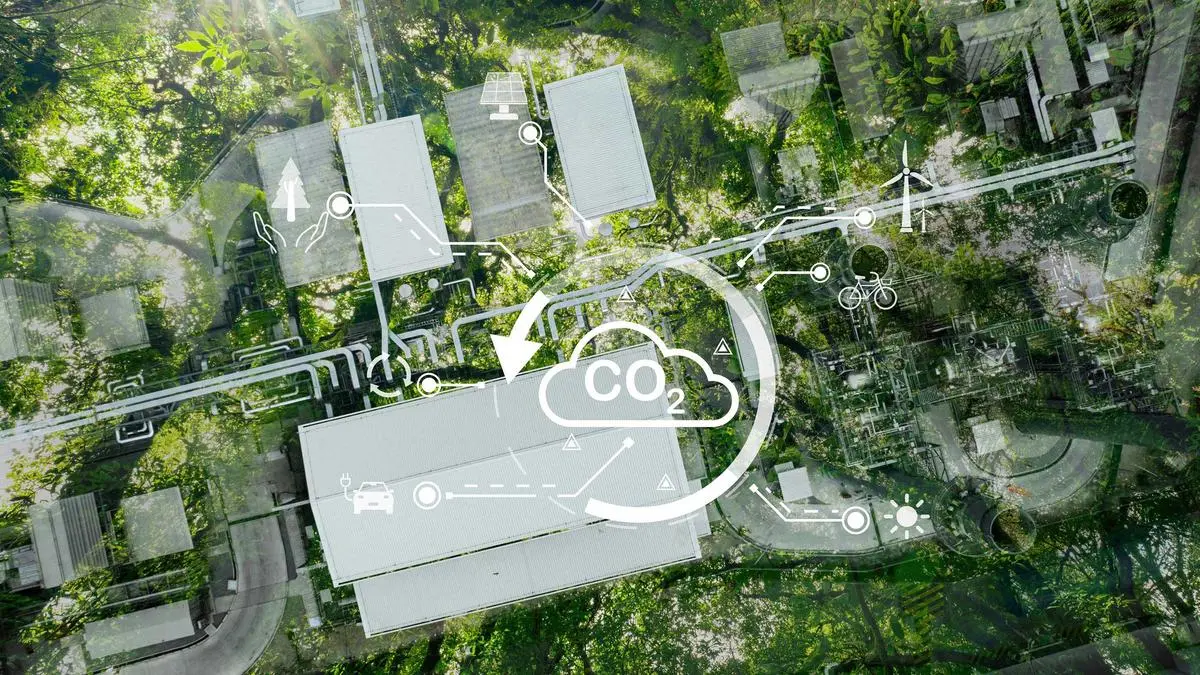
For just transition, India will need to store 0.3-0.4 billion tonnes of CO2 every year | Photo Credit: Getty Images
There has been a threefold increase in the Carbon Capture and Storage (CCS) projects globally. According to the Global CCS Institute, there are 77 commercial projects with a total capacity of 55 mtpa in operation. As many as 47 projects are under construction, and ~250 are in the FEED (Front-End Engineering Design)stage.
This speaks to the necessity of CCS as a key pathway to limit global warming to less than 2 degrees Celsius from the pre-industrial levels by the turn of the century. As much as 1.5 degrees Celsius temperature rise might have been baked in already!
Unfortunately, this belief is not ingrained among the Indian decision-makers. Result – not one material CCS project is in the hopper. ONGC, which is perhaps most suitably placed to undertake a CCS project, has also been cautious; only a 0.5 million tonne per annum (mtpa) CCS project by 2030 appears in the company’s net-zero plan.
For just transition, India will need to store 0.3-0.4 billion tonnes of CO2 every year (out of ~3 billion tonne of annual emissions) in safe geological storage – this will allow continued but limited use of fossil fuels and will prevent stranded assets in the hard-to-abate sectors like cement, steel and power. However, against this requirement, we are at nil now!
A well-designed CO2-EOR (Enhanced Oil Recovery) and Enhanced Coal-Based Methane recovery using CO2 could help India meet the twin objectives of CO2 storage and enhanced oil recovery, leading to increased production of oil and gas. According to the EOR Institute, one billion cubic feet of CO2 is injected into the US oil and gas fields daily, leading to an incremental production of 2,73,000 barrels of oil per day.
Estimates of India’s unconstrained, theoretical CO2 storage potential range from 400 to 600 gt (depleted oil and gas fields: ~3.4 gt, saline aquifers: ~300 gt, basalts: ~100-300 gt). This could take a hit by 80-90 per cent if social and technological constraints are considered and imposed. Even with the reduced storage potential, India could be among the top 10 countries for CCS projects.
India has a strong source-sink match in the Cambay basin, which can allow the development of a CCS hub in the Western flank of India. CO2 emitters or sources of 30-40 mtpa are located within a 50-300 km radius of possible geological storage of 400-500 mt in the Cambay Basin – Mehsana, Ankheleshwar, Hazira, Bharuch, Gandhar, etc. Learnings from planned CCS Hubs in Europe – Porthos, Aramis, Acorn, Net Zero Teesside, etc. – could be put ot use.
Similar to the Longship Project (Northern Lights) in Norway, which offers storage to CO2 emitters across Europe, India could provide geological storage to emitters in Europe and South East Asia at a tariff – liquid CO2 ships can bring the CO2 for storage to Indian shores. This revenue stream can buttress the CCS ecosystem in India.
Low-cost base in India could allow an average CCS full value chain cost (capture, transportation, compression, injection and monitoring) of $60-$80 per tonne of CO 2 compared to $120-$160 for a similar scope in the West. Policy frameworks and regulatory emission mandates help manage the cost angle of CCS projects.
These can help project developers cover their costs and provide a basis for the carbon markets to grow. Some policy constructs like the Emission Caps, Emissions Trading Systems (EU ETS, tradeable Australian Carbon Credit Units, K-ETS, Korea), Performance-based tax credits (IRA through 45Q in the US - the Big Beautiful Bill might change it but not yet), bespoke State Aid Package (Norway for Longship project ~ 75% of the project cost), Cost gap funding (SDE++ in Netherlands) etc. support 30-80 per cent of the costs of CCS projects.
Delivery of CCS projects in India is wrought with its own set of challenges.
Social cost of carbon in dollar terms: billions are spent post facto managing the impacts of climate change, but the government is unable to justify pre-emptive incentives for CCS projects in the absence of a $/tonne social cost of carbon. We need to work out a dollar-value social cost of carbon for India, akin to what exists in the US.
Project developers must bear the liability for a CCS project indefinitely. This is a nonstarter. The government needs to take over after an agreed period.
Technologies used in the CCS projects have been in operation for the past 30 years – they are all at TRL 9. All that CCS projects need is a detailed understanding of the risks and the firming up of preventative and control barriers around these risks.
Innovation to reduce costs by 40-60 per cent from the FOAK (First of a Kind) to NOAK (nth of a Kind) must be funded. Finally, the skill gap should be plugged using a knowledge management system that also creates awareness among the decision-makers about the need of CCS as a key climate action for India.
(The author is Partner and Group CEO of the Bengaluru-based company Nauavata Energy Transition Enterprise)
Published on December 8, 2025
此内容由惯性聚合(RSS阅读器)自动聚合整理,仅供阅读参考。 原文来自 — 版权归原作者所有。