




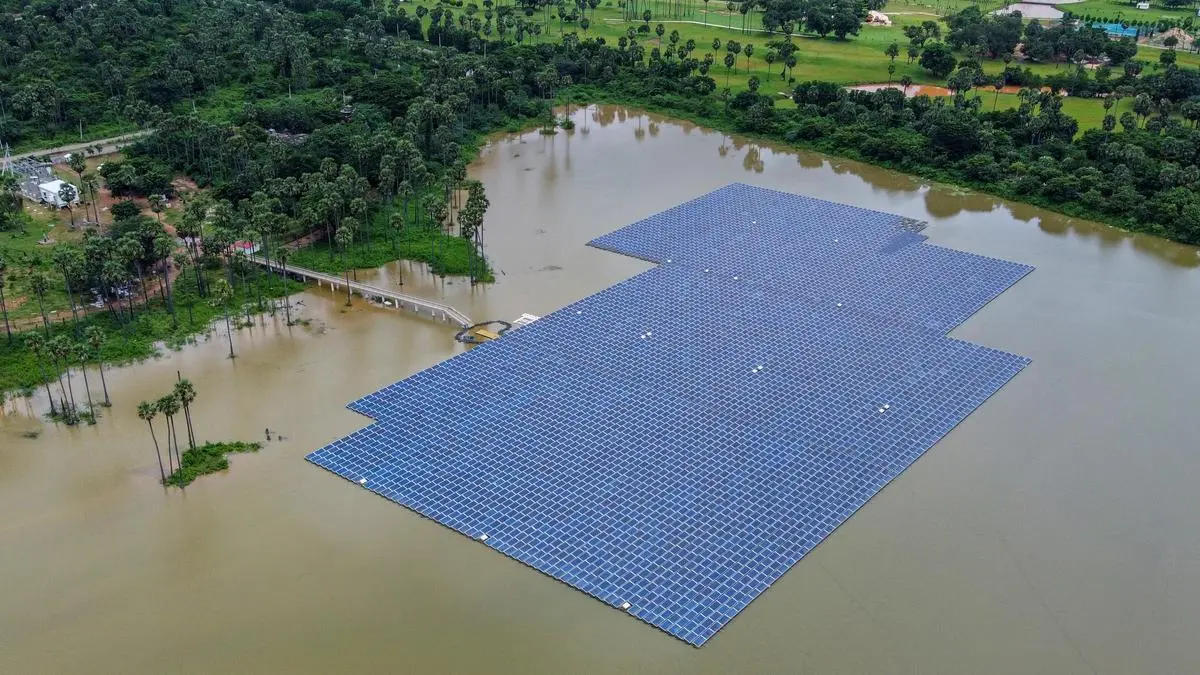
COOL FACT: Floating solar panels help cut evaporation at dams used for irrigation and hydropower generation | Photo Credit: DEEPAK KR
Terrestrial solar energy parks have been the norm. But since land is scarce and costly in urban areas, floating solar photovoltaic (FPV) technology offers a viable alternative.
India has set itself a target of establishing 500 gigawatts (GW) of non-fossil fuel energy capacity by 2030, including about 280 GW of solar energy. For context, only recently did the country cross the 250-GW mark in non-fossil fuel energy capacity.
In a paper published in the journal Energy for Sustainable Development, authors Abhinav Jindal, Pradhuman Shaktawat and S Abhilash Kumar say that just 10 per cent of India’s available water sources could help generate about 227 GW of FPV power.
Other than avoiding land use, FPVs offer several advantages: the PV modules benefit from the natural cooling of water, leading to higher efficiency and energy output — typically 5–10 per cent more than ground-mounted systems. Moreover, since FPVs cover the water surface, they help prevent some evaporation. This is particularly useful at dams used for irrigation and hydropower generation.
However, there are challenges associated with large-scale installation of FPVs, which tend to have higher initial costs compared with ground-based solar PV.
The authors analysed 130 hydropower reservoirs in the country that satisfied conditions they defined as both necessary and ‘conducive’. They identified 17 reservoirs as technically suitable for FPV deployment, in terms of minimising the challenges related to anchoring, mooring, and power evacuation.
The study found that Maharashtra had the highest number of suitable reservoirs, followed by Odisha. Almatti reservoir in Karnataka was found the ‘most suitable’, with high ‘global horizontal irradiance’ (amount of solar radiation received by the water surface) and moderate variations in water level over time.
The authors also used the ‘level-ised cost of energy’ (LCOE) — average cost of generating 1 kWh of electricity over a project’s lifetime — in analysing the financial viability of FPVs. In select reservoirs, the LCOE for FPVs ranges from ₹3.16 to ₹3.80 per kWh, which is significantly lower than the national average electricity tariff of ₹6.29 per kWh.
The LCOE for the Tungabhadra reservoir came in at ₹3.16 per kWh, which the authors attribute to its high energy yield.
Despite the overall competitiveness, FPV systems are costlier to install than land-based ones. The LCOE for Almatti reservoir, for example, is about 12.5 per cent higher compared with land-based PVs, largely due to the 15.5 per cent higher capital expenditure (capex) on components such as floating structures and anchoring systems.
The authors recommend targeted policy interventions to address this gap and encourage large-scale adoption. Their study concluded that an interest rate subsidy of 1.75 per cent or a 12 per cent capex subsidy could effectively equalise the cost of FPVs and LPVs. Alternatively, the government could consider an incentive of 12.5 per cent of the FPV LCOE, based on power generated.
FPVs also face non-financial barriers such as lack of standard components, inadequate local manufacturing capacity, and the need for approvals from multiple government agencies.
It is also not clearly evident whether FPV deployment would pay off on the sustainability front. While FPVs offer net annual carbon dioxide savings of 970-1,167 tonnes per megawatt (MW) capacity, their deployment on waterbodies could have potential impact on local biodiversity and aquatic ecosystems.
To minimise the risks to livelihoods such as fishing and tourism from FPV projects, the authors recommend a structured assessment of the social impact through consultations with stakeholders. Dr Shaktawat tells businessline that compensation or benefit-sharing, like those used in hydropower resettlement planning, may help FPVs take off.
He also points out that the lack of reliable data on water depths across reservoirs has led to the exclusion of this crucial factor in the final ranking of the study. This data could alter the LCOE estimates through the use of ‘exact anchoring costs’, he acknowledges.
Published on November 24, 2025
此内容由惯性聚合(RSS阅读器)自动聚合整理,仅供阅读参考。 原文来自 — 版权归原作者所有。