










Capital, it is often argued, is the biggest beneficiary of war. However, in the Age of Finance, that assessment is coloured by the fact that it is finance capital and its institutions that are the profit-making leaders. Finance capital ensures this supremacy by subordinating the profit-making infrastructure to its ends. In a time of war, the principal component of that infrastructure is the military-industrial complex, which experiences a rapid run down of inventories and a lengthening order book and exploits that circumstance to inflate profit margins. US President Donald Trump has plans to massively hike defence spending with a $1 trillion demand from the US Congress for the purpose. That should boost profits of defence equipment producing firms.
In the Age of Finance, what finance capital seeks to do is ride on any profit machine to extract a share of the surplus for itself. Betting on the appreciation in the value of the shares of profit-making firms is the easiest route to extracting that share. And the surge in interest in the shares of defence firms accelerates the appreciation in the values of their shares, helping realise profit expectations.
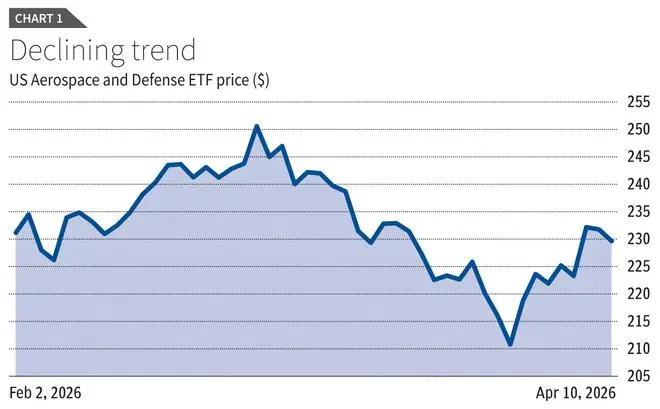
What has been surprising in the case of the US-Israeli unprovoked war against Iran is that the share prices of defence firms have not shown the expected buoyancy. Chart 1 traces the movement in the prices of an exchange traded fund tracking the share prices of US aerospace and defence firms from the beginning of February, through the date of start of the aggression (February 28), and till the date of launch of the now failed peace negotiations (April 10). What emerges is that this indicator of defence firm share price rose in the days preceding the start of the war and then began to decline and fell to levels well below the early February figure.
Defence factor
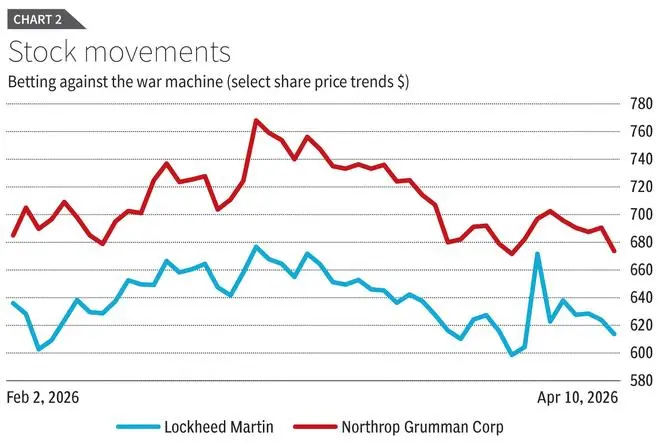
Two of these firms were lead beneficiaries of a war in which the principal weaponry used was the means and instruments of deploying air power by the US: Lockheed Martin and Northrop Grumman Corp. They both experienced similar share price trends, with steep declines after the war began (Chart 2). A part of Trump’s supplementary budgetary demand for defence expenditure is to be spent on 85 Lockheed Martin jets, for example, as compared with an already high request for 47 jets in the previous year. Despite that, finance capital seems to be pulling out of, rather than seeking to profit from, the war machine.
This action is clearly not driven by expectations of poor profit performance of firms that are the main beneficiaries of the US-Israeli war. Stakeholders in those firms are among the very few who would laugh their way to the bank as the world witnesses the political assassinations and civilian massacres that are central to the so-called ‘war’. Rather, given the footloose nature of finance, the explanation can only be that it has moved into areas in which the expected profits are even higher.
Hormuz impact
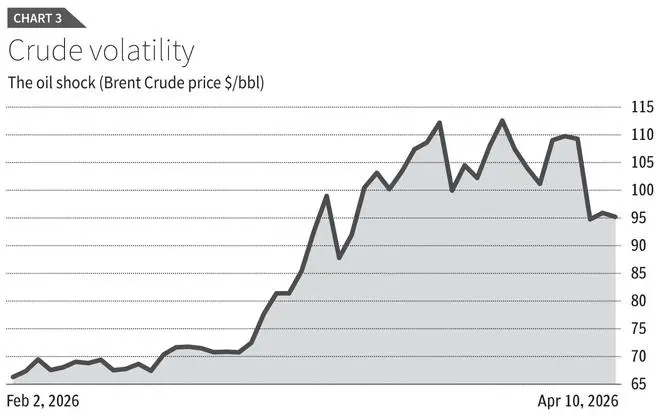
That market is the one for oil and associated financial markets such as that for oil futures. With Iran shutting down the Strait of Hormuz and substantially reducing the access to energy of a range of oil importers, oil prices have soared. In the month following the beginning of the aggression, the benchmark Brent Crude price rose sharply from around $70 a barrel to more than $100 a barrel and has fluctuated around that high level since.
This bonanza from speculating in oil markets cannot however be the sole reason why the defence industry has not attracted a similar speculative inflow. There is no binding ceiling on the access to liquidity of financial investors. Therefore, there must be factors other than the higher returns offered by oil investments to explain the lacklustre performance of financial instruments linked to defence. One such factor could be that with Israel’s genocidal attack on Palestine, and the earlier US-Israeli attacks on Iran, speculation in defence stocks could have already run its course before the current war began, warranting a correction even when demand for defence equipment is rising further.
The other explanation could be the uncertainty resulting from the unpredictability of Trump’s war mongering. Since profits from defence take time to materialise and may evaporate if Trump retreats, betting on military equipment producers may not be as attractive. Quick and easy profits from oil markets are clearly a better bet.
Inflation fears
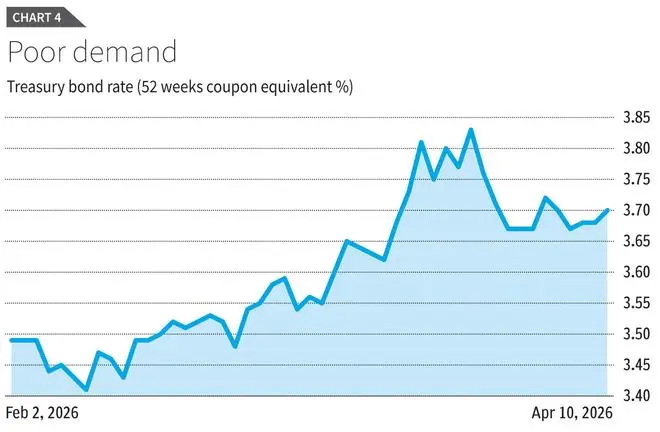
But uncertainty does not seem to be influencing markets as much as could be expected. If that were the case, the consequence would be a rush into safe assets such as US Treasuries or gold. But as Chart 4 shows, yields on one-year Treasuries (or the inverse of prices) have risen, indicating that bond prices have fallen because of tepid demand. Here too oil prices have played a role. The spike in global oil prices (including in the United States) has revived fears of inflation. And bonds are bad investments in inflationary times.
Moreover, the spike in defence spending would increase the federal fiscal deficit in the US, and the resulting rise in borrowing make bond holding less attractive. But, in addition, the signal bond markets are sending out is that there is no uncertainty factor dominating investor behaviour.
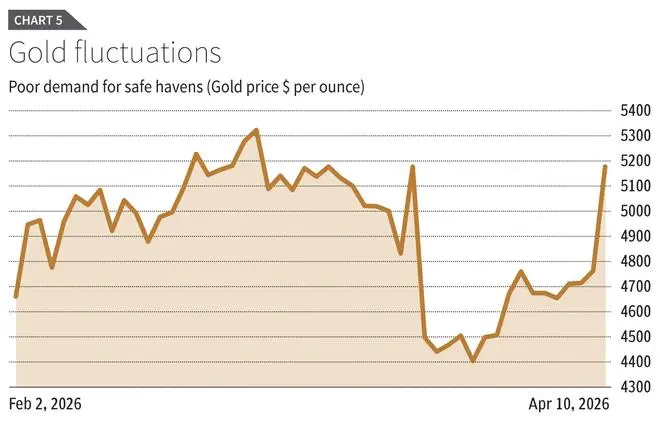
It could be argued that Treasury assets are not being seen as such a safe haven — but the perception that there is no flight to safety due to uncertainty is also corroborated by the trends in the prices of the other typical safe haven asset: gold. As Chart 5 shows, gold prices did not show any sharp trend in either direction through much of the war-torn days and then recorded a collapse on March 20 only to slowly recover that level over the next 20 days.
In sum, a reading of these indicators suggests that the war on Iran has not driven financial investors into expanding their holding in firms that are central to the military-industrial complex, even though they are the ones being rewarded by Trump’s militaristic adventurism and alliance with Israel. Rather, finance capital seems to be betting on something that Trump did not want — a spike in oil prices that would accelerate his domestic popularity decline. In this sense too, it is Iran that has won a war that it never wanted to engage in.
Published on April 14, 2026