








Corporate India has recently been rocked by news of sexual harassment of women employees at TCS. The way female employees were left defenceless over an extended period, despite the legal mandate to companies to provide protection to women at their workplaces, raises doubts about the seriousness with which India Inc deals with the POSH (Sexual Harassment of Women at Workplace (Prevention, Prohibition and Redressal)) Act, 2013.
The complaints span four years from July 2022 to March 2026 and involve complaints from eight women employees of TCS’ Nashik office involving sexual assault, harassment, injury to religious sentiment and religious coercion. Complaints to the Human Resources department did not stop these offences and the accused were let off with mere verbal warnings. The Nagpur police has now stepped in and arrested seven individuals with one person absconding; a special investigation team has also been formed to investigate the case.
N Chandrasekaran, the Chairman of Tata group, has said that the issue is ‘gravely concerning and anguishing’, while suspending all the eight accused. Interestingly, he has also said that “any necessary process improvements or corrective measures will be promptly implemented and strictly enforced.” This statement appears to be signalling that there were gaps in the processes followed by the company in dealing with POSH complaints.
If the country’s bellwether IT company with market capitalisation of ₹9.25 lakh crore, employing over six lakh people, is found wanting in ensuring a safe workplace for women, it is quite possible that other companies are also taking it easy in this regard and many women are suffering silently, especially in the IT sector.
The legal mandate
The POSH Act, which came into force after the Supreme Court ruling in Vishaka case, seeks to protect women from any act of sexual harassment at workplace. It mandates that every company should have an internal complaints committee made of three employees and one external member. When companies have branches in different cities where women employees work, there should be an internal committee at all such branches.
Besides having a committee in place, companies are also expected to display the names and contact details of all internal committee members prominently on notice boards so that employees are aware about the persons they can reach out to in case of transgressions. Regular awareness programmes among employees regarding the POSH rules is another mandate.
The gaps in TCS case
While all the details of the case are yet to be revealed, the information being shared so far shows the functioning of the human resources department of TCS in poor light. Despite repeated complaints to the HR, the offences have been allowed to continue and multiply.
As per the POSH Act if a complaint is received by the human resources department, it must immediately be transferred to the internal committee, which should then investigate the case and decide on the punishment, if any. In this case, there is no mention of the internal complaints committee so far. The HR department does not seem to have forwarded the complaints to the Internal Committee.
Given the way the complainants have allowed themselves to be sexually harassed, it is possible that they had very little knowledge about the contours of the POSH Act and how it protects them. This is a lapse on the part of the company in not communicating the protection provided by the Act to female employees clearly.
POSH disclosures
Perusal of the POSH Act related disclosures by the top four information technology majors indicates that all of them do have an internal committee and complaints are being forwarded to the committee. But the number of these complaints is quite small compared to the number of women employed by these companies.
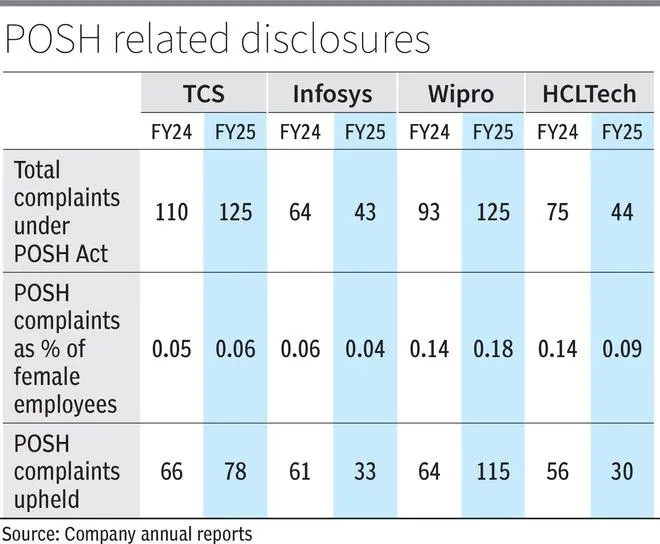
For instance, in FY25, TCS received 125 complaints under the POSH Act. Out of this, around 78 were upheld or proven to be true. This means that only 62 per cent of complaints were seen to be true. While false complaints are quite common, the low proportion of proven complaints could deter women from coming forward to lodge complaints.
TCS employed 6.3 lakh employees in 2024-25, of which 35.3 per cent were women. Around 2.2 lakh women work in the organisation. The number of complaints filed account for just 0.06 per cent of this universe. While it could point towards a safe and happy working environment, it could also point towards lack of awareness about POSH rules among female employees.
Red flags for IT industry
While Nasscom has issued a statement saying that this incident should not be taken as indicative of ‘systemic weakness across the sector’, it does raise questions about the safety of women employees in the IT sector.
With the sector employing more than 20 lakh women and accounting for over one-third of the workforce in the sector, it is especially important that all IT companies ensure that they have proper channels for complaining and active internal committees in all cities to address these complaints. Regular awareness workshops are also required to let women know about the presence of these support systems.
It is typically seen that the women employees in the IT companies are employed at the lower and mid-levels, with a large proportion of them aged under 40 years. These women are quite vulnerable and may not want to lodge sexual harassment complaints due to fear of losing their jobs. Some may fear physical harm to themselves or families and so desist from complaining. IT companies need to assure all their women employees that they are in a safe workplace and their grievances will be heeded seriously.
The Ministry of Child and Family Welfare must carry out an audit of the POSH compliance in all companies in general and IT companies in particular. If women’s participation in workforce must be improved, improving POSH compliance and adoption is an exigency.
Published on April 16, 2026