







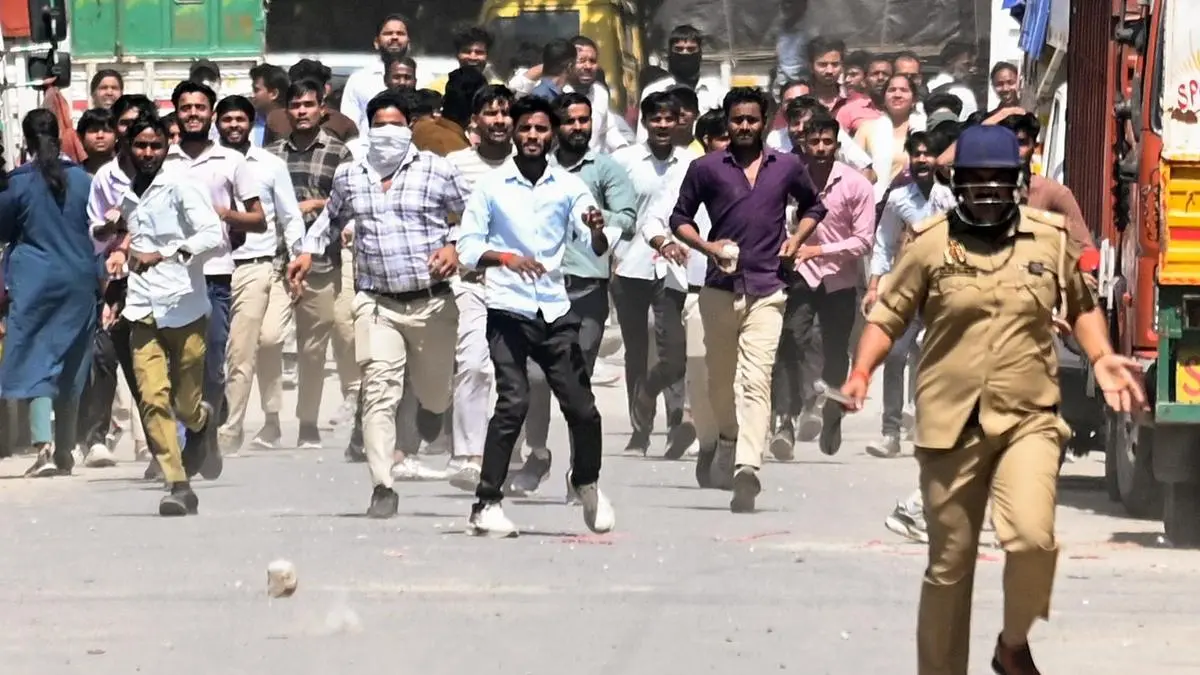
A large segment of workers in industrial belts operates without formal, written agreements, leaving them outside the ambit of statutory benefits and with little clarity on their rights | Photo Credit: ANI
The recent labour unrest in Noida is a reminder that a significant part of India’s workforce rests on a fragile foundation: low wages and weak labour protections. The unrest is not an isolated flashpoint, but a symptom of deep structural gaps in wage-setting and employment practices.
At the heart of the issue lies India’s minimum wage framework. The Centre last set the national floor wage in 2017 at ₹176 per day, a level that has seen little meaningful revision even as living costs have risen sharply. A review cycle of up to five years under the Code on Wages, 2019 is too slow for an economy where prices adjust far more frequently. While a Variable Dearness Allowance (VDA), tied to the Consumer Price Index, is built into the framework, it cannot compensate for an inadequately set base wage or infrequent revisions. In contrast, countries such as Brazil have institutionalised regular revisions linked to inflation and broader economic indicators. Delayed revisions in India could turn the minimum wage into a lagging indicator rather than a proactive policy tool. The recent trigger for unrest underscores this reactive approach. In neighbouring Haryana, minimum wages saw a sharp increase amid labour unrest in industrial belts such as Manesar. The Uttar Pradesh government has since announced an interim 21 per cent increase for workers in Noida and Ghaziabad. While these moves may offer temporary relief, they highlight an uncomfortable reality: wage adjustments in India are often driven by agitation rather than anticipation. Policymakers must revise wages based on credible data on inflation, consumption and living standards.
Equally pressing is the widespread use of contract labour. A large segment of workers in industrial belts operates without formal, written agreements, leaving them outside the ambit of statutory benefits and with little clarity on their rights. The Occupational Safety, Health and Working Conditions Code, 2020 seeks to streamline regulation and mandates registration of establishments and contractors. However, it stops short of requiring universal written contracts for workers. Moreover, by raising the threshold for applicability to establishments with 50 or more contract workers, it allows a large number of small enterprises to remain outside stricter oversight. Formal registration cannot substitute for enforceable, transparent employment relationships.
Sustainable growth demands a more balanced approach — one that recognises labour not merely as a cost to be minimised, but as a stakeholder in value creation. The Periodic Labour Force Survey points out that over half of regular wage and salaried workers in non-agricultural sectors have no written contract or social security benefits — in other words, the prevalence of informality in the formal sector. This applies to the Noida region — and is likely to act as a periodic trigger for unrest, unless both policies as well as attitudes towards labour undergo a shift.
Published on April 21, 2026
此内容由惯性聚合(RSS阅读器)自动聚合整理,仅供阅读参考。 原文来自 — 版权归原作者所有。