








Today’s young adults (20-29 years) will remain in employment for at least the next three decades. The key question is how many of them are contributing directly to economic activity, as measured by two markers: the share of young adults in paid employment and the average daily hours those who are employed spend at work and on the commute.
Our estimates from the Time Use Survey 2024 reveal a complex reality for the country’s young adults. While the nation looks to its young population to drive growth, more than half of young adults are currently not in paid work. For those who are employed, it is a paradoxical mix of underemployment, overwork, and lengthy commutes.
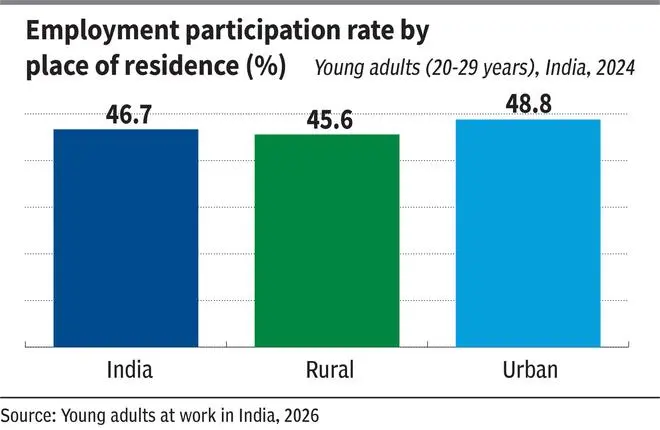
Low employment participation: Less than half of India’s young adults are employed (46.7 per cent), indicating that a significant portion of potential talent remains untapped nationwide. Urban areas show a slightly higher participation rate compared to rural regions,
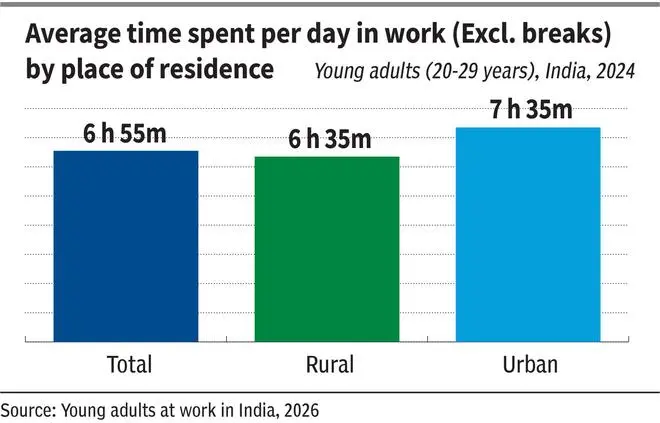
Urban workday is an hour longer than rural: The average workday for young adults lasts 6 hours and 55 minutes, excluding breaks. Urban jobs are considerably more time-intensive than rural.
Overwork vs underemployment: Here, ‘formal enterprises’ include employment in corporations, government and non-profit institutions, while ‘informal enterprises’ include household or unincorporated enterprises.
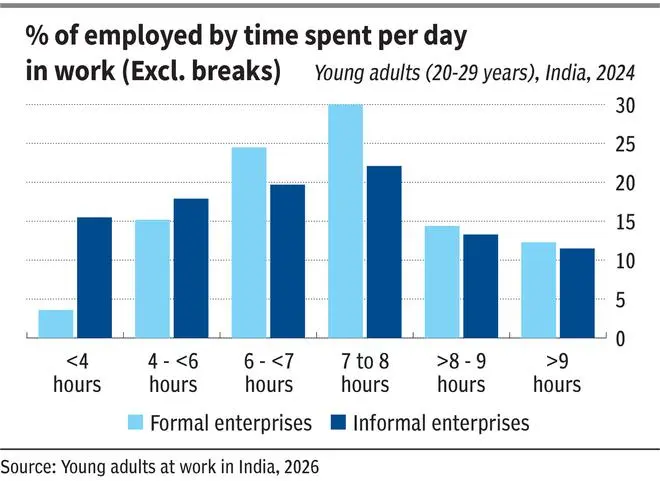
The largest share of young adults works 7-8 hours per day (excluding breaks): 30 per cent of those in formal enterprises and 22 per cent in informal enterprises. Roughly one-quarter of young workers are overworking, spending more than 8 hours per day at work, excluding breaks.
We find that underemployment is more prevalent in informal enterprises. 15.5 per cent of informal workers spend less than 4 hours per day at work, as against only 3.6 per cent in formal employment. Among those working 4-6 hours, 33.4 per cent of informal workers work under 6 hours per day, compared with 18.8 per cent in formal enterprises. In addition, the distribution of informal employment is more dispersed, with higher shares at very low hours (9 hours). This bi-modality mirrors greater heterogeneity in work quality, volatile demand, and/or limited worker control over hours, which are core features of job precarity.
The commute tax
The daily commute adds a substantial “time tax”. On average, young workers spend 50 minutes a day travelling for work. Urban workers bear a heavier burden, spending 56 minutes commuting compared to 44 minutes for rural workers. Long commute tends to act as a significant barrier to productivity and well-being.
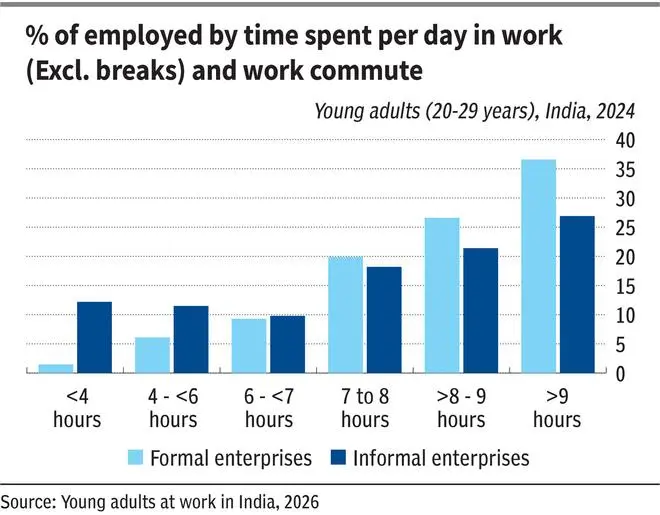
Once we include time spent commuting for work, the combined work hours increase substantially. This is particularly true among formal workers who see a sharp rise in time spent at work with the percentage exceeding 8 hours nearly tripling. A greater share of the young workforce (36.6 per cent in formal enterprises and 26.9 per cent in informal enterprises) spends more than 9 hours in total. Commuting alone accounts for a significant share of time spent on work-related activities, pointing to issues with mobility, transport, and affordable housing distinct from workplace overwork.
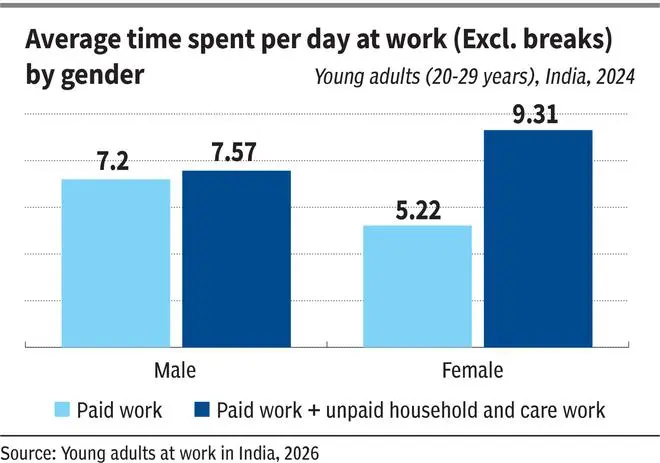
Men clock more paid hours of work than women, on average, in both formal and informal enterprises. However, upon including unpaid household and care work, this pattern completely reverses, with women working over 9 hours 31 minutes compared to men’s 7 hours 57 minutes. The jump in women’s work hours by nearly 4 hours per day, compared to the 30-minute increase among men, is drastic. The finding is a reminder that women bear the overwhelming burden of household and care work — invisible in labour statistics and concealed by the absence of pay.
And all of this is before AI. The entry-level formal enterprise jobs many young workers depend on are precisely those most exposed to automation. The AI world may widen the participation gap, intensify the overwork already visible in formal employment, and leave women’s unpaid burden untouched.
Finally, across States, the intensity of young adults’ workdays varies sharply, revealing a clear economic geography. In India’s prosperous States — Maharashtra, Gujarat, Delhi, Tamil Nadu, Haryana, and Karnataka — urban young workers spend close to or above 9 hours daily on work and commute combined.
By contrast, in eastern and central States such as Odisha, West Bengal, Madhya Pradesh, and Bihar, the total workday falls well below the all-India urban average — almost certainly a marker of underemployment. Among large States, only in Andhra Pradesh, Haryana, and Tamil Nadu do rural work hours, including commute, reach 8 hours.
The commute tax hits hardest in metro-anchored States: urban workers add 1 hour 17 minutes in Maharashtra, 1 hour 12 minutes in Tamil Nadu, 1 hour 8 minutes in Delhi, and 59 minutes in Karnataka. The geography of the long workday is, in part, the geography of unaffordable housing near jobs and weak public transport — a structural drag distinct from workplace overwork.
In sum, with fewer than half of young adults employed, the labour market is increasingly polarised between extreme overwork and underemployment. As AI threatens to displace earlier high-quality roles, young adults must commit to a more rigorous and continuous education to master specialised skills. Employment will increasingly depend on developing unique expertise that either complements technology or handles the tasks AI simply cannot touch.
Mahambare and Gowthaman are with Great Lakes Institute of Management; Munjal and Baruah are with National Council of Applied Economic Research
Published on May 5, 2026