


惯性聚合 高效追踪和阅读你感兴趣的博客、新闻、科技资讯
阅读原文 在惯性聚合中打开

推荐订阅源

爱范儿
爱范儿
钛媒体:引领未来商业与生活新知
钛媒体:引领未来商业与生活新知
The Hacker News
The Hacker News
N
News and Events Feed by Topic
Simon Willison's Weblog
博客园 - 三生石上(FineUI控件)
V
Vulnerabilities – Threatpost
T
Tenable Blog
Threat Intelligence Blog | Flashpoint
P
Proofpoint News Feed
Security Latest
Security Latest
博客园 - 【当耐特】
腾讯CDC
The Cloudflare Blog
T
Tailwind CSS Blog
L
LINUX DO - 热门话题
博客园_首页
P
Palo Alto Networks Blog
人人都是产品经理
人人都是产品经理
P
Privacy & Cybersecurity Law Blog
阮一峰的网络日志
阮一峰的网络日志
有赞技术团队
有赞技术团队
AWS News Blog
AWS News Blog
S
Securelist
博客园 - Franky
C
Cyber Attacks, Cyber Crime and Cyber Security
让小产品的独立变现更简单 - ezindie.com
WordPress大学
WordPress大学
酷 壳 – CoolShell
酷 壳 – CoolShell
S
Schneier on Security
Apple Machine Learning Research
A
Arctic Wolf
P
Privacy International News Feed
Cisco Talos Blog
Cisco Talos Blog
C
Cybersecurity and Infrastructure Security Agency CISA
OSCHINA 社区最新新闻
OSCHINA 社区最新新闻
D
Darknet – Hacking Tools, Hacker News & Cyber Security
H
Heimdal Security Blog
Help Net Security
Help Net Security
博客园 - 叶小钗
月光博客
月光博客
I
Intezer
Cyberwarzone
Cyberwarzone
美团技术团队
C
CXSECURITY Database RSS Feed - CXSecurity.com
宝玉的分享
宝玉的分享
奇客Solidot–传递最新科技情报
奇客Solidot–传递最新科技情报
K
Kaspersky official blog
Hugging Face - Blog
Hugging Face - Blog
Jina AI
Jina AI

Opinion, Editorial, Views, Columnists, Columns | The HinduBusinessLine

Rupee can’t be defended from just one side Railways’ performance Why not have a women-only party? Labour pangs Pak’s peculiar comeback on the global stage Letters to Editor India has jobs, but it needs better ones Cross-border insolvency laws and trade A major health challenge Editorial. Snooping around Letters to the Editor dated April 20, 2026 All you want to know about the women’s reservation and delimitation bills fiasco Editorial. Process deficit Letters to the Editor dated April 19, 2026 WPI effect on new GDP series The tragic reality of police brutality India’s AI value paradox Prepare the ground India-Korea economic ties poised to strengthen Nari Shakti Bill — a missed opportunity Natural farming should become mainstream policy Insights from new GDP data Strategies to enhance fertilizer security Pathway to maritime insurance sovereignty Why the GoP’s jittery Clear the smoke Aiding piped gas push Stocks are the least over-priced asset in India Is TCS harassment case tip of the iceberg? SIP with caution Global gold ETFs post worst-ever $12 billion monthly outflow: WGC How India is funding Silicon Valley’s rise Cyber insecurity Continuity via status quo Iran war, a boon for the BRICS Assessing the easing of provisioning norms by RBI Iran war, a test for India’s economic resilience Iran war’s impact on India’s farm output and food inflation Economic competence in judiciary Pressure point India moving up the pharma value chain NFRA’s statutory leap Finance capital in time of war How West-Asia war could reshape the AI race When signals diverge: Reading the Nifty-Gold ratio Mohali’s miracle boys Plastic concerns Nice countries come last Lawyers matter more than ever for corporates Odisha central to our aluminium ambitions Editorial. Fair deal Editorial. Wait and watch Letters to the Editor dated April 10, 2026 Unfortunate fallout of cyber crime investigations Letters to the Editor dated April 9, 2026 Will the uneasy truce hold? Charting an intellectually honest way of forecasting RBI plumps for caution amidst uncertainty Large corporates and the sustainability transition of MSMEs MPC positive, despite strong headwinds Cease and desist Together, let us empower our Nari Shakti An AI model that’s too risky NPS funds consistency check: what 10-year rolling returns reveal Editorial. Nuclear milestone Letters to the Editor dated April 7, 2026 Packaging woes China’s perennial industrial policy Sensex has fallen on account of global forces India’s strategic defiance at the WTO meet Freebies will hit Tamil Nadu’s fiscal health Close the backdoor in tobacco FDI policy Is EU’s CBAM discriminatory? Editorial. Freebies unplugged Letters to the Editor dated April 6, 2026 Projecting growth is not easy Improving safety in Indian aviation Amendments to FCRA India’s outreach to Angola will contain energy risk Oil shocks and the rupee: The tricky 100s Sensex at 40: Secrets behind long-term wealth in markets Editorial. Sweeping powers India’s next social protection is care, not cash In West Asia, it is advantage China Is awarding Trump a Nobel Prize the best bet for peace? Editorial. Knotty regulations Letters to the Editor dated April 3, 2026 Time to push for rupee internationalisation Up in the air Time for industry to lead economic resilience Allied healthcare needs attention What holds back investor participation? Still no endgame in sight Challenging year What happens when CAD rises Reorienting farm research Telecom infra must rest on strong fibre network A severe test for monetary policy India’s chance in supply chain reset Bengaluru’s housing market is growing but affordability is shrinking
Fuel for thought
2026-04-29 · via Opinion, Editorial, Views, Columnists, Columns | The HinduBusinessLine
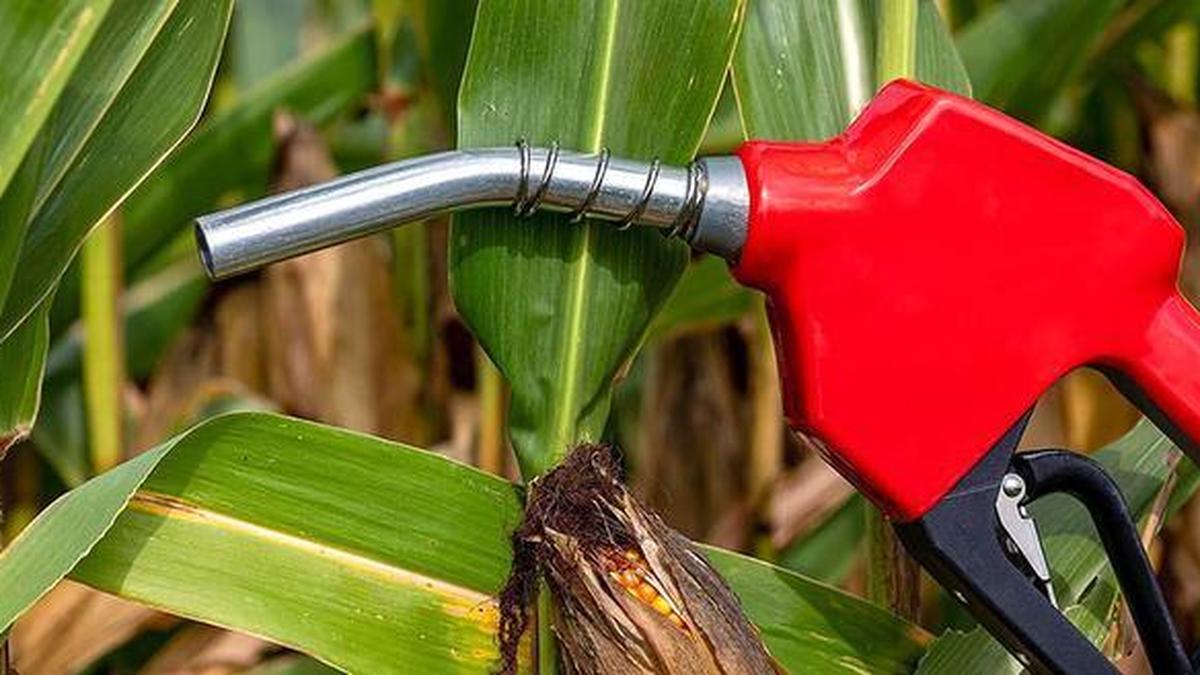
 A big shift to ethanol raises questions about its impact on rice, sugarcane, pulses, millets and maize availability 

 A big shift to ethanol raises questions about its impact on rice, sugarcane, pulses, millets and maize availability  | Photo Credit: JJ Gouin

The conflict in West Asia has understandably lent a new urgency to the need to curb energy imports. The government is set to expedite the roll-out of flex-fuel vehicles (FFVs). While a 20 per cent ethanol-petrol blend (E20) is the current mandate, FFV engines are engineered for any mix all the way up to 100 per cent ethanol (E100).

The motivation for this push is not difficult to understand — according to a statement issued by the Centre in August 2025, ethanol blending over 11 years up to July 2025 had resulted in savings of over ₹1.4 lakh crore in foreign exchange and crude oil substitution of 245 lakh tonnes. A study by NITI Aayog claims that emissions from the use of sugarcane and maize based ethanol are much lower than those of petrol. But ethanol’s merits have been a subject of considerable global debate. A big shift to ethanol raises questions about its impact on rice, sugarcane, pulses, millets and maize availability. Recent reports suggest that the Centre is considering a lower allocation of broken rice to the public distribution system — a move that would free up 90 lakh tonnes of broken rice for ethanol use. For current levels of ethanol output (12 billion litres annually), 30-40 lakh tonnes of sugar are used, while the Food Corporation of India allocated five million tonnes of rice last year for ethanol.

Efforts to encourage broken rice use, even as close to half the ethanol produced in India is made from maize, are hard to understand. Maize, whose acreage has been rising sharply on account of ethanol demand, is less water intensive than paddy or sugarcane, but its cultivation seems to be cutting into area under millets and pulses. As ethanol ambitions rise, the costs of foodcrop diversion and the implicit energy (power and fertilizer) and water use will become harder to ignore, vis-a-vis the crude oil import bill saved. The use of new cropland makes ethanol seem more unviable. Besides, as a fuel ethanol generates less energy than petrol. Economists have, however, noted the benefits of producing ethanol from agriculture and industrial waste. India generates at least 500 million tonnes of agricultural waste, of which about 35 per cent comes from paddy alone. Using such waste as the raw material for what is referred to as 2G ethanol is already under way but needs to scale up. Recently released short duration maize varieties would help maintain the cropping balance.

Ethanol vehicles can be considered as an element in the auto mix, especially to offset the dependency on critical minerals for EV batteries. However, research suggests that solar-powered EVs are 180-250 times more efficient than ethanol vehicles. Meanwhile, EV batteries are evolving rapidly in terms of capacity and recyclable ability. It is best that auto policy develops a well considered, consistent position, that incentivises the use of EVs produced from renewables and FFVs produced by ethanol from residues in particular. The rest is smoke and noise.

Published on April 28, 2026