
惯性聚合 高效追踪和阅读你感兴趣的博客、新闻、科技资讯
阅读原文 在惯性聚合中打开

推荐订阅源

Google DeepMind News
人人都是产品经理
人人都是产品经理
H
Hacker News: Front Page
Stack Overflow Blog
Stack Overflow Blog
B
Blog
I
InfoQ
GbyAI
GbyAI
T
The Blog of Author Tim Ferriss
F
Fortinet All Blogs
Y
Y Combinator Blog
Cyber Security Advisories - MS-ISAC
月光博客
月光博客
Hugging Face - Blog
Hugging Face - Blog
爱范儿
爱范儿
F
Full Disclosure
Hacker News - Newest:
Hacker News - Newest: "LLM"
Recent Announcements
freeCodeCamp Programming Tutorials: Python, JavaScript, Git & More
Jina AI
Jina AI
T
Tailwind CSS Blog
S
Secure Thoughts
P
Privacy International News Feed
美团技术团队
钛媒体:引领未来商业与生活新知
钛媒体:引领未来商业与生活新知
L
LINUX DO - 最新话题
H
Hackread – Cybersecurity News, Data Breaches, AI and More
C
Cybersecurity and Infrastructure Security Agency CISA
Last Week in AI
Last Week in AI
W
WeLiveSecurity
Google Online Security Blog
P
Privacy & Cybersecurity Law Blog
D
DataBreaches.Net
Engineering at Meta
Engineering at Meta
Know Your Adversary
Know Your Adversary
P
Palo Alto Networks Blog
I
Intezer
Application and Cybersecurity Blog
Project Zero
Project Zero
V2EX - 技术
V2EX - 技术
H
Heimdal Security Blog
博客园 - Franky
阮一峰的网络日志
阮一峰的网络日志
D
Darknet – Hacking Tools, Hacker News & Cyber Security
T
Troy Hunt's Blog
V
Vulnerabilities – Threatpost
H
Help Net Security
Martin Fowler
Martin Fowler
cs.AI updates on arXiv.org
G
GRAHAM CLULEY
博客园 - 【当耐特】

Opinion, Editorial, Views, Columnists, Columns | The HinduBusinessLine

Rupee can’t be defended from just one side Railways’ performance Why not have a women-only party? Labour pangs Pak’s peculiar comeback on the global stage Letters to Editor India has jobs, but it needs better ones Cross-border insolvency laws and trade A major health challenge Editorial. Snooping around Letters to the Editor dated April 20, 2026 All you want to know about the women’s reservation and delimitation bills fiasco Editorial. Process deficit Letters to the Editor dated April 19, 2026 WPI effect on new GDP series The tragic reality of police brutality India’s AI value paradox Prepare the ground India-Korea economic ties poised to strengthen Nari Shakti Bill — a missed opportunity Natural farming should become mainstream policy Insights from new GDP data Strategies to enhance fertilizer security Pathway to maritime insurance sovereignty Why the GoP’s jittery Clear the smoke Aiding piped gas push Stocks are the least over-priced asset in India Is TCS harassment case tip of the iceberg? SIP with caution Global gold ETFs post worst-ever $12 billion monthly outflow: WGC How India is funding Silicon Valley’s rise Cyber insecurity Continuity via status quo Iran war, a boon for the BRICS Assessing the easing of provisioning norms by RBI Iran war, a test for India’s economic resilience Iran war’s impact on India’s farm output and food inflation Economic competence in judiciary Pressure point India moving up the pharma value chain NFRA’s statutory leap Finance capital in time of war How West-Asia war could reshape the AI race When signals diverge: Reading the Nifty-Gold ratio Mohali’s miracle boys Plastic concerns Nice countries come last Lawyers matter more than ever for corporates Odisha central to our aluminium ambitions Editorial. Fair deal Editorial. Wait and watch Letters to the Editor dated April 10, 2026 Unfortunate fallout of cyber crime investigations Letters to the Editor dated April 9, 2026 Will the uneasy truce hold? Charting an intellectually honest way of forecasting RBI plumps for caution amidst uncertainty Large corporates and the sustainability transition of MSMEs MPC positive, despite strong headwinds Cease and desist Together, let us empower our Nari Shakti An AI model that’s too risky NPS funds consistency check: what 10-year rolling returns reveal Editorial. Nuclear milestone Letters to the Editor dated April 7, 2026 Packaging woes China’s perennial industrial policy Sensex has fallen on account of global forces India’s strategic defiance at the WTO meet Freebies will hit Tamil Nadu’s fiscal health Close the backdoor in tobacco FDI policy Is EU’s CBAM discriminatory? Editorial. Freebies unplugged Letters to the Editor dated April 6, 2026 Projecting growth is not easy Improving safety in Indian aviation Amendments to FCRA India’s outreach to Angola will contain energy risk Oil shocks and the rupee: The tricky 100s Sensex at 40: Secrets behind long-term wealth in markets Editorial. Sweeping powers India’s next social protection is care, not cash In West Asia, it is advantage China Is awarding Trump a Nobel Prize the best bet for peace? Editorial. Knotty regulations Letters to the Editor dated April 3, 2026 Time to push for rupee internationalisation Up in the air Time for industry to lead economic resilience Allied healthcare needs attention What holds back investor participation? Still no endgame in sight Challenging year What happens when CAD rises Reorienting farm research Telecom infra must rest on strong fibre network A severe test for monetary policy India’s chance in supply chain reset Bengaluru’s housing market is growing but affordability is shrinking
India-Korea partnership needs deeper engagement
By Reji K Joseph · 2026-05-16 · via Opinion, Editorial, Views, Columnists, Columns | The HinduBusinessLine
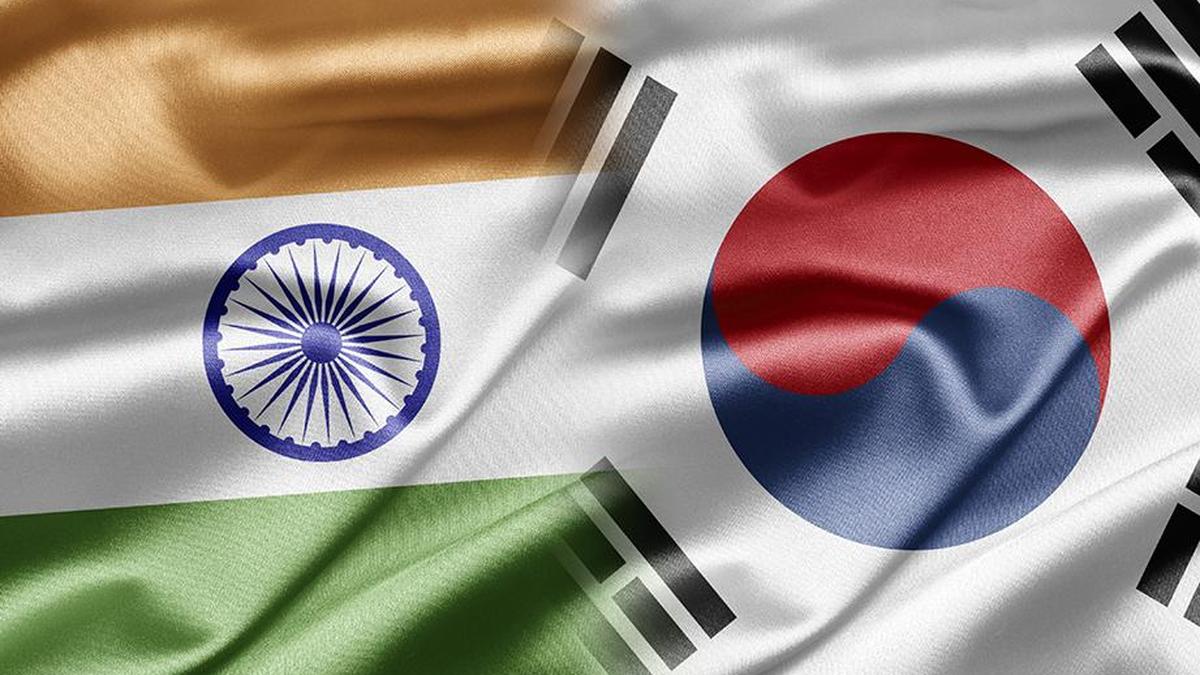
The joint startegic vision is a step in the right direction

The joint startegic vision is a step in the right direction | Photo Credit: Ruskpp

During South Korean President Lee Jae Myung visit to India in April, he announced, with Prime Minister Narendra Modi, a Joint Strategic Vision for the India-Korea Special Strategic Partnership.

The vision calls for expanding bilateral trade to $50 billion by 2030, speedy conclusion of the upgrade of the Comprehensive Economic Partnership Agreement (CEPA), in force since 2010, and cooperation in critical areas such as supply-chain resilience, green hydrogen and nuclear power.

This is an opportune time for the two economies to tap their complementarities. Korea is a manufacturing powerhouse, and India is determined to transform its manufacturing base. India offers an attractive alternative location for Korean firms looking to diversify their supply chains. India’s deep human-resource pool and software ecosystem also complement Korea’s hardware strengths — a natural fit for collaboration in semiconductors, electronics and artificial intelligence.

The key question, however, is why the existing CEPA has not met the expectations of either side. Three issues stand out.

One, Indian exporters face major market access barriers in Korea. Despite India’s rising share in global merchandise trade, Korea’s share in India’s exports has declined from 2 per cent in 2009 to 1 per cent in 2024, while India’s merchandise trade deficit with Korea has quadrupled from $4 billion to $16 billion.

A study at ISID (https://bit.ly/4d8iQzM) has identified 26 product groups — including pharmaceuticals, textiles and apparel, marine products and leather — where India has a global comparative advantage but only a marginal presence in the Korean market.

In pharmaceuticals, complicated import procedures make market access effectively impossible for Indian exporters: though India accounted for 3 per cent of global imports in 2024, its share in Korea’s imports was barely 1 per cent.

Investment slowdown

Two, the missing second wave of Korean investment is a serious concern. The first wave came in the 1990s, when Samsung, LG and Hyundai established their operations in India. Korean FDI accounted for close to 4 per cent of India’s inflows in that decade, peaking at 13 per cent in 1999.

The post-CEPA period was expected to bring a second wave, with expectations rising further in the wake of Make in India initiatives and the Production Linked Incentive (PLI) scheme. Yet Korea’s share in India’s FDI inflows over the last five years has been only about 0.7 per cent. Korea has been diversifying its outward investment as part of a broader restructuring of its supply chains: its manufacturing OFDI (Outward FDI) in the last two years is more than double pre-pandemic levels.

The Fast Track Mechanism set up by DPIIT and Invest India in March 2024 to address the grievances of Korean investors is a useful start, but much more needs to be done to end this elusiveness.

Three, Korea has long maintained that India’s commitments under CEPA have not been substantial — pointing to the deeper concessions in India’s other FTAs, for example CEPA with Japan, which came into force a year after the one with Korea. Korea has also flagged that India’s rules-of-origin requirements are unusually stringent and have deterred Korean firms. On the first count, India is now better placed to make deeper commitments in the upgraded CEPA. The second is harder. India is seriously concerned about third-country routing through FTAs and has tightened its rules of origin accordingly.

The notification of April 2025 has shifted the regulatory burden from compliance certificates issued by the partner country to a verification-based regime imposed on the importer. Korean conglomerates, whose procurement, pricing and supplier management are generally centralised at headquarters rather than at local subsidiaries, will find the new rules harder to navigate.

The Joint Strategic Vision has identified the right priorities and laid down a credible framework for transforming the India-Korea economic partnership. However, market access barriers facing Indian exporters, the missing second wave of Korean investment, and rules-of-origin compliance need immediate attention from policymakers in both countries.

The writer is faculty member, Institute for Studies in Industrial Development, New Delhi

Published on May 16, 2026