






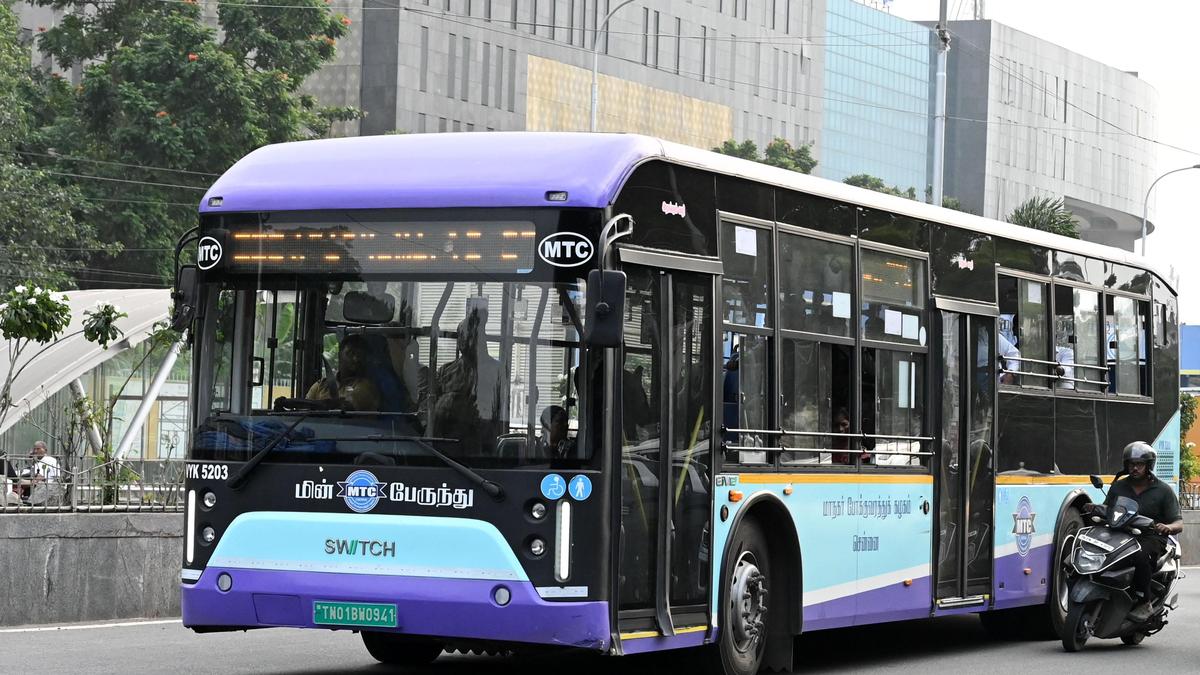
Electrifying public transport will play a crucial role in decreasing our carbon footprint | Photo Credit: BIJOY GHOSH
The Gulf war has highlighted India’s Achilles heel — a growing reliance on imported crude, Liquified Natural Gas (LNG) and Liquified Petroleum Gas (LPG). For India, moving away from petroleum fuels to renewable energy —solar, wind, nuclear or biofuel and to clean coal technologies — has a dual purpose.
It strengthens India’s strategic autonomy by reducing our import dependence for 85 per cent of crude, 45 per cent of LNG and 65 per cent of LPG consumption. Enhanced renewable capacity also contains our future carbon emissions which would otherwise increase in line with income growth. Pleading the Kyoto principle of “differentiated responsibilities” India’s Nationally Determined Contributions (NDC) propose net zero by 2070. China has opted for 2060 and most developed economies for 2050 — though US commitment is uncertain.
India’s NDC for the period 2031 to 2035, under the Paris Agreement 2015, were formalised in March. The secretariat of the United Nations Framework Convention on Climate Change uses this quinquennial submission to collate global energy transition plans. Does India’s NDC reflect a new resolve to accelerate our transition from petroleum consumption to, either non fossil fuels like compressed biogas or electrical vehicles in transport or induction stoves for cooking?
The NDCs are presented at a high level of aggregation. A plain reading of the document does not provide insight into sector strategies or the phasing till 2070, possibly, to retain negotiating leverage at the cost of reduced transparency.
India strategic response to the West Asian crisis was to enhance petroleum storage capacity. Japan, Korea and the EU, similarly dependent on petroleum imports, have storage capacities more than three times ours relative to consumption. Building additional storage capacity, particularly for LNG, is not a trivial outlay. A more cost-effective short-term response is to diversify the sourcing, buttressed by supportive diplomacy.
Expanding the use of hedging instruments can similarly contain the inflation impact of potential oil shocks from supply disruptions. The cost of diversification and storage — the latter far outweighs the former because it is front-loaded — are integral to ensuring energy resilience. This higher cost of resilient petroleum products supply, is also an appropriate proxy for determining the outer bound of spending on fast forwarding oil substitutes.
More rapid electrification of transport — is the obvious near-term option — particularly passenger vehicles, where technology and end use product costs are reaching oil and compressed natural gas (CNG) substitution levels. A NITI Aayog 2026 research paper assessing the demand for critical minerals highlights that greater ambition in EVs is appropriate. This advice resonates in the context of fragile crude, LPG and LNG supply networks demonstrated by the ongoing West Asian war. India is overweight on supply from this region.
The outlay on dual purpose industrial policy which promotes climate action and enhances strategic autonomy, must be selectively increased. Delinking energy services from oil imports is one such. Diesel has a share of 40 per cent in total consumption of petroleum products.
This share is reducing as electricity supply improves, decreasing the need for stand-by generators and diesel fuelled ground water pumps. Petrol accounts for 18 per cent but is growing fast as higher incomes drive ownership of personal transport. LPG accounts for 15 per cent of total petroleum product consumption. Containing further growth requires a strategic intervention.
One such is to step up EV adoption via facilitative incentives, particularly at the State government level, where the resulting health gains are realised. The targets for the share of EV in total vehicle production should be fast forwarded to 90 per cent for all vehicles by 2050 rather than from 2070 as at present. Presently only two-wheelers and cars have this target.
This need not be accompanied by fast forwarding the net zero emissions targets for electricity from 2070. The idea here is to privilege the objective of oil autonomy over the objective of decarbonisation thereby, spreading out the energy transition costs. For transitioning to EVs, a resilient electricity grid is key. Decarbonised supply can follow.
The decarbonisation target in the new NDCs peg 60 per cent of electricity generation capacity to be renewable, including nuclear, by 2031. The 2050 target is not specified nor is the peak emissions point defined, unlike China which proposes to peak “before 2030”.
The next round of NDCs in 2031 could set a date for peaking emissions and disclose the sector-wise composition of emissions to enhance confidence in these projections.
In 2047, India celebrates a century of political independence and hopefully, the commencement of economic maturity as a developed country. It is unlikely that India will discover sufficient domestic oil resources by 2047 to power an economy at least five times larger than today. A necessary ingredient for a leading economy is strategic autonomy. Stagnating petroleum import volumes is a key route to strategic autonomy.
Petroleum energy substitutes like coal gasification, methanol production with carbon capture and use or storage, nuclear power, access to rare earths and access to critical minerals for semiconductor production is the long list of must haves. Near-term strategic essentials like energy autonomy and resilience must override long-term decarbonisation objectives.
The writer is distinguished fellow Chintan Research Foundation and was previously in the IAS and the World Bank
Published on June 2, 2026
此内容由惯性聚合(RSS阅读器)自动聚合整理,仅供阅读参考。 原文来自 — 版权归原作者所有。