






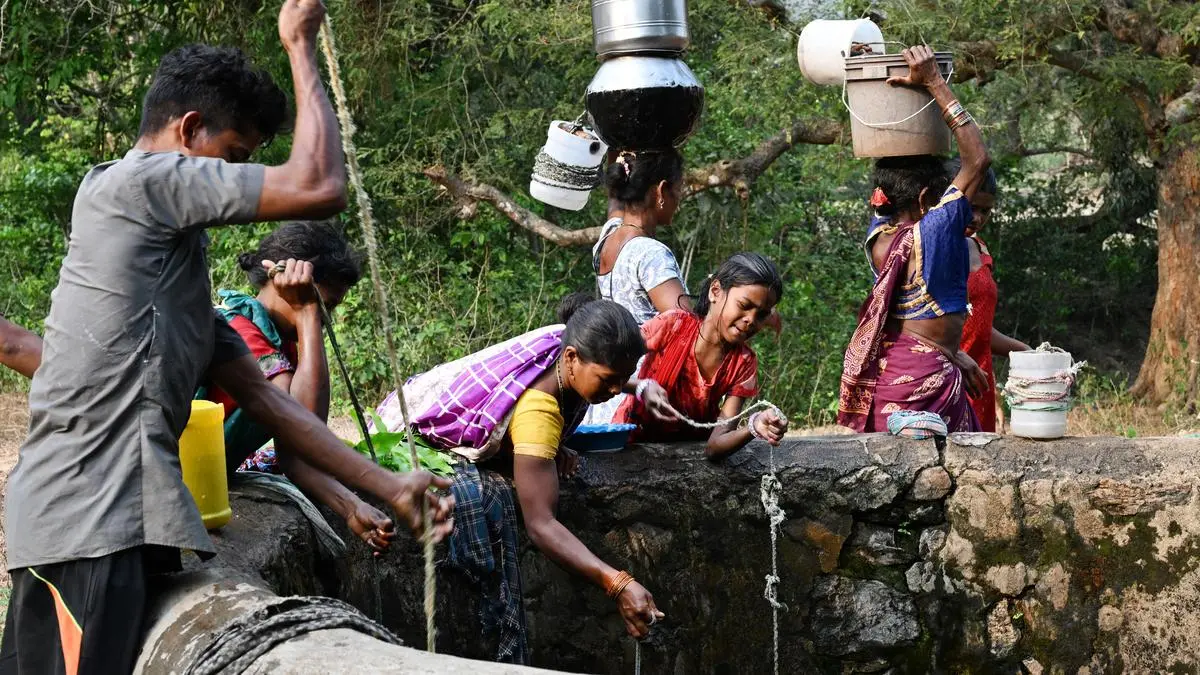
Groundwater, the country’s invisible lifeline, is under severe stress | Photo Credit: V RAJU
India’s water crisis is no longer a distant warning; it is a lived reality. From drying borewells in peninsular India to falling water tables across the Indo-Gangetic plains, groundwater, the country’s invisible lifeline is under severe stress. Yet, paradoxically, it remains one of the least governed resources. In this context, aquifer-based participatory water management offers not just a technical solution, but a transformative shift in how India understands and governs water. Increasingly, this shift also aligns with global sustainability priorities, particularly the Sustainable Development Goals (SDGs), which emphasise integrated, inclusive, and ecologically grounded water management.
At its core, aquifer-based participatory water management rests on a simple but powerful idea: groundwater must be managed where it actually exists ‘in aquifers’ and by the people who depend on it. Unlike rivers or lakes, aquifers do not follow administrative boundaries. They are geological formations, often shared across villages and districts. Managing them through fragmented policies or individual extraction decisions has led to overuse, inequity, and ecological decline. Recent global sustainability assessments reinforce that such fragmentation is one of the primary reasons water governance continues to fall short of SDG targets on efficiency, sustainability, and ecosystem protection.
The participatory dimension is equally crucial. Groundwater in India is effectively a common pool resource, accessed through millions of private wells. Regulatory approaches alone have proven inadequate in such a decentralised landscape. Instead, involving communities in understanding aquifer behaviour, monitoring water levels, and making collective decisions on usage introduces both accountability and sustainability.
The evolution of this approach in India has been gradual but significant. For decades after Independence, water policy focused largely on supply-side interventions — dams, canals, and later, the proliferation of borewells. Groundwater extraction grew rapidly, aided by subsidised electricity and advances in drilling technology. However, the ecological limits of this model became evident by the 1990s, as over-extraction began to outpace natural recharge. Contemporary SDG assessments now warn that such unsustainable extraction patterns are contributing not only to local water stress but also to broader environmental risks, including land degradation, ecosystem collapse, and even alterations in regional hydrological cycles.
It was in the early 2000s that a paradigm shift began to take shape. Initiatives such as the Andhra Pradesh Farmer Managed Groundwater Systems demonstrated that when farmers are equipped with basic hydrogeological knowledge and data, they can make informed decisions, adjusting cropping patterns, reducing water-intensive practices, and collectively managing extraction. These experiments challenged the assumption that groundwater governance must be top-down.
Over the past decade, this approach has gained institutional backing. Large-scale programmes have sought to map aquifers scientifically and integrate community participation into groundwater management. The emphasis has moved from merely augmenting supply to balancing demand with available resources — through water budgeting, crop planning, and local governance mechanisms.
The spread of such practices across States like Maharashtra, Gujarat, Rajasthan, and Karnataka underscores both their adaptability and effectiveness. In several villages, communities have voluntarily adopted water-sharing norms, shifted to less water-intensive crops, and invested in recharge structures. These are not isolated success stories, but indicators of a broader shift in thinking.
The importance of this approach cannot be overstated. Groundwater accounts for a substantial share of India’s irrigation and drinking water needs. Its over-exploitation threatens not only agricultural sustainability but also rural livelihoods and urban water security. Moreover, climate change is likely to intensify variability in rainfall, making reliance on resilient groundwater systems even more critical.
However, the path ahead is not without challenges. A significant portion of India’s aquifers remains inadequately mapped. Hydrogeological knowledge is still limited at the community level. Institutional fragmentation continues to hinder coordinated action, with multiple agencies operating in silos. Economic incentives, such as free or subsidised electricity, often encourage excessive extraction. Without addressing these structural issues, participatory approaches may struggle to scale.
Yet, the future remains promising. Advances in technology, from remote sensing to real-time monitoring, are making aquifer data more accessible. Policy frameworks are increasingly recognizing the need for decentralized, community-led governance. Perhaps most importantly, there is a growing awareness that water security cannot be achieved without behavioural change at the local level. Strengthening “aquifer literacy” will be critical, not only for improving water management but also for advancing broader sustainability objectives.
What India needs now is a sustained commitment to empowering citizens to understand the science beneath their feet. This must be complemented by institutional reforms that align incentives with sustainability, and by integrating groundwater management with broader efforts in watershed development, agriculture, and climate adaptation.
Aquifer-based participatory water management is not a quick fix. It is a long-term investment in resilience, equity, and ecological balance. But in a country where the future of water lies underground, reclaiming this invisible resource through collective stewardship may be our most viable path forward.
The writer is an independent researcher (water resources management, climate change and disaster risk resilience)
Published on June 3, 2026
此内容由惯性聚合(RSS阅读器)自动聚合整理,仅供阅读参考。 原文来自 — 版权归原作者所有。