

惯性聚合 高效追踪和阅读你感兴趣的博客、新闻、科技资讯
阅读原文 在惯性聚合中打开

推荐订阅源

Jina AI
Jina AI
宝玉的分享
宝玉的分享
Last Week in AI
Last Week in AI
Help Net Security
Help Net Security
让小产品的独立变现更简单 - ezindie.com
人人都是产品经理
人人都是产品经理
奇客Solidot–传递最新科技情报
奇客Solidot–传递最新科技情报
GbyAI
GbyAI
博客园_首页
freeCodeCamp Programming Tutorials: Python, JavaScript, Git & More
MongoDB | Blog
MongoDB | Blog
Cyber Security Advisories - MS-ISAC
L
LINUX DO - 最新话题
PCI Perspectives
PCI Perspectives
博客园 - 三生石上(FineUI控件)
V2EX - 技术
V2EX - 技术
Spread Privacy
Spread Privacy
T
Tor Project blog
量子位
阮一峰的网络日志
阮一峰的网络日志
S
SegmentFault 最新的问题
小众软件
小众软件
博客园 - 叶小钗
Threat Intelligence Blog | Flashpoint
Blog — PlanetScale
Blog — PlanetScale
H
Help Net Security
Y
Y Combinator Blog
N
News | PayPal Newsroom
K
KPMG report finds enterprise disconnect between AI and its ROI | CIO
T
Tenable Blog
Scott Helme
Scott Helme
G
GRAHAM CLULEY
大猫的无限游戏
大猫的无限游戏
aimingoo的专栏
aimingoo的专栏
IT之家
IT之家
Schneier on Security
F
Fortinet All Blogs
Martin Fowler
Martin Fowler
T
Threat Research - Cisco Blogs
博客园 - 司徒正美
Application and Cybersecurity Blog
钛媒体:引领未来商业与生活新知
钛媒体:引领未来商业与生活新知
Attack and Defense Labs
Exploit-DB.com RSS Feed
The Last Watchdog
The Last Watchdog
L
LangChain Blog
C
Check Point Blog
Google Online Security Blog
V
Visual Studio Blog
Latest news
Latest news

Databricks

How lakebase architecture delivers 5x faster Postgres writes Why Talent Transformation Is the Missing Focus of Enterprise AI Public Health Intelligence Shouldn't Require a Data Scientist Mean Time to Detect Is a Data Access Problem First-party audience data is the ad sales relationship now Rethinking Distributed Systems for Serverless Performance and Reliability The AI Scaling Gap Hiding in Digital Native Companies 10 trillion samples a day: Scaling beyond traditional monitoring infra at Databricks AI success starts with clean data, not just better models How nOps Rebuilt Their Cloud Optimization Platform on Databricks Lakebase, and Why Other ISVs Should Too Peril Predicts: Precision Payouts for a Volatile World The foundation of AI scalability: one team, one platform, one operating model The Federal Data Paradox: Rich in Data, Poor in Access Driving Budapest Forward: How BKK Uses Databricks to Transform City Mobility LLM Vs AI: A Practical Guide to Differences, Use Cases, and Tools Model Risk Governance Is Not the Same as Risk Intelligence Generative AI for Business: A Complete Strategy and Implementation Guide Data Science vs Data Engineering: Choosing Analysis or Infrastructure AI Applications: Tools, Use Cases, and Platforms MLOps vs DevOps: A Practical Guide for Data Scientists and IT Teams Top Data Warehouse Tools For Modern Data Analytics Unlocking SAP Business Context in Databricks with Semantic Metadata Delta Sharing The marketing activation gap has a fix: Databricks and Stitch partner to turn data infrastructure into marketing performance Alert Fatigue Is a Business Risk Backstage with Lakebase Shipping Faster isn’t Learning Faster Why Your OEE Dashboard Is Lying to You The Turbine That Tried to Tell You It Was Failing Predicting Readmissions Isn't Enough. Acting in Time Is. Clinical Trials Run Longer Than They Have To. That's a Patient Problem Network Quality Is a Revenue Problem, Not a Technical One Shelf Availability Starts with Better Demand Visibility When Predicting the Next Hit Requires More Than Intuition Approximate Answers, Exact Decisions: New Sketch Functions for Analytics Companies Winning with AI Built the Data Layer First Rethinking SQL ETL for modern data platforms Stripe data now available on Databricks via Databricks Marketplace Databricks and Stripe Projects: Infrastructure Built for Agents Agents are ready but your architecture probably isn't Interoperability Between Unity Catalog and Google BigQuery via Catalog Federation Built In, Not Bolted On: What AI-Native Actually Means in Cybersecurity Operationalizing AI for public sector fraud prevention Agentic Data Engineering with Genie Code and Lakeflow Securely send first-party conversion signals with Snapchat Conversions API on Databricks Marketplace How leading tech companies are killing the builder’s tax with Lakebase Inside one of the first production deployments of Lakebase: LangGuard's agentic workflow governance engine The next generation of Databricks Genie Model Risk Management in 2026: A Banker’s Guide to the Revised Interagency Guidance OpenAI GPT-5.5 now available on Databricks, fully-governed through Unity AI Gateway Operational databases: How they work and when to use them Databricks partners with OpenAI on GPT-5.5 Announcing the Public Preview of Lakeflow Designer Are LLM agents good at join order optimization? How conversational analytics removes the BI bottleneck How to transform document activation workflows with Genie and Agent Bricks Beyond the spreadsheet: how Databricks is delivering the modern CFO in Financial Services AI App Development: Guide To Building AI-Powered Apps IoT in Manufacturing: Strategy, Components, Use Cases, and Challenges Stop Hand-Coding Change Data Capture Pipelines Multimodal Data Integration: Production Architectures for Healthcare AI Personalization Strategies for Media Companies A Modern AI Risk Management Framework Introducing the Databricks Excel Add-in for Business Users Real-Time Decisioning for AI Agents: Why you Need a Customer Context Layer First A Practical Guide to LLM Fine Tuning AI Data Transformation Guide for Data Engineers and Data Scientists Concurrency Control in DBMS: How Locking, MVCC and Optimistic Strategies Keep Data Consistent Bridging data science and marketing: Databricks unveils Delta Sharing integration for Adobe Experience Platform and agentic marketing workflows Take Control: Customer-Managed Keys for Lakebase Postgres Get hands on with agents, vibe coding and more at Data+ AI Summit Mercedes-Benz Builds a Cross-Cloud Data Mesh with Delta Sharing and Intelligent Replication, Cutting Costs by 66% What Is a Transactional Database? Introducing Genie Agent Mode Governing coding agent sprawl with Unity AI Gateway Governing Coding Agent Sprawl with Unity AI Gateway What is pgvector? Banks Don’t Have an AI Problem – They Have a Data Platform Problem Open Platform, Unified Pipelines: Why dbt on Databricks is Accelerating Why Your Agents Can’t Read Enterprise Documents — and How to Fix It Building with Databricks Document Intelligence and Lakeflow Databricks on Google Cloud: Innovate Faster. Smarter. Together. Introducing the Databricks Connector for Google Sheets: Real-Time, Governed Lakehouse Data in the Sheets Users Love Unity AI Gateway: How to connect agents to external MCPs securely Expanding agent governance with Unity AI Gateway Agentic reasoning in practice: Making sense of structured and unstructured data Agent Bricks: The Governed Enterprise Agent Platform 8 AI and data trends shaping financial services in 2026 Building real-time product search on Databricks Lovable + Databricks: Build Data-Driven Apps at the Speed of Thought Memory scaling for AI agents Powering clinical research innovation: How TriNetX uses Databricks to accelerate drug development Database Branching in Postgres: Git-Style Workflows with Databricks Lakebase How Zalando built a unified data foundation for AI and analytics on Databricks The next era of the open lakehouse: Apache Iceberg™ v3 in Public Preview on Databricks How FSIs eliminate silos between clients, operations, and finance How MakeMyTrip achieved millisecond personalization at scale with Databricks A multi-agent approach to audience intelligence AiChemy: Next-generation agent with MCP, skills and custom data for drug discovery Accelerate business insights with Lakeflow Connect, now with a Free Tier Unlocking Next-Gen Customer Experiences with Data Intelligence for Marketing
From months to minutes: Building real-time clinical data pipelines with natural language
2026-04-29 · via Databricks

This post was co-written by Assunta Carey-Saylor (Senior Product Marketing at Redox), Tim Kessler (Field Chief Technology Officer at Redox), and Matt Giglia (Forward Deployed Engineer for
Healthcare & Life Sciences at Databricks)

Most healthcare data teams spend months building and maintaining pipelines to move data from EHR systems into their analytics environment. Even after that work is done, data is often routed through intermediary storage layers before it can be processed, introducing latency that limits real-time use cases.

The result is a system that is complex to maintain and too slow to act on.

Databricks and Redox have teamed up to change this model, removing two core barriers:

  • The complexity of building healthcare data integrations
  • The latency of getting data into the analytics environment

Now, teams can stand up real-time clinical data pipelines using natural language prompts directly within Databricks, simplifying how data is accessed and activated. 

TL;DR: Databricks and Redox enable healthcare teams to build real-time clinical data pipelines using natural language, stream data into cloud environments with subsecond latency, and write AI outputs back into the EHR to drive action at the point of care.

The Problem: AI Strategy Is Bottlenecked by Integration + Latency

Healthcare organizations are under pressure to operationalize AI, but execution consistently bottlenecks at clinical data integration.

Before any models or workflows can be deployed, teams must integrate with EHR systems, normalize formats like HL7, CCD, and X12, and build ETL pipelines. This work is time-intensive and requires specialized expertise.

Even after pipelines are in place, data often flows through intermediary storage layers before reaching Databricks, adding latency and operational overhead. What is labeled “real-time” becomes delayed, and engineering teams remain focused on infrastructure instead of delivering insights.

As a result, AI initiatives stall and time-to-insight stretches from weeks into months.

A New Approach

Databricks’ Zerobus Ingest and the Redox MCP Server introduce a different approach for building and operating clinical data pipelines in Databricks.

The Redox MCP Server allows teams to build and manage integrations using natural language, reducing the time and complexity involved in building new data pipelines. Zerobus streams clinical data directly into Databricks Unity Catalog managed tables with subsecond latency, removing the need for intermediary storage layers or workflows to load the files for processing.

Together, they change both how pipelines are built and how quickly data becomes usable. Integration is defined through prompts instead of code, and data is available for processing as it is generated. This means teams can connect to EHR systems, stream clinical data, and activate workflows directly within Databricks.

What This Looks Like in Practice

Inside the Databricks platform, a user connects to the Redox MCP Server and begins with a prompt. Within a few interactions:

  • The system identifies available environments and datasets
  • Suggests next steps to complete the workflow
  • Executes integration tasks across systems
  • Surfaces validation signals like logs and performance summaries

Behind the scenes, Zerobus handles the direct delivery of streaming data into Databricks, eliminating the need for staging layers or batch ingestion. This allows each step of the workflow to operate on live data as it arrives.

In one example, the system retrieved a recent patient admission and returned both structured data and a plain-language summary. Complex clinical data became immediately usable for downstream analytics and decisioning.
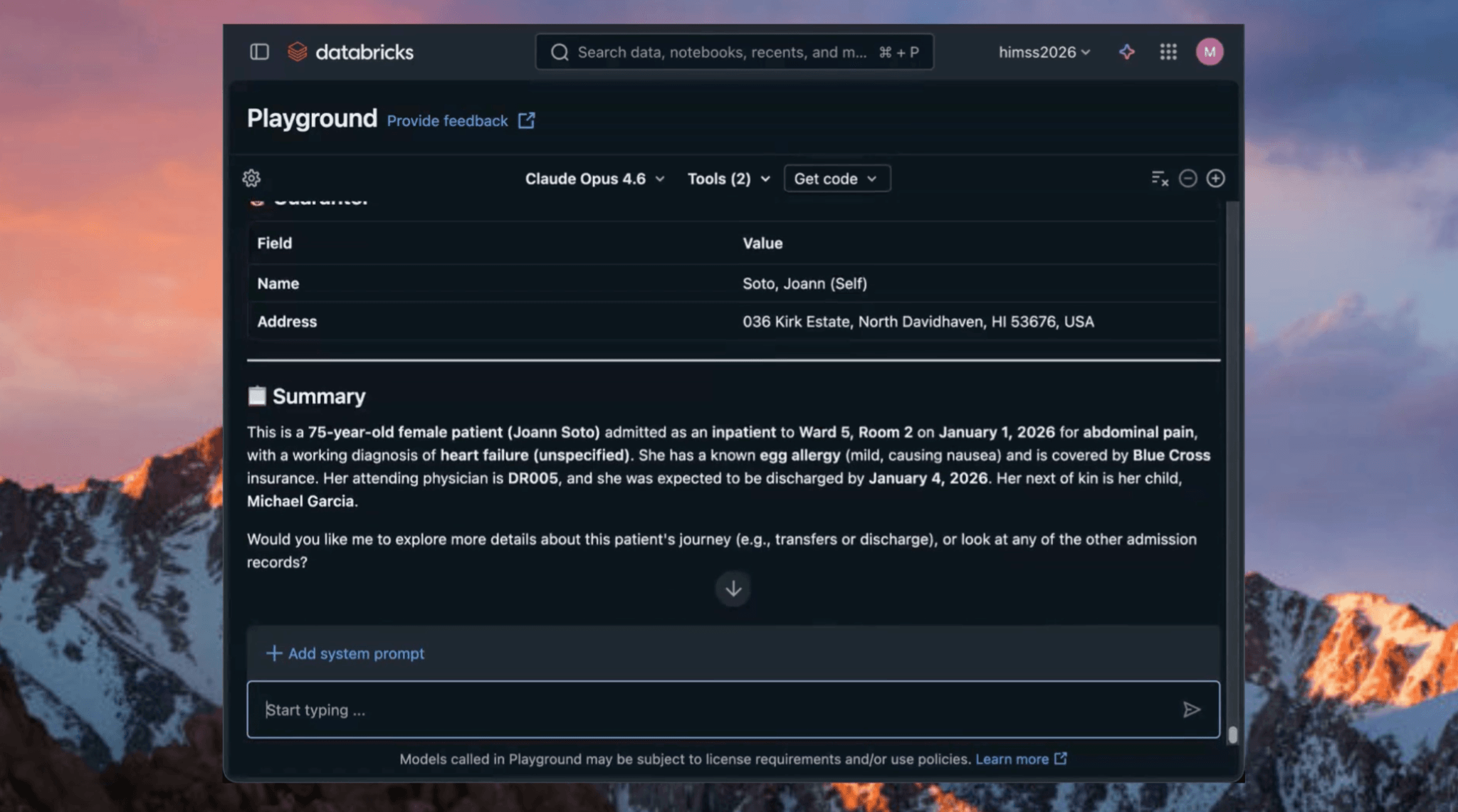
Figure 1. The system summarized a recent patient admission in plain English.

From Months to Minutes: Accelerating Time-to-Insight

What previously required weeks or months of integration work can now be initiated in minutes all using natural language without leaving Databricks. 

By eliminating intermediary data landing steps with Zerobus and simplifying pipeline creation through natural language prompting, organizations can dramatically reduce both latency and development time. This enables teams to validate AI use cases faster, shorten development cycles, and move from experimentation to production more quickly.

Integration is no longer the gating factor, and data latency is no longer the limiting constraint.

Reducing Dependency on Specialized Expertise

Healthcare integration has traditionally required deep expertise in HL7, APIs, and data orchestration.

With the Redox MCP Server, much of that complexity is abstracted away. Organizations can reduce their reliance on HL7 experts and integration specialists, enabling broader teams to work with clinical data.

Data scientists and ML engineers can focus on building models and generating insights instead of managing ETL pipelines. Engineering teams can shift from maintaining integrations to enabling new capabilities.

The focus moves from “how do we get the data” to “how do we use the data.”

Enabling Real-Time Clinical Intelligence

With Zerobus, clinical data arrives in Databricks with subsecond latency without intermediate storage layers or batch processing. This allows FHIR to be treated like it was always meant to be treated–as transactional and sent to REST API endpoints. For example, a health plan or provider organization can send prior authorization specific bundles through Redox directly to a dedicated REST API endpoint where it needs to be in Databricks instead of landing in a FHIR Store or as a substantiated FHIR JSON file first.  
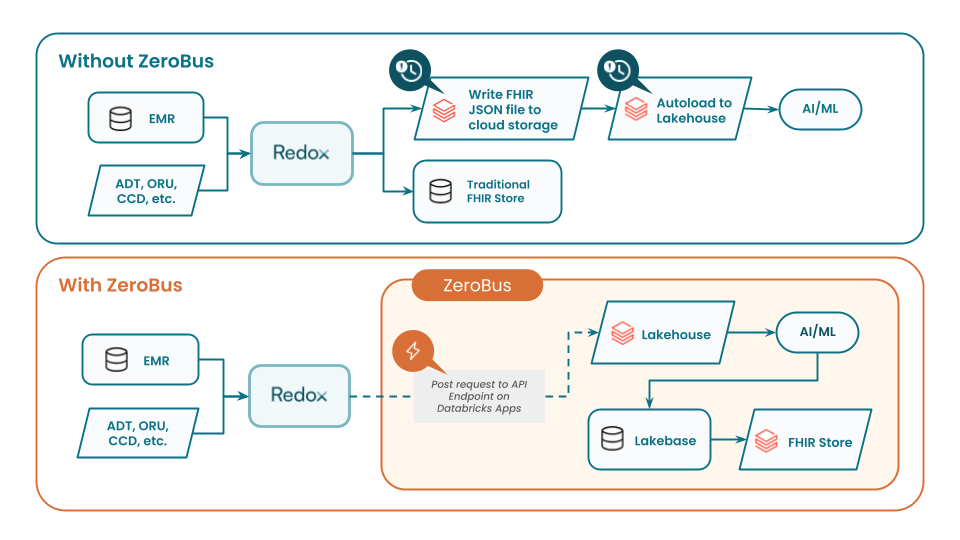
This allows ML and AI Agent frameworks to process prior authorization requests and responses instantly. By bypassing the need for additional data pulls or the complex ETL required to parse raw FHIR JSON files, these systems can capture and act on the patient journey as it unfolds, not after the fact.

Paired with Redox EHR writeback capabilities, these insights can be operationalized directly within clinical workflows. AI-generated outputs can be written back into the EHR in real time, closing the loop between data, intelligence, and action at the point of care. This shifts Databricks beyond a system of analytics into an application layer for healthcare operations, where data pipelines and AI models do not just inform decisions, but actively drive interventions inside core clinical systems.

This unlocks a new class of real-time use cases:

  • Track patient state in real time
    Continuously update admissions, transfers, discharges, and clinical events as they happen

  • Optimize capacity as conditions change
    Use live patient movement and census signals to improve bed management, staffing, and throughput

  • Trigger interventions at the right moment
    Engage patients, care teams, or systems based on live clinical signals rather than delayed reports

  • Detect risk as it emerges
    Identify deterioration, gaps in care, or operational bottlenecks while there is still time to respond

  • Adapt discharge and care pathways dynamically
    Adjust next steps based on current patient status rather than static snapshots

  • Synchronize clinical and financial workflows
    Capture events as they occur to improve coding, billing, and revenue cycle accuracy

Now, healthcare organizations can operate with greater agility and responsiveness, aligning their data workflows with the pace of patient care delivery.

Why This Works: A Trusted Foundation AI Can Act On

This capability depends on a reliable, standardized clinical data foundation. Redox provides the standardized layer for exchanging healthcare data across EHRs and other downstream systems through a single platform and API.

Zerobus ensures that this data arrives in Databricks without delay. The Redox MCP Server makes that data accessible and actionable through natural language by translating intent into execution while enforcing enterprise-grade security, compliance, and operational controls.

Together, they create a real-time execution layer for clinical data and AI workflows.

Beyond Pipelines: Building the "Redox Agent"

And we’re not stopping at data ingestion. Because the Redox MCP server sits alongside Databricks Genie Spaces on top of the clinical data, AI teams can now build Redox Agents on Databricks.

These specialized agents are capable of:

  • Reviewing Redox platform logs to troubleshoot or audit data flows in real-time.
  • Answering questions about the clinical data sent by Redox using natural language.
  • Embedding intelligence directly into clinical applications while maintaining the strict governance, security, and traceability that enterprise healthcare requires.

By combining the power of the Redox MCP and Genie, teams can move from simply moving data to creating conversational, intelligent interfaces that sit right inside the provider's existing workflow.

See It In Action

In an upcoming Redox and Databricks webinar on April 30, we’ll demo how Zerobus and the MCP Server work together to deliver real-time data pipelines inside Databricks.

You will see how teams can move from intent to execution using natural language, while operating on live data with subsecond latency.

Register here to explore how this approach applies to your organization.