
惯性聚合 高效追踪和阅读你感兴趣的博客、新闻、科技资讯
阅读原文 在惯性聚合中打开

推荐订阅源

S
Security @ Cisco Blogs
H
Hacker News: Front Page
P
Privacy International News Feed
N
News and Events Feed by Topic
T
Threatpost
Simon Willison's Weblog
S
Schneier on Security
K
Kaspersky official blog
S
Secure Thoughts
V2EX - 技术
V2EX - 技术
Security Latest
Security Latest
钛媒体:引领未来商业与生活新知
钛媒体:引领未来商业与生活新知
www.infosecurity-magazine.com
C
CERT Recently Published Vulnerability Notes
L
Lohrmann on Cybersecurity
Jina AI
Jina AI
P
Proofpoint News Feed
AI
AI
雷峰网
雷峰网
T
Tailwind CSS Blog
Engineering at Meta
Engineering at Meta
cs.CL updates on arXiv.org
D
Darknet – Hacking Tools, Hacker News & Cyber Security
Recent Commits to openclaw:main
cs.AI updates on arXiv.org
博客园 - 叶小钗
Webroot Blog
Webroot Blog
Apple Machine Learning Research
SecWiki News
SecWiki News
罗磊的独立博客
N
Netflix TechBlog - Medium
Martin Fowler
Martin Fowler
Google DeepMind News
Cyberwarzone
Cyberwarzone
MongoDB | Blog
MongoDB | Blog
博客园 - Franky
Schneier on Security
The GitHub Blog
The GitHub Blog
S
Security Affairs
Blog — PlanetScale
Blog — PlanetScale
Last Week in AI
Last Week in AI
P
Proofpoint News Feed
月光博客
月光博客
D
Docker
OSCHINA 社区最新新闻
OSCHINA 社区最新新闻
S
Securelist
W
WeLiveSecurity
T
Troy Hunt's Blog
A
Arctic Wolf
博客园 - 司徒正美

Databricks

How lakebase architecture delivers 5x faster Postgres writes Why Talent Transformation Is the Missing Focus of Enterprise AI Public Health Intelligence Shouldn't Require a Data Scientist Mean Time to Detect Is a Data Access Problem First-party audience data is the ad sales relationship now Rethinking Distributed Systems for Serverless Performance and Reliability The AI Scaling Gap Hiding in Digital Native Companies 10 trillion samples a day: Scaling beyond traditional monitoring infra at Databricks AI success starts with clean data, not just better models How nOps Rebuilt Their Cloud Optimization Platform on Databricks Lakebase, and Why Other ISVs Should Too Peril Predicts: Precision Payouts for a Volatile World The foundation of AI scalability: one team, one platform, one operating model The Federal Data Paradox: Rich in Data, Poor in Access Driving Budapest Forward: How BKK Uses Databricks to Transform City Mobility LLM Vs AI: A Practical Guide to Differences, Use Cases, and Tools Model Risk Governance Is Not the Same as Risk Intelligence Generative AI for Business: A Complete Strategy and Implementation Guide Data Science vs Data Engineering: Choosing Analysis or Infrastructure AI Applications: Tools, Use Cases, and Platforms MLOps vs DevOps: A Practical Guide for Data Scientists and IT Teams Top Data Warehouse Tools For Modern Data Analytics Unlocking SAP Business Context in Databricks with Semantic Metadata Delta Sharing The marketing activation gap has a fix: Databricks and Stitch partner to turn data infrastructure into marketing performance Alert Fatigue Is a Business Risk Backstage with Lakebase Shipping Faster isn’t Learning Faster Why Your OEE Dashboard Is Lying to You The Turbine That Tried to Tell You It Was Failing Predicting Readmissions Isn't Enough. Acting in Time Is. Clinical Trials Run Longer Than They Have To. That's a Patient Problem Network Quality Is a Revenue Problem, Not a Technical One Shelf Availability Starts with Better Demand Visibility When Predicting the Next Hit Requires More Than Intuition Approximate Answers, Exact Decisions: New Sketch Functions for Analytics Companies Winning with AI Built the Data Layer First Rethinking SQL ETL for modern data platforms Stripe data now available on Databricks via Databricks Marketplace Databricks and Stripe Projects: Infrastructure Built for Agents Agents are ready but your architecture probably isn't Interoperability Between Unity Catalog and Google BigQuery via Catalog Federation Built In, Not Bolted On: What AI-Native Actually Means in Cybersecurity Operationalizing AI for public sector fraud prevention From months to minutes: Building real-time clinical data pipelines with natural language Agentic Data Engineering with Genie Code and Lakeflow Securely send first-party conversion signals with Snapchat Conversions API on Databricks Marketplace How leading tech companies are killing the builder’s tax with Lakebase Inside one of the first production deployments of Lakebase: LangGuard's agentic workflow governance engine The next generation of Databricks Genie Model Risk Management in 2026: A Banker’s Guide to the Revised Interagency Guidance OpenAI GPT-5.5 now available on Databricks, fully-governed through Unity AI Gateway Operational databases: How they work and when to use them Databricks partners with OpenAI on GPT-5.5 Announcing the Public Preview of Lakeflow Designer Are LLM agents good at join order optimization? How conversational analytics removes the BI bottleneck How to transform document activation workflows with Genie and Agent Bricks Beyond the spreadsheet: how Databricks is delivering the modern CFO in Financial Services AI App Development: Guide To Building AI-Powered Apps IoT in Manufacturing: Strategy, Components, Use Cases, and Challenges Stop Hand-Coding Change Data Capture Pipelines Multimodal Data Integration: Production Architectures for Healthcare AI Personalization Strategies for Media Companies A Modern AI Risk Management Framework Introducing the Databricks Excel Add-in for Business Users Real-Time Decisioning for AI Agents: Why you Need a Customer Context Layer First A Practical Guide to LLM Fine Tuning AI Data Transformation Guide for Data Engineers and Data Scientists Concurrency Control in DBMS: How Locking, MVCC and Optimistic Strategies Keep Data Consistent Bridging data science and marketing: Databricks unveils Delta Sharing integration for Adobe Experience Platform and agentic marketing workflows Take Control: Customer-Managed Keys for Lakebase Postgres Get hands on with agents, vibe coding and more at Data+ AI Summit Mercedes-Benz Builds a Cross-Cloud Data Mesh with Delta Sharing and Intelligent Replication, Cutting Costs by 66% What Is a Transactional Database? Introducing Genie Agent Mode Governing coding agent sprawl with Unity AI Gateway Governing Coding Agent Sprawl with Unity AI Gateway What is pgvector? Banks Don’t Have an AI Problem – They Have a Data Platform Problem Open Platform, Unified Pipelines: Why dbt on Databricks is Accelerating Why Your Agents Can’t Read Enterprise Documents — and How to Fix It Building with Databricks Document Intelligence and Lakeflow Databricks on Google Cloud: Innovate Faster. Smarter. Together. Introducing the Databricks Connector for Google Sheets: Real-Time, Governed Lakehouse Data in the Sheets Users Love Unity AI Gateway: How to connect agents to external MCPs securely Expanding agent governance with Unity AI Gateway Agentic reasoning in practice: Making sense of structured and unstructured data Agent Bricks: The Governed Enterprise Agent Platform Building real-time product search on Databricks Lovable + Databricks: Build Data-Driven Apps at the Speed of Thought Memory scaling for AI agents Powering clinical research innovation: How TriNetX uses Databricks to accelerate drug development Database Branching in Postgres: Git-Style Workflows with Databricks Lakebase How Zalando built a unified data foundation for AI and analytics on Databricks The next era of the open lakehouse: Apache Iceberg™ v3 in Public Preview on Databricks How FSIs eliminate silos between clients, operations, and finance How MakeMyTrip achieved millisecond personalization at scale with Databricks A multi-agent approach to audience intelligence AiChemy: Next-generation agent with MCP, skills and custom data for drug discovery Accelerate business insights with Lakeflow Connect, now with a Free Tier Unlocking Next-Gen Customer Experiences with Data Intelligence for Marketing
8 AI and data trends shaping financial services in 2026
Kim Hatton, Junta Nakai, Marcela Granados, Antoine Amend, Ashraf · 2026-04-14 · via Databricks

For most of the past decade, AI has been sold as the next frontier in financial services.

That framing is outdated.

By the end of 2026, AI will be nearly ubiquitous. Nearly every major bank, insurer, and asset manager has a pilot or deployment. Generative AI, in particular, has transitioned from buzz to business utility much faster than many expected. Roughly 94% of financial services firms are piloting or deploying generative AI within core business functions such as cybersecurity, pricing, risk, and personalized products.

And yet, the impact is uneven.

Some firms are clearly seeing measurable gains. Decisions are faster, operations leaner, and costs are coming down. Analysts project that AI-driven automation could reduce operating costs by up to 20% for institutions that successfully operationalize it. Most firms, however, are not realizing these benefits.

The reason is not a lack of models or strategy. It is execution.

The real bottleneck is systemic, not technical

The idea that AI fails because models are ineffective is a common misconception.

In practice, many prototypes and early use cases work in isolated environments. But only a fraction of those make it into production, where they can truly influence operations and outcomes. Across industries and use cases, a pattern is emerging: organizations often have more pilots than production deployments, and progression is slow.

Multiple industry surveys and usage reports show that despite heavy investment, many initiatives stall between the lab and the live environment. This is not due to the potential of AI. It is due to the realities of complex, fragmented data infrastructure.

Financial institutions carry decades of legacy systems, layered solutions, and regulatory requirements. These systems were never designed to support continuous, real-time, governed AI workflows. When teams try to scale use cases across domains — for real‑time fraud detection, dynamic pricing, or customer personalization — they encounter gaps in data consistency, lineage, and control that undermine reliability.

What distinguishable firms do differently

The firms moving ahead are not just better at building models. They are better at setting up the conditions in which models can thrive enterprise‑wide.

Instead of treating AI as an add‑on, they are treating it as part of how the business actually runs. That requires:

  • Treating data as a managed asset, not a by‑product of operations.
  • Embedding governance into data and model pipelines rather than bolting it on at the end.
  • Aligning data, analytics, and AI teams around common definitions, workflows, and metrics.

This approach has a compounding effect. Projects move into production faster. Outputs are more trusted by business owners. Models become part of operational decisioning, not curiosities on a sandbox server.

This pattern is already visible in areas like cybersecurity, where generative AI is not only identifying threats more rapidly but helping automate responses when underlying data is consistent and governed.

Eight trends, one coherent system

The Databricks 2026 Financial Services Outlook identifies eight forces shaping the competitive landscape:
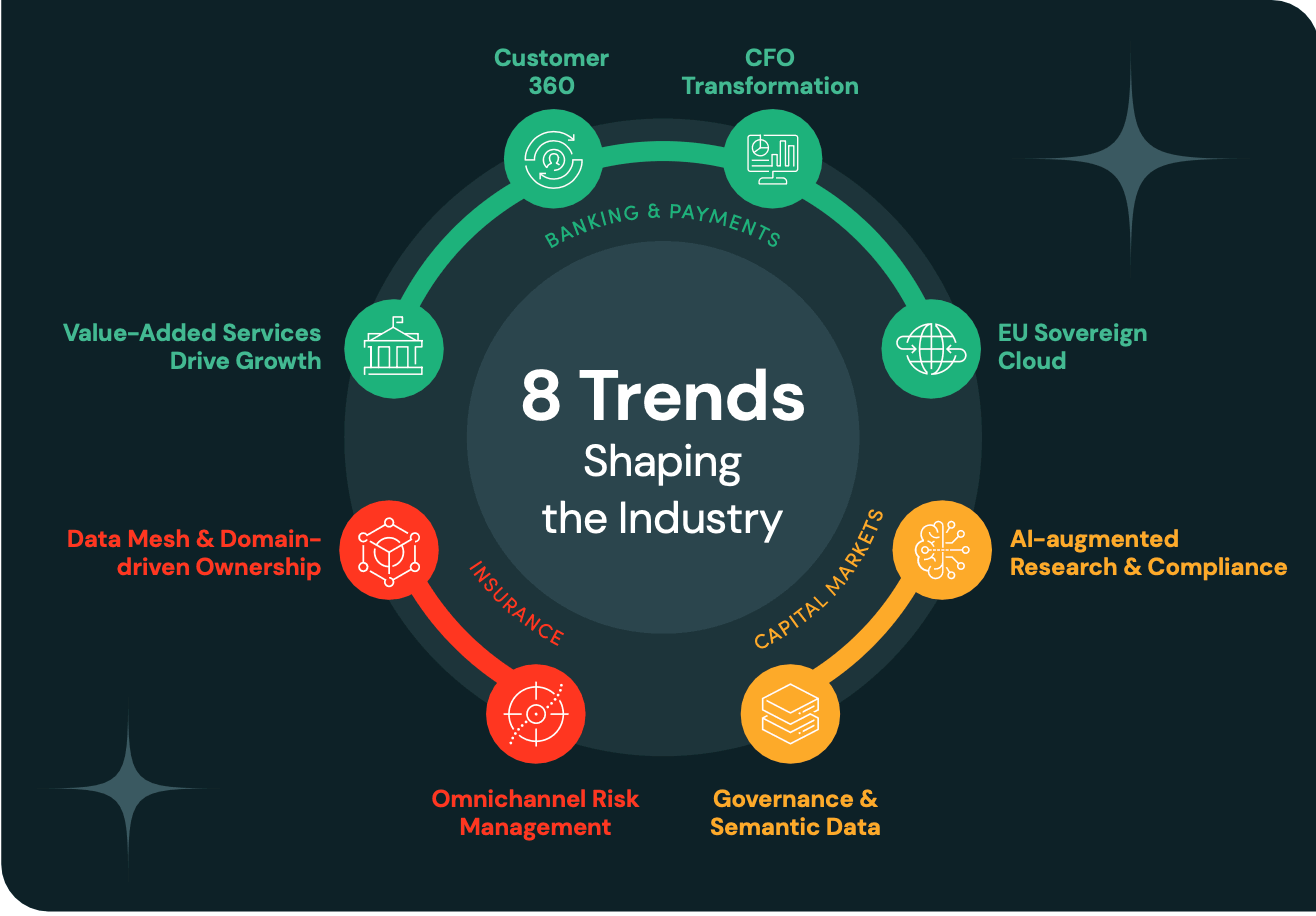
Databricks 2026 Financial Services Outlook

Viewed individually, these trends are familiar. Taken together, they describe a single systemic shift.

For example, real‑time fraud detection depends on streaming, governed data. Customer 360 initiatives rely on unified definitions across business units. Agentic AI — where systems plan and execute multi‑step workflows — only works when governance, lineage, and observability are built into the lifecycle. Organizations that address these capabilities in isolation will find themselves piecemeal at scale.

The platform question is the real question

At some point, every AI strategy crosses this threshold: Can the underlying platform support the business at scale?

Most traditional stacks were designed for reporting and batch analytics, not continuous AI‑driven operations. They separate storage, governance, modeling, and deployment into distinct tools that rarely speak the same language. This fragmentation slows governance, complicates auditing, and forces repeated rebuilds.

The firms that are making tangible progress increasingly adopt a unified approach that treats data, analytics, and AI as a continuous operating environment rather than stitched‑together modules.

This is what a modern data and AI platform enables:

  • A single lakehouse foundation where storage, compute, governance, and AI workflows coexist, eliminating repeated data movement and reconciliation.
  • Centralized governance and metadata with Unity Catalog, so access control, lineage, and auditing are consistent across data, models, and applications.
  • Lifecycle tools that support everything from exploration and feature engineering to deployment, monitoring, and model drift detection — all in one environment.
  • Workflow orchestration that unifies ETL, streaming, and model pipelines into repeatable, auditable processes.
  • Support for AI agents and conversational experiences that operate on governed enterprise data, enabling autonomous workflows that extend beyond simple query interfaces to execution.

This isn’t theoretical. Enterprises deploying strong governance frameworks are seeing measurable results: telemetry indicates that organizations using governance tools are significantly more likely to push AI projects into production than those that do not.

In other words, the competitive advantage is not in any single component. It is in platform coherence — the ability to run data, analytics, and AI without friction.

The 2026 divide

By the end of 2026, the industry will be re-segmented not by who adopted AI, but who made it work in practice.

The leaders will be firms where AI is embedded in daily operations — in risk decisioning, pricing models, customer engagement, and fraud detection — at scale. Data will be more consistent. Systems will be connected. Insights will move seamlessly from experimentation to production.

Others will still have pilots. They will still be talking about potential.

The difference between the two groups may look subtle at first, but it compounds. And once established, it becomes difficult to close.

The bottom line

Early adoption no longer confers advantage. Execution does.

Operationalizing AI — embedding it into decisions that matter — is how investments convert into measurable business outcomes. Firms that do this in 2026 will pull ahead. Everyone else will fall behind.

Read our 2026 Outlook for Financial Services and reach out to your representative to get started on true transformation today.