
惯性聚合 高效追踪和阅读你感兴趣的博客、新闻、科技资讯
阅读原文 在惯性聚合中打开

推荐订阅源

酷 壳 – CoolShell
酷 壳 – CoolShell
D
Docker
Microsoft Security Blog
Google DeepMind News
M
MIT News - Artificial intelligence
P
Proofpoint News Feed
Engineering at Meta
Engineering at Meta
Y
Y Combinator Blog
Vercel News
Vercel News
F
Fortinet All Blogs
B
Blog
Recent Announcements
A
About on SuperTechFans
GbyAI
GbyAI
T
The Blog of Author Tim Ferriss
钛媒体:引领未来商业与生活新知
钛媒体:引领未来商业与生活新知
博客园 - Franky
MongoDB | Blog
MongoDB | Blog
Stack Overflow Blog
Stack Overflow Blog
B
Blog RSS Feed
C
Check Point Blog
Cyber Security Advisories - MS-ISAC
V
Visual Studio Blog
月光博客
月光博客

Databricks

Why Talent Transformation Is the Missing Focus of Enterprise AI Public Health Intelligence Shouldn't Require a Data Scientist Mean Time to Detect Is a Data Access Problem First-party audience data is the ad sales relationship now Rethinking Distributed Systems for Serverless Performance and Reliability The AI Scaling Gap Hiding in Digital Native Companies 10 trillion samples a day: Scaling beyond traditional monitoring infra at Databricks AI success starts with clean data, not just better models How nOps Rebuilt Their Cloud Optimization Platform on Databricks Lakebase, and Why Other ISVs Should Too Peril Predicts: Precision Payouts for a Volatile World The foundation of AI scalability: one team, one platform, one operating model The Federal Data Paradox: Rich in Data, Poor in Access Driving Budapest Forward: How BKK Uses Databricks to Transform City Mobility LLM Vs AI: A Practical Guide to Differences, Use Cases, and Tools Model Risk Governance Is Not the Same as Risk Intelligence Generative AI for Business: A Complete Strategy and Implementation Guide Data Science vs Data Engineering: Choosing Analysis or Infrastructure AI Applications: Tools, Use Cases, and Platforms MLOps vs DevOps: A Practical Guide for Data Scientists and IT Teams Top Data Warehouse Tools For Modern Data Analytics Unlocking SAP Business Context in Databricks with Semantic Metadata Delta Sharing The marketing activation gap has a fix: Databricks and Stitch partner to turn data infrastructure into marketing performance Alert Fatigue Is a Business Risk Backstage with Lakebase Shipping Faster isn’t Learning Faster Why Your OEE Dashboard Is Lying to You The Turbine That Tried to Tell You It Was Failing Predicting Readmissions Isn't Enough. Acting in Time Is. Clinical Trials Run Longer Than They Have To. That's a Patient Problem Network Quality Is a Revenue Problem, Not a Technical One
Announcing Lakebase Change Data Feed (CDF)
Pranav Aurora, Cheng Chen, Hristo Stoyanov · 2026-05-27 · via Databricks

Moving data from your operational database has traditionally meant setting up and monitoring a pipeline for each source to each destination. For most teams, this is a brittle, ungoverned, and O(n) human effort.

Today, we’re changing this approach. Available now in Public Preview, Lakebase features a Change Data Feed (CDF) that is stored and governed in Unity Catalog Managed Tables. Enable the feed once and allow all engines, models, and agents to read from it directly. 
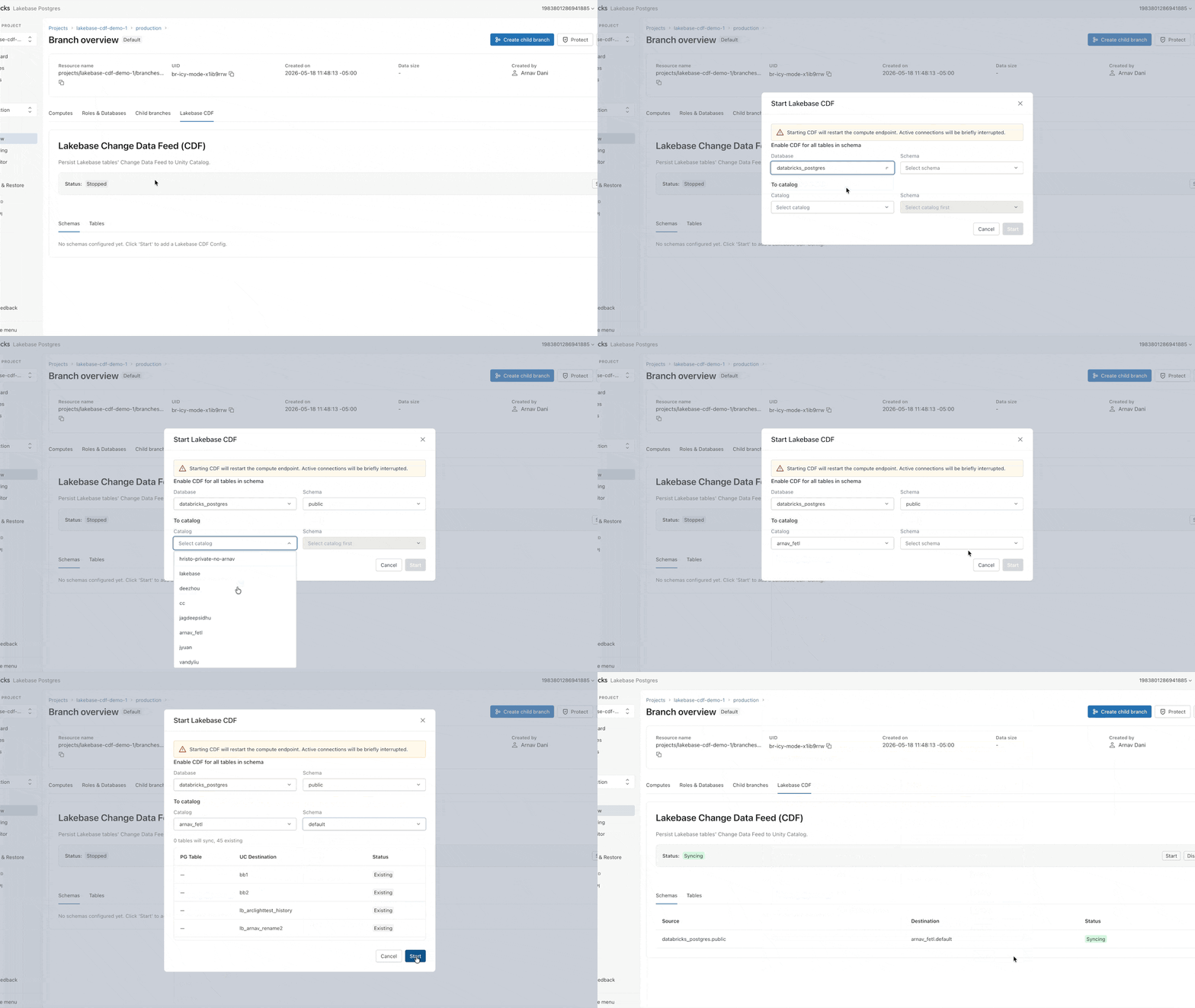
set up Lakebase CDF in just a few clicks.

Why is landing operational data into the lake still so hard?

While Lakeflow Connect has made ingesting data into the Lakehouse trivial, getting data out of the OLTP database is remains a manual and high-friction process. Extracting Change Data Capture (CDC) forces teams to configure database connectors, babysit replication states, mitigate performance impacts, and track errors through disconnected tools. This model breaks down in agent-first development that relies on rapid data branching. Maintaining complex, ungoverned extraction pipelines for every new branch to every destination is unsustainable.

We solved this in the Lakehouse. Now we’re bringing it to Lakebase.

The Lakehouse eliminated extraction pipelines for analytics by storing data once in open formats (Apache Iceberg™, Delta Lake). It established Change Data Feed (CDF) as the standard for downstream replication, powering ETL, streaming workflows, and audit logs.
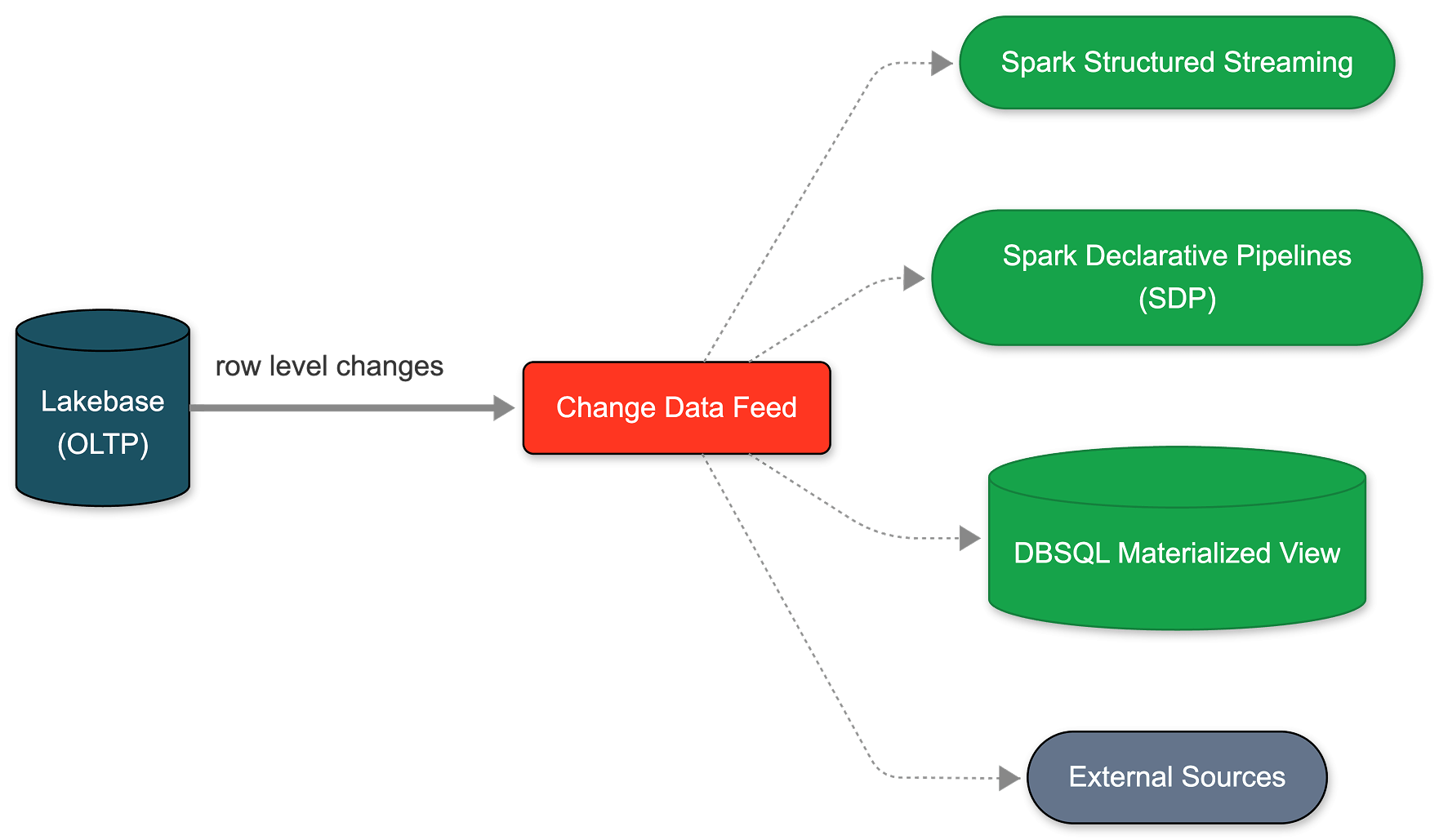
Lakebase CDF syncs row level changes

You can now set up that CDF natively on Lakebase. It takes less than a minute to enable, applying to all tables within a project. From this single feed, you can build streaming pipelines with SDP, generate materialized views with DBSQL, or compute and store embeddings with Agent Bricks. Every downstream consumer subscribes to the exact same feed, completely isolated from your primary operational workload.

Operational databases belong in the medallion architecture

With Lakebase, your operational data is no longer isolated from the Lakehouse. Lakebase already offers Synced Tables, establishing the pattern of serving Gold datasets directly to applications. Lakebase CDF completes the architecture. Your operational database is now your native Bronze layer, eliminating the need for separate pipelines or extraction jobs to land data into the Lakehouse. Instead, you get full  governance and lineage across the data life cycle through Unity Catalog.

This is just the start. We are bringing the openness you love from the Lakehouse directly to Lakebase. Stay tuned for Data and AI Summit, and join our breakout session on this architecture.