

惯性聚合 高效追踪和阅读你感兴趣的博客、新闻、科技资讯
阅读原文 在惯性聚合中打开

推荐订阅源

WordPress大学
WordPress大学
The Register - Security
Hugging Face - Blog
Hugging Face - Blog
博客园 - 聂微东
GbyAI
GbyAI
Recent Commits to openclaw:main
博客园_首页
D
Docker
S
Security @ Cisco Blogs
K
Kaspersky official blog
爱范儿
爱范儿
Simon Willison's Weblog
TaoSecurity Blog
TaoSecurity Blog
V
V2EX
C
CXSECURITY Database RSS Feed - CXSecurity.com
T
Troy Hunt's Blog
Cloudbric
Cloudbric
博客园 - 三生石上(FineUI控件)
Cyber Security Advisories - MS-ISAC
The Hacker News
The Hacker News
美团技术团队
S
SegmentFault 最新的问题
L
Lohrmann on Cybersecurity
cs.AI updates on arXiv.org
宝玉的分享
宝玉的分享
The Last Watchdog
The Last Watchdog
Y
Y Combinator Blog
M
MIT News - Artificial intelligence
钛媒体:引领未来商业与生活新知
钛媒体:引领未来商业与生活新知
奇客Solidot–传递最新科技情报
奇客Solidot–传递最新科技情报
CTFtime.org: upcoming CTF events
Martin Fowler
Martin Fowler
Google Online Security Blog
K
KPMG report finds enterprise disconnect between AI and its ROI | CIO
C
Cybersecurity and Infrastructure Security Agency CISA
T
Tor Project blog
Vercel News
Vercel News
The Cloudflare Blog
G
Google Developers Blog
T
Threat Research - Cisco Blogs
AI
AI
Stack Overflow Blog
Stack Overflow Blog
I
InfoQ
Scott Helme
Scott Helme
S
Schneier on Security
大猫的无限游戏
大猫的无限游戏
The GitHub Blog
The GitHub Blog
S
Securelist
IT之家
IT之家
Microsoft Azure Blog

Databricks

Why Talent Transformation Is the Missing Focus of Enterprise AI Public Health Intelligence Shouldn't Require a Data Scientist Mean Time to Detect Is a Data Access Problem First-party audience data is the ad sales relationship now Rethinking Distributed Systems for Serverless Performance and Reliability The AI Scaling Gap Hiding in Digital Native Companies 10 trillion samples a day: Scaling beyond traditional monitoring infra at Databricks AI success starts with clean data, not just better models How nOps Rebuilt Their Cloud Optimization Platform on Databricks Lakebase, and Why Other ISVs Should Too Peril Predicts: Precision Payouts for a Volatile World The foundation of AI scalability: one team, one platform, one operating model The Federal Data Paradox: Rich in Data, Poor in Access Driving Budapest Forward: How BKK Uses Databricks to Transform City Mobility LLM Vs AI: A Practical Guide to Differences, Use Cases, and Tools Model Risk Governance Is Not the Same as Risk Intelligence Generative AI for Business: A Complete Strategy and Implementation Guide Data Science vs Data Engineering: Choosing Analysis or Infrastructure AI Applications: Tools, Use Cases, and Platforms MLOps vs DevOps: A Practical Guide for Data Scientists and IT Teams Top Data Warehouse Tools For Modern Data Analytics Unlocking SAP Business Context in Databricks with Semantic Metadata Delta Sharing The marketing activation gap has a fix: Databricks and Stitch partner to turn data infrastructure into marketing performance Alert Fatigue Is a Business Risk Backstage with Lakebase Shipping Faster isn’t Learning Faster Why Your OEE Dashboard Is Lying to You The Turbine That Tried to Tell You It Was Failing Predicting Readmissions Isn't Enough. Acting in Time Is. Clinical Trials Run Longer Than They Have To. That's a Patient Problem Network Quality Is a Revenue Problem, Not a Technical One Shelf Availability Starts with Better Demand Visibility When Predicting the Next Hit Requires More Than Intuition Approximate Answers, Exact Decisions: New Sketch Functions for Analytics Companies Winning with AI Built the Data Layer First Rethinking SQL ETL for modern data platforms Stripe data now available on Databricks via Databricks Marketplace Databricks and Stripe Projects: Infrastructure Built for Agents Agents are ready but your architecture probably isn't Interoperability Between Unity Catalog and Google BigQuery via Catalog Federation Built In, Not Bolted On: What AI-Native Actually Means in Cybersecurity Operationalizing AI for public sector fraud prevention From months to minutes: Building real-time clinical data pipelines with natural language Agentic Data Engineering with Genie Code and Lakeflow Securely send first-party conversion signals with Snapchat Conversions API on Databricks Marketplace How leading tech companies are killing the builder’s tax with Lakebase Inside one of the first production deployments of Lakebase: LangGuard's agentic workflow governance engine The next generation of Databricks Genie Model Risk Management in 2026: A Banker’s Guide to the Revised Interagency Guidance OpenAI GPT-5.5 now available on Databricks, fully-governed through Unity AI Gateway Operational databases: How they work and when to use them Databricks partners with OpenAI on GPT-5.5 Announcing the Public Preview of Lakeflow Designer Are LLM agents good at join order optimization? How conversational analytics removes the BI bottleneck How to transform document activation workflows with Genie and Agent Bricks Beyond the spreadsheet: how Databricks is delivering the modern CFO in Financial Services AI App Development: Guide To Building AI-Powered Apps IoT in Manufacturing: Strategy, Components, Use Cases, and Challenges Stop Hand-Coding Change Data Capture Pipelines Multimodal Data Integration: Production Architectures for Healthcare AI Personalization Strategies for Media Companies A Modern AI Risk Management Framework Introducing the Databricks Excel Add-in for Business Users Real-Time Decisioning for AI Agents: Why you Need a Customer Context Layer First A Practical Guide to LLM Fine Tuning AI Data Transformation Guide for Data Engineers and Data Scientists Concurrency Control in DBMS: How Locking, MVCC and Optimistic Strategies Keep Data Consistent Bridging data science and marketing: Databricks unveils Delta Sharing integration for Adobe Experience Platform and agentic marketing workflows Take Control: Customer-Managed Keys for Lakebase Postgres Get hands on with agents, vibe coding and more at Data+ AI Summit Mercedes-Benz Builds a Cross-Cloud Data Mesh with Delta Sharing and Intelligent Replication, Cutting Costs by 66% What Is a Transactional Database? Introducing Genie Agent Mode Governing coding agent sprawl with Unity AI Gateway Governing Coding Agent Sprawl with Unity AI Gateway What is pgvector? Banks Don’t Have an AI Problem – They Have a Data Platform Problem Open Platform, Unified Pipelines: Why dbt on Databricks is Accelerating Why Your Agents Can’t Read Enterprise Documents — and How to Fix It Building with Databricks Document Intelligence and Lakeflow Databricks on Google Cloud: Innovate Faster. Smarter. Together. Introducing the Databricks Connector for Google Sheets: Real-Time, Governed Lakehouse Data in the Sheets Users Love Unity AI Gateway: How to connect agents to external MCPs securely Expanding agent governance with Unity AI Gateway Agentic reasoning in practice: Making sense of structured and unstructured data Agent Bricks: The Governed Enterprise Agent Platform 8 AI and data trends shaping financial services in 2026 Building real-time product search on Databricks Lovable + Databricks: Build Data-Driven Apps at the Speed of Thought Memory scaling for AI agents Powering clinical research innovation: How TriNetX uses Databricks to accelerate drug development Database Branching in Postgres: Git-Style Workflows with Databricks Lakebase How Zalando built a unified data foundation for AI and analytics on Databricks The next era of the open lakehouse: Apache Iceberg™ v3 in Public Preview on Databricks How FSIs eliminate silos between clients, operations, and finance How MakeMyTrip achieved millisecond personalization at scale with Databricks A multi-agent approach to audience intelligence AiChemy: Next-generation agent with MCP, skills and custom data for drug discovery Accelerate business insights with Lakeflow Connect, now with a Free Tier Unlocking Next-Gen Customer Experiences with Data Intelligence for Marketing
Pushing the Frontier for Data Agents with Genie
2026-05-08 · via Databricks

Genie is Databricks’ state-of-the-art data agent designed for answering complex questions about enterprise data consisting of both structured (tables, dashboards, notebooks, etc.) and unstructured (workspace files, Google Drive, Sharepoint etc.) data sources. This blog describes some of the unique challenges faced by data agents and introduces techniques to address them, including using specialized knowledge search, parallel thinking, and Multi-LLM designs. From our experiments on an internal benchmark of real-world data analysis tasks, we observe that these techniques can significantly improve the overall accuracy of Genie over a leading coding agent (from 32% to over 90%) while also significantly reducing the costs and latency.
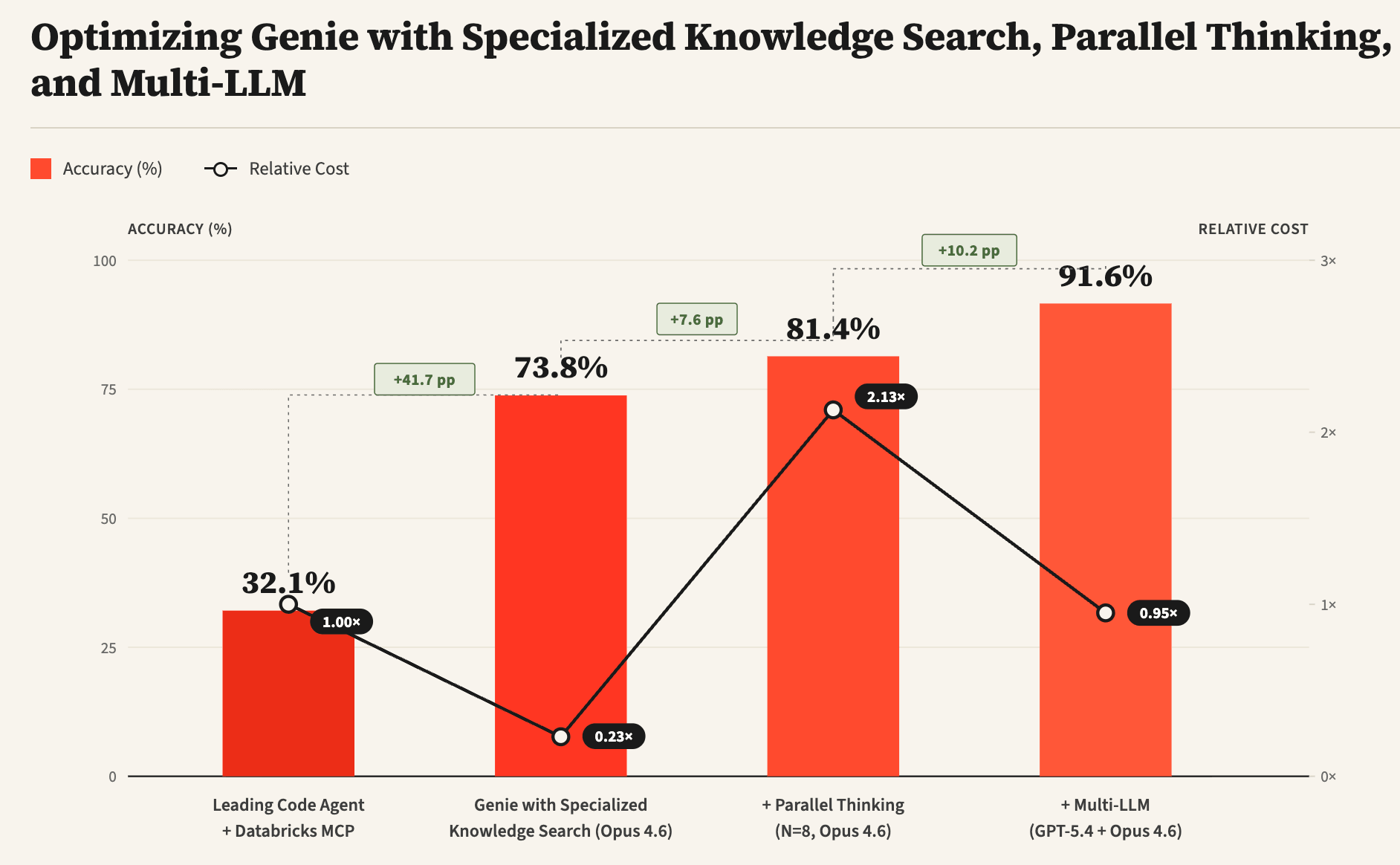
Figure 1: A plot of Genie experiments using different techniques such as specialized knowledge search, parallel thinking, and a Multi-LLM design with optimized prompts.

Key Challenges for Data Agents

Coding agents have shown that a powerful LLM can do incredible things autonomously when equipped with tools that help it understand the code context. While coding agents operate effectively in static, deterministic environments like a disk's file system, data agents introduce an entirely new paradigm. Data agents work within a dynamic, constantly evolving data lakehouse that encompasses a wealth of semantic context across hundreds of thousands of tables, notebooks, dashboards, and documents.

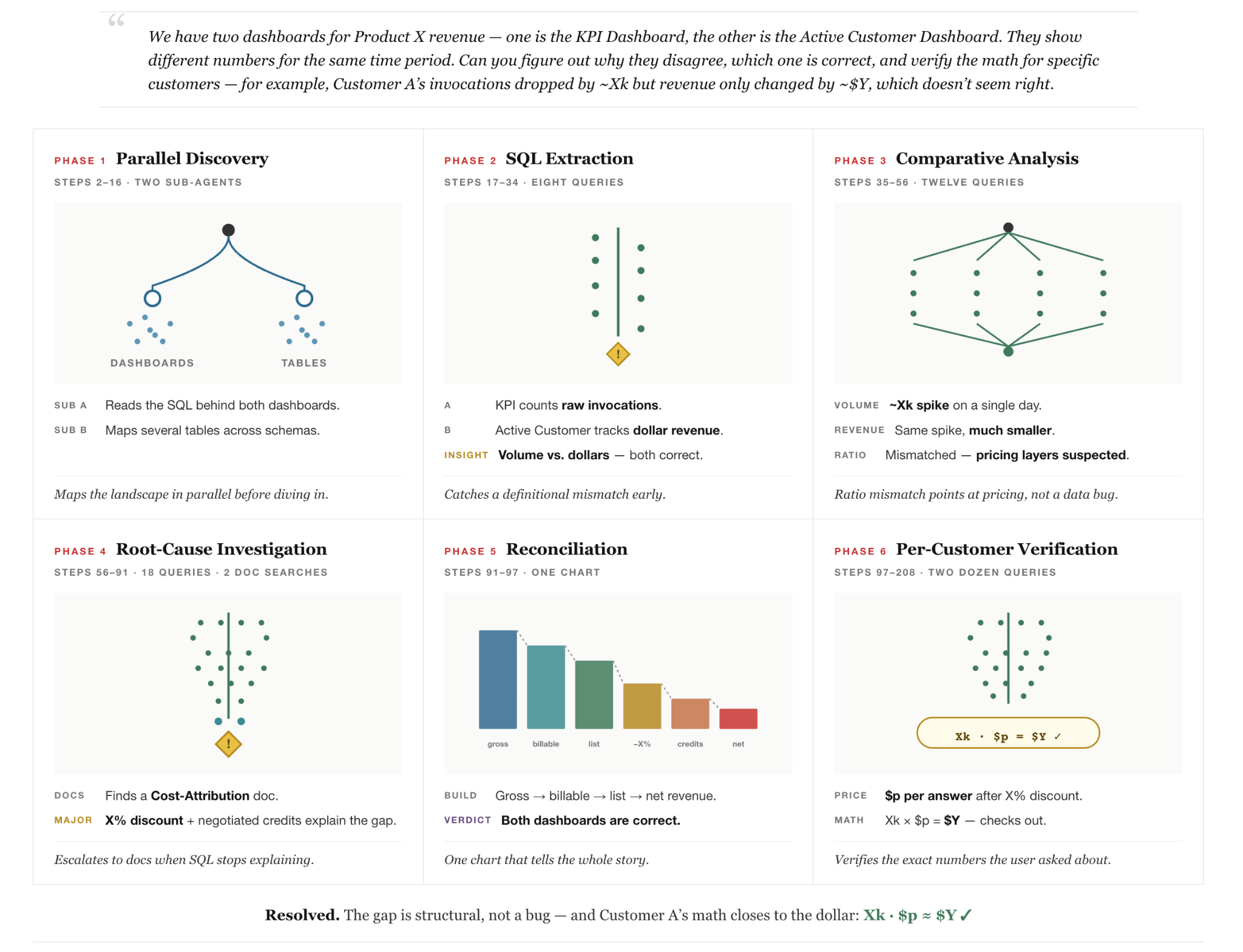
For example, consider a real (anonymized) query asked by an internal user in Figure 2: the user notices that two enterprise dashboards reporting the same product's revenue show contradictory spikes on different dates and asks the agent to explain why. This reasonable question is deceptively hard because no single data source contains the answer and resolving the question requires cross-system discovery across tables, internal documents, and dashboards, and reasoning about how multi-day reports are set up. Additionally, it requires the agent to dig into enterprise pricing details to find contract rates. Finally, it requires the agent to have an ability to automatically correct itself when intermediate calculations reveal incorrect initial assumptions. The figure shows how the agent is able to successfully solve the task by proceeding in different phases: (1) parallel multi-agent data discovery, (2) data investigation, (3) self-correction loop, and (4) verification.

Compared to Coding Agents, Data Agents have three key unique challenges:
  • Scale of Data Discovery: Finding the right data sources to answer the user query is one of the biggest challenges with enterprise customers having millions of structured and unstructured sources (like tables, dashboards, and documents), a scale that breaks conventional search methods.
  • Determining "Source of Truth" Business Knowledge: Answering business questions needs deep, specific knowledge drawn from many sources (e.g., table metadata, company documents, internal messages) that are often outdated, contradictory, or superseded, forcing the agent to determine the most authoritative information.
  • Lack of Verifiable Tests: Unlike coding agents that can use deterministic, verifiable tests to iteratively refine code, data agents have no corresponding test because the "specification" is just the high-level user query without a notion of the expected correct answer. Moreover, the queries may not always be answerable because of incompleteness in data, and it is important for data agents to be able to identify such cases and surface it back to users. 
Figure 2: An example trajectory showing how Genie solves a complex user query across different phases: parallel multi-agent asset discovery, data investigation (SQL extraction, comparative analysis, root-cause investigation), self-correction and reconciliation, and final verification.

Key Technical Advances

Figure 3 shows some of the key technical innovations in Genie that enable it to perform significantly better than generic coding agents, namely: i) Specialized Knowledge Search, ii) Parallel Thinking, and iii) Multi-LLM. Specialized knowledge search uses semantic contextual data to ground the asset discovery sub-agents and significantly improve the search quality. Parallel thinking allows the agent to sample multiple different trajectories and then aggregate the findings across trajectories to compute the final answer. Finally, Multi-LLM allows the agent to use different LLMs for each of the different sub-agents together with their optimized prompts to further improve the overall accuracy and latency.
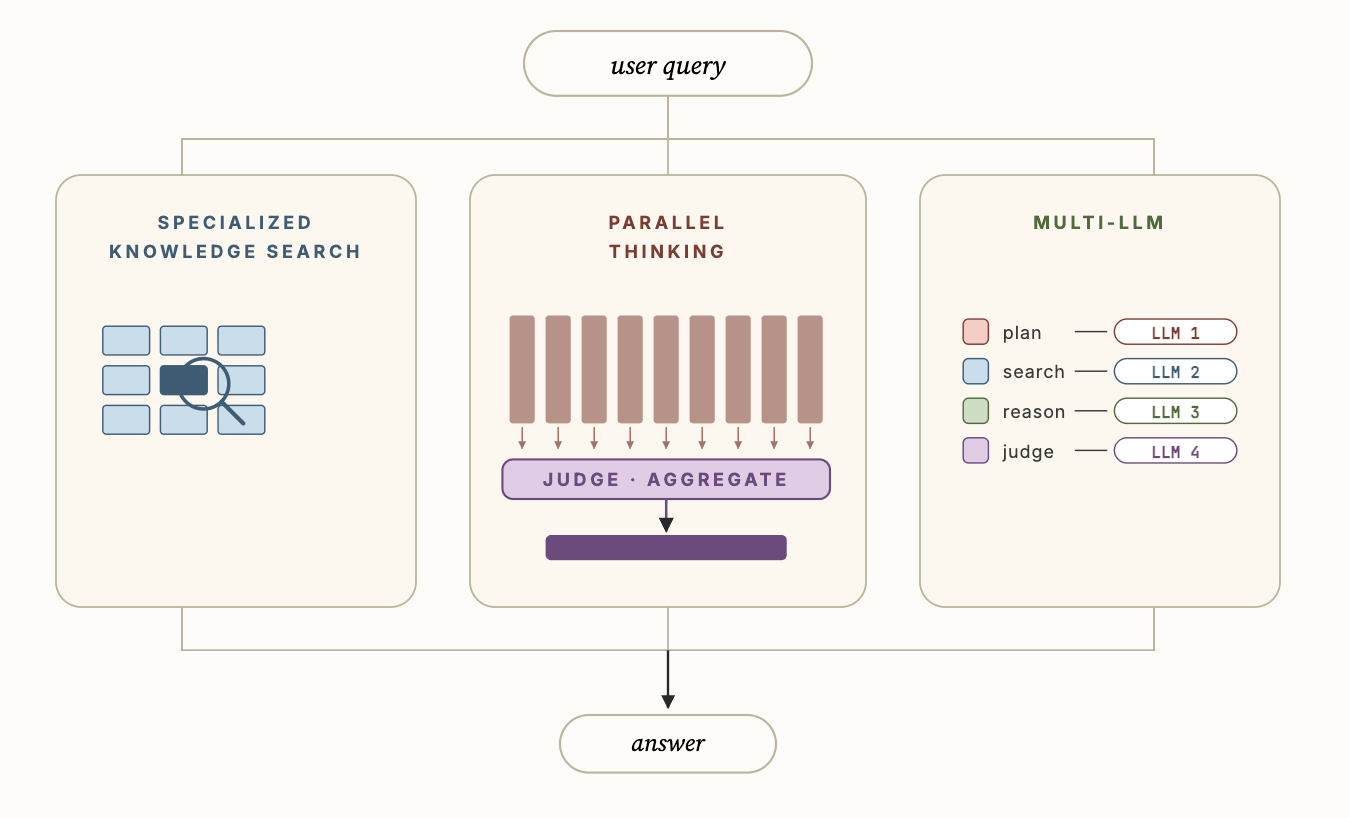
Figure 3: The key technical advances in Genie: i) Specialized Knowledge Search, ii) Parallel Thinking, and iii) Multi-LLM that allow for significant improvements in accuracy and latency.

Specialized Knowledge Search

Genie uses the existing data assets such as workspace tables, notebooks, dashboards, documents, and files to derive a rich semantic enterprise context and then uses this context to construct a search index. It uses multiple search indices in parallel together with rich metadata signals to efficiently discover most relevant assets for a user query. Figure 4 demonstrates how leveraging the specialized knowledge search helps Genie improve table search performance by up to 40% on our table discovery benchmarks. 
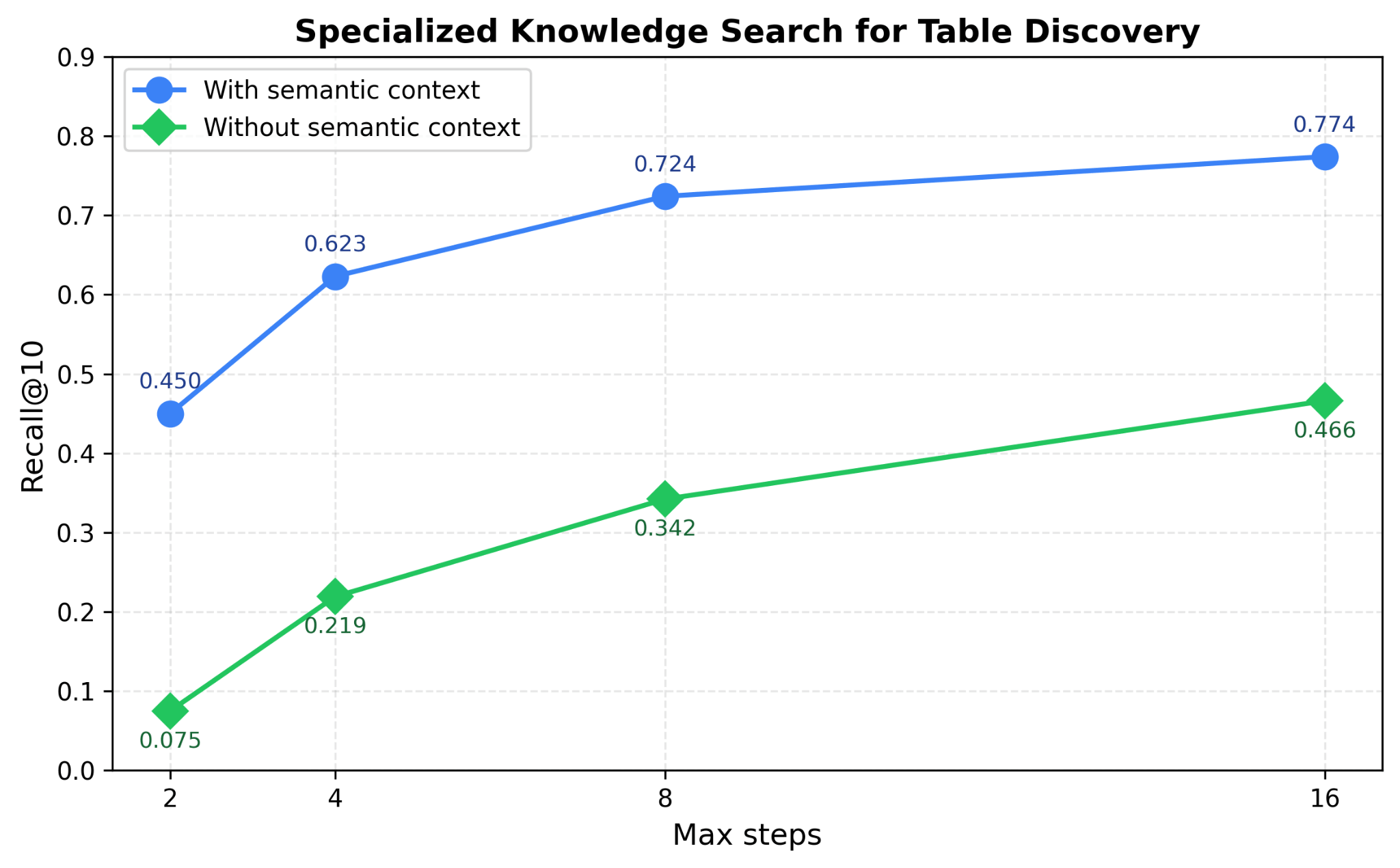
Figure 4: Comparison of Specialized Knowledge Search for Table Search performance.

Parallel Thinking

Unlike software engineering tasks, where coding agents can first write tests to verify the desired functionality and then iterate on code generation until the tests pass, the open-ended data queries don't have such corresponding unit tests. In the absence of tests, it becomes challenging for data agents to know if the generated answer is correct or needs more refinement. To address this challenge, we leverage parallel thinking by sampling multiple trajectories and aggregating relevant information across the trajectories to compute the final answer. Figure 5 shows how parallel thinking can significantly improve the answer accuracy, although with some additional latency and token costs. Furthermore, as shown in Figure 1, combining Multi-LLM and further optimizations can further significantly reduce costs and latency.
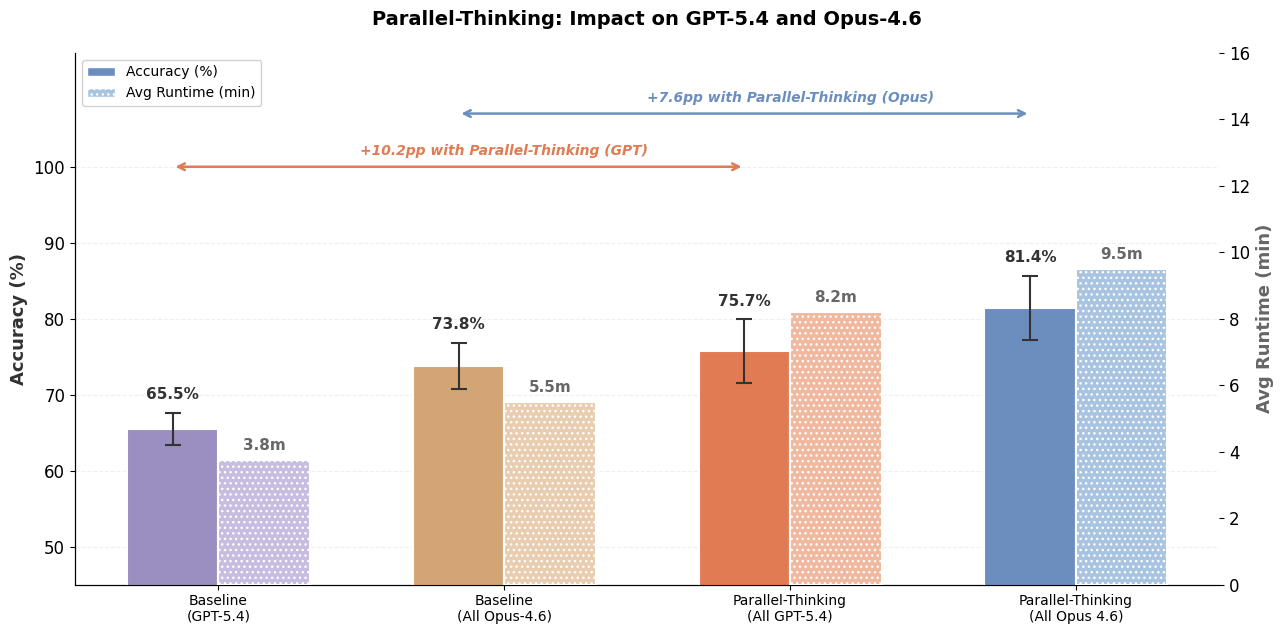
Figure 5: Adding parallel thinking improves overall performance across both GPT-5.4 and Opus-4.6.

Multi-LLM

One of the key technical advances in Genie is the ability to leverage different LLMs for different sub-agents as we observe different LLMs are good at complementary capabilities. For example, it can use a different LLM for the planning stage, a different LLM for various search sub-agents, a different one for code generation and judges. With the Databricks platform, it is seamless to try out any of the frontier models (including Opus, GPT, and Gemini), open-source models, as well as custom trained models. In addition to accuracy, we also observe that different LLMs result in very different latency and cost characteristics. Figure 6 shows how different LLMs perform on table search tasks and how the corresponding accuracy and cost can be further optimized using methods like GEPA.
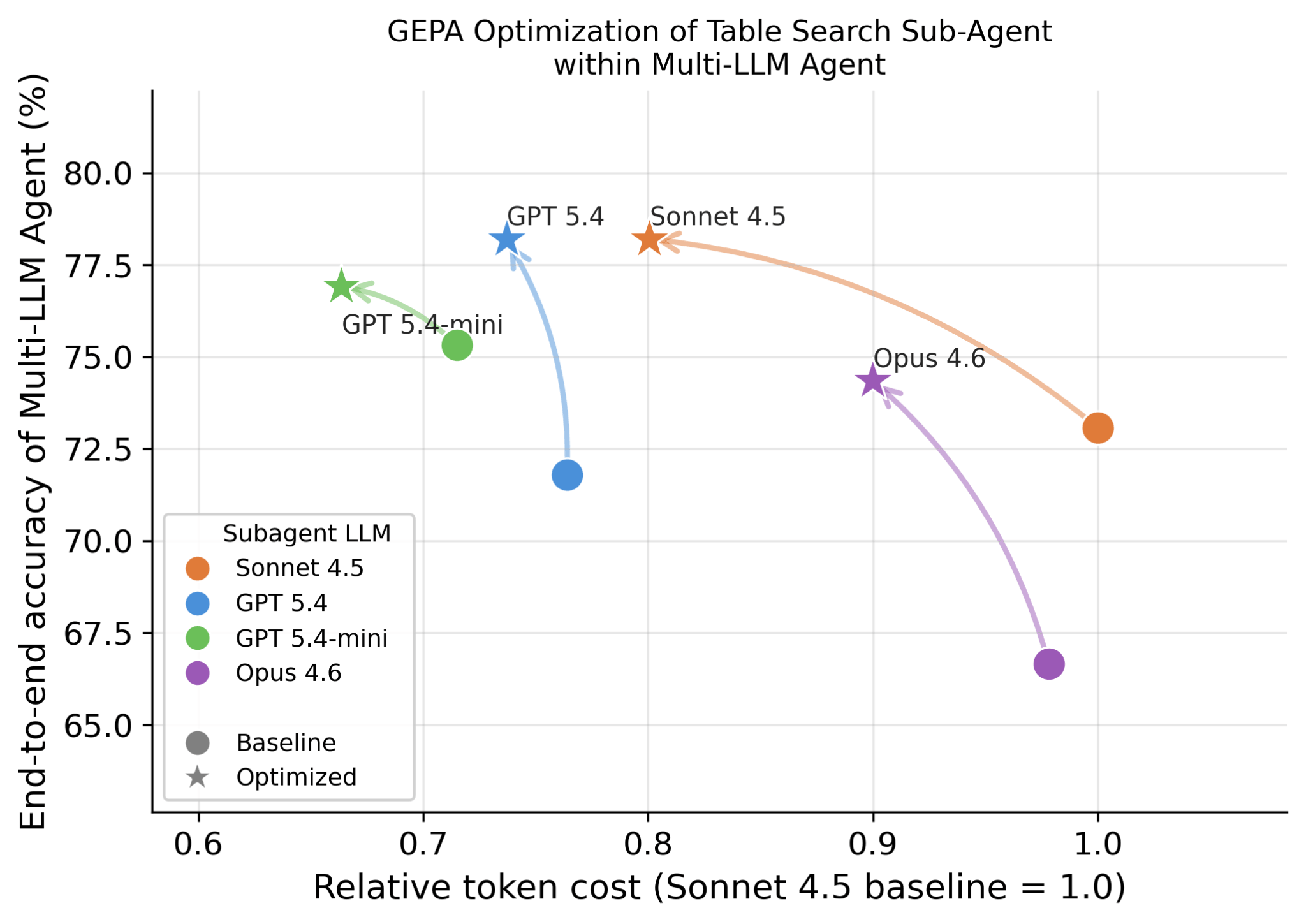
Figure 6: Optimizing the accuracy and cost for different LLMs for Table Search using GEPA.

Conclusion

While coding and data analysis share many conceptual similarities, the dynamic nature of enterprise data systems create some unique challenges. Data agents need to efficiently discover the right assets from a large enterprise context, determine “truth” in an ambiguous environment and write efficient code and queries to correctly answer user's questions. We developed several novel approaches to solve these problems such as specialized knowledge search to leverage rich semantic information and multiple metadata signals, Multi-LLM to leverage different LLMs with optimized prompts using GEPA, and parallel thinking to further improve the overall accuracy. Adding these approaches to Genie helps it perform significantly better than leading coding agents on the benchmark tasks. There are still a lot of challenging open-ended questions left to explore, and it has never been a more exciting time to explore research in this area of building state-of-the-art data agents for enterprises.