





惯性聚合 高效追踪和阅读你感兴趣的博客、新闻、科技资讯
阅读原文 在惯性聚合中打开

推荐订阅源

The GitHub Blog
The GitHub Blog
云风的 BLOG
云风的 BLOG
T
Threatpost
WordPress大学
WordPress大学
CTFtime.org: upcoming CTF events
PCI Perspectives
PCI Perspectives
T
The Exploit Database - CXSecurity.com
Y
Y Combinator Blog
雷峰网
雷峰网
爱范儿
爱范儿
The Hacker News
The Hacker News
Last Week in AI
Last Week in AI
Simon Willison's Weblog
T
Tor Project blog
S
Securelist
宝玉的分享
宝玉的分享
L
LangChain Blog
O
OpenAI News
AI
AI
P
Privacy International News Feed
L
LINUX DO - 最新话题
D
DataBreaches.Net
Exploit-DB.com RSS Feed
Attack and Defense Labs
罗磊的独立博客
M
MIT News - Artificial intelligence
Security Archives - TechRepublic
月光博客
月光博客
博客园 - 【当耐特】
T
Tailwind CSS Blog
C
Cybersecurity and Infrastructure Security Agency CISA
H
Help Net Security
freeCodeCamp Programming Tutorials: Python, JavaScript, Git & More
博客园_首页
K
KPMG report finds enterprise disconnect between AI and its ROI | CIO
Hacker News - Newest:
Hacker News - Newest: "LLM"
腾讯CDC
Jina AI
Jina AI
The Last Watchdog
The Last Watchdog
K
Kaspersky official blog
Webroot Blog
Webroot Blog
奇客Solidot–传递最新科技情报
奇客Solidot–传递最新科技情报
Blog — PlanetScale
Blog — PlanetScale
MyScale Blog
MyScale Blog
MongoDB | Blog
MongoDB | Blog
P
Proofpoint News Feed
Recorded Future
Recorded Future
Threat Intelligence Blog | Flashpoint
博客园 - 三生石上(FineUI控件)
The Cloudflare Blog

Databricks

How lakebase architecture delivers 5x faster Postgres writes Why Talent Transformation Is the Missing Focus of Enterprise AI Public Health Intelligence Shouldn't Require a Data Scientist Mean Time to Detect Is a Data Access Problem First-party audience data is the ad sales relationship now Rethinking Distributed Systems for Serverless Performance and Reliability The AI Scaling Gap Hiding in Digital Native Companies 10 trillion samples a day: Scaling beyond traditional monitoring infra at Databricks AI success starts with clean data, not just better models How nOps Rebuilt Their Cloud Optimization Platform on Databricks Lakebase, and Why Other ISVs Should Too Peril Predicts: Precision Payouts for a Volatile World The foundation of AI scalability: one team, one platform, one operating model The Federal Data Paradox: Rich in Data, Poor in Access Driving Budapest Forward: How BKK Uses Databricks to Transform City Mobility LLM Vs AI: A Practical Guide to Differences, Use Cases, and Tools Model Risk Governance Is Not the Same as Risk Intelligence Generative AI for Business: A Complete Strategy and Implementation Guide Data Science vs Data Engineering: Choosing Analysis or Infrastructure AI Applications: Tools, Use Cases, and Platforms MLOps vs DevOps: A Practical Guide for Data Scientists and IT Teams Top Data Warehouse Tools For Modern Data Analytics Unlocking SAP Business Context in Databricks with Semantic Metadata Delta Sharing The marketing activation gap has a fix: Databricks and Stitch partner to turn data infrastructure into marketing performance Alert Fatigue Is a Business Risk Backstage with Lakebase Shipping Faster isn’t Learning Faster Why Your OEE Dashboard Is Lying to You The Turbine That Tried to Tell You It Was Failing Predicting Readmissions Isn't Enough. Acting in Time Is. Clinical Trials Run Longer Than They Have To. That's a Patient Problem Network Quality Is a Revenue Problem, Not a Technical One Shelf Availability Starts with Better Demand Visibility When Predicting the Next Hit Requires More Than Intuition Approximate Answers, Exact Decisions: New Sketch Functions for Analytics Companies Winning with AI Built the Data Layer First Rethinking SQL ETL for modern data platforms Stripe data now available on Databricks via Databricks Marketplace Databricks and Stripe Projects: Infrastructure Built for Agents Agents are ready but your architecture probably isn't Interoperability Between Unity Catalog and Google BigQuery via Catalog Federation Built In, Not Bolted On: What AI-Native Actually Means in Cybersecurity Operationalizing AI for public sector fraud prevention From months to minutes: Building real-time clinical data pipelines with natural language Agentic Data Engineering with Genie Code and Lakeflow Securely send first-party conversion signals with Snapchat Conversions API on Databricks Marketplace How leading tech companies are killing the builder’s tax with Lakebase Inside one of the first production deployments of Lakebase: LangGuard's agentic workflow governance engine The next generation of Databricks Genie Model Risk Management in 2026: A Banker’s Guide to the Revised Interagency Guidance OpenAI GPT-5.5 now available on Databricks, fully-governed through Unity AI Gateway Operational databases: How they work and when to use them Databricks partners with OpenAI on GPT-5.5 Announcing the Public Preview of Lakeflow Designer Are LLM agents good at join order optimization? How conversational analytics removes the BI bottleneck How to transform document activation workflows with Genie and Agent Bricks Beyond the spreadsheet: how Databricks is delivering the modern CFO in Financial Services AI App Development: Guide To Building AI-Powered Apps IoT in Manufacturing: Strategy, Components, Use Cases, and Challenges Stop Hand-Coding Change Data Capture Pipelines Multimodal Data Integration: Production Architectures for Healthcare AI Personalization Strategies for Media Companies A Modern AI Risk Management Framework Introducing the Databricks Excel Add-in for Business Users Real-Time Decisioning for AI Agents: Why you Need a Customer Context Layer First A Practical Guide to LLM Fine Tuning AI Data Transformation Guide for Data Engineers and Data Scientists Concurrency Control in DBMS: How Locking, MVCC and Optimistic Strategies Keep Data Consistent Bridging data science and marketing: Databricks unveils Delta Sharing integration for Adobe Experience Platform and agentic marketing workflows Take Control: Customer-Managed Keys for Lakebase Postgres Get hands on with agents, vibe coding and more at Data+ AI Summit Mercedes-Benz Builds a Cross-Cloud Data Mesh with Delta Sharing and Intelligent Replication, Cutting Costs by 66% What Is a Transactional Database? Introducing Genie Agent Mode Governing coding agent sprawl with Unity AI Gateway Governing Coding Agent Sprawl with Unity AI Gateway What is pgvector? Banks Don’t Have an AI Problem – They Have a Data Platform Problem Open Platform, Unified Pipelines: Why dbt on Databricks is Accelerating Why Your Agents Can’t Read Enterprise Documents — and How to Fix It Building with Databricks Document Intelligence and Lakeflow Databricks on Google Cloud: Innovate Faster. Smarter. Together. Introducing the Databricks Connector for Google Sheets: Real-Time, Governed Lakehouse Data in the Sheets Users Love Unity AI Gateway: How to connect agents to external MCPs securely Expanding agent governance with Unity AI Gateway Agent Bricks: The Governed Enterprise Agent Platform 8 AI and data trends shaping financial services in 2026 Building real-time product search on Databricks Lovable + Databricks: Build Data-Driven Apps at the Speed of Thought Memory scaling for AI agents Powering clinical research innovation: How TriNetX uses Databricks to accelerate drug development Database Branching in Postgres: Git-Style Workflows with Databricks Lakebase How Zalando built a unified data foundation for AI and analytics on Databricks The next era of the open lakehouse: Apache Iceberg™ v3 in Public Preview on Databricks How FSIs eliminate silos between clients, operations, and finance How MakeMyTrip achieved millisecond personalization at scale with Databricks A multi-agent approach to audience intelligence AiChemy: Next-generation agent with MCP, skills and custom data for drug discovery Accelerate business insights with Lakeflow Connect, now with a Free Tier Unlocking Next-Gen Customer Experiences with Data Intelligence for Marketing
Agentic reasoning in practice: Making sense of structured and unstructured data
The Databricks AI Research Team · 2026-04-14 · via Databricks

Enterprise data is rarely useful in a silo. Answering questions like, "Which of our products have had declining sales over the past three months, and what potentially related issues are brought up in customer reviews on various seller sites?" requires reasoning across a mix of structured and unstructured data sources, including data lakes, review data, and product information management systems. In this blog, we demonstrate how Databricks Agent Bricks Supervisor Agent (SA) can help with these complex, realistic tasks through multi-step reasoning grounded in a hybrid of structured and unstructured data.
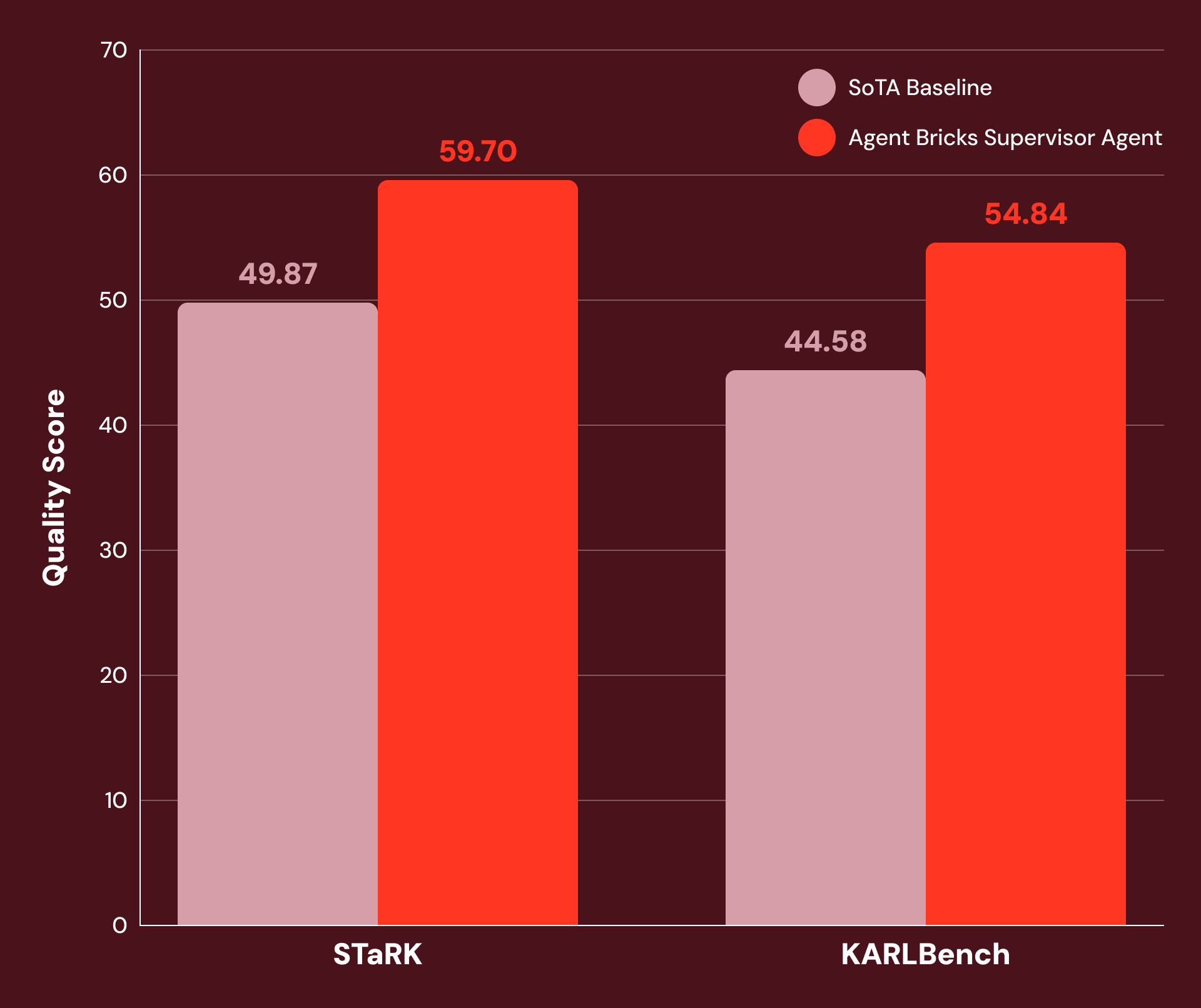
Comparison between the quality of SoTA RAG agents and Agent Bricks SA on STaRK and KARLBench benchmarks. For STaRK, we report average Hit@1 across all STaRK datasets (Amazon, MAG, Prime) as a quality score. For KARLBench, we’re reporting average of normalized metrics across six datasets (see more details below).
Figure 1: Comparison between the quality of SoTA baseline and Agent Bricks SA on STaRK and KARLBench benchmarks. For STaRK, we report average Hit@1 across all STaRK datasets (Amazon, MAG, Prime) as a quality score. For KARLBench, we report the average of normalized metrics across six datasets (see more details below).

With tuned instructions and careful tool configuration, we find SA to be highly performant on a wide range of knowledge-intensive enterprise tasks. Figure 1 shows that SA achieves 20% or more improvement over SoTA baselines on:

  • STaRK: a suite of three semi-structured retrieval tasks published by Stanford researchers.
  • KARLBench: a benchmark suite for complex grounded reasoning recently published by Databricks.

Supervisor Agent demonstrates significant gains on a wide range of economically valuable tasks: from academic retrieval (+21% on STaRK-MAG) to biomedical reasoning (+38% on STaRK Prime) and financial analysis (+23% on FinanceBench).

Agent Setup

Agent Bricks Supervisor Agent is a declarative agent builder that orchestrates agents and tools. It is built on aroll — an internal agentic framework for building, evaluating, and deploying multi-step LLM workflows at scale.1 aroll and SA were specifically designed for the advanced agentic use cases our customers frequently encounter.

aroll enables adding new tools and custom instructions through simple configuration changes, can handle thousands of concurrent conversations and parallel tool executions, and incorporates advanced agent orchestration and context management techniques to refine queries and recover from partial answers. All of these are difficult to achieve with SoTA single-turn systems today.

Because SA is built on this flexible architecture, its quality can be continually improved through simple user curation, such as tweaking top-level instructions or refining agent descriptions, without needing to write any custom code.
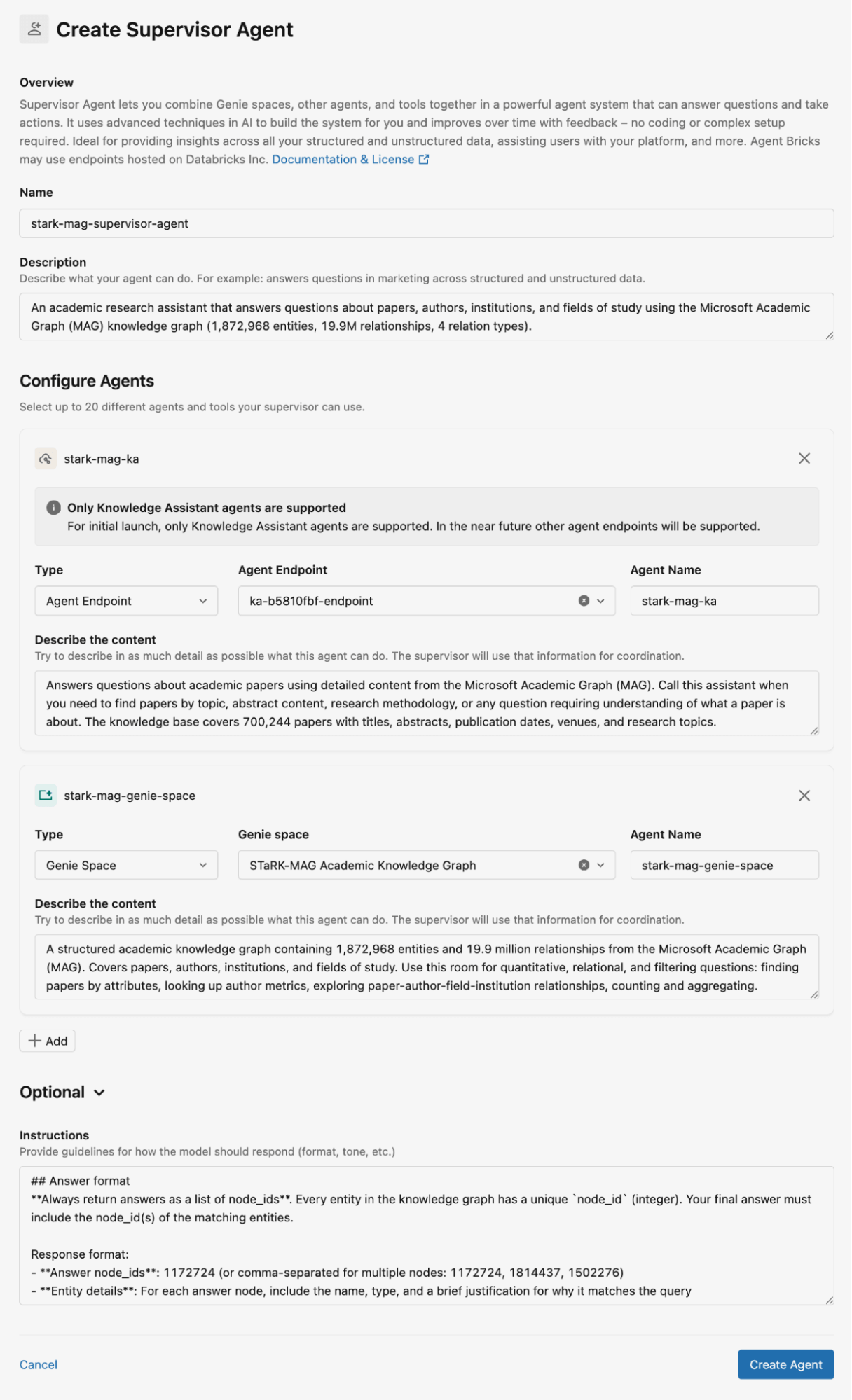
Setting up Databricks Supervisor Agent for the STaRK MAG dataset.
Figure 2: Setting up Databricks Supervisor Agent for the STaRK MAG dataset.

Figure 2 shows how we configured the Supervisor Agent for the STaRK-MAG dataset. In this blog, we use Genie spaces for storing the relational knowledge bases and Knowledge Assistants for storing unstructured documents for retrieval. We provide detailed descriptions for all Knowledge Assistants and Genie spaces, as well as instructions for the agent responses.

Hybrid Reasoning: Structured Meets Unstructured

To evaluate grounded reasoning based on a hybrid of structured and unstructured data, we use the STaRK benchmark, which includes three domains: 

  • Amazon: product attributes (structured) and reviews (unstructured)
  • MAG: citation networks (structured) and academic papers (unstructured)
  • Prime: biomedical entities (structured) and literature (unstructured)

For example, “Find me a paper written by a co-author with 115 papers and is about the Rydberg atom” requires the system to combine structured filtering (“co-author with 115 papers”) with unstructured understanding (“about the Rydberg atom”). The best published baselines use vector similarity search with an LLM-based reranker — a strong single-turn approach, but one that cannot decompose queries across data types. To ensure a fair comparison, we reran this baseline with the current SoTA foundational model, providing a substantially stronger baseline.
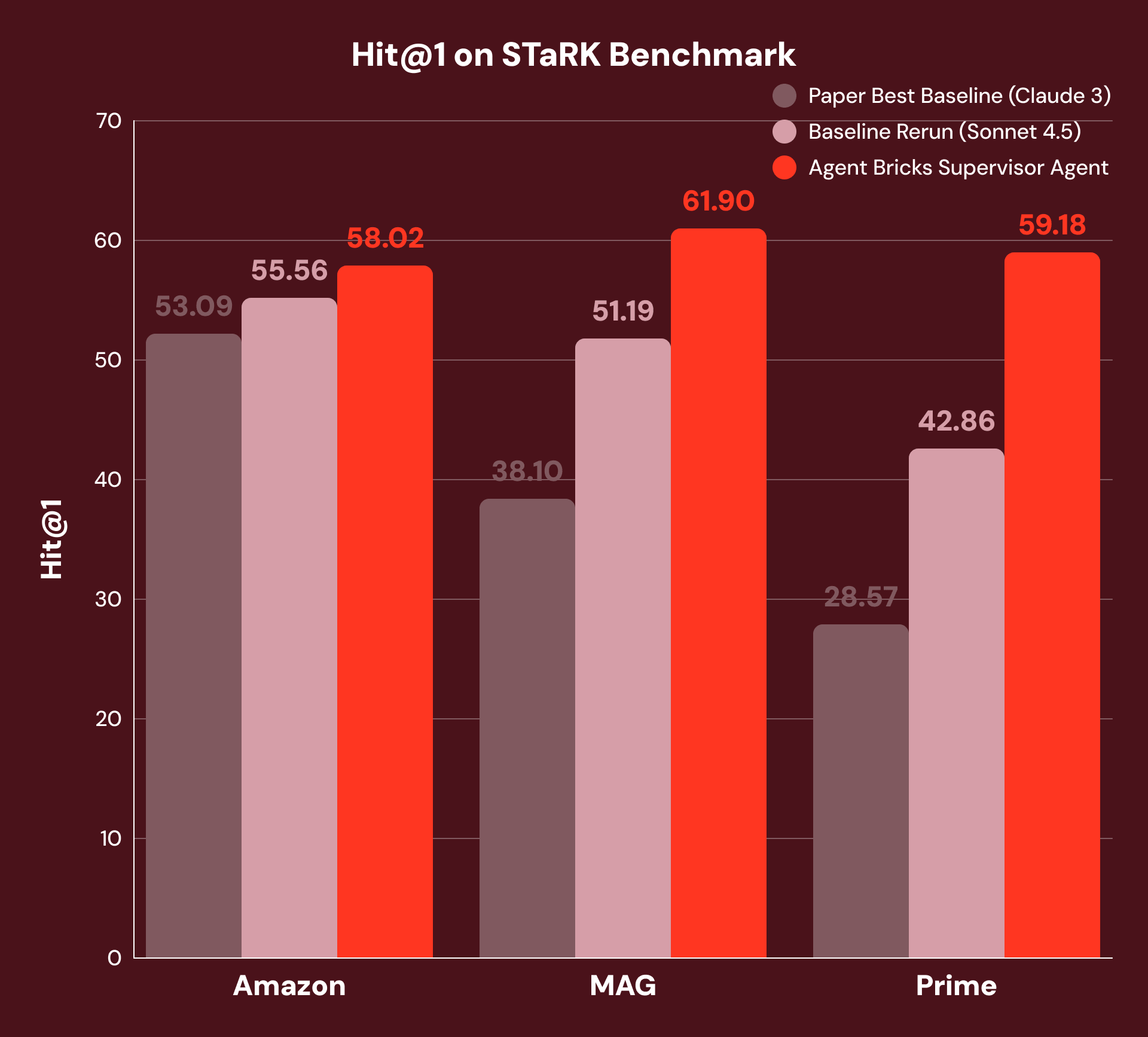
Results on STaRK – human-generated portions of the respective datasets. We report Hit@1 for (a) best baseline reported in the paper (b) baseline re-implementation using current SoTA foundational model (c) Agent Bricks SA.
Figure 3: Results on STaRK – human-generated portions of the respective datasets. We report Hit@1 for (a) best baseline reported in the paper (b) baseline re-implementation using current SoTA foundational model (c) Agent Bricks SA.

With our approach, SA decomposes each question, routes sub-questions to the appropriate tool, and synthesizes results across multiple reasoning steps. As Figure 3 shows, this achieves +4% Hit@1 on Amazon, +21% on MAG, and +38% on Prime over both the best of the original baselines and our rerun baselines with the current SoTA foundational model. We see the best improvements in MAG and Prime where the answer requires the tightest integration of structured and unstructured data.
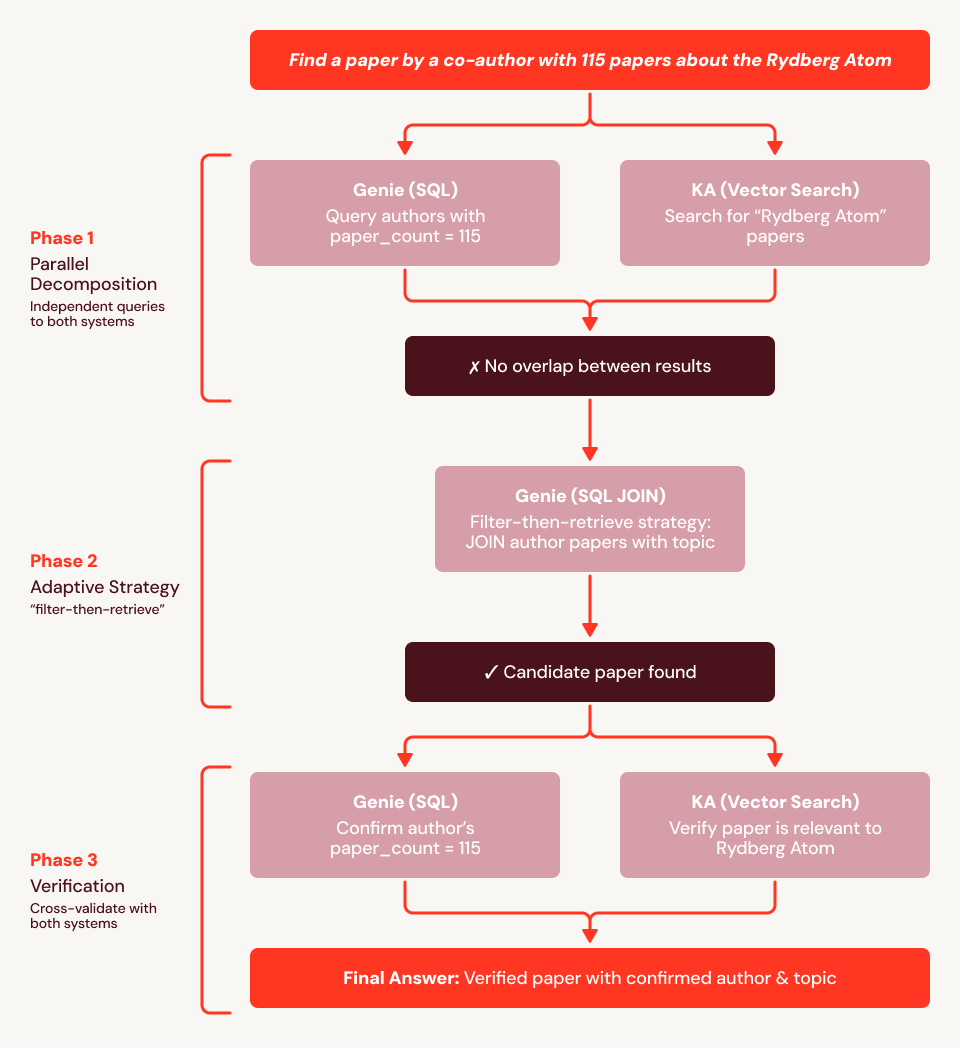
Agent Bricks SA execution strategy for query 17 in STaRK-MAG (“Find me a paper written by a co-author with 115 papers and is about the Rydberg atom”).
Figure 4: Agent Bricks SA execution strategy for query 17 in STaRK-MAG (“Find me a paper written by a co-author with 115 papers and is about the Rydberg atom”).

Using our example question from above (“Find me a paper written by a co-author with 115 papers and is about the Rydberg atom”), we find the baseline fails because the embeddings cannot encode the structural constraint (“co-author has exactly 115 papers”). In Figure 4, we show an execution trace for SA: it first uses Genie to find all 759 authors with 115 papers and Knowledge Assistant to retrieve Rydberg papers, then cross-references the two sets. When no overlap is found, SA adapts: it issues a SQL JOIN of the 115-paper author list against all papers mentioning "Rydberg" in the title or abstract, surfacing the answer directly from the structured data. It then calls Knowledge Assistant to verify relevance and Genie to confirm the author's paper count, and successfully returns the correct paper.
The Agentic Advantage on Knowledge-Intensive Tasks

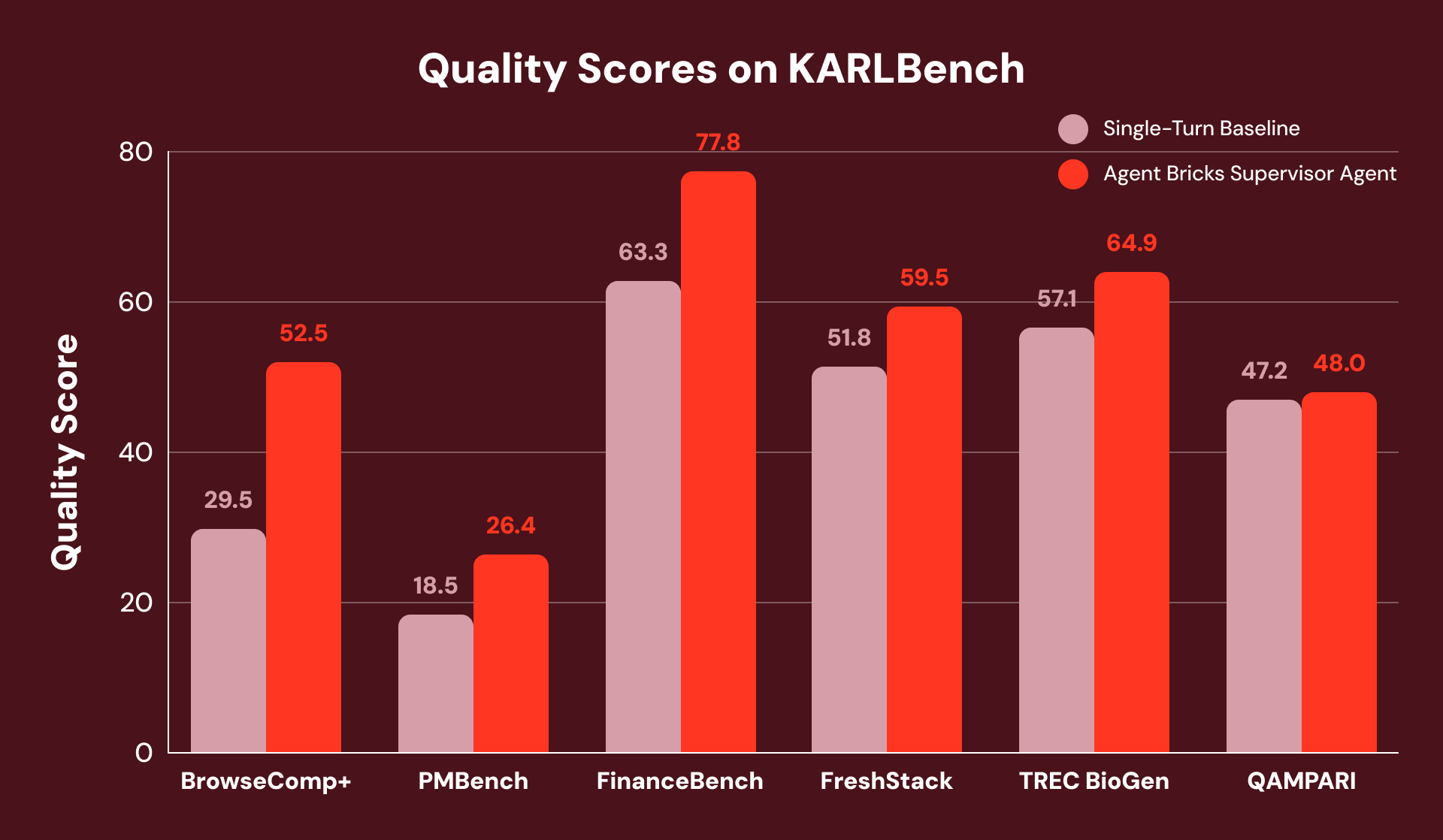
Quality scores on KARLBench
Figure 5: Results on KARLBench – a suite of six challenging grounded reasoning tasks. Note: Each task uses its own metric (Nugget Completeness for TREC-Biogen/QAMPARI/PMBench/FreshStack, binary accuracy for BrowseComp+, Answer Correctness for FinanceBench), and they're all normalized to the 0-100 scale for the ease of presentation.

To compare the performance of Agent Bricks SA with a strong single-turn baseline (similar to the best published baseline for STaRK) where no structured data is required, we evaluate them using KARLBench, a grounded reasoning benchmark suite that collectively stress-tests different retrieval and reasoning capabilities: 

  • BrowseComp+: process-of-elimination entity search
  • TREC BioGen: biomedical literature synthesis
  • FinanceBench: numerical reasoning over financial filings
  • QAMPARI: exhaustive entity recall
  • FreshStack: technical troubleshooting over documentation
  • PMBench: Databricks internal enterprise document comprehension

Overall, the Supervisor Agent achieves consistent gains across all six benchmarks, with the largest improvements on tasks that demand either exhaustive analysis or self-correction. On FinanceBench, it recovers from initially incomplete retrieval by detecting gaps and reformulating queries, yielding overall +23% improvement.

For example, BrowseComp+’s questions each have 5-10 interlocking constraints, like “Find a player who left a Russian club (2015-2020), naturalized European (2010-2016), height 1.95-2.06m. What was their block success rate at the COVID-postponed Olympics?” The single-turn baseline issues one broad query that correctly identifies the player but fails to surface granular statistics documents and fails the question.
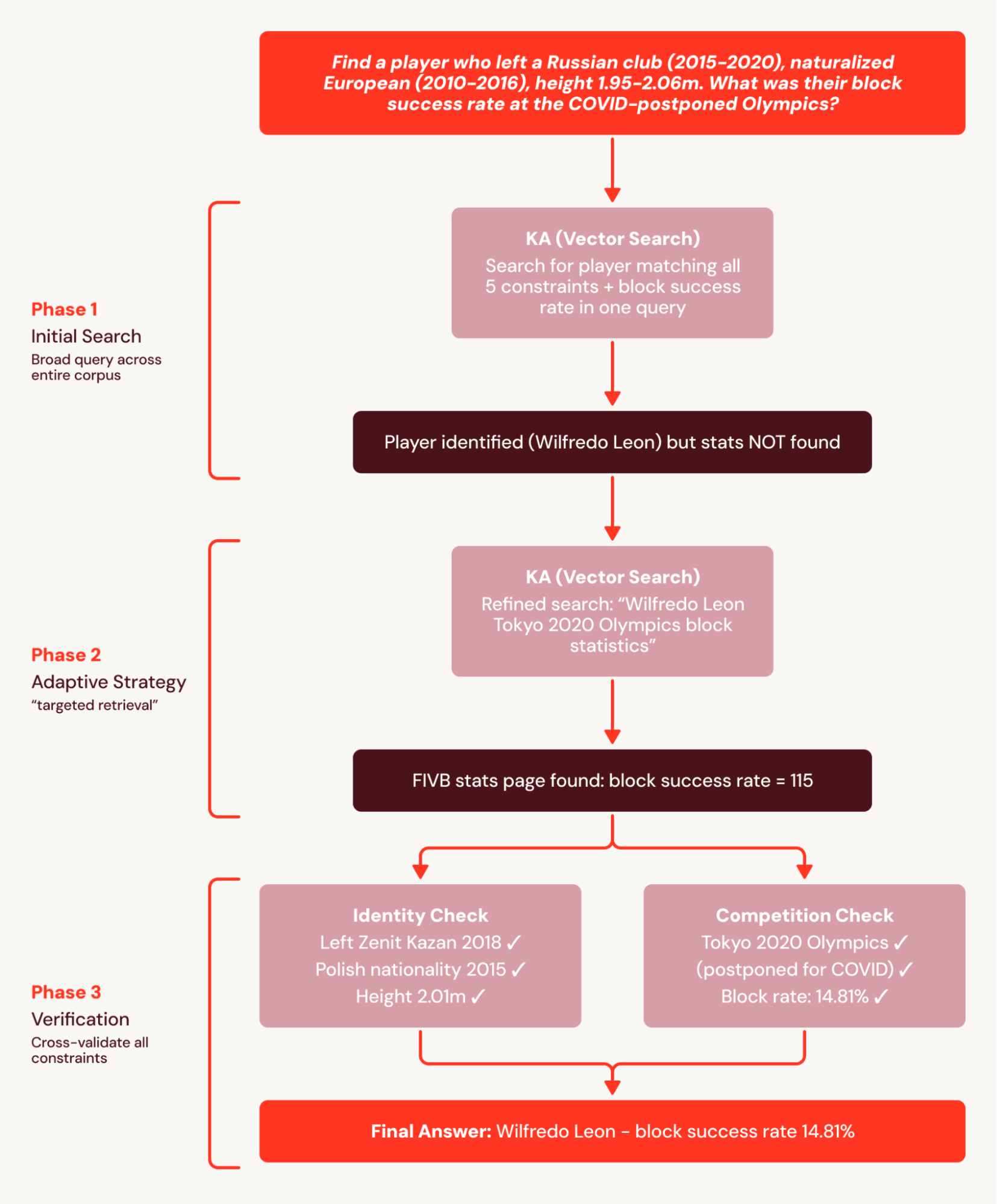
Detailed trace from the Supervisor Agent for a BrowseComp+ question.
Figure 6: Detailed trace from the Supervisor Agent for a BrowseComp+ question.

SA breaks this task into a coordinated search plan and decomposes the plan into searchable subsets. This avoids the single-turn baseline failure where stats are not found because they are retrieved in a subsequent search. As a result, SA achieves a +78% relative improvement.

In another example from PMBench, one of the questions is “what are the guardrail types customers are using” which requires 26 nuggets (see definition in KARL report) across 10+ customer conversation documents for an exhaustive answer. Single-turn baseline finds only one customer mention because it cannot search across every guardrail category in a single question. SA searches each guardrail category separately (“PII detection,” “hallucination,” “toxicity,” “prompt injection”), and incrementally surfaces more and more customer mentions in the process. 

What We Learned

The results across our experiments point to a few key takeaways: 

  1. Grounded reasoning agents can benefit from a hybrid of structured and unstructured data retrieval if given access to the right tools and data representations.
  2. For high-quality retrieval scenarios, building custom RAG pipelines over heterogeneous datasets should be avoided, even if SoTA models are used for the re-ranking stage. Multi-step reasoning where, at each step, the agent selects the right data source and reflects on its utility, is crucial for upleveling performance.
  3. A declarative approach to agent building such as the one implemented by the Databricks Supervisor Agent provides a good trade-off between ease of use and quality.

We use the Databricks Supervisor Agent to build agents for all three STaRK domains and six unstructured datasets in KARLBench. The only things that differ across these nine tasks are the instructions and tools — no custom code was required to process these diverse datasets. Thus, building a performant agent for a new enterprise task is largely a matter of writing precise instructions and equipping it with the right tools, rather than building a new system from scratch.

Agent Bricks Supervisor Agent is available to all our customers. You can get started with Agent Bricks SA simply by creating an agent and connecting it to your existing agents, tools and MCP servers. Explore the documentation to see how Supervisor Agent fits into your production workflows.

Authors: Xinglin Zhao, Arnav Singhvi, Mark Rizkallah, Jonathan Li, Jacob Portes, Elise Gonzales, Sabhya Chhabria, Kevin Wang, Yu Gong, Moonsoo Lee, Michael Bendersky and Matei Zaharia.


1See our recent publication “KARL: Knowledge Agents via Reinforcement Learning” for more details how aroll is used for synthetic data generation, scalable RL training and online inference for agentic task.