

惯性聚合 高效追踪和阅读你感兴趣的博客、新闻、科技资讯
阅读原文 在惯性聚合中打开

推荐订阅源

Y
Y Combinator Blog
MyScale Blog
MyScale Blog
Recent Announcements
酷 壳 – CoolShell
酷 壳 – CoolShell
GbyAI
GbyAI
freeCodeCamp Programming Tutorials: Python, JavaScript, Git & More
Cyber Security Advisories - MS-ISAC
N
Netflix TechBlog - Medium
V
V2EX
MongoDB | Blog
MongoDB | Blog
Microsoft Security Blog
博客园 - 三生石上(FineUI控件)
Stack Overflow Blog
Stack Overflow Blog
U
Unit 42
B
Blog
Microsoft Azure Blog
博客园_首页
H
Help Net Security
D
DataBreaches.Net
OSCHINA 社区最新新闻
OSCHINA 社区最新新闻
阮一峰的网络日志
阮一峰的网络日志
T
The Blog of Author Tim Ferriss
C
Check Point Blog
奇客Solidot–传递最新科技情报
奇客Solidot–传递最新科技情报

Databricks

Why Talent Transformation Is the Missing Focus of Enterprise AI Public Health Intelligence Shouldn't Require a Data Scientist Mean Time to Detect Is a Data Access Problem First-party audience data is the ad sales relationship now Rethinking Distributed Systems for Serverless Performance and Reliability The AI Scaling Gap Hiding in Digital Native Companies 10 trillion samples a day: Scaling beyond traditional monitoring infra at Databricks AI success starts with clean data, not just better models How nOps Rebuilt Their Cloud Optimization Platform on Databricks Lakebase, and Why Other ISVs Should Too Peril Predicts: Precision Payouts for a Volatile World The foundation of AI scalability: one team, one platform, one operating model The Federal Data Paradox: Rich in Data, Poor in Access Driving Budapest Forward: How BKK Uses Databricks to Transform City Mobility LLM Vs AI: A Practical Guide to Differences, Use Cases, and Tools Model Risk Governance Is Not the Same as Risk Intelligence Generative AI for Business: A Complete Strategy and Implementation Guide Data Science vs Data Engineering: Choosing Analysis or Infrastructure AI Applications: Tools, Use Cases, and Platforms MLOps vs DevOps: A Practical Guide for Data Scientists and IT Teams Top Data Warehouse Tools For Modern Data Analytics Unlocking SAP Business Context in Databricks with Semantic Metadata Delta Sharing The marketing activation gap has a fix: Databricks and Stitch partner to turn data infrastructure into marketing performance Alert Fatigue Is a Business Risk Backstage with Lakebase Shipping Faster isn’t Learning Faster Why Your OEE Dashboard Is Lying to You The Turbine That Tried to Tell You It Was Failing Predicting Readmissions Isn't Enough. Acting in Time Is. Clinical Trials Run Longer Than They Have To. That's a Patient Problem Network Quality Is a Revenue Problem, Not a Technical One
Databricks at SIGMOD 2026
Indrajit Roy · 2026-05-30 · via Databricks

Databricks continues to lead the way in engineering innovation, consistently pushing the boundaries of what’s possible in the Data and AI space. We are thrilled to announce that our work on Spark Declarative Pipelines will be featured at SIGMOD 2026, and has received an honorable mention award at the conference. We’re headed to SIGMOD, this upcoming June 1-5 as a Platinum Sponsor. SIGMOD will take place in Bangalore, India which is also a large Databricks R&D hub.

Our upcoming papers on data engineering show how Databricks has simplified incremental processing for customers. There are two ways to write incremental programs in Spark Declarative Pipelines (SDP), and customers can mix-and-match these within a pipeline:

  • Data engineers can specify Materialized Views for transformations. The Enzyme engine incrementally maintains them as new data arrives. All the complexity of incremental processing is completely hidden from the creators of the materialized views. The SIGMOD 2026 paper “Enzyme: Incremental View Maintenance for Data Engineering” discusses some of these ideas.
  • Data engineers who are well versed in stream processing can instead use SDP’s streaming engine to incrementally process data. The streaming APIs provide a wide variety of constructs– from stateful operators to watermarks, making it easy to express complicated business logic like custom aggregations. Key ideas in our streaming product will appear in the VLDB 2026 paper “A Decade of Apache Spark Structured Streaming: How We Evolved the Architecture To Meet Real-world Needs”.

Here’s a sneak peak at the Enzyme paper and what the team has been working on:
 

Enzyme at SIGMOD 2026

Incremental View Maintenance 

Let’s say you are an analyst in a company and want to analyze the total number of orders sold in a region. The materialized view below provides the answer. 

CREATE MATERIALIZED VIEW  order_report as 

SELECT region, sum(orders) 

FROM customer_and_order_table

GROUP by region

As new orders are added, you expect the materialized view to remain up to date. This data maintenance is essentially the incremental view maintenance problem. While keeping the above toy MV updated seems simple, imagine if the MV needed to join data across multiple tables or had window functions or made calls to LLM functions. 

Enzyme Innovations

Materialized views (MVs) are popular for query acceleration– speeding up dashboards on data residing in data warehouses. When creating Spark Declarative Pipelines, we decided to go beyond query acceleration and apply materialized views to the extract-transform-load (ETL) use cases. Our key observation is that if MVs can be efficiently and incrementally maintained, it will significantly simplify ETL workloads which otherwise require writing complex custom code.

Enzyme adds to the rich literature on incrementally maintaining materialized views and demonstrates how to scale these techniques on production workloads. Some of the innovations that the team worked on are:
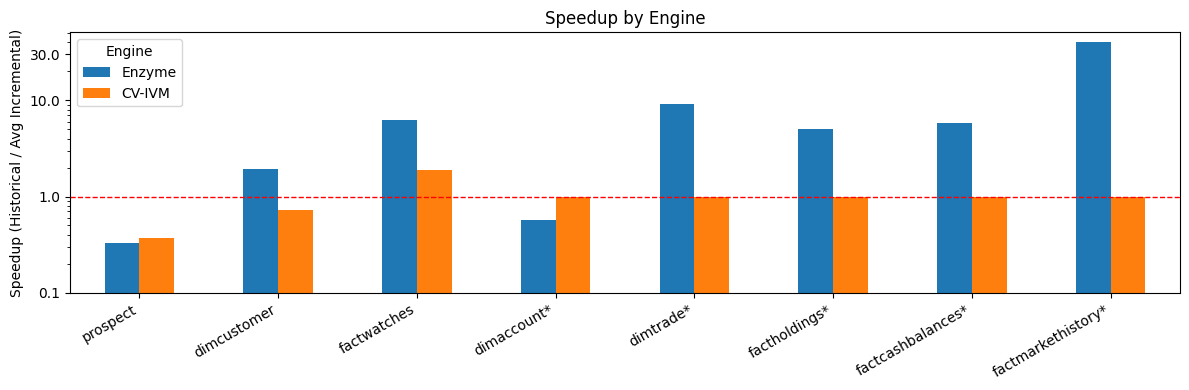
  • Support for extensive MV patterns: Enzyme incrementally maintains complex MVs in production including those with joins, window functions, aggregations, and their combinations. Unlike other industry solutions, Enzyme also supports non-deterministic functions such as current_date() and AI specific functions.
  • Multi-language support: While most industry solutions just focus on SQL, Enzyme supports MVs specified in Python as well. Python is now the language of choice for most data engineering and AI workloads. Enzyme solves many interesting challenges that multi-language support entails such as accurately detecting changes in MV definition. 
  • Performance optimizations: Enzyme has multiple optimizations to reduce the amount of data that needs to be processed including techniques that automatically determine if updates should be applied at partition level instead of row level thus reducing rewrite overheads. It selectively caches intermediate results to reduce IO costs. It uses a cost model that leverages plan information and prior executions to determine the most efficient incrementalization strategy. 

Figure 1: Enzyme has significantly better performance than another competing industry solution (name anonymized to CV-IVM due to licensing restrictions).

Figure 1: Enzyme has significantly better performance than another competing industry solution (name anonymized to CV-IVM due to licensing restrictions).

Interested in learning more? Check out the paper and if you're at SIGMOD, attend our talk for more details.

Meet the team at SIGMOD:

Stop by our booth to meet the team and learn more about the innovation that is happening at Databricks. Plus, don’t miss the chance to hear directly from Ritwik Yadav, during his presentation at SIGMOD!