




惯性聚合 高效追踪和阅读你感兴趣的博客、新闻、科技资讯
阅读原文 在惯性聚合中打开

推荐订阅源

量子位
Google DeepMind News
爱范儿
爱范儿
OSCHINA 社区最新新闻
OSCHINA 社区最新新闻
NISL@THU
NISL@THU
T
Threat Research - Cisco Blogs
freeCodeCamp Programming Tutorials: Python, JavaScript, Git & More
L
Lohrmann on Cybersecurity
V
Visual Studio Blog
Cyberwarzone
Cyberwarzone
D
Docker
The Hacker News
The Hacker News
C
CERT Recently Published Vulnerability Notes
Vercel News
Vercel News
Project Zero
Project Zero
S
Schneier on Security
aimingoo的专栏
aimingoo的专栏
I
Intezer
腾讯CDC
M
MIT News - Artificial intelligence
Hugging Face - Blog
Hugging Face - Blog
P
Palo Alto Networks Blog
C
CXSECURITY Database RSS Feed - CXSecurity.com
AWS News Blog
AWS News Blog
GbyAI
GbyAI
MongoDB | Blog
MongoDB | Blog
Cyber Security Advisories - MS-ISAC
V
Vulnerabilities – Threatpost
G
Google Developers Blog
N
Netflix TechBlog - Medium
The Cloudflare Blog
Microsoft Security Blog
Y
Y Combinator Blog
A
Arctic Wolf
S
Securelist
酷 壳 – CoolShell
酷 壳 – CoolShell
Cisco Talos Blog
Cisco Talos Blog
Recent Announcements
C
Cyber Attacks, Cyber Crime and Cyber Security
L
LINUX DO - 热门话题
T
Threatpost
Latest news
Latest news
Blog — PlanetScale
Blog — PlanetScale
Security Latest
Security Latest
Engineering at Meta
Engineering at Meta
大猫的无限游戏
大猫的无限游戏
H
Help Net Security
The GitHub Blog
The GitHub Blog
T
Tor Project blog
P
Proofpoint News Feed

Databricks

How lakebase architecture delivers 5x faster Postgres writes Why Talent Transformation Is the Missing Focus of Enterprise AI Public Health Intelligence Shouldn't Require a Data Scientist Mean Time to Detect Is a Data Access Problem First-party audience data is the ad sales relationship now Rethinking Distributed Systems for Serverless Performance and Reliability The AI Scaling Gap Hiding in Digital Native Companies 10 trillion samples a day: Scaling beyond traditional monitoring infra at Databricks AI success starts with clean data, not just better models How nOps Rebuilt Their Cloud Optimization Platform on Databricks Lakebase, and Why Other ISVs Should Too Peril Predicts: Precision Payouts for a Volatile World The foundation of AI scalability: one team, one platform, one operating model The Federal Data Paradox: Rich in Data, Poor in Access Driving Budapest Forward: How BKK Uses Databricks to Transform City Mobility LLM Vs AI: A Practical Guide to Differences, Use Cases, and Tools Model Risk Governance Is Not the Same as Risk Intelligence Generative AI for Business: A Complete Strategy and Implementation Guide Data Science vs Data Engineering: Choosing Analysis or Infrastructure AI Applications: Tools, Use Cases, and Platforms MLOps vs DevOps: A Practical Guide for Data Scientists and IT Teams Top Data Warehouse Tools For Modern Data Analytics Unlocking SAP Business Context in Databricks with Semantic Metadata Delta Sharing The marketing activation gap has a fix: Databricks and Stitch partner to turn data infrastructure into marketing performance Alert Fatigue Is a Business Risk Shipping Faster isn’t Learning Faster Why Your OEE Dashboard Is Lying to You The Turbine That Tried to Tell You It Was Failing Predicting Readmissions Isn't Enough. Acting in Time Is. Clinical Trials Run Longer Than They Have To. That's a Patient Problem Network Quality Is a Revenue Problem, Not a Technical One Shelf Availability Starts with Better Demand Visibility When Predicting the Next Hit Requires More Than Intuition Approximate Answers, Exact Decisions: New Sketch Functions for Analytics Companies Winning with AI Built the Data Layer First Rethinking SQL ETL for modern data platforms Stripe data now available on Databricks via Databricks Marketplace Databricks and Stripe Projects: Infrastructure Built for Agents Agents are ready but your architecture probably isn't Interoperability Between Unity Catalog and Google BigQuery via Catalog Federation Built In, Not Bolted On: What AI-Native Actually Means in Cybersecurity Operationalizing AI for public sector fraud prevention From months to minutes: Building real-time clinical data pipelines with natural language Agentic Data Engineering with Genie Code and Lakeflow Securely send first-party conversion signals with Snapchat Conversions API on Databricks Marketplace How leading tech companies are killing the builder’s tax with Lakebase Inside one of the first production deployments of Lakebase: LangGuard's agentic workflow governance engine The next generation of Databricks Genie Model Risk Management in 2026: A Banker’s Guide to the Revised Interagency Guidance OpenAI GPT-5.5 now available on Databricks, fully-governed through Unity AI Gateway Operational databases: How they work and when to use them Databricks partners with OpenAI on GPT-5.5 Announcing the Public Preview of Lakeflow Designer Are LLM agents good at join order optimization? How conversational analytics removes the BI bottleneck How to transform document activation workflows with Genie and Agent Bricks Beyond the spreadsheet: how Databricks is delivering the modern CFO in Financial Services AI App Development: Guide To Building AI-Powered Apps IoT in Manufacturing: Strategy, Components, Use Cases, and Challenges Stop Hand-Coding Change Data Capture Pipelines Multimodal Data Integration: Production Architectures for Healthcare AI Personalization Strategies for Media Companies A Modern AI Risk Management Framework Introducing the Databricks Excel Add-in for Business Users Real-Time Decisioning for AI Agents: Why you Need a Customer Context Layer First A Practical Guide to LLM Fine Tuning AI Data Transformation Guide for Data Engineers and Data Scientists Concurrency Control in DBMS: How Locking, MVCC and Optimistic Strategies Keep Data Consistent Bridging data science and marketing: Databricks unveils Delta Sharing integration for Adobe Experience Platform and agentic marketing workflows Take Control: Customer-Managed Keys for Lakebase Postgres Get hands on with agents, vibe coding and more at Data+ AI Summit Mercedes-Benz Builds a Cross-Cloud Data Mesh with Delta Sharing and Intelligent Replication, Cutting Costs by 66% What Is a Transactional Database? Introducing Genie Agent Mode Governing coding agent sprawl with Unity AI Gateway Governing Coding Agent Sprawl with Unity AI Gateway What is pgvector? Banks Don’t Have an AI Problem – They Have a Data Platform Problem Open Platform, Unified Pipelines: Why dbt on Databricks is Accelerating Why Your Agents Can’t Read Enterprise Documents — and How to Fix It Building with Databricks Document Intelligence and Lakeflow Databricks on Google Cloud: Innovate Faster. Smarter. Together. Introducing the Databricks Connector for Google Sheets: Real-Time, Governed Lakehouse Data in the Sheets Users Love Unity AI Gateway: How to connect agents to external MCPs securely Expanding agent governance with Unity AI Gateway Agentic reasoning in practice: Making sense of structured and unstructured data Agent Bricks: The Governed Enterprise Agent Platform 8 AI and data trends shaping financial services in 2026 Building real-time product search on Databricks Lovable + Databricks: Build Data-Driven Apps at the Speed of Thought Memory scaling for AI agents Powering clinical research innovation: How TriNetX uses Databricks to accelerate drug development Database Branching in Postgres: Git-Style Workflows with Databricks Lakebase How Zalando built a unified data foundation for AI and analytics on Databricks The next era of the open lakehouse: Apache Iceberg™ v3 in Public Preview on Databricks How FSIs eliminate silos between clients, operations, and finance How MakeMyTrip achieved millisecond personalization at scale with Databricks A multi-agent approach to audience intelligence AiChemy: Next-generation agent with MCP, skills and custom data for drug discovery Accelerate business insights with Lakeflow Connect, now with a Free Tier Unlocking Next-Gen Customer Experiences with Data Intelligence for Marketing
Backstage with Lakebase
2026-04-30 · via Databricks

For thirty years, the operational database and the analytical database have been two artifacts, two governance planes, two budgets, and usually two on-call rotations, connected by an ETL job someone wrote in a hurry and nobody wants to own. That split was never a design choice; it was a physics constraint. OLTP and OLAP had genuinely different storage layouts, different compute profiles, and different failure modes, so we built two platforms and wired them together after the fact.

That constraint is dissolving. When storage is shared, compute is serverless and isolated per workload, and governance lives at the catalog layer, "operational" and "analytical" stop being architectural categories and start being access patterns against the same foundation.

To test whether that's actually true in practice, we took Backstage, Spotify's notoriously state-heavy Internal Developer Portal, ripped it off its standard Postgres database, and pointed it at Databricks Lakebase. Across this three-part series, we'll explore what happens to Deployment Cycles (Part 1), Governance (Part 2), and FinOps (Part 3) when you collapse the wall between the operational app and the data platform.

The Setup: Pointing Backstage at Lakebase

Lakebase exposes a serverless Postgres surface (leveraging Neon's architecture under the hood) that lives inside the Databricks Platform. Because it speaks wire-protocol Postgres, Backstage doesn't know or care that it isn't talking to RDS.

Getting it connected required pointing app-config.yaml at Lakebase and swapping Backstage's default in-memory search for PgSearchEngine. One immediate hurdle: Lakebase rejects classic Databricks Personal Access Tokens, expecting an OAuth JWT instead. The CLI provides databricks postgres generate-database-credential which generates a scoped, short-lived JWT for a specific endpoint, the intended approach for apps and CI. For this POC, we wrapped that command in a lightweight cron script that rewrote the DATABRICKS_TOKEN in our .env file every 50 minutes to handle the token expiration.

With auth sorted, the Knex migrations ran cleanly, and the portal was live.

Branching Changes the Database Development Cycle

The most underappreciated thing about a traditional Postgres isn't its feature set; it's the tempo it forces on the teams that own it.

Thoughtworks has been a consistent advocate for Backstage as an IDP foundation through the Technology Radar, so along with being very familiar with the tool, we chose Backstage for this POC because its schema migrations are notoriously fragile and it seemed like a perfect opportunity to test out a Lakebase integration. On traditional RDS, testing a risky migration means waiting minutes or hours for a snapshot to restore into a parallel instance. Because making a copy is slow and expensive, teams simply don't test. They cross their fingers and run the migration in a maintenance window.

When making a copy becomes free, you stop asking "is this change safe enough to run?" and start asking "which fork of production do I want to try it on first?"

Because Lakebase separates storage from compute using a copy-on-write architecture, creating a branch doesn't copy any data, it creates a pointer to the same underlying pages, and only diverges on write. That's why the operation is instant. 
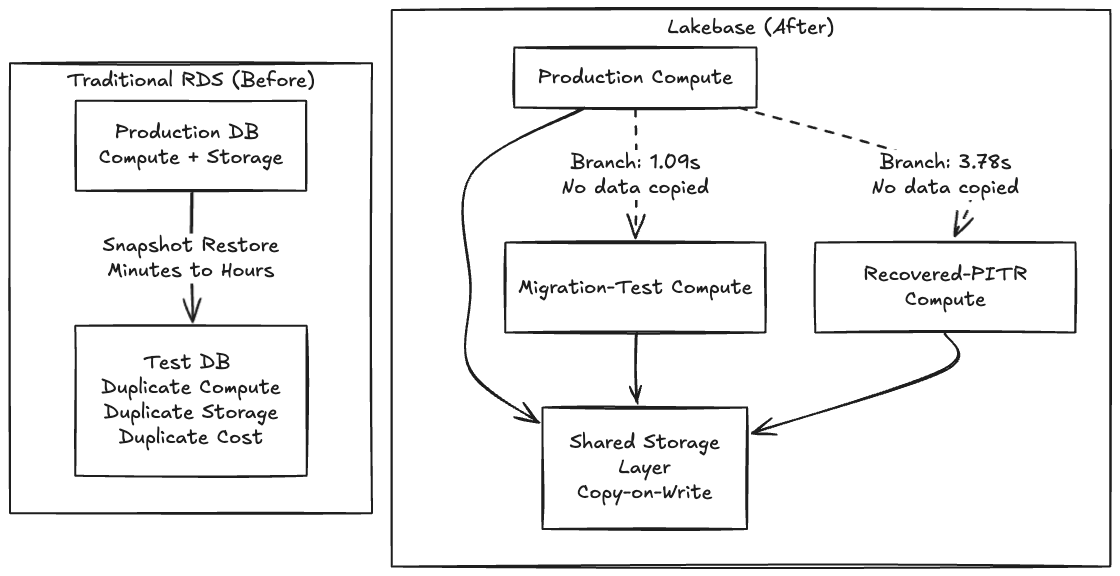
Because Lakebase separates storage from compute using a copy-on-write architecture, creating a branch doesn't copy any data, it creates a pointer to the same underlying pages, and only diverges on write

One gotcha the docs don’t make obvious: the request body must nest everything inside a spec object, and you must specify ttlexpire_time, or no_expiry. Without that, the API returns "Expiration must be specified."

The control plane acknowledged it instantly. The actual data-plane clone of the ~63 MB Backstage catalog landed in 1.09 seconds.

Point-in-Time Recovery: The Undo Button

Branching and Point-in-Time Recovery (PITR) are essentially the same primitive: branching is just PITR with source_branch_time = now. To test recovery against real deleted data, we wiped our final_entities table, dropping the count from 32 to 0.

We then created a recovery branch from a timestamp captured seconds before the delete:

The elapsed time end-to-end was 3.78 seconds.

Verifying the data confirmed the recovered branch had all 32 entities back; production was still at zero, confirming the delete was real and the branches are fully isolated. Notably, we asked for 22:56:02Z, but Lakebase snapped to 22:55:50Z, 12 seconds earlier, snapping backward to the nearest WAL record. This WAL-level granularity is an important caveat for time-sensitive recovery workflows, but the incident cycle still ran in under a minute.

When database state becomes a cheap, forkable artifact instead of a 2 TB EBS volume, every risky operation gets a dry run, and every incident gets an undo.

From Infrastructure Capability to Developer Workflow

As shown above, it proves that database branching works – a 1-second clone, a 4-second recovery, and a real application that doesn't know the difference. But there's a gap between "the database can branch" and "my team branches the database as naturally as they branch code." Closing that gap is where the massive impact on developer productivity can be realized in objective gains.

We’ve spent the last several months working with development teams to answer a specific question: what happens to a team's velocity when database branching becomes invisible – when it's not a CLI command you run, but something that happens automatically as part of how you already work in your editor of choice? Work is underway on a VS Code/Cursor extension that synchronizes git and database branches automatically to prove this out -- but the tooling is secondary to what it enables.

What Branching Enables

Across the teams we’ve had experience with, the sprint cycle without database branching looks like this: 

  1. Create a git branch for feature development
  2. Write mock objects for every database interface (MockUserRepository, MockOrderService...) for testing purposes
  3. Write unit tests with a mocked or in-memory database (H2, SQLite)
  4. Submit a PR, get it reviewed and merge code
  5. Deploy to a shared staging environment
  6. Discover that the schema migration doesn't work against real data or the size of data is a blocker
  7. Fix schema migration, redeploy, repeat

With the availability of database branching capability, a developers feature development cycle changes:

  1. Create a git branch – a Lakebase database branch can be created automatically in < 1 second
  2. Your IDE connects to the real branch database immediately
  3. Write code and run migrations against real live database data from the first line of code
  4. Write integration tests against the real database – not database mocks
  5. Multiple solutions can be experimented, since rollback of database changes is trivial 
  6. Push and open a PR – CI creates its own database branch, validates both code and schema, publishes a schema diff
  7. The QA team members can get their own database branch for destructive testing – can be reset in seconds
  8. Merge – Once merged the CD pipeline can migrate upstream environments like UAT and production and clean up all branches – code and data.

The mock objects disappear. The staging collisions disappear. The "works on my machine but breaks in staging" disappears, developers get a live database to try multiple solutions. The database changes that used to be discovered at deployment are now caught during development, where they're cheap to fix. Instant branches for Performance tests, disposable and isolated branches for Functional tests and a running branch for UAT stakeholders becomes trivial.

In our experience across multiple partner teams evaluating this workflow, mock objects account for 20-30% of test code. That's not test coverage -- it's test infrastructure. Infrastructure that diverges from production behavior over time, creating false confidence. When branching a production-equivalent database costs nothing, mocking becomes the expensive choice.

The question now is how much of your sprint are you spending on workarounds for a constraint that no longer exists.

In Part 2 of this series, we will look at what happens to security and compliance when this operational database gets absorbed directly into Unity Catalog, Databrick’s unified governance layer.