

惯性聚合 高效追踪和阅读你感兴趣的博客、新闻、科技资讯
阅读原文 在惯性聚合中打开

推荐订阅源

Project Zero
Project Zero
宝玉的分享
宝玉的分享
C
Check Point Blog
freeCodeCamp Programming Tutorials: Python, JavaScript, Git & More
博客园 - 【当耐特】
人人都是产品经理
人人都是产品经理
T
Tailwind CSS Blog
IT之家
IT之家
The Cloudflare Blog
V
V2EX
雷峰网
雷峰网
www.infosecurity-magazine.com
P
Proofpoint News Feed
I
Intezer
C
Cybersecurity and Infrastructure Security Agency CISA
美团技术团队
P
Privacy International News Feed
Apple Machine Learning Research
G
GRAHAM CLULEY
C
CXSECURITY Database RSS Feed - CXSecurity.com
C
Cisco Blogs
Simon Willison's Weblog
T
The Exploit Database - CXSecurity.com
TaoSecurity Blog
TaoSecurity Blog
O
OpenAI News
Security Latest
Security Latest
V2EX - 技术
V2EX - 技术
S
SegmentFault 最新的问题
博客园_首页
H
Hacker News: Front Page
有赞技术团队
有赞技术团队
博客园 - 聂微东
AWS News Blog
AWS News Blog
博客园 - 司徒正美
T
Threat Research - Cisco Blogs
K
Kaspersky official blog
N
News and Events Feed by Topic
K
KPMG report finds enterprise disconnect between AI and its ROI | CIO
T
Threatpost
The Last Watchdog
The Last Watchdog
S
Security Affairs
Application and Cybersecurity Blog
Schneier on Security
S
Secure Thoughts
奇客Solidot–传递最新科技情报
奇客Solidot–传递最新科技情报
PCI Perspectives
PCI Perspectives
让小产品的独立变现更简单 - ezindie.com
H
Heimdal Security Blog
博客园 - 叶小钗
罗磊的独立博客

Databricks

Why Talent Transformation Is the Missing Focus of Enterprise AI Public Health Intelligence Shouldn't Require a Data Scientist Mean Time to Detect Is a Data Access Problem First-party audience data is the ad sales relationship now Rethinking Distributed Systems for Serverless Performance and Reliability The AI Scaling Gap Hiding in Digital Native Companies 10 trillion samples a day: Scaling beyond traditional monitoring infra at Databricks AI success starts with clean data, not just better models How nOps Rebuilt Their Cloud Optimization Platform on Databricks Lakebase, and Why Other ISVs Should Too Peril Predicts: Precision Payouts for a Volatile World The foundation of AI scalability: one team, one platform, one operating model The Federal Data Paradox: Rich in Data, Poor in Access Driving Budapest Forward: How BKK Uses Databricks to Transform City Mobility LLM Vs AI: A Practical Guide to Differences, Use Cases, and Tools Model Risk Governance Is Not the Same as Risk Intelligence Generative AI for Business: A Complete Strategy and Implementation Guide Data Science vs Data Engineering: Choosing Analysis or Infrastructure AI Applications: Tools, Use Cases, and Platforms MLOps vs DevOps: A Practical Guide for Data Scientists and IT Teams Top Data Warehouse Tools For Modern Data Analytics Unlocking SAP Business Context in Databricks with Semantic Metadata Delta Sharing The marketing activation gap has a fix: Databricks and Stitch partner to turn data infrastructure into marketing performance Alert Fatigue Is a Business Risk Backstage with Lakebase Shipping Faster isn’t Learning Faster Why Your OEE Dashboard Is Lying to You The Turbine That Tried to Tell You It Was Failing Predicting Readmissions Isn't Enough. Acting in Time Is. Clinical Trials Run Longer Than They Have To. That's a Patient Problem Network Quality Is a Revenue Problem, Not a Technical One Shelf Availability Starts with Better Demand Visibility When Predicting the Next Hit Requires More Than Intuition Approximate Answers, Exact Decisions: New Sketch Functions for Analytics Companies Winning with AI Built the Data Layer First Rethinking SQL ETL for modern data platforms Stripe data now available on Databricks via Databricks Marketplace Databricks and Stripe Projects: Infrastructure Built for Agents Agents are ready but your architecture probably isn't Interoperability Between Unity Catalog and Google BigQuery via Catalog Federation Built In, Not Bolted On: What AI-Native Actually Means in Cybersecurity Operationalizing AI for public sector fraud prevention From months to minutes: Building real-time clinical data pipelines with natural language Agentic Data Engineering with Genie Code and Lakeflow Securely send first-party conversion signals with Snapchat Conversions API on Databricks Marketplace How leading tech companies are killing the builder’s tax with Lakebase Inside one of the first production deployments of Lakebase: LangGuard's agentic workflow governance engine The next generation of Databricks Genie Model Risk Management in 2026: A Banker’s Guide to the Revised Interagency Guidance OpenAI GPT-5.5 now available on Databricks, fully-governed through Unity AI Gateway Operational databases: How they work and when to use them Databricks partners with OpenAI on GPT-5.5 Announcing the Public Preview of Lakeflow Designer Are LLM agents good at join order optimization? How conversational analytics removes the BI bottleneck How to transform document activation workflows with Genie and Agent Bricks Beyond the spreadsheet: how Databricks is delivering the modern CFO in Financial Services AI App Development: Guide To Building AI-Powered Apps IoT in Manufacturing: Strategy, Components, Use Cases, and Challenges Stop Hand-Coding Change Data Capture Pipelines Multimodal Data Integration: Production Architectures for Healthcare AI Personalization Strategies for Media Companies A Modern AI Risk Management Framework Introducing the Databricks Excel Add-in for Business Users Real-Time Decisioning for AI Agents: Why you Need a Customer Context Layer First A Practical Guide to LLM Fine Tuning AI Data Transformation Guide for Data Engineers and Data Scientists Concurrency Control in DBMS: How Locking, MVCC and Optimistic Strategies Keep Data Consistent Bridging data science and marketing: Databricks unveils Delta Sharing integration for Adobe Experience Platform and agentic marketing workflows Take Control: Customer-Managed Keys for Lakebase Postgres Get hands on with agents, vibe coding and more at Data+ AI Summit Mercedes-Benz Builds a Cross-Cloud Data Mesh with Delta Sharing and Intelligent Replication, Cutting Costs by 66% What Is a Transactional Database? Introducing Genie Agent Mode Governing coding agent sprawl with Unity AI Gateway Governing Coding Agent Sprawl with Unity AI Gateway What is pgvector? Banks Don’t Have an AI Problem – They Have a Data Platform Problem Open Platform, Unified Pipelines: Why dbt on Databricks is Accelerating Why Your Agents Can’t Read Enterprise Documents — and How to Fix It Building with Databricks Document Intelligence and Lakeflow Databricks on Google Cloud: Innovate Faster. Smarter. Together. Introducing the Databricks Connector for Google Sheets: Real-Time, Governed Lakehouse Data in the Sheets Users Love Unity AI Gateway: How to connect agents to external MCPs securely Expanding agent governance with Unity AI Gateway Agentic reasoning in practice: Making sense of structured and unstructured data Agent Bricks: The Governed Enterprise Agent Platform 8 AI and data trends shaping financial services in 2026 Building real-time product search on Databricks Lovable + Databricks: Build Data-Driven Apps at the Speed of Thought Memory scaling for AI agents Powering clinical research innovation: How TriNetX uses Databricks to accelerate drug development Database Branching in Postgres: Git-Style Workflows with Databricks Lakebase How Zalando built a unified data foundation for AI and analytics on Databricks The next era of the open lakehouse: Apache Iceberg™ v3 in Public Preview on Databricks How FSIs eliminate silos between clients, operations, and finance How MakeMyTrip achieved millisecond personalization at scale with Databricks A multi-agent approach to audience intelligence AiChemy: Next-generation agent with MCP, skills and custom data for drug discovery Accelerate business insights with Lakeflow Connect, now with a Free Tier Unlocking Next-Gen Customer Experiences with Data Intelligence for Marketing
Databricks and NVIDIA: Building for the Agentic Era
Hanlin Tang · 2026-06-18 · via Databricks

The Full Stack of AI, Accelerated

NVIDIA accelerated computing powers some of the most demanding AI workloads on Databricks, from large-scale training, fine-tuning, and inference to industry-specific AI solutions. Today at Data + AI Summit, we're highlighting how NVIDIA AI infrastructure lies at the center of new announcements from Databricks AI Runtime, Model Serving, and Industry AI solutions, including a look at how the new NVIDIA Vera CPU will power the next generation of agentic infrastructure.

"Our partnership with NVIDIA spans the full AI lifecycle. From NVIDIA accelerated infrastructure powering distributed training in AI Runtime to software running inside our serving and developer platforms. We're excited to combine NVIDIA technology with the data and governance capabilities of Databricks to unlock incredible value for our customers: enterprise AI that's fast, scalable, and built on a foundation they can trust."— Adam Conway, SVP, Product, Databricks
“Databricks enables enterprises to build, deploy, scale and govern AI agents that are informed by their most valuable resource: business data. Through our expanded partnership, NVIDIA and Databricks are supercharging the next wave of enterprise AI by embedding full-stack NVIDIA accelerated computing with Vera CPUs, Rubin GPUs, NVIDIA Quantum InfiniBand networking and NVIDIA Agent Toolkit software into the Databricks platform.”— Pat Lee, Vice President, Enterprise Strategic Partnerships, NVIDIA

Here's how Databricks and NVIDIA are building an AI platform together, from GPUs for training and inference, to purpose-built CPUs for the agentic era.

1. Training and Fine-Tuning

Databricks AI Runtime (AIR) brings NVIDIA GPU acceleration directly to data and AI teams, so they can train and fine-tune models on governed enterprise data without managing separate GPU infrastructure. With AIR, customers obtain the advanced NVIDIA hardware and networking, directly where their governed data is on Databricks:
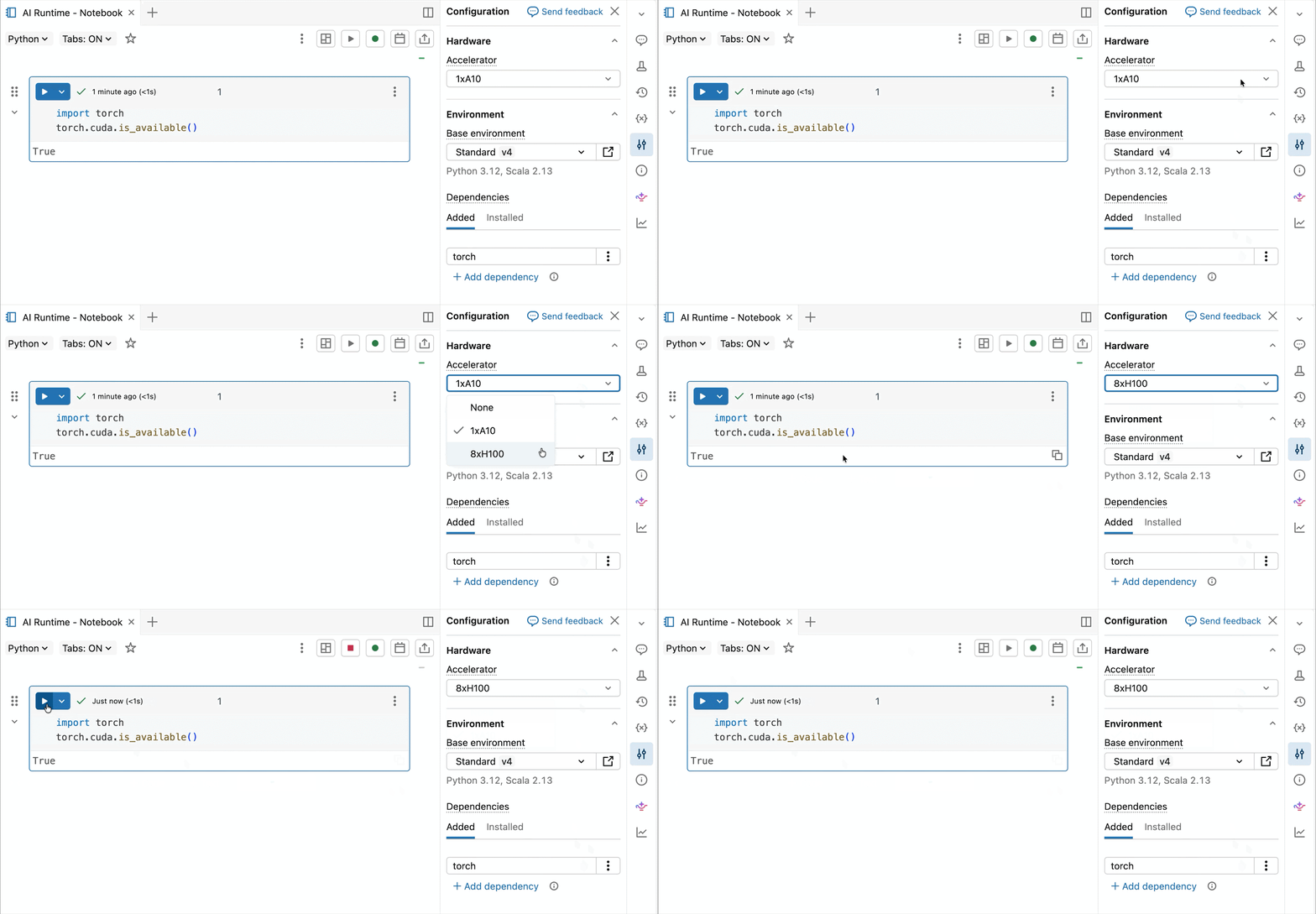
  • NVIDIA Hopper GPUs with NVIDIA Quantum InfiniBand: purpose-built for multi-node distributed training. Whether you're pre-training a foundation model or running large-scale fine-tuning, AIR provides built-in support for NVIDIA’s high-bandwidth, low-latency GPU interconnects (RDMA-capable networking) that eliminate communication bottlenecks across nodes. AIR is also being prepared for the NVIDIA Blackwell architecture, ensuring customers are always on the leading edge of accelerated computing.
  • NVIDIA GPUs in Free Edition: at DAIS, we’re excited to announce the support of GPUs within Databricks Free Edition, supporting developers, students, and startups worldwide to build and deploy their AI workloads on GPUs.
  • Support for NVIDIA containers: Soon, Databricks will support NGC containers and custom NVIDIA CUDA environments, enabling them to run natively on data within the platform.

AI Runtime enables seamless access to NVIDIA GPUs within Databricks.

AI Runtime enables seamless access to NVIDIA GPUs within Databricks.

2. Inference: NVIDIA Acceleration in Databricks Model Serving

Databricks Model Serving powers production inference for thousands of Databricks customers. At the core of Model Serving, NVIDIA hardware and software deliver the low-latency, high-throughput inference at scale our customers need, across frontier models like Qwen, GPT-OSS and custom neural networks our customers build. Additional serving capabilities include NVIDIA hardware and Triton Inference Server. Model Serving supports leading inference-optimized GPUs with Triton's advanced dynamic batching and optimized performance coming soon. With Model Serving, customers can serve the models they train on NVIDIA hardware directly on managed Databricks infrastructure.

3. Agentic infrastructure: exploring NVIDIA Vera for the next compute bottleneck

The rise of autonomous agents introduces a new infrastructure challenge. While GPUs excel at model inference, the agent harness, tool calls, CPU-powered analytics and managing multi-step reasoning, all run on CPUs. Today's CPUs are often the bottleneck: latency in tool calling, communication overhead between agent steps, and inconsistent performance under load all degrade the agentic experience.

NVIDIA Vera is a next-generation CPU designed specifically for this workload. Engineered for three core use cases, agentic workloads, reinforcement learning, and CPU-based data analytics, Vera delivers:

  • High-performance NVIDIA-designed, Arm-compatible cores that deliver up to 3x faster SQL queries and 80% faster agentic performance, optimized for the latency-sensitive, bursty compute patterns such as tool calls and agent orchestration
  • Massive memory bandwidth for the data-intensive operations that agents perform between model calls
  • Fast core-to-core communication helping deliver predictable performance as agent complexity scales

The vision is an end-to-end NVIDIA-accelerated stack on Databricks: models run on NVIDIA GPUs for inference, while the agent harness and tool calls could run on Vera CPUs, each workload on silicon purpose-built for its characteristics. Developers customize models on Databricks using proprietary data, deploy them via Model Serving, and the surrounding agentic infrastructure runs on compute designed from the ground up for that exact pattern.

4. Developer experience: making accelerated AI easier to build

NVIDIA Agent Toolkit: Deploy on Databricks

Built on Databricks Apps, teams can host and run NVIDIA Agent Toolkit, NVIDIA's open source development platform for building, customizing, and deploying agentic AI workflows, directly within their Databricks environment. This means you get:

  • NVIDIA Agent Toolkit capabilities: guardrails, tool use, retrieval-augmented generation, and multi-step reasoning, running in applications hosted on Databricks.
  • Databricks Apps as the hosting layer: deploy any codebase, including agents or services built with NVIDIA Agent Toolkit, as managed applications with built-in authentication, networking, and governance through Unity Catalog.
  • Seamless integration with Databricks' data, models, and serving infrastructure. Your agents can access governed data, call models via FMAPI, and leverage the full platform without leaving the environment.

Using Genie Code for GPU Workloads

GPUs are powerful, but getting great utilization, diagnosing performance issues, and debugging workloads has traditionally required deep systems expertise. We're changing that with an agent-first approach:

Genie Code supports skills designed around NVIDIA hardware and software. Developers can:

  • Debug GPU workloads conversationally: describe the issue, get actionable guidance
  • Performance-optimize: identify utilization bottlenecks, memory issues, and communication overhead
  • Leverage NVIDIA-specific knowledge: skills that understand CUDA, cuDNN, NCCL, and NVIDIA profiling tools

Genie Code and NVIDIA debugging tools are also fully integrated with various Databricks product surfaces, including:
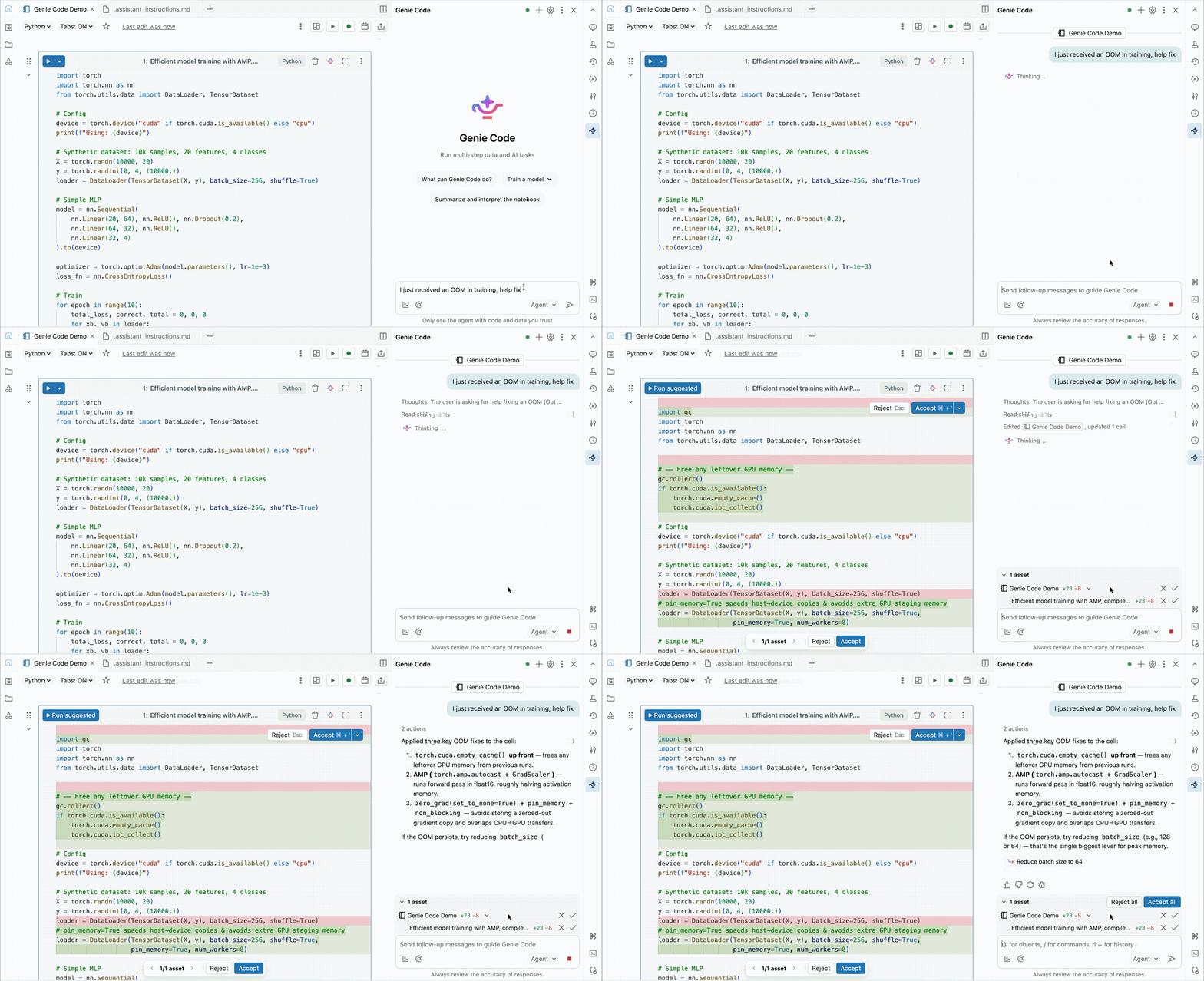
  • Notebooks: first-class GPU monitoring, profiling, and debugging in the notebook environment
  • MLflow: track GPU metrics and utilization alongside experiments
  • Model Serving: diagnose endpoint health and GPU performance, identify opportunities to optimize endpoint mechanics like autoscaling

image2.gif

5. Industry AI: NVIDIA software on governed Databricks data

Every industry faces unique computational challenges shaped by the data it generates and the models it builds. These challenges span everything from analyzing genomes and accelerating drug discovery to optimizing supply chains, interpreting medical images, and simulating factories, robots, and digital twins.

To help solve these problems, NVIDIA has invested heavily in domain-specific accelerated computing libraries and frameworks. We're excited to bring these capabilities directly into the Databricks platform.

Customers can leverage NVIDIA's accelerated computing stack across the end-to-end Databricks experience – from data engineering and experimentation to model development and production workflows; and now domain-specific R&D teams can use NVIDIA's accelerated capabilities without leaving the Databricks platform.

The partnership extends across NVIDIA's accelerated computing libraries and domain frameworks that customers can use with Databricks for industry-specific AI workloads:

DomainNVIDIA IntegrationCapability
Medical ImagingNVIDIA MONAIAI-powered medical image analysis and annotation
Image ProcessingNVIDIA nvImageCodecHardware-accelerated image encoding/decoding
Drug Discovery & BiologyNVIDIA BioNeMoGenerative AI for biomolecular design
Protein & Molecular ModelingNVIDIA Proteina-ComplexaProtein structure prediction and molecular interaction modeling
GenomicsNVIDIA ParabricksGPU-accelerated genomic analysis pipelines
Single CellNVIDIA cuMLGPU-accelerated single cell analysis with rapids-singlecell (scverse)
Decision OptimizationNVIDIA cuOptGPU-accelerated mathematical optimization including linear programming, mixed-integer programming, quadratic programming and routing
Simulation & RoboticsNVIDIA Isaac SimPhysically accurate simulation for robotics
Digital Twins & 3D SimulationNVIDIA OmniverseIndustrial digital twin creation and visualization
Document IntelligenceNemotron ParseHigh-accuracy document parsing and extraction

Looking Ahead: Building for the Agentic Era

NVIDIA AI infrastructure supports critical layers of AI on Databricks: the GPUs powering training and inference, the Vera CPUs that will power your agent orchestration and data analytics, the NVIDIA Agent Toolkit enabling your agentic applications, and the developer tools that help you get the most out of every compute cycle.

Whether you're a startup experimenting with your first GPU workload in Free Edition, a pharma company running BioNeMo for drug discovery, or an enterprise deploying frontier models at scale, Databricks and NVIDIA together deliver the performance, simplicity, and governance you need.

Get started today: try NVIDIA GPUs in Databricks Free Edition, deploy NVIDIA Agent Toolkit on Databricks Apps, or explore our Foundation Model API powered by NVIDIA accelerated computing.