


惯性聚合 高效追踪和阅读你感兴趣的博客、新闻、科技资讯
阅读原文 在惯性聚合中打开

推荐订阅源

T
Troy Hunt's Blog
GbyAI
GbyAI
大猫的无限游戏
大猫的无限游戏
Apple Machine Learning Research
爱范儿
爱范儿
OSCHINA 社区最新新闻
OSCHINA 社区最新新闻
博客园 - 三生石上(FineUI控件)
罗磊的独立博客
Know Your Adversary
Know Your Adversary
Project Zero
Project Zero
G
GRAHAM CLULEY
T
Threatpost
T
Threat Research - Cisco Blogs
博客园 - 叶小钗
雷峰网
雷峰网
Hugging Face - Blog
Hugging Face - Blog
钛媒体:引领未来商业与生活新知
钛媒体:引领未来商业与生活新知
Threat Intelligence Blog | Flashpoint
IT之家
IT之家
月光博客
月光博客
C
CXSECURITY Database RSS Feed - CXSecurity.com
W
WeLiveSecurity
阮一峰的网络日志
阮一峰的网络日志
C
Cisco Blogs
S
Schneier on Security
cs.AI updates on arXiv.org
V
Visual Studio Blog
宝玉的分享
宝玉的分享
Recent Commits to openclaw:main
Last Week in AI
Last Week in AI
T
Tenable Blog
V
V2EX
I
Intezer
T
Tailwind CSS Blog
博客园_首页
S
Security @ Cisco Blogs
量子位
PCI Perspectives
PCI Perspectives
cs.CV updates on arXiv.org
D
Darknet – Hacking Tools, Hacker News & Cyber Security
人人都是产品经理
人人都是产品经理
SecWiki News
SecWiki News
小众软件
小众软件
Spread Privacy
Spread Privacy
D
DataBreaches.Net
Cyber Security Advisories - MS-ISAC
P
Palo Alto Networks Blog
T
The Exploit Database - CXSecurity.com
Application and Cybersecurity Blog
C
CERT Recently Published Vulnerability Notes

Databricks

Why Talent Transformation Is the Missing Focus of Enterprise AI Public Health Intelligence Shouldn't Require a Data Scientist Mean Time to Detect Is a Data Access Problem First-party audience data is the ad sales relationship now Rethinking Distributed Systems for Serverless Performance and Reliability The AI Scaling Gap Hiding in Digital Native Companies 10 trillion samples a day: Scaling beyond traditional monitoring infra at Databricks AI success starts with clean data, not just better models How nOps Rebuilt Their Cloud Optimization Platform on Databricks Lakebase, and Why Other ISVs Should Too Peril Predicts: Precision Payouts for a Volatile World The foundation of AI scalability: one team, one platform, one operating model The Federal Data Paradox: Rich in Data, Poor in Access Driving Budapest Forward: How BKK Uses Databricks to Transform City Mobility LLM Vs AI: A Practical Guide to Differences, Use Cases, and Tools Model Risk Governance Is Not the Same as Risk Intelligence Generative AI for Business: A Complete Strategy and Implementation Guide Data Science vs Data Engineering: Choosing Analysis or Infrastructure AI Applications: Tools, Use Cases, and Platforms MLOps vs DevOps: A Practical Guide for Data Scientists and IT Teams Top Data Warehouse Tools For Modern Data Analytics Unlocking SAP Business Context in Databricks with Semantic Metadata Delta Sharing The marketing activation gap has a fix: Databricks and Stitch partner to turn data infrastructure into marketing performance Alert Fatigue Is a Business Risk Backstage with Lakebase Shipping Faster isn’t Learning Faster Why Your OEE Dashboard Is Lying to You The Turbine That Tried to Tell You It Was Failing Predicting Readmissions Isn't Enough. Acting in Time Is. Clinical Trials Run Longer Than They Have To. That's a Patient Problem Network Quality Is a Revenue Problem, Not a Technical One Shelf Availability Starts with Better Demand Visibility When Predicting the Next Hit Requires More Than Intuition Approximate Answers, Exact Decisions: New Sketch Functions for Analytics Companies Winning with AI Built the Data Layer First Rethinking SQL ETL for modern data platforms Stripe data now available on Databricks via Databricks Marketplace Databricks and Stripe Projects: Infrastructure Built for Agents Agents are ready but your architecture probably isn't Interoperability Between Unity Catalog and Google BigQuery via Catalog Federation Built In, Not Bolted On: What AI-Native Actually Means in Cybersecurity Operationalizing AI for public sector fraud prevention From months to minutes: Building real-time clinical data pipelines with natural language Agentic Data Engineering with Genie Code and Lakeflow Securely send first-party conversion signals with Snapchat Conversions API on Databricks Marketplace How leading tech companies are killing the builder’s tax with Lakebase Inside one of the first production deployments of Lakebase: LangGuard's agentic workflow governance engine The next generation of Databricks Genie Model Risk Management in 2026: A Banker’s Guide to the Revised Interagency Guidance OpenAI GPT-5.5 now available on Databricks, fully-governed through Unity AI Gateway Operational databases: How they work and when to use them Databricks partners with OpenAI on GPT-5.5 Announcing the Public Preview of Lakeflow Designer Are LLM agents good at join order optimization? How conversational analytics removes the BI bottleneck How to transform document activation workflows with Genie and Agent Bricks Beyond the spreadsheet: how Databricks is delivering the modern CFO in Financial Services AI App Development: Guide To Building AI-Powered Apps IoT in Manufacturing: Strategy, Components, Use Cases, and Challenges Stop Hand-Coding Change Data Capture Pipelines Multimodal Data Integration: Production Architectures for Healthcare AI Personalization Strategies for Media Companies A Modern AI Risk Management Framework Introducing the Databricks Excel Add-in for Business Users Real-Time Decisioning for AI Agents: Why you Need a Customer Context Layer First A Practical Guide to LLM Fine Tuning AI Data Transformation Guide for Data Engineers and Data Scientists Concurrency Control in DBMS: How Locking, MVCC and Optimistic Strategies Keep Data Consistent Bridging data science and marketing: Databricks unveils Delta Sharing integration for Adobe Experience Platform and agentic marketing workflows Take Control: Customer-Managed Keys for Lakebase Postgres Get hands on with agents, vibe coding and more at Data+ AI Summit Mercedes-Benz Builds a Cross-Cloud Data Mesh with Delta Sharing and Intelligent Replication, Cutting Costs by 66% What Is a Transactional Database? Introducing Genie Agent Mode Governing coding agent sprawl with Unity AI Gateway Governing Coding Agent Sprawl with Unity AI Gateway What is pgvector? Banks Don’t Have an AI Problem – They Have a Data Platform Problem Open Platform, Unified Pipelines: Why dbt on Databricks is Accelerating Why Your Agents Can’t Read Enterprise Documents — and How to Fix It Building with Databricks Document Intelligence and Lakeflow Databricks on Google Cloud: Innovate Faster. Smarter. Together. Introducing the Databricks Connector for Google Sheets: Real-Time, Governed Lakehouse Data in the Sheets Users Love Unity AI Gateway: How to connect agents to external MCPs securely Expanding agent governance with Unity AI Gateway Agentic reasoning in practice: Making sense of structured and unstructured data Agent Bricks: The Governed Enterprise Agent Platform 8 AI and data trends shaping financial services in 2026 Building real-time product search on Databricks Lovable + Databricks: Build Data-Driven Apps at the Speed of Thought Memory scaling for AI agents Powering clinical research innovation: How TriNetX uses Databricks to accelerate drug development Database Branching in Postgres: Git-Style Workflows with Databricks Lakebase How Zalando built a unified data foundation for AI and analytics on Databricks The next era of the open lakehouse: Apache Iceberg™ v3 in Public Preview on Databricks How FSIs eliminate silos between clients, operations, and finance How MakeMyTrip achieved millisecond personalization at scale with Databricks A multi-agent approach to audience intelligence AiChemy: Next-generation agent with MCP, skills and custom data for drug discovery Accelerate business insights with Lakeflow Connect, now with a Free Tier Unlocking Next-Gen Customer Experiences with Data Intelligence for Marketing
What’s New in the AI Platform: Agents for ML Engineering, Our Deep Learning Platform, and New Capabilities for Real-Time ML
Tejas Sundaresan · 2026-06-17 · via Databricks

There’s never been a more dynamic, exciting time to be building your own AI models and systems. From demand forecasting and fraud detection to search, recommendations, personalization, and multimodal AI, machine learning is powering critical applications across every industry.

At Data + AI Summit 2026, we're thrilled to announce the following new capabilities within the Databricks AI Platform:

  • Genie Code for ML: Genie Code now comes with upgraded intelligence for ML engineering and native integrations across every Databricks ML Platform component: feature engineering, model training, serving, and monitoring.
  • AI Runtime (Public Preview): a serverless GPU training environment, enabling research-grade deep learning and fine-tuning without complex infrastructure management.
  • Enhanced Support for Real-time ML: including low-latency, high QPS support across our Feature Store and Model Serving products.

Together, these capabilities streamline the path from experimentation to production, enabling organizations to build, deploy, and scale AI applications an significantly faster than ever before.

Let's take a closer look at what's new.

Genie Code for Machine Learning

Today, bringing an ML model to production can take months, with teams spending countless hours on repetitive tasks across the ML lifecycle—from feature engineering and experiment management to model evaluation, and deployment. But agents have transformed how engineering and technical teams operate. To that end, at DAIS this year, we’re excited to announce Genie Code’s support for the entire ML lifecycle.

Building and operating ML models takes nuanced decisions that generic coding agents can't make. Can I rely on this dataset’s freshness and quality as a feature? Will this feature leak future information into the model? Is this serving endpoint starting to drift? Getting the details in ML right requires deep context, and that context only comes from tight integration with the data and ML platform: your data and its quality, feature lineage, experiment history, training infrastructure, and production performance.

That's where Genie Code comes in:

  • Context on your data via Unity Catalog: Genie Code understands your data, business semantics, and governance model. Through its integration with Unity Catalog, it knows which tables and features are high quality for ML, how data flows through your ML pipelines, and what access controls and policies must be respected.
  • Context on the Databricks ML stack: Genie Code is built for ML on Databricks and integrates deeply with Feature Store, Serverless Compute, AI Runtime, Model Serving, and Inference Tables. It can optimize training jobs, diagnose serving issues, evaluate challenger models, and take action across the ML stack, not just generate code that interacts with it.
  • Context on your ML lifecycle and workflows: Through MLflow, Genie Code understands the full ML lifecycle, from feature engineering and experimentation to deployment, monitoring, drift detection, retraining, and production operations. It doesn't stop when a model is shipped; it helps ensure the business metrics that model drives, such as CTR, conversion, or revenue, stay healthy in production.

And so, with Genie Code, your ML teams can move faster than ever before.

Genie Code handles feature engineering the way your senior ML engineer would—learning your team's existing patterns, reusing proven transformations, and building features that are consistent with what's already in production.

Genie Code doesn't just write ML code—it trains and tunes production-grade models. It automatically selects and configures the right infrastructure, whether that's CPU for lightweight experiments or GPU for distributed training, and logs every run natively to MLflow.

Genie Code takes models from notebook to production in one flow—registering to Unity Catalog, deploying to a serving endpoint, and keeping governance intact every step of the way.

Genie Code has completely changed how I work. I run upwards of 15 parallel threads scoped to different notebooks and assets every day, and managing all of that across tabs is one of the biggest sources of friction in my workflow. Full page Genie Code with concurrent sessions would give me a true workspace for running everything in parallel without constantly losing context.— Moritz Schiek, Solution Consultant, Bosch
With Genie Code, we moved from raw data to a governed, production-ready ML workflow in 90 minutes. Because it uniquely understands production ML workflows on Databricks, it helped us create Delta tables, explore the data, train and compare models, register them with MLflow and Unity Catalog, and deploy the champion model to a serving endpoint, with time left to optimize for the business outcome that mattered most.— Radu Dragusin, Principal Engineer, Data & AI, Danfoss

To learn more about Genie Code, please get started here!

Introducing AI Runtime: A Research Grade GPU Platform within the Lakehouse

GPUs power today’s most advanced AI workloads—from forecasting and recommendations to multimodal foundation models. But deep learning teams struggle to procure and manage GPU infrastructure, configure distributed training environments, and resolve performance bottlenecks. They prefer to focus on modeling instead of infrastructure.

In March, we launched a preview of AI Runtime, and today, we’re excited to share, as part of Data AI Summit, that AI Runtime now supports high performance multinode training. With AI Runtime, Databricks users now have:

  • Serverless, on-demand NVIDIA GPUs: Simply configure your notebook in 2-3 clicks, and get fast attach to Serverless A10 and H100 GPUs to start training – no cluster needed. Only pay for the GPUs that you use, without worrying about idle time, utilization, or upfront commitments.
  • Robust orchestration tools: Use the full power of Databricks’ orchestration suite with Lakeflow Jobs and DABs support for long-running GPU workloads.
  • Optimized distributed training: AIR bundles distributed GPU performance enhancements, like RDMA and high-performance data loading to achieve optimal performance for your GPU workloads.
  • Centralized governance and observability: run, observe, and govern GPU workloads exactly where your data resides, with built in experiment management via MLflow, access management with Unity Catalog, and Genie Code-assisted debugging.

With this launch, Databricks customers can now leverage the same research-grade GPU platform our own team used to power training of foundation models like DBRX and KARL. Today, AI Runtime now powers frontier workloads for hundreds of Databricks customers – helping bring state-of-the-art AI from research into production enterprise applications.
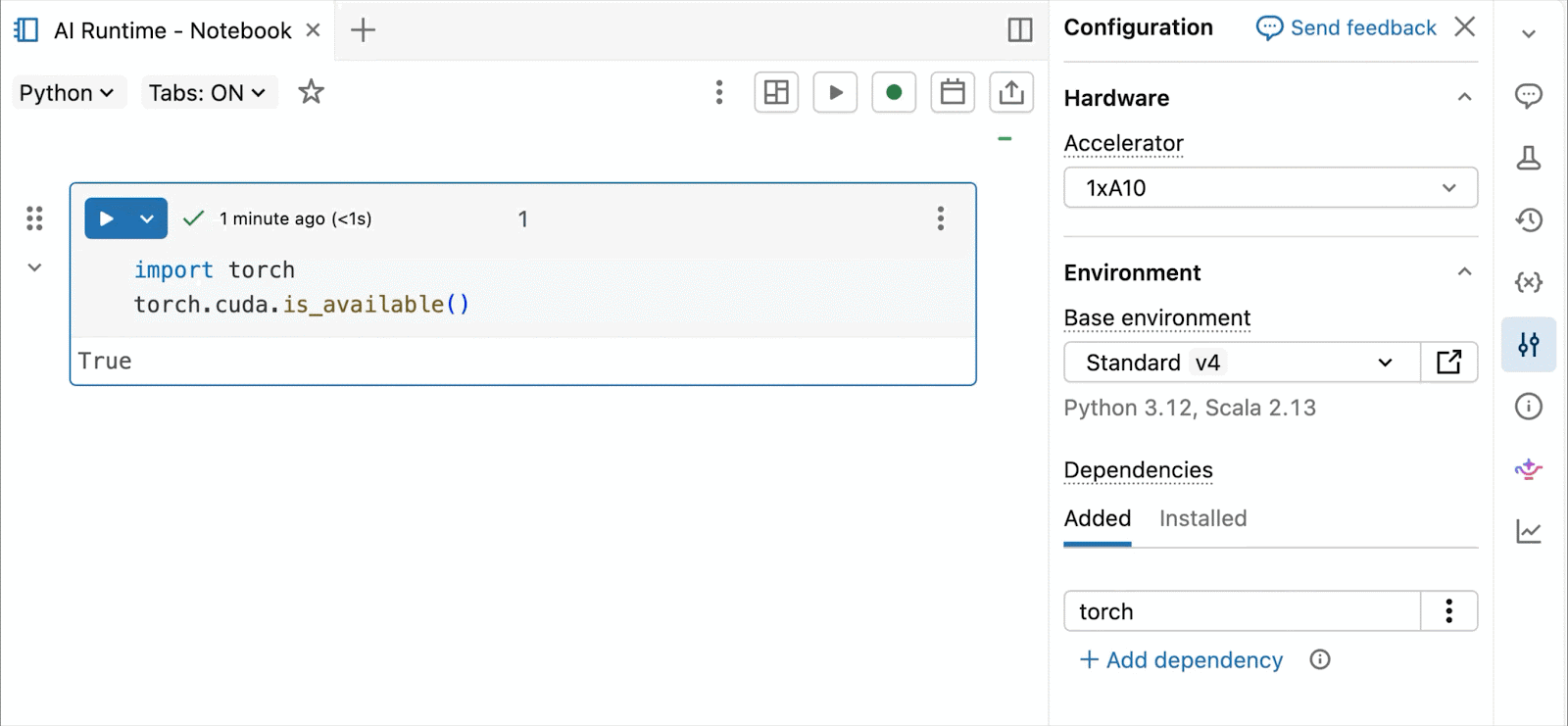
AI Runtime Notebook

Attach Serverless A10 and H100 GPUs to your notebook in 2–3 clicks. No cluster management required; only pay for what you use.
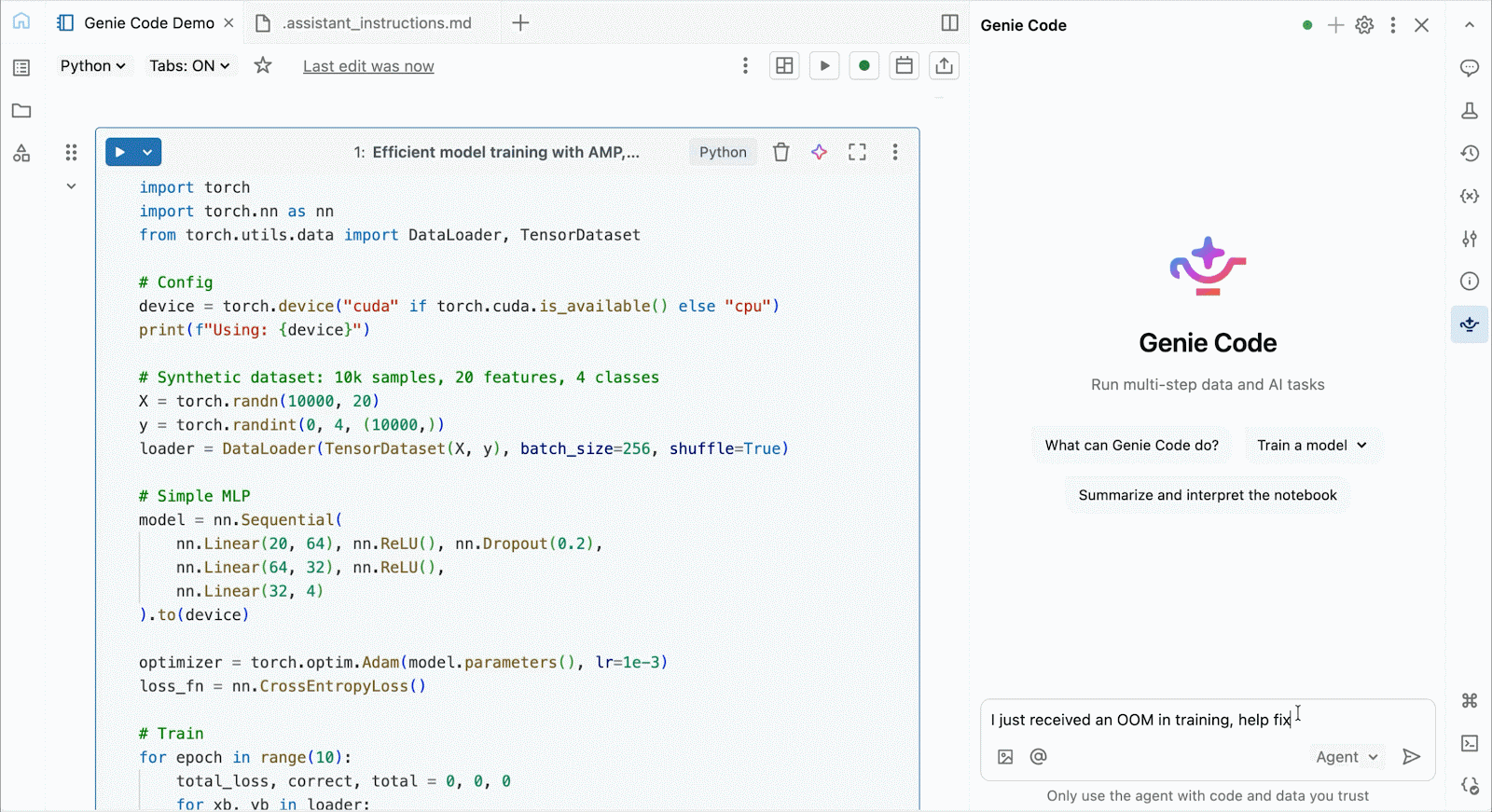
Genie Code Demo Image

Use Genie Code to help resolve performance bottlenecks, experiment with new architectures, or debug tricky bugs around model convergence or cryptic framework errors.
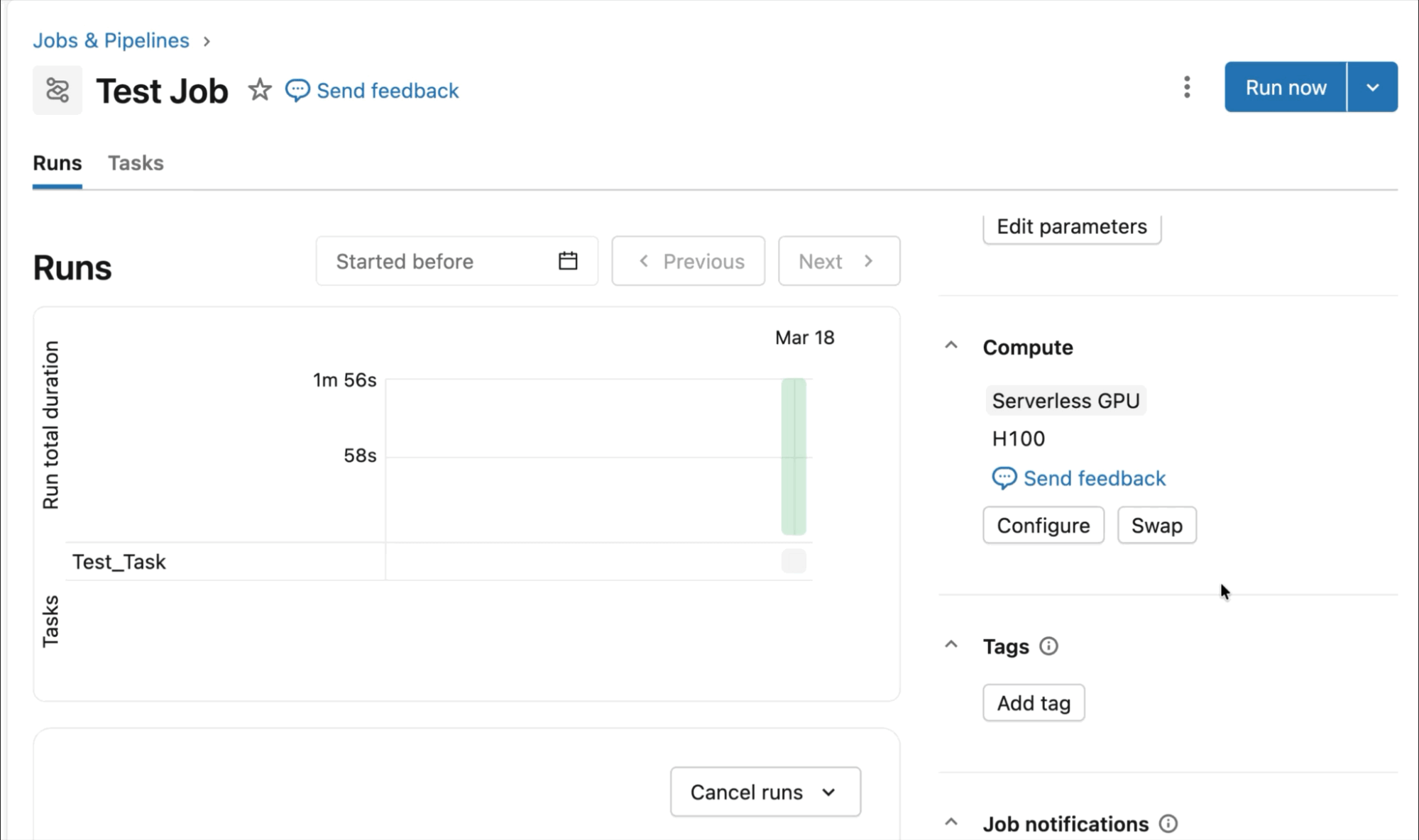
Job and Pipelines

AI Runtime is a production-grade platform for accelerated computing. Develop your deep learning code in interactive notebooks, and then use the full power of Lakeflow to submit and orchestrate jobs on GPU compute.

Databricks' AI Runtime greatly streamlined the process of training a custom Text To Formula (TTF) model. With no infrastructure setup or delays, it was easy to choose the right compute based on prompt size and output token generation. This allowed us to move quickly, maintain our Lakehouse workflows, and deliver a high-quality model with full governance, reducing time to setup, train and deploy our model from days to hours.— Nikhil Sunderraj, Principal Machine Learning Engineer, FactSet Research Systems, Inc.

To get started training your next model on GPUs, please see our examples and documentation here!

Real-Time ML at Scale: Feature Store and Model Serving

The most impactful machine learning applications operate in real time: serving recommendations in milliseconds, stopping fraudulent transactions before they're approved, and delivering search results that feel instantaneous.

Deploying a model to production is a delicate balance: every request needs to complete within a few milliseconds, even when traffic spikes – but your costs should stay low when traffic is quiet. Keeping that balance at scale has historically been as hard as building the model itself. Under high QPS, serving infrastructure becomes the bottleneck. Latency grows unpredictable, costs climb, and teams burden their best engineers with re-tuning replica counts, concurrency limits, and autoscaling thresholds every time a model or its traffic shifts.

At Data + AI Summit, we're announcing new capabilities that eliminate that burden – and streamlines achieving low latency, high QPS serving on Databricks:

  • Declarative Feature Engineering — Define features once and automatically materialize them for training and serving.
  • Streaming Features — Build extremely fresh features on your event streams for ML that reacts to customer activity in real-time.
  • High-QPS Model Serving — An enhanced inference engine and network routing for low-latency serving across both CPU and GPU models, with no knobs to tune. The platform adapts to each model and its traffic automatically, reaching 300K+ QPS at under 10ms p99 latency overhead.
  • Online Feature Serving on Lakebase — Serve fresh features with low-latency access for production applications.
  • Genie ZeroOps for ML — Genie Code can query inference tables, debugs performance issues in serving endpoints, and runs root-cause analysis on alerts, bringing agentic operational observability to models in production.

Customers running on Databricks Model Serving have cut infrastructure costs by up to 90%+ versus self-managed stacks, improved p99 and p50 latency by up to 2x, and scaled past 100K QPS in production with little to no maintenance, all with enterprise grade reliability and availability. Leading ML teams like Grammarly, GoGuardian, and thousands of other customers rely on Databricks to serve their real-time ML systems.

Learn more at Data + AI Summit 2026!

For your next AI model, please give these new features a try! Learn more in the documentation or our detailed walkthrough blog posts:

See the AI Platform in action and learn how leading organizations are building and deploying AI models at scale at Data + AI Summit 2026.