


惯性聚合 高效追踪和阅读你感兴趣的博客、新闻、科技资讯
阅读原文 在惯性聚合中打开

推荐订阅源

博客园 - 【当耐特】
让小产品的独立变现更简单 - ezindie.com
AI
AI
酷 壳 – CoolShell
酷 壳 – CoolShell
D
Docker
宝玉的分享
宝玉的分享
Hugging Face - Blog
Hugging Face - Blog
云风的 BLOG
云风的 BLOG
Cyber Security Advisories - MS-ISAC
奇客Solidot–传递最新科技情报
奇客Solidot–传递最新科技情报
博客园 - 三生石上(FineUI控件)
J
Java Code Geeks
cs.CL updates on arXiv.org
Y
Y Combinator Blog
P
Palo Alto Networks Blog
P
Privacy & Cybersecurity Law Blog
T
Tenable Blog
B
Blog
大猫的无限游戏
大猫的无限游戏
L
LINUX DO - 热门话题
Cisco Talos Blog
Cisco Talos Blog
IT之家
IT之家
Engineering at Meta
Engineering at Meta
C
CERT Recently Published Vulnerability Notes
A
Arctic Wolf
Scott Helme
Scott Helme
C
Cisco Blogs
F
Fortinet All Blogs
Jina AI
Jina AI
W
WeLiveSecurity
Hacker News: Ask HN
Hacker News: Ask HN
GbyAI
GbyAI
L
LangChain Blog
P
Privacy International News Feed
Martin Fowler
Martin Fowler
The GitHub Blog
The GitHub Blog
Project Zero
Project Zero
TaoSecurity Blog
TaoSecurity Blog
A
About on SuperTechFans
N
News | PayPal Newsroom
Threat Intelligence Blog | Flashpoint
G
GRAHAM CLULEY
I
InfoQ
K
Kaspersky official blog
钛媒体:引领未来商业与生活新知
钛媒体:引领未来商业与生活新知
T
Troy Hunt's Blog
博客园_首页
K
KPMG report finds enterprise disconnect between AI and its ROI | CIO
I
Intezer
博客园 - 聂微东

Databricks

Why Talent Transformation Is the Missing Focus of Enterprise AI Public Health Intelligence Shouldn't Require a Data Scientist Mean Time to Detect Is a Data Access Problem First-party audience data is the ad sales relationship now Rethinking Distributed Systems for Serverless Performance and Reliability The AI Scaling Gap Hiding in Digital Native Companies 10 trillion samples a day: Scaling beyond traditional monitoring infra at Databricks AI success starts with clean data, not just better models How nOps Rebuilt Their Cloud Optimization Platform on Databricks Lakebase, and Why Other ISVs Should Too Peril Predicts: Precision Payouts for a Volatile World The foundation of AI scalability: one team, one platform, one operating model The Federal Data Paradox: Rich in Data, Poor in Access Driving Budapest Forward: How BKK Uses Databricks to Transform City Mobility LLM Vs AI: A Practical Guide to Differences, Use Cases, and Tools Model Risk Governance Is Not the Same as Risk Intelligence Generative AI for Business: A Complete Strategy and Implementation Guide Data Science vs Data Engineering: Choosing Analysis or Infrastructure AI Applications: Tools, Use Cases, and Platforms MLOps vs DevOps: A Practical Guide for Data Scientists and IT Teams Top Data Warehouse Tools For Modern Data Analytics Unlocking SAP Business Context in Databricks with Semantic Metadata Delta Sharing The marketing activation gap has a fix: Databricks and Stitch partner to turn data infrastructure into marketing performance Alert Fatigue Is a Business Risk Backstage with Lakebase Shipping Faster isn’t Learning Faster Why Your OEE Dashboard Is Lying to You The Turbine That Tried to Tell You It Was Failing Predicting Readmissions Isn't Enough. Acting in Time Is. Clinical Trials Run Longer Than They Have To. That's a Patient Problem Network Quality Is a Revenue Problem, Not a Technical One Shelf Availability Starts with Better Demand Visibility When Predicting the Next Hit Requires More Than Intuition Approximate Answers, Exact Decisions: New Sketch Functions for Analytics Companies Winning with AI Built the Data Layer First Rethinking SQL ETL for modern data platforms Stripe data now available on Databricks via Databricks Marketplace Databricks and Stripe Projects: Infrastructure Built for Agents Agents are ready but your architecture probably isn't Interoperability Between Unity Catalog and Google BigQuery via Catalog Federation Built In, Not Bolted On: What AI-Native Actually Means in Cybersecurity Operationalizing AI for public sector fraud prevention From months to minutes: Building real-time clinical data pipelines with natural language Agentic Data Engineering with Genie Code and Lakeflow Securely send first-party conversion signals with Snapchat Conversions API on Databricks Marketplace How leading tech companies are killing the builder’s tax with Lakebase Inside one of the first production deployments of Lakebase: LangGuard's agentic workflow governance engine The next generation of Databricks Genie Model Risk Management in 2026: A Banker’s Guide to the Revised Interagency Guidance OpenAI GPT-5.5 now available on Databricks, fully-governed through Unity AI Gateway Operational databases: How they work and when to use them Databricks partners with OpenAI on GPT-5.5 Announcing the Public Preview of Lakeflow Designer Are LLM agents good at join order optimization? How conversational analytics removes the BI bottleneck How to transform document activation workflows with Genie and Agent Bricks Beyond the spreadsheet: how Databricks is delivering the modern CFO in Financial Services AI App Development: Guide To Building AI-Powered Apps IoT in Manufacturing: Strategy, Components, Use Cases, and Challenges Stop Hand-Coding Change Data Capture Pipelines Multimodal Data Integration: Production Architectures for Healthcare AI Personalization Strategies for Media Companies A Modern AI Risk Management Framework Introducing the Databricks Excel Add-in for Business Users Real-Time Decisioning for AI Agents: Why you Need a Customer Context Layer First A Practical Guide to LLM Fine Tuning AI Data Transformation Guide for Data Engineers and Data Scientists Concurrency Control in DBMS: How Locking, MVCC and Optimistic Strategies Keep Data Consistent Bridging data science and marketing: Databricks unveils Delta Sharing integration for Adobe Experience Platform and agentic marketing workflows Take Control: Customer-Managed Keys for Lakebase Postgres Get hands on with agents, vibe coding and more at Data+ AI Summit Mercedes-Benz Builds a Cross-Cloud Data Mesh with Delta Sharing and Intelligent Replication, Cutting Costs by 66% What Is a Transactional Database? Introducing Genie Agent Mode Governing coding agent sprawl with Unity AI Gateway Governing Coding Agent Sprawl with Unity AI Gateway What is pgvector? Banks Don’t Have an AI Problem – They Have a Data Platform Problem Open Platform, Unified Pipelines: Why dbt on Databricks is Accelerating Why Your Agents Can’t Read Enterprise Documents — and How to Fix It Building with Databricks Document Intelligence and Lakeflow Databricks on Google Cloud: Innovate Faster. Smarter. Together. Introducing the Databricks Connector for Google Sheets: Real-Time, Governed Lakehouse Data in the Sheets Users Love Unity AI Gateway: How to connect agents to external MCPs securely Expanding agent governance with Unity AI Gateway Agentic reasoning in practice: Making sense of structured and unstructured data Agent Bricks: The Governed Enterprise Agent Platform 8 AI and data trends shaping financial services in 2026 Building real-time product search on Databricks Lovable + Databricks: Build Data-Driven Apps at the Speed of Thought Memory scaling for AI agents Powering clinical research innovation: How TriNetX uses Databricks to accelerate drug development Database Branching in Postgres: Git-Style Workflows with Databricks Lakebase How Zalando built a unified data foundation for AI and analytics on Databricks The next era of the open lakehouse: Apache Iceberg™ v3 in Public Preview on Databricks How FSIs eliminate silos between clients, operations, and finance How MakeMyTrip achieved millisecond personalization at scale with Databricks A multi-agent approach to audience intelligence AiChemy: Next-generation agent with MCP, skills and custom data for drug discovery Accelerate business insights with Lakeflow Connect, now with a Free Tier Unlocking Next-Gen Customer Experiences with Data Intelligence for Marketing
Introducing OpenSharing: the Next Evolution of Delta Sharing for the Agentic Era
Huey Han · 2026-06-17 · via Databricks

When Databricks pioneered Delta Sharing in 2021, we set out to solve a problem that every data team knew too well: sharing live data across organizational boundaries was slow, fragile, and full of compromise. You either copied data — creating stale replicas and compliance headaches — or you constrained yourself to only sharing with partners on the same platform as you, thereby significantly restricting innovation.

Delta Sharing changed that. A single open protocol. No data copying. No platform silos. And in the five years since, it has become the most widely adopted open zero-copy data-sharing protocol — with 28,000+ data recipients and 33% of shares flowing across platforms via open connectors. Leading companies such as SAP, Atlassian, Mercedes-Benz, The Trade Desk, LSEG, S&P Global, and many more have adopted Delta Sharing to share and collaborate on data.

But the world has moved on. The rise of agentic AI has fundamentally changed what enterprises need to share. Today, we're taking the next step.

We're excited to announce OpenSharing — the next evolution of Delta Sharing, and the industry's first open protocol built for the agentic era. OpenSharing advances Delta Sharing into an independent open-source project, expanding its scope from data sharing to the full AI stack: models, agents — across any cloud, any vendor, and any format.

Why sharing protocols need to evolve for AI

Delta Sharing was built for a world of tables and files. But organizations must now exchange semantic context, AI skills, unstructured data, and autonomous agents across cloud, vendor, and company boundaries. Today's sharing protocols remain locked into vendor-specific formats, can't handle AI logic, and depend on brittle networking that takes weeks to configure for each new partner.

The result: collaboration slows, data silos persist, and the value locked inside enterprise data goes unrealized.

OpenSharing solves this. It's a single open protocol that shares data and AI across any format, any cloud, and any organizational boundary — natively supporting Delta Lake, Apache Iceberg, and Parquet so data stays where it lives and flows to whoever needs it.

"Delta Sharing proved the industry would choose open over locked-in. OpenSharing extends that principle to the full AI stack, while expanding the cross-platform ecosystem to Iceberg recipients and on-premises providers. The agentic era deserves an open foundation, and OpenSharing delivers it." — Matei Zaharia, Co-founder and CTO of Databricks.

OpenSharing on Databricks

OpenSharing exists at two layers. The open-source protocol — now hosted by the Linux Foundation — is the published spec that any vendor or community member can implement. Databricks OpenSharing is the enterprise implementation of the open protocol, built on top of other Databricks features such as Unity Catalog for governance and audit logging, Marketplace for discoverability, and more.

We are excited to launch a suite of features for OpenSharing on Databricks.

Genie Agent Sharing: share a governed AI experience, not just data

For the first time, organizations can share governed AI experiences — not just datasets — across organizational boundaries.

Genie Agents are Databricks' AI-powered conversational analytics environments. With OpenSharing, a provider can now share Genie Agents — including their underlying semantic context, business metrics, and reusable AI logic — with any partner or customer, with governance end-to-end via Unity Catalog. Optionally, providers can control how recipients access data — including hiding proprietary Genie instructions, restricting data access to the Genie Agent only, setting daily prompt quotas, and capping row export limits. These controls unlock new monetization opportunities for data providers, such as usage-based pricing instead of a full data license.
 

SecureConnect and Global Distribution: simpler multi-cloud networking, lower egress costs

Cross-cloud data sharing has always had two distinct problems. OpenSharing on Databricks now solves both.

The first is networking. When provider storage sits behind a private network — which is almost always the case for sensitive data exchanges or regulated industries — onboarding a new recipient can take weeks of manual IP allowlisting, firewall coordination, and back-and-forth with cloud admins. For providers with dozens or hundreds of recipients, this doesn't scale. SecureConnect solves this problem: a Databricks-managed proxy that routes storage access on behalf of all recipients. Configure it once — no per-recipient firewall changes needed, ever. Read the announcement blog.
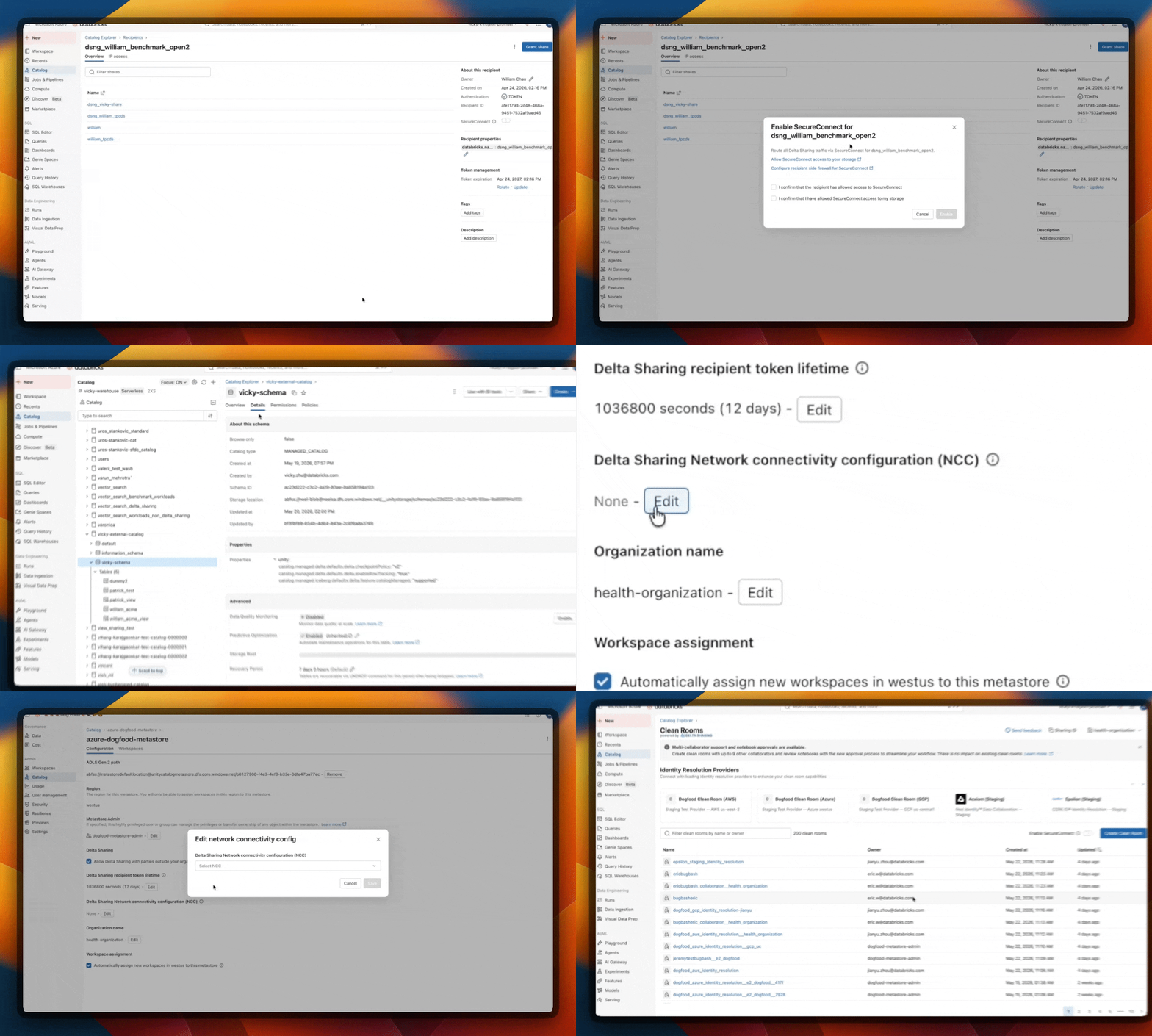
 

SecureConnect

The second is egress cost. Cross-cloud queries generate egress fees that compound at scale, becoming a significant and unpredictable cost that makes broad multi-cloud sharing economically impractical. Global Distribution solves this with automatic cross-region and cross-cloud replication. Recipients query a local replica — fast, with no egress fees. Providers get a predictable cost structure. Global teams get low-latency access regardless of where the source data lives.
 

Open Client Interoperability & On-prem Storage Ecosystem: Meet your partners where they are

OpenSharing is built on the conviction that data ecosystems thrive when they are truly open — not just in name, but in practice. That means supporting the formats, storage systems, and clients your partners already use.

Storage Ecosystem: Govern everything, wherever it lives

Not all enterprise data can — or should — move to the cloud. Regulatory mandates, data gravity, edge latency, and sheer economics mean that some of the world's most valuable data will stay on-premises. OpenSharing reaches it.
The Databricks Storage Ecosystem brings the Databricks Data Intelligence Platform directly to on-premises, private cloud, and edge environments — powered by OpenSharing. Storage partners implement the OpenSharing server, connecting their data estates to Unity Catalog without moving a single byte. No migration. No duplication. Read the announcement
Launch partners include MinIO (GA), Everpure (Private Preview), Qumulo (Private Preview Soon), and VAST Data (Private Preview Soon) — with Cohesity, Commvault, NetApp, and Nutanix coming by the end of the year. Collectively, these partners manage hundreds of exabytes of enterprise data.

Iceberg interoperability
Delta Sharing is already supported in a wide range of platforms and connectors, including Databricks, Tableau, Power BI, Apache Spark, and Snowflake. OpenSharing has now added support for Apache Iceberg REST Catalog API — making it possible to share data with any Iceberg-compatible client. Providers can also share tables from external catalogs including AWS Glue, Hive Metastore, and Snowflake Horizon — bringing external data into the governed OpenSharing ecosystem without replication.

Iceberg Sharing

How OpenSharing works

Building on the same simplicity that made Delta Sharing successful, OpenSharing extends the protocol to support the full AI asset stack:

  1. The data provider creates a share in Unity Catalog — defining which datasets, models, agents, or Genie Agents to share and setting fine-grained access permissions.
  2. The recipient receives secure credentials and queries the share directly from their existing tools, cloud, or Iceberg client — without needing to be on Databricks.
  3. Unity Catalog enforces governance end-to-end — auditing every access, enforcing row- and column-level controls, and ensuring compliance policies travel with every shared asset.
  4. Data never moves — recipients query live data directly from the provider's cloud storage, ensuring a single source of truth.

For enterprise deployments on Databricks, SecureConnect and Global Distribution layer on top of this flow — handling cross-cloud networking and replication automatically, with no changes to how providers or recipients interact with their shares.

Ready to get started with OpenSharing?