

惯性聚合 高效追踪和阅读你感兴趣的博客、新闻、科技资讯
阅读原文 在惯性聚合中打开

推荐订阅源

O
OpenAI News
GbyAI
GbyAI
人人都是产品经理
人人都是产品经理
Last Week in AI
Last Week in AI
F
Fortinet All Blogs
钛媒体:引领未来商业与生活新知
钛媒体:引领未来商业与生活新知
罗磊的独立博客
爱范儿
爱范儿
B
Blog
C
Check Point Blog
H
Hackread – Cybersecurity News, Data Breaches, AI and More
博客园_首页
A
About on SuperTechFans
Engineering at Meta
Engineering at Meta
V
Visual Studio Blog
P
Proofpoint News Feed
小众软件
小众软件
Google DeepMind News
奇客Solidot–传递最新科技情报
奇客Solidot–传递最新科技情报
G
Google Developers Blog
Y
Y Combinator Blog
Recorded Future
Recorded Future
博客园 - 聂微东
WordPress大学
WordPress大学
博客园 - 【当耐特】
腾讯CDC
T
Tailwind CSS Blog
The Register - Security
V
V2EX
S
SegmentFault 最新的问题
IT之家
IT之家
D
Docker
I
InfoQ
大猫的无限游戏
大猫的无限游戏
云风的 BLOG
云风的 BLOG
Microsoft Azure Blog
月光博客
月光博客
Stack Overflow Blog
Stack Overflow Blog
让小产品的独立变现更简单 - ezindie.com
Jina AI
Jina AI
The Cloudflare Blog
量子位
Microsoft Security Blog
aimingoo的专栏
aimingoo的专栏
博客园 - 叶小钗
H
Help Net Security
MongoDB | Blog
MongoDB | Blog
freeCodeCamp Programming Tutorials: Python, JavaScript, Git & More
美团技术团队
B
Blog RSS Feed

Databricks

How lakebase architecture delivers 5x faster Postgres writes Why Talent Transformation Is the Missing Focus of Enterprise AI Public Health Intelligence Shouldn't Require a Data Scientist Mean Time to Detect Is a Data Access Problem First-party audience data is the ad sales relationship now Rethinking Distributed Systems for Serverless Performance and Reliability The AI Scaling Gap Hiding in Digital Native Companies 10 trillion samples a day: Scaling beyond traditional monitoring infra at Databricks AI success starts with clean data, not just better models How nOps Rebuilt Their Cloud Optimization Platform on Databricks Lakebase, and Why Other ISVs Should Too Peril Predicts: Precision Payouts for a Volatile World The foundation of AI scalability: one team, one platform, one operating model The Federal Data Paradox: Rich in Data, Poor in Access Driving Budapest Forward: How BKK Uses Databricks to Transform City Mobility LLM Vs AI: A Practical Guide to Differences, Use Cases, and Tools Model Risk Governance Is Not the Same as Risk Intelligence Generative AI for Business: A Complete Strategy and Implementation Guide Data Science vs Data Engineering: Choosing Analysis or Infrastructure AI Applications: Tools, Use Cases, and Platforms MLOps vs DevOps: A Practical Guide for Data Scientists and IT Teams Top Data Warehouse Tools For Modern Data Analytics Unlocking SAP Business Context in Databricks with Semantic Metadata Delta Sharing The marketing activation gap has a fix: Databricks and Stitch partner to turn data infrastructure into marketing performance Alert Fatigue Is a Business Risk Backstage with Lakebase Shipping Faster isn’t Learning Faster Why Your OEE Dashboard Is Lying to You The Turbine That Tried to Tell You It Was Failing Predicting Readmissions Isn't Enough. Acting in Time Is. Clinical Trials Run Longer Than They Have To. That's a Patient Problem Network Quality Is a Revenue Problem, Not a Technical One Shelf Availability Starts with Better Demand Visibility When Predicting the Next Hit Requires More Than Intuition Approximate Answers, Exact Decisions: New Sketch Functions for Analytics Companies Winning with AI Built the Data Layer First Rethinking SQL ETL for modern data platforms Stripe data now available on Databricks via Databricks Marketplace Databricks and Stripe Projects: Infrastructure Built for Agents Agents are ready but your architecture probably isn't Interoperability Between Unity Catalog and Google BigQuery via Catalog Federation Built In, Not Bolted On: What AI-Native Actually Means in Cybersecurity Operationalizing AI for public sector fraud prevention From months to minutes: Building real-time clinical data pipelines with natural language Agentic Data Engineering with Genie Code and Lakeflow Securely send first-party conversion signals with Snapchat Conversions API on Databricks Marketplace How leading tech companies are killing the builder’s tax with Lakebase Inside one of the first production deployments of Lakebase: LangGuard's agentic workflow governance engine The next generation of Databricks Genie Model Risk Management in 2026: A Banker’s Guide to the Revised Interagency Guidance OpenAI GPT-5.5 now available on Databricks, fully-governed through Unity AI Gateway Operational databases: How they work and when to use them Databricks partners with OpenAI on GPT-5.5 Announcing the Public Preview of Lakeflow Designer Are LLM agents good at join order optimization? How conversational analytics removes the BI bottleneck How to transform document activation workflows with Genie and Agent Bricks Beyond the spreadsheet: how Databricks is delivering the modern CFO in Financial Services AI App Development: Guide To Building AI-Powered Apps IoT in Manufacturing: Strategy, Components, Use Cases, and Challenges Stop Hand-Coding Change Data Capture Pipelines Multimodal Data Integration: Production Architectures for Healthcare AI Personalization Strategies for Media Companies A Modern AI Risk Management Framework Introducing the Databricks Excel Add-in for Business Users Real-Time Decisioning for AI Agents: Why you Need a Customer Context Layer First A Practical Guide to LLM Fine Tuning AI Data Transformation Guide for Data Engineers and Data Scientists Concurrency Control in DBMS: How Locking, MVCC and Optimistic Strategies Keep Data Consistent Bridging data science and marketing: Databricks unveils Delta Sharing integration for Adobe Experience Platform and agentic marketing workflows Take Control: Customer-Managed Keys for Lakebase Postgres Get hands on with agents, vibe coding and more at Data+ AI Summit Mercedes-Benz Builds a Cross-Cloud Data Mesh with Delta Sharing and Intelligent Replication, Cutting Costs by 66% What Is a Transactional Database? Introducing Genie Agent Mode Governing coding agent sprawl with Unity AI Gateway Governing Coding Agent Sprawl with Unity AI Gateway What is pgvector? Banks Don’t Have an AI Problem – They Have a Data Platform Problem Why Your Agents Can’t Read Enterprise Documents — and How to Fix It Building with Databricks Document Intelligence and Lakeflow Databricks on Google Cloud: Innovate Faster. Smarter. Together. Introducing the Databricks Connector for Google Sheets: Real-Time, Governed Lakehouse Data in the Sheets Users Love Unity AI Gateway: How to connect agents to external MCPs securely Expanding agent governance with Unity AI Gateway Agentic reasoning in practice: Making sense of structured and unstructured data Agent Bricks: The Governed Enterprise Agent Platform 8 AI and data trends shaping financial services in 2026 Building real-time product search on Databricks Lovable + Databricks: Build Data-Driven Apps at the Speed of Thought Memory scaling for AI agents Powering clinical research innovation: How TriNetX uses Databricks to accelerate drug development Database Branching in Postgres: Git-Style Workflows with Databricks Lakebase How Zalando built a unified data foundation for AI and analytics on Databricks The next era of the open lakehouse: Apache Iceberg™ v3 in Public Preview on Databricks How FSIs eliminate silos between clients, operations, and finance How MakeMyTrip achieved millisecond personalization at scale with Databricks A multi-agent approach to audience intelligence AiChemy: Next-generation agent with MCP, skills and custom data for drug discovery Accelerate business insights with Lakeflow Connect, now with a Free Tier Unlocking Next-Gen Customer Experiences with Data Intelligence for Marketing
Open Platform, Unified Pipelines: Why dbt on Databricks is Accelerating
Srilekha Dornadula, Ramiz Bozai · 2026-04-17 · via Databricks

dbt brings structure to data transformation workflows. Teams use it to turn raw data into curated datasets that power downstream consumption like BI dashboards, AI/ML models, and cross-functional reporting.

But here's the reality: dbt is only as powerful as the data platform it runs on.

Most data stacks force you to piece together storage, compute, governance, orchestration, and monitoring across multiple systems. The result? Duplicated data, inconsistent permissions, fragmented observability, and performance tuning that becomes a part-time job. It's why a growing number of teams are consolidating their dbt workflows onto Databricks.

To run dbt effectively, a platform needs four things:

  1. Open foundations so your dbt workflows aren't locked into a proprietary stack
  2. Seamless orchestration to run dbt pipelines end-to-end in one place
  3. Built-in governance that's part of the default dbt workflow
  4. Strong price-performance so dbt runs fast from day one without manual tuning

Databricks delivers all four pillars natively integrated in one platform. When you run dbt on Databricks, you get the dbt developer experience on top of a lakehouse architecture designed for openness, governance, performance, and operational simplicity from day one. Let's look at how each of these works in practice:
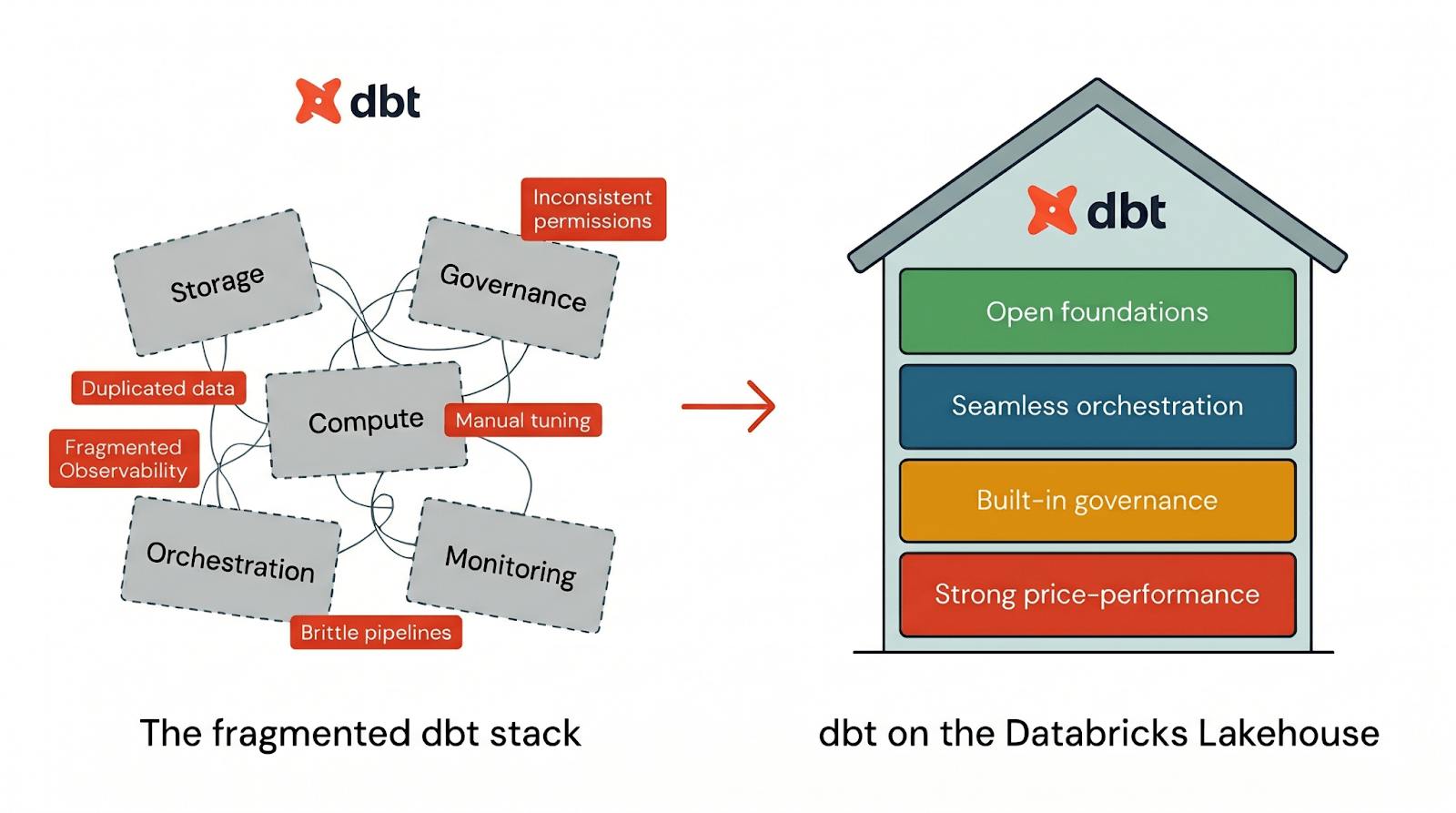
dbt on the Databricks Lakehouse is no longer fragmented

Running dbt on Databricks let us consolidate a sprawling legacy of notebooks and 7+ source systems into a single, governed data platform. With Unity Catalog, we manage 341 tenants, multiple environments, and external partner data sharing through catalog-level isolation. Our dbt documentation flows directly into UC, so analysts can self-serve without bottlenecks. By publishing to open formats and Delta Sharing, partners and downstream teams can easily consume dbt-generated datasets across tools and environments. It's one platform for building, but an open platform for consuming. —Sohan Chatterjee, Head of Data and Analytics, iSolved

Run dbt on open foundations with zero vendor lock-in 

Vendor lock-in is one of the most significant strategic risks to an organization’s data strategy. dbt is built with an open adapter framework, meaning your transformation logic isn't locked to any single platform. dbt is open by design, and Databricks provides an open platform to run it on. Many modern data stacks center on a proprietary storage layer that offers short-term convenience but introduces long-term friction. Over time, this leads to duplicated data and export pipelines to serve different consumers, storage formats that limit interoperability, and escalating switching costs as platform requirements evolve.

Databricks is an open lakehouse: a unified platform where your data lives in open table formats and is accessible through open interfaces, ensuring storage and governance aren’t tied to a single query engine. On Databricks, dbt models become tables in open formats, Delta Lake and Apache Iceberg, ensuring your transformed data remains accessible across the entire data landscape without exporting or maintaining parallel copies. This openness matters for dbt workflows specifically. Your carefully modeled silver and gold tables become reusable data products that downstream users can consume through any query engine, not just through the platform where dbt runs.

This openness extends beyond storage. Unity Catalog is built around open catalog and access standards that support governed reads and writes from external engines. Databricks SQL follows ANSI standards, ensuring your queries remain portable across platforms to reduce vendor-specific rewrites. That means your dbt workflows run on a stack designed for portability, not lock-in. 

Orchestrate dbt pipelines end-to-end with Lakeflow Jobs

Orchestration is where operational complexity accumulates. Pairing dbt with an external orchestrator alongside Databricks means two systems to operate, two places to debug, and brittle handoffs between them.

Lakeflow Jobs removes that complexity by treating dbt as a first-class task type within a unified pipeline. Instead of maintaining a separate orchestration layer, teams run dbt alongside upstream ingestion and downstream actions in a single workflow. For example, you can ingest raw data with Auto Loader, transform data with dbt models, then trigger dashboard refreshes or ML retraining, all in one pipeline with unified retry logic and dependency management. dbt on Databricks also enables ingestion directly through streaming tables. For dbt Platform users, the dbt Platform task (in Beta) enables Lakeflow to trigger and manage dbt workflows running in dbt Platform.  
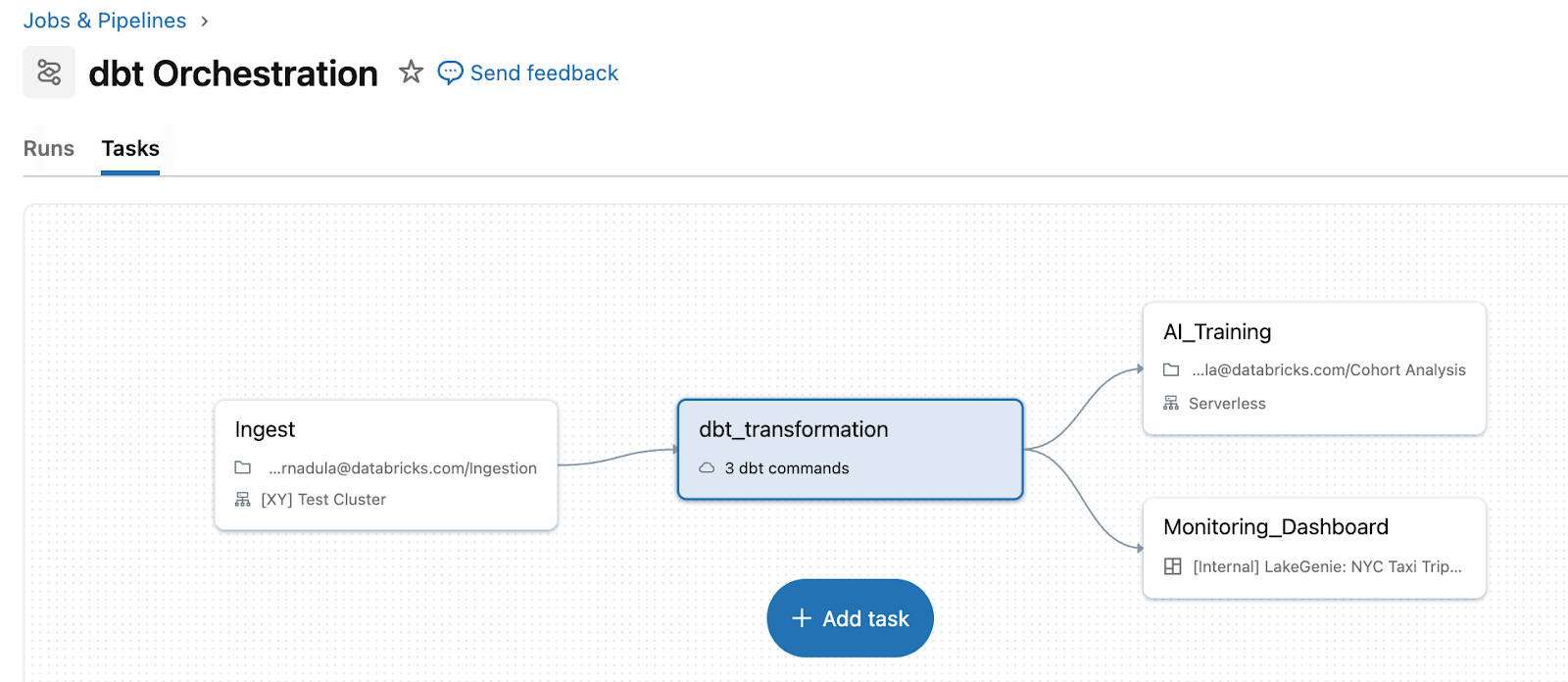
dbt Orchestration

When dbt is orchestrated through Lakeflow, failures, retries, and context are visible in one place. Instead of switching between a separate dbt orchestrator and Databricks logs, you can see the failure, affected downstream tasks, and impacted dashboards directly in the same job run view.

Make governance part of the default dbt workflow

As dbt workflows scale, governance becomes the bottleneck. Teams need clear answers about table contents, ownership, and access permissions. In traditional stacks, this context is fragmented across separate catalog tools, permission systems, and incomplete lineage views that don't connect end to end.

Databricks solves this with Unity Catalog, which unifies access control, discovery, and lineage for your entire lakehouse – not just within dbt, but across ingestion, BI, ML/AI, and beyond. With Unity Catalog, you don't need to re-run grant statements every time dbt recreates a table. Permissions are managed at the schema level and persist across table rebuilds. Fine-grained controls like row-level filterscolumn masks, and attribute-based access control apply consistently across dbt, BI tools, and notebooks. 

For example, when you persist dbt documentation into Unity Catalog using dbt's persist_docs functionality, column descriptions and context authored in dbt become discoverable where data is queried and consumed. Unity Catalog provides column-level data lineage that traces data flow from raw ingestion through dbt transformations to downstream usage. When a source schema changes, you can instantly see which dbt models and downstream assets are affected. This level of visibility is impossible when data pipelines span disconnected systems.

Cost governance matters just as much as data governance. With query tags, you can attach business context to dbt runs and track spend by team, project, or environment through System Tables. Teams can finally answer "how much do our marketing analytics dbt pipelines cost?" with real data instead of estimates. Additionally, DBSQL Granular Cost Monitoring (in Private Preview) also provides aggregated cost monitoring across all dbt workloads.

Run dbt with strong price-performance from day one

Optimizing a data warehouse for performance typically requires ongoing manual work. Teams often end up trading developer velocity for performance hygiene. 

Databricks abstracts this complexity by combining a high-performance execution engine with features that work natively with dbt, delivering speed improvements without manual overhead. 

Built-in performance 

  • Photon engine accelerates SQL workloads through vectorized execution, delivering up to 12x better price-performance compared to cloud data warehouses. Serverless SQL warehouses include Photon by default, so teams get accelerated performance without additional cost.
  • Predictive Optimization uses AI to monitor tables and automate maintenance, achieving up to 20x faster queries. This reduces the need for manual OPTIMIZE post-hooks that dbt engineers historically relied on.

Performance features unlocked through dbt config

  • dbt’s integration with Liquid Clustering which replaces rigid partitioning strategies with a flexible approach that dynamically adjusts as data volume grows, resulting in up to 10x faster speeds without manual tuning
  • Materialized Views in dbt, powered by open-source Spark Declarative Pipelines, handle incremental processing automatically. Databricks manages the complexity of determining what needs updating and only processes new or modified records, rather than recomputing entire datasets. This delivers lower compute costs compared to inefficient scheduled batch refreshes.

With these features, users spend less time tuning and more time building pipelines that stay performant as datasets grow. In 2025 alone, Databricks SQL achieved a performance improvement of 10% on ETL workloads (queries with writes) without needing any additional configurations. 

Get started today

Databricks brings open storage, unified governance, strong price performance, and integrated operations together in one place for dbt workflows. Join 2900+ customers already running dbt on Databricks. Get started by following the quick start guide.