


惯性聚合 高效追踪和阅读你感兴趣的博客、新闻、科技资讯
阅读原文 在惯性聚合中打开

推荐订阅源

Martin Fowler
Martin Fowler
D
DataBreaches.Net
F
Fortinet All Blogs
阮一峰的网络日志
阮一峰的网络日志
博客园_首页
Apple Machine Learning Research
H
Help Net Security
M
MIT News - Artificial intelligence
美团技术团队
人人都是产品经理
人人都是产品经理
freeCodeCamp Programming Tutorials: Python, JavaScript, Git & More
Cyber Security Advisories - MS-ISAC
The Cloudflare Blog
有赞技术团队
有赞技术团队
L
LangChain Blog
博客园 - Franky
钛媒体:引领未来商业与生活新知
钛媒体:引领未来商业与生活新知
博客园 - 【当耐特】
S
SegmentFault 最新的问题
V
Visual Studio Blog
Blog — PlanetScale
Blog — PlanetScale
Hugging Face - Blog
Hugging Face - Blog
B
Blog
I
InfoQ

Databricks

Why Talent Transformation Is the Missing Focus of Enterprise AI Public Health Intelligence Shouldn't Require a Data Scientist Mean Time to Detect Is a Data Access Problem First-party audience data is the ad sales relationship now Rethinking Distributed Systems for Serverless Performance and Reliability The AI Scaling Gap Hiding in Digital Native Companies 10 trillion samples a day: Scaling beyond traditional monitoring infra at Databricks AI success starts with clean data, not just better models How nOps Rebuilt Their Cloud Optimization Platform on Databricks Lakebase, and Why Other ISVs Should Too Peril Predicts: Precision Payouts for a Volatile World The foundation of AI scalability: one team, one platform, one operating model The Federal Data Paradox: Rich in Data, Poor in Access Driving Budapest Forward: How BKK Uses Databricks to Transform City Mobility LLM Vs AI: A Practical Guide to Differences, Use Cases, and Tools Model Risk Governance Is Not the Same as Risk Intelligence Generative AI for Business: A Complete Strategy and Implementation Guide Data Science vs Data Engineering: Choosing Analysis or Infrastructure AI Applications: Tools, Use Cases, and Platforms MLOps vs DevOps: A Practical Guide for Data Scientists and IT Teams Top Data Warehouse Tools For Modern Data Analytics Unlocking SAP Business Context in Databricks with Semantic Metadata Delta Sharing The marketing activation gap has a fix: Databricks and Stitch partner to turn data infrastructure into marketing performance Alert Fatigue Is a Business Risk Backstage with Lakebase Shipping Faster isn’t Learning Faster Why Your OEE Dashboard Is Lying to You The Turbine That Tried to Tell You It Was Failing Predicting Readmissions Isn't Enough. Acting in Time Is. Clinical Trials Run Longer Than They Have To. That's a Patient Problem Network Quality Is a Revenue Problem, Not a Technical One
Announcing the Databricks analytics engineer learning pat...
2026-05-18 · via Databricks

A new pathway that teaches SQL practitioners how to model data, build pipelines, define metrics, and ship Genie spaces on Databricks

by Maroua Lazzarou and Pratyarth Rao

Today, we are launching the new Databricks Analytics Engineer Learning Pathway. This curriculum teaches you how to transform raw data into governed, AI-ready semantic models and metric views, the trusted foundation that powers analytics, dashboards, and AI agents on the lakehouse. The pathway is built for SQL practitioners ready to take on more ownership of the data their teams rely on.
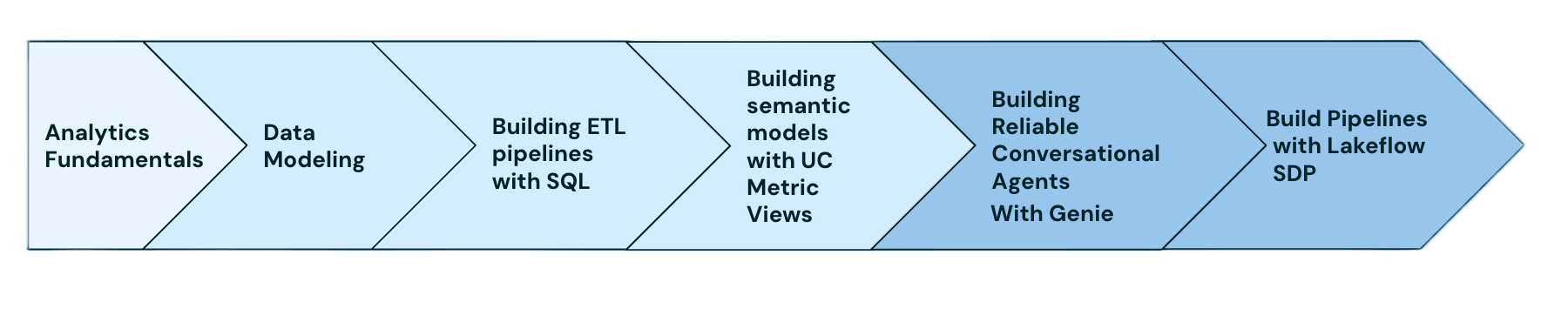
learning pathway analytics engineer

Why analytics engineering is becoming essential   

SQL has always been the foundation of modern analytics. But the work built on top of it is widening — into modeling, pipelines, metrics, and the data layers that agents and dashboards now depend on.

Reliable analytics and AI run on the same foundation: data that's governed, modeled, and trusted. Building that foundation is more difficult than it used to be. Data lives across more sources and feeds more downstream consumers. Data teams traditionally responsible for getting data ready are tapped out. According to a recent Economist Enterprise report, nearly two-thirds of organizations are fully dependent on data engineers for every aspect of pipeline creation, and almost half of those engineers spend most of their time just configuring and fixing data source connections. There is limited capacity to absorb the new work. Increasingly, it's falling to the practitioners closest to the business: the ones working with SQL.

SQL practitioners sit closer to the business and understand the questions being asked, the data underneath, and the metrics teams care about. Analytics engineering is the discipline of using that context to build models, pipelines, and metrics the business can rely on. The tools for this work are now SQL-native. The judgment to use them well is what this pathway teaches.

Inside the pathway 

The Analytics Engineer Pathway consists of hands-on courses that cover the full SQL ETL toolkit on Databricks. Start with Analytics Fundamentals to ground yourself in how analytics works on the lakehouse. From there, the rest of the curriculum goes deeper into each part of the analytics engineering skillset taught by Databricks experts and built around hands-on examples. 

1. Analytics FundamentalsLearn how analytics works on Databricks: unified semantics, AI/BI Dashboards, and Genie. A one-hour grounding course. 

2. Data Modeling StrategiesLearn how to design data models that hold up in production on the lakehouse.

  • Align data organization and model design with business requirements
  • Define data architectures using Delta Lake and Unity Catalog
  • Understand the data products lifecycle on the lakehouse
  • Apply techniques for data integration and sharing

3. Build ETL Pipelines with SQLLearn how to build production SQL ETL pipelines with Materialized Views, Streaming Tables, and Lakeflow Jobs 

  • Leverage Streaming Tables, Materialized Views, and AUTO CDC for declarative pipelines.
  • Implement incremental ingestion and transformations across the medallion architecture.
  • Handle SCD Type 1 and Type 2 with AUTO CDC.
  • Orchestrate pipelines using Lakeflow Jobs and SQL-based workflows

4. Build Semantic Models with UC Metric ViewsLearn how to define and govern business metrics in SQL, then surface trusted numbers everywhere they're consumed.

  • Define and manage metric views in Unity Catalog
  • Model advanced metrics including windowed and semi-additive measures
  • Integrate with Databricks dashboards, Genie spaces, and SQL workflows
  • Apply governance, security, and maintenance practices

5. Build Reliable Conversational Agents with GenieLearn how to design, ship, and continuously improve Genie spaces business users can trust.

  • Configure Genie Spaces with Unity Catalog tables, SQL warehouses, and benchmarks
  • Curate the Knowledge Store with synonyms, descriptions, and prompt-matching features
  • Encode business logic in SQL with derived expressions, joins, and instructions
  • Govern access with Unity Catalog permissions and ABAC policies
  • Iterate using benchmarks, user feedback, and observed outputs

6. Build Pipelines with Lakeflow Spark Declarative PipelinesLearn how to build governed, end-to-end SQL pipelines using the Spark Declarative Pipelines editor.

  • Understand streaming tables, materialized views, and temporary views
  • Enforce data quality with built-in expectations
  • Handle slowly changing dimensions with AUTO CDC INTO
  • Analyze pipeline execution through event logs and metrics

Every course is available in self-paced and instructor-led formats. The full pathway is also included with any active Databricks learning subscription.

Start Your Journey Today

The analytics engineer learning pathway is available now on Databricks Academy. By the end, you'll be modeling raw data, shipping pipelines, and defining the metrics that power dashboards and AI alike.

If you're leading a team, the pathway is also the fastest way to get your team delivering data that business users rely on to make decisions.

Start exploring with Analytics Fundamentals today, and visit Databricks Academy to continue building your skills across the rest of the pathway.