


惯性聚合 高效追踪和阅读你感兴趣的博客、新闻、科技资讯
阅读原文 在惯性聚合中打开

推荐订阅源

U
Unit 42
N
News and Events Feed by Topic
S
Schneier on Security
G
GRAHAM CLULEY
Scott Helme
Scott Helme
钛媒体:引领未来商业与生活新知
钛媒体:引领未来商业与生活新知
让小产品的独立变现更简单 - ezindie.com
GbyAI
GbyAI
OSCHINA 社区最新新闻
OSCHINA 社区最新新闻
C
CERT Recently Published Vulnerability Notes
T
The Exploit Database - CXSecurity.com
C
Cisco Blogs
T
The Blog of Author Tim Ferriss
Cisco Talos Blog
Cisco Talos Blog
P
Privacy & Cybersecurity Law Blog
K
KPMG report finds enterprise disconnect between AI and its ROI | CIO
博客园 - 司徒正美
Blog — PlanetScale
Blog — PlanetScale
Project Zero
Project Zero
MyScale Blog
MyScale Blog
Recent Commits to openclaw:main
Apple Machine Learning Research
小众软件
小众软件
The Last Watchdog
The Last Watchdog
Vercel News
Vercel News
The Cloudflare Blog
C
Check Point Blog
Help Net Security
Help Net Security
Microsoft Security Blog
AI
AI
Simon Willison's Weblog
云风的 BLOG
云风的 BLOG
M
MIT News - Artificial intelligence
Stack Overflow Blog
Stack Overflow Blog
腾讯CDC
NISL@THU
NISL@THU
S
Security @ Cisco Blogs
CTFtime.org: upcoming CTF events
S
SegmentFault 最新的问题
MongoDB | Blog
MongoDB | Blog
C
CXSECURITY Database RSS Feed - CXSecurity.com
T
Threatpost
AWS News Blog
AWS News Blog
Cloudbric
Cloudbric
N
News and Events Feed by Topic
PCI Perspectives
PCI Perspectives
S
Securelist
Cyber Security Advisories - MS-ISAC
V
Vulnerabilities – Threatpost
S
Secure Thoughts

Databricks

Why Talent Transformation Is the Missing Focus of Enterprise AI Public Health Intelligence Shouldn't Require a Data Scientist Mean Time to Detect Is a Data Access Problem First-party audience data is the ad sales relationship now Rethinking Distributed Systems for Serverless Performance and Reliability The AI Scaling Gap Hiding in Digital Native Companies 10 trillion samples a day: Scaling beyond traditional monitoring infra at Databricks AI success starts with clean data, not just better models How nOps Rebuilt Their Cloud Optimization Platform on Databricks Lakebase, and Why Other ISVs Should Too Peril Predicts: Precision Payouts for a Volatile World The foundation of AI scalability: one team, one platform, one operating model The Federal Data Paradox: Rich in Data, Poor in Access Driving Budapest Forward: How BKK Uses Databricks to Transform City Mobility LLM Vs AI: A Practical Guide to Differences, Use Cases, and Tools Model Risk Governance Is Not the Same as Risk Intelligence Generative AI for Business: A Complete Strategy and Implementation Guide Data Science vs Data Engineering: Choosing Analysis or Infrastructure AI Applications: Tools, Use Cases, and Platforms MLOps vs DevOps: A Practical Guide for Data Scientists and IT Teams Top Data Warehouse Tools For Modern Data Analytics Unlocking SAP Business Context in Databricks with Semantic Metadata Delta Sharing The marketing activation gap has a fix: Databricks and Stitch partner to turn data infrastructure into marketing performance Alert Fatigue Is a Business Risk Backstage with Lakebase Shipping Faster isn’t Learning Faster Why Your OEE Dashboard Is Lying to You The Turbine That Tried to Tell You It Was Failing Predicting Readmissions Isn't Enough. Acting in Time Is. Clinical Trials Run Longer Than They Have To. That's a Patient Problem Network Quality Is a Revenue Problem, Not a Technical One Shelf Availability Starts with Better Demand Visibility When Predicting the Next Hit Requires More Than Intuition Approximate Answers, Exact Decisions: New Sketch Functions for Analytics Companies Winning with AI Built the Data Layer First Rethinking SQL ETL for modern data platforms Stripe data now available on Databricks via Databricks Marketplace Databricks and Stripe Projects: Infrastructure Built for Agents Agents are ready but your architecture probably isn't Interoperability Between Unity Catalog and Google BigQuery via Catalog Federation Built In, Not Bolted On: What AI-Native Actually Means in Cybersecurity Operationalizing AI for public sector fraud prevention From months to minutes: Building real-time clinical data pipelines with natural language Agentic Data Engineering with Genie Code and Lakeflow Securely send first-party conversion signals with Snapchat Conversions API on Databricks Marketplace How leading tech companies are killing the builder’s tax with Lakebase Inside one of the first production deployments of Lakebase: LangGuard's agentic workflow governance engine The next generation of Databricks Genie Model Risk Management in 2026: A Banker’s Guide to the Revised Interagency Guidance OpenAI GPT-5.5 now available on Databricks, fully-governed through Unity AI Gateway Operational databases: How they work and when to use them Databricks partners with OpenAI on GPT-5.5 Announcing the Public Preview of Lakeflow Designer Are LLM agents good at join order optimization? How conversational analytics removes the BI bottleneck How to transform document activation workflows with Genie and Agent Bricks Beyond the spreadsheet: how Databricks is delivering the modern CFO in Financial Services AI App Development: Guide To Building AI-Powered Apps IoT in Manufacturing: Strategy, Components, Use Cases, and Challenges Stop Hand-Coding Change Data Capture Pipelines Multimodal Data Integration: Production Architectures for Healthcare AI Personalization Strategies for Media Companies A Modern AI Risk Management Framework Introducing the Databricks Excel Add-in for Business Users Real-Time Decisioning for AI Agents: Why you Need a Customer Context Layer First A Practical Guide to LLM Fine Tuning AI Data Transformation Guide for Data Engineers and Data Scientists Concurrency Control in DBMS: How Locking, MVCC and Optimistic Strategies Keep Data Consistent Bridging data science and marketing: Databricks unveils Delta Sharing integration for Adobe Experience Platform and agentic marketing workflows Take Control: Customer-Managed Keys for Lakebase Postgres Get hands on with agents, vibe coding and more at Data+ AI Summit Mercedes-Benz Builds a Cross-Cloud Data Mesh with Delta Sharing and Intelligent Replication, Cutting Costs by 66% What Is a Transactional Database? Introducing Genie Agent Mode Governing coding agent sprawl with Unity AI Gateway Governing Coding Agent Sprawl with Unity AI Gateway What is pgvector? Banks Don’t Have an AI Problem – They Have a Data Platform Problem Open Platform, Unified Pipelines: Why dbt on Databricks is Accelerating Why Your Agents Can’t Read Enterprise Documents — and How to Fix It Building with Databricks Document Intelligence and Lakeflow Databricks on Google Cloud: Innovate Faster. Smarter. Together. Introducing the Databricks Connector for Google Sheets: Real-Time, Governed Lakehouse Data in the Sheets Users Love Unity AI Gateway: How to connect agents to external MCPs securely Expanding agent governance with Unity AI Gateway Agentic reasoning in practice: Making sense of structured and unstructured data Agent Bricks: The Governed Enterprise Agent Platform 8 AI and data trends shaping financial services in 2026 Building real-time product search on Databricks Lovable + Databricks: Build Data-Driven Apps at the Speed of Thought Memory scaling for AI agents Powering clinical research innovation: How TriNetX uses Databricks to accelerate drug development Database Branching in Postgres: Git-Style Workflows with Databricks Lakebase How Zalando built a unified data foundation for AI and analytics on Databricks The next era of the open lakehouse: Apache Iceberg™ v3 in Public Preview on Databricks How FSIs eliminate silos between clients, operations, and finance How MakeMyTrip achieved millisecond personalization at scale with Databricks A multi-agent approach to audience intelligence AiChemy: Next-generation agent with MCP, skills and custom data for drug discovery Accelerate business insights with Lakeflow Connect, now with a Free Tier Unlocking Next-Gen Customer Experiences with Data Intelligence for Marketing
Stop Rogue AI: How Unity Catalog Secures Your Agent Actions
2026-05-19 · via Databricks

The risks of agentic AI are no longer theoretical. Agents connected to external tools are taking destructive, irreversible actions in production: wiping entire databases in secondsdeleting millions of rows of critical data, and dropping production databases mid-task. In each incident, the agent was acting within the scope of their delegated authority. What it lacked was any restriction on which tools it could invoke, and any record of the actions it took.  

Today, we are launching the ability to govern every MCP tool the same way you govern data, with fine-grained access control, policy enforcement, and a full audit trail. Unity Catalog lets you now set who can call which MCP servers, and admins can layer service policies to restrict access to specific tools (e.g. delete_database) or define conditions on when a tool can be called (e.g. only admins can call delete_database). Unity AI Gateway enforces these policies in real time on every call, with full payload logging of every request.

The problem: access is all-or-nothing, and tool calls leave no trace

An MCP server exposes a set of tools to any connected agent — a GitHub MCP might expose `push_files`, `delete_file`, and `merge_pull_request`; a database MCP might expose `execute_query` and `drop_table`. By default, if an agent is authorized to connect, all of those tools are available at any time. There is no way to say "this agent can read but not write," or "only senior engineers can perform this action," or "nobody should be calling admin tools in production."

And when something does go wrong, there is nothing to investigate. Tool calls do not appear in model logs or application logs. The exact action the agent took, with what arguments, on behalf of whom, simply does not exist as a record anywhere.

That means one misconfigured agent, one unexpected action, and you have no way to prevent it before it happens and no way to explain it after.

The solution: MCP governance in Unity Catalog

Unity Catalog now governs the entire GenAI estate, including LLMs and MCPs. Once MCPs are registered, you get exactly what was missing: control over what agents are allowed to do, and a full record of what they actually did. Both are enforced in real time on every MCP call by Unity AI Gateway.

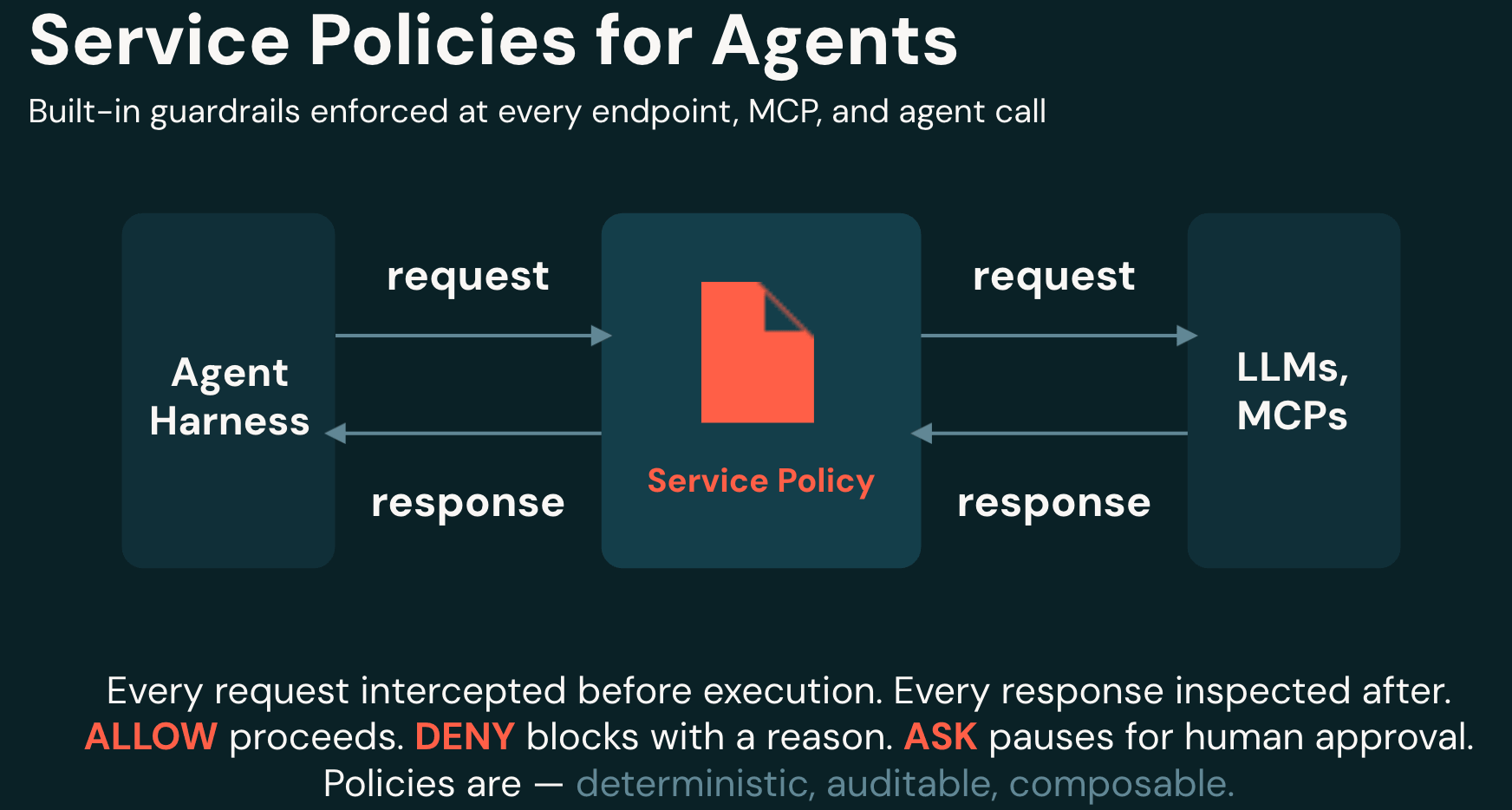
Service policies let you write rules that evaluate every tool call before and after it reaches the upstream MCP server. You decide which calls are allowed, denied, or require user consent. Service policies are defined in SQL and let admins check arguments, including caller properties and other context properties. If a call doesn't pass the policy, it is blocked

Payload logging captures every tool call as an entry in a tracing table managed in Unity Catalog. Tool name, arguments, result, user identity, and whether the call was allowed or denied. Query it with SQL like any other table.
How it works

Define your policy function in Unity Catalog

Unity Catalog allows you to register and govern any external MCP (see our blog on how this works!). A service policy is a Unity Catalog SQL function. It receives two arguments, actor (who is calling) and context (what they're calling), and returns allow or deny with a reason.

Here's a simple policy on a GitHub MCP. It blocks file deletion entirely, and blocks merging PRs unless the caller is an approved engineer:

Attach and enforce

Once written, attach the policy to any MCP service in Unity AI Gateway. From that point, every tool call routed through that service is evaluated before it executes. No code changes needed in the agent or the MCP server.

Log and verify

Every tool call is automatically captured in a Delta table in Unity Catalog. Send a prompt that should be blocked and one that should pass. The results appear in your logs immediately, queryable with SQL like any other table. 

Get started

Service policies and payload logging for MCP are available as a Gated Beta, extending the same governance concepts you already use for data to every MCP call. To get early access, reach out to your Databricks account team.