

惯性聚合 高效追踪和阅读你感兴趣的博客、新闻、科技资讯
阅读原文 在惯性聚合中打开

推荐订阅源

T
Threat Research - Cisco Blogs
NISL@THU
NISL@THU
A
Arctic Wolf
Threat Intelligence Blog | Flashpoint
S
Schneier on Security
T
Tenable Blog
I
Intezer
S
Securelist
Scott Helme
Scott Helme
V
Visual Studio Blog
Simon Willison's Weblog
Google DeepMind News
T
The Blog of Author Tim Ferriss
D
Darknet – Hacking Tools, Hacker News & Cyber Security
AWS News Blog
AWS News Blog
H
Hackread – Cybersecurity News, Data Breaches, AI and More
MongoDB | Blog
MongoDB | Blog
L
LangChain Blog
F
Fortinet All Blogs
cs.CL updates on arXiv.org
C
Cisco Blogs
L
Lohrmann on Cybersecurity
M
MIT News - Artificial intelligence
G
GRAHAM CLULEY
博客园 - 司徒正美
aimingoo的专栏
aimingoo的专栏
雷峰网
雷峰网
MyScale Blog
MyScale Blog
D
DataBreaches.Net
Cyber Security Advisories - MS-ISAC
Recent Announcements
C
CXSECURITY Database RSS Feed - CXSecurity.com
量子位
博客园 - 三生石上(FineUI控件)
P
Proofpoint News Feed
Blog — PlanetScale
Blog — PlanetScale
云风的 BLOG
云风的 BLOG
大猫的无限游戏
大猫的无限游戏
GbyAI
GbyAI
Cisco Talos Blog
Cisco Talos Blog
Security Latest
Security Latest
Project Zero
Project Zero
K
Kaspersky official blog
罗磊的独立博客
Know Your Adversary
Know Your Adversary
T
The Exploit Database - CXSecurity.com
P
Privacy International News Feed
P
Privacy & Cybersecurity Law Blog
C
Cyber Attacks, Cyber Crime and Cyber Security
Apple Machine Learning Research

Databricks

How lakebase architecture delivers 5x faster Postgres writes Why Talent Transformation Is the Missing Focus of Enterprise AI Public Health Intelligence Shouldn't Require a Data Scientist Mean Time to Detect Is a Data Access Problem First-party audience data is the ad sales relationship now Rethinking Distributed Systems for Serverless Performance and Reliability The AI Scaling Gap Hiding in Digital Native Companies 10 trillion samples a day: Scaling beyond traditional monitoring infra at Databricks AI success starts with clean data, not just better models How nOps Rebuilt Their Cloud Optimization Platform on Databricks Lakebase, and Why Other ISVs Should Too Peril Predicts: Precision Payouts for a Volatile World The foundation of AI scalability: one team, one platform, one operating model The Federal Data Paradox: Rich in Data, Poor in Access Driving Budapest Forward: How BKK Uses Databricks to Transform City Mobility LLM Vs AI: A Practical Guide to Differences, Use Cases, and Tools Model Risk Governance Is Not the Same as Risk Intelligence Generative AI for Business: A Complete Strategy and Implementation Guide Data Science vs Data Engineering: Choosing Analysis or Infrastructure AI Applications: Tools, Use Cases, and Platforms MLOps vs DevOps: A Practical Guide for Data Scientists and IT Teams Top Data Warehouse Tools For Modern Data Analytics Unlocking SAP Business Context in Databricks with Semantic Metadata Delta Sharing The marketing activation gap has a fix: Databricks and Stitch partner to turn data infrastructure into marketing performance Alert Fatigue Is a Business Risk Backstage with Lakebase Shipping Faster isn’t Learning Faster Why Your OEE Dashboard Is Lying to You The Turbine That Tried to Tell You It Was Failing Predicting Readmissions Isn't Enough. Acting in Time Is. Clinical Trials Run Longer Than They Have To. That's a Patient Problem Network Quality Is a Revenue Problem, Not a Technical One Shelf Availability Starts with Better Demand Visibility When Predicting the Next Hit Requires More Than Intuition Approximate Answers, Exact Decisions: New Sketch Functions for Analytics Companies Winning with AI Built the Data Layer First Rethinking SQL ETL for modern data platforms Stripe data now available on Databricks via Databricks Marketplace Databricks and Stripe Projects: Infrastructure Built for Agents Agents are ready but your architecture probably isn't Interoperability Between Unity Catalog and Google BigQuery via Catalog Federation Built In, Not Bolted On: What AI-Native Actually Means in Cybersecurity Operationalizing AI for public sector fraud prevention From months to minutes: Building real-time clinical data pipelines with natural language Agentic Data Engineering with Genie Code and Lakeflow Securely send first-party conversion signals with Snapchat Conversions API on Databricks Marketplace Inside one of the first production deployments of Lakebase: LangGuard's agentic workflow governance engine The next generation of Databricks Genie Model Risk Management in 2026: A Banker’s Guide to the Revised Interagency Guidance OpenAI GPT-5.5 now available on Databricks, fully-governed through Unity AI Gateway Operational databases: How they work and when to use them Databricks partners with OpenAI on GPT-5.5 Announcing the Public Preview of Lakeflow Designer Are LLM agents good at join order optimization? How conversational analytics removes the BI bottleneck How to transform document activation workflows with Genie and Agent Bricks Beyond the spreadsheet: how Databricks is delivering the modern CFO in Financial Services AI App Development: Guide To Building AI-Powered Apps IoT in Manufacturing: Strategy, Components, Use Cases, and Challenges Stop Hand-Coding Change Data Capture Pipelines Multimodal Data Integration: Production Architectures for Healthcare AI Personalization Strategies for Media Companies A Modern AI Risk Management Framework Introducing the Databricks Excel Add-in for Business Users Real-Time Decisioning for AI Agents: Why you Need a Customer Context Layer First A Practical Guide to LLM Fine Tuning AI Data Transformation Guide for Data Engineers and Data Scientists Concurrency Control in DBMS: How Locking, MVCC and Optimistic Strategies Keep Data Consistent Bridging data science and marketing: Databricks unveils Delta Sharing integration for Adobe Experience Platform and agentic marketing workflows Take Control: Customer-Managed Keys for Lakebase Postgres Get hands on with agents, vibe coding and more at Data+ AI Summit Mercedes-Benz Builds a Cross-Cloud Data Mesh with Delta Sharing and Intelligent Replication, Cutting Costs by 66% What Is a Transactional Database? Introducing Genie Agent Mode Governing coding agent sprawl with Unity AI Gateway Governing Coding Agent Sprawl with Unity AI Gateway What is pgvector? Banks Don’t Have an AI Problem – They Have a Data Platform Problem Open Platform, Unified Pipelines: Why dbt on Databricks is Accelerating Why Your Agents Can’t Read Enterprise Documents — and How to Fix It Building with Databricks Document Intelligence and Lakeflow Databricks on Google Cloud: Innovate Faster. Smarter. Together. Introducing the Databricks Connector for Google Sheets: Real-Time, Governed Lakehouse Data in the Sheets Users Love Unity AI Gateway: How to connect agents to external MCPs securely Expanding agent governance with Unity AI Gateway Agentic reasoning in practice: Making sense of structured and unstructured data Agent Bricks: The Governed Enterprise Agent Platform 8 AI and data trends shaping financial services in 2026 Building real-time product search on Databricks Lovable + Databricks: Build Data-Driven Apps at the Speed of Thought Memory scaling for AI agents Powering clinical research innovation: How TriNetX uses Databricks to accelerate drug development Database Branching in Postgres: Git-Style Workflows with Databricks Lakebase How Zalando built a unified data foundation for AI and analytics on Databricks The next era of the open lakehouse: Apache Iceberg™ v3 in Public Preview on Databricks How FSIs eliminate silos between clients, operations, and finance How MakeMyTrip achieved millisecond personalization at scale with Databricks A multi-agent approach to audience intelligence AiChemy: Next-generation agent with MCP, skills and custom data for drug discovery Accelerate business insights with Lakeflow Connect, now with a Free Tier Unlocking Next-Gen Customer Experiences with Data Intelligence for Marketing
How leading tech companies are killing the builder’s tax with Lakebase
2026-04-28 · via Databricks

The hidden cost killing your AI apps roadmap

Across leading tech organizations building AI-native apps, the primary constraint has shifted from model capability to the underlying data architecture, and specifically, data pipelines. The requirements of AI systems to access real-time, stateful context for agents and low marginal cost for rapid, experimental development have exposed the critical flaw in traditional, separated data architectures.

Operational workloads typically run on cloud transactional databases (e.g., managed Postgres/MySQL engines), while analytics, ML pipelines, and feature engineering live in the lakehouse. Synchronization between these layers relies on a complex mesh of CDC pipelines, ETL/ELT jobs, and reverse ETL frameworks. This results in systemic inefficiencies: 

  • Data staleness: AI systems operate on lagging snapshots rather than real-time state
  • Architectural fragmentation: Governance, lineage, and access control are duplicated across systems
  • Operational overhead: Engineering effort shifts from product development to pipeline orchestration and failure management

We call this the builder’s tax: a structural inefficiency arising from decoupled operational and analytical stacks. For the people within tech companies that build the platforms, SaaS products and developer tools everyone else runs on, this tax is especially damaging. Every new AI feature spawns another database, another pipeline, another quarter of delay.

Architectural shift: co-locating apps and data

To break this pattern, leading tech companies are redesigning the architecture, moving beyond the adoption of just another specialized tool. We see them running apps and AI directly on the same governed foundation as their analytics.

That foundation is Lakebase: a fully managed serverless Postgres engine natively integrated into the Databricks Platform.

  • Apps read and write directly against lakehouse-managed data
  • Governance is centralized through Unity Catalog across all workloads
  • Reliable operational data with automated snapshots and built-in failure recovery
This establishes an Interoperable Application Foundation: a single, governed layer where apps, AI, and analytics share the same operational store.

Real world scenario 

Amey Banarse presented “From Transactions to Agents: PostgreSQL in Modern AI Applications” at PostgresConf 2026 [Slides]. Amey covers a live walkthrough of a healthtech claims app built entirely on Lakebase + the AI DevKit, showing how lakehouse intelligence, operational insights and a continuous learning loop run on a single Databricks foundation. 

Organizations are typically entering this architecture through three primary vectors:

  • Elimination of reverse ETL pipelines: Analytical datasets (gold-layer tables) are synchronized directly into Lakebase through native integration. This removes dependency on external tools and reduces pipeline fragility.
  • AI-native apps and internal tools: Run Databricks Apps + Lakebase as a single, serverless stack with model serving, feature store and analytics. No extra infrastructure to provision.
  • Agentic memory and state: Lakebase with pgvector for semantic search becomes the operational memory layer for agents built with Agent Bricks, alongside the data they reason over.

What tech companies are actually seeing

The outcomes below come from tech companies that have moved to a Lakebase architecture:
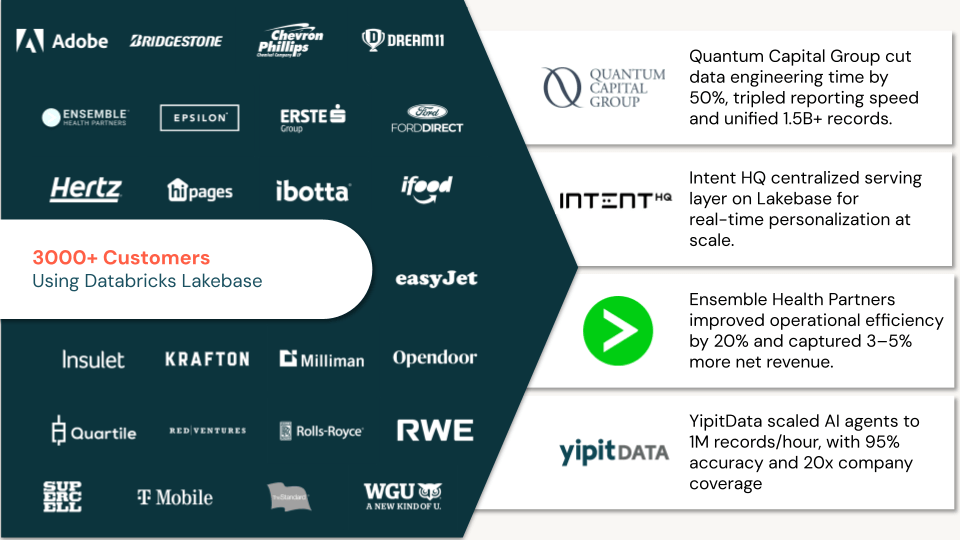
Tech industry Lakebase customer logos

YipitData scaled their AI agent pipeline to process 1M records per hour, achieving 92–95% tagging accuracy and 20x company coverage. By using Lakebase as the relational system of record inside Unity Catalog, their agents operate with a durable, governed state — no fragile external stores, no sync lag.

Quantum Capital Group was managing 1.5B+ records across six fragmented data sources. After consolidating on Lakebase, they eliminated 100+ redundant tables, cut data engineering time by 50%, and tripled reporting speed — teams now work from a single trusted dataset instead of fighting version sprawl.

Ensemble Health Partners unified 15+ fragmented SQL Server systems. With Lakebase as the transactional layer, they deployed AI-driven revenue-cycle workflows that improved operational efficiency by 20% and helped customers capture 3–5% more net revenue year over year.

Replit, whose platform powers millions of developers building and deploying software, uses Lakebase + the Databricks AI DevKit to help customers launch production code-generation AI in 3 weeks with 10x developer velocity, eliminating the gap between operational and analytical systems from day one.

IntentHQ, a consumer intelligence platform, centralized its serving layer on Lakebase to power real-time personalization at scale — giving AI models a low-latency operational store that stays in sync with its lakehouse data without custom pipelines.

The architecture pattern behind the outcomes

Despite differing use cases — from AI agents and personalization engines to healthcare workflows and developer platforms — these organizations are not succeeding through isolated optimizations. They are converging on a fundamentally different architectural model.
At its core, this architectural model eliminates the traditional separation between transactional systems, analytical platforms, and AI pipelines, replacing it with a shared, interoperable data foundation. 
This pattern consistently includes three tightly integrated layers:

  1. Lakehouse intelligence layer 

    A governed, scalable foundation where batch and streaming data, feature engineering, and AI/ML workloads operate. This layer provides the system of insight, enabling large-scale processing, model training, and analytics on unified data.

  2. Operational data layer

    A low-latency transactional interface (Lakebase) that serves as the system of execution for applications and agents. This layer enables real-time reads/writes, state management, and application logic directly on governed data — without replication or synchronization overhead.

  3. Continuous learning loop

    A closed feedback system where application interactions, agent outputs, and user signals are captured and reintegrated into model pipelines. This establishes a system of continuous improvement, allowing AI capabilities to evolve based on real-world use.

When these three layers share a foundation, AI systems transition from isolated workloads to continuously improving production systems.

Eliminating the builder’s tax

The cuilder’s tax isn’t inevitable. It’s a consequence of building AI on top of infrastructure that was designed for a different era — when databases were monolithic, apps were stateless, and intelligence was a separate project.

Lakebase changes the math! Apps run where the data lives. Agents have the context they need. And the engineering time your team spent on pipelines goes back to shipping. 

Watch Amey Banarse’s PostgresConf 2026 session, “From Transactions to Agents: PostgreSQL in Modern AI Applications [Slidesto see a full AI-native app built on Lakebase in action.

Databricks Lakebase is serverless Postgres built for agents and apps. Learn more at databricks.com/product/lakebase.