

惯性聚合 高效追踪和阅读你感兴趣的博客、新闻、科技资讯
阅读原文 在惯性聚合中打开

推荐订阅源

酷 壳 – CoolShell
酷 壳 – CoolShell
H
Hacker News: Front Page
P
Palo Alto Networks Blog
T
ThreatConnect
Apple Machine Learning Research
博客园_首页
T
True Tiger Recordings
P
Privacy & Cybersecurity Law Blog
B
Blog
IT之家
IT之家
Last Week in AI
Last Week in AI
F
Full Disclosure
Hacker News: Ask HN
Hacker News: Ask HN
C
Comments on: Blog
Microsoft Azure Blog
C
Cybersecurity and Infrastructure Security Agency CISA
Microsoft Security Blog
博客园 - 【当耐特】
N
News and Events Feed by Topic
NISL@THU
NISL@THU
腾讯CDC
雷峰网
雷峰网
Security Latest
Security Latest
李成银的技术随笔
M
Microsoft Research Blog - Microsoft Research
L
LangChain Blog
L
Lohrmann on Cybersecurity
cs.CL updates on arXiv.org
C
Check Point Blog
Y
Y Combinator Blog
Recent Announcements
博客园 - Franky
N
News | PayPal Newsroom
V
V2EX
A
About on SuperTechFans
The Register - Security
月光博客
月光博客
奇客Solidot–传递最新科技情报
奇客Solidot–传递最新科技情报
Google Online Security Blog
MyScale Blog
MyScale Blog
Cisco Talos Blog
Cisco Talos Blog
Vercel News
Vercel News
WordPress大学
WordPress大学
C
Cyber Attacks, Cyber Crime and Cyber Security
The Hacker News
The Hacker News
IntelliJ IDEA : IntelliJ IDEA – the Leading IDE for Professional Development in Java and Kotlin | The JetBrains Blog
爱范儿
爱范儿
A
Arctic Wolf
L
LINUX DO - 最新话题
freeCodeCamp Programming Tutorials: Python, JavaScript, Git & More

Databricks

Unlock seamless and cost-effective marketing campaigns with Lakebase Governing AI agents at scale with Unity Catalog How telecom CFOs can make smarter network capex decisions with AI How Databricks Genie improves retail personalization Databricks for Good and Virtue Foundation: Partnering to Connect Medical Volunteers to Critical Health Services in 72 Countries Automate Data & KPI Monitoring with SQL Alerts How to Build Real-Time Fraud Detection using Spark Real-Time Mode and Lakebase How Databricks Genie improves supply chain visibility with real-time AI analytics A CFO’s guide to managing value-based care financial performance Stop Rogue AI: How Unity Catalog Secures Your Agent Actions Why AI Security Infrastructure is Now a CMO Priority Databricks context engineer associate: the industry’s first certification for reliable AI agent systems Introducing AI Spend Controls with Unity AI Gateway How to safeguard AI workloads with Unity AI Gateway Guardrails What’s new in Unity AI Gateway: service policies, guardrails, observability, and cost controls for AI agents and MCPs MemEx: A Programmable Scratchpad for LLM Agents How Deutsche Börse built a generative AI tool to tackle the large-scale migration of Zeppelin notebooks to Databricks Announcing the Databricks analytics engineer learning pathway The question your commercial data should already be able to answer PipelineIQ: Forward‑Looking Sales Intelligence That Drives Action Backstage with Lakebase, part 2 Expanded interoperability with Unity Catalog Open APIs From manual to autonomous: how AI agents are transforming electric grid operations Data quality is the AI strategy Clinical operations intelligence belongs on the Lakehouse The Rosetta stone of CPS: Claroty’s AI-powered library ABAC row filtering and column masking policies, governed tags, and data classification are now generally available in Unity Catalog The Rise of Sports Intelligence: How the Lakehouse Turns Tracking Data into Competitive Advantage How CFOs in consulting can recover margin with Databricks Announcing Native Lakehouse Sync Announcing Databricks Student Fellows Faster Queries and New Capabilities with the Open-Source Databricks JDBC Driver The Convergence of Open Table Formats and Open Catalogs: Catalog Commits is Generally Available Unlocking the Archives: Turning Unstructured Documents into a Searchable Database for Groundwater Discovery Using MemAlign to Improve Evaluation of Traditional Machine Learning in Genie Code How Superhuman and Databricks built a 200K QPS inference platform together Addressing HR's widening capacity gap with AI MCP Marketplace Brings Real-Time Intelligence to Agentic Applications Pushing the Frontier for Data Agents with Genie Energy trading analytics in a real-time market Operating room utilization is hiding in your scheduling data Predictive Quality Starts Where Defect Detection Stops Retail markdown optimization: from reactive markdowns to proactive Why telecom churn prediction misses the intervention window Growth Analytics Is What Comes After Growth Hacking Real-world evidence for medical affairs: who can actually use it? Wealth advisor productivity starts with the client conversation How lakebase architecture delivers 5x faster Postgres writes Why Talent Transformation Is the Missing Focus of Enterprise AI Public Health Intelligence Shouldn't Require a Data Scientist Mean Time to Detect Is a Data Access Problem First-party audience data is the ad sales relationship now Rethinking Distributed Systems for Serverless Performance and Reliability The AI Scaling Gap Hiding in Digital Native Companies 10 trillion samples a day: Scaling beyond traditional monitoring infra at Databricks AI success starts with clean data, not just better models How nOps Rebuilt Their Cloud Optimization Platform on Databricks Lakebase, and Why Other ISVs Should Too Peril Predicts: Precision Payouts for a Volatile World The foundation of AI scalability: one team, one platform, one operating model The Federal Data Paradox: Rich in Data, Poor in Access Driving Budapest Forward: How BKK Uses Databricks to Transform City Mobility LLM Vs AI: A Practical Guide to Differences, Use Cases, and Tools Model Risk Governance Is Not the Same as Risk Intelligence Generative AI for Business: A Complete Strategy and Implementation Guide Data Science vs Data Engineering: Choosing Analysis or Infrastructure AI Applications: Tools, Use Cases, and Platforms MLOps vs DevOps: A Practical Guide for Data Scientists and IT Teams Top Data Warehouse Tools For Modern Data Analytics Unlocking SAP Business Context in Databricks with Semantic Metadata Delta Sharing The marketing activation gap has a fix: Databricks and Stitch partner to turn data infrastructure into marketing performance Alert Fatigue Is a Business Risk Backstage with Lakebase Shipping Faster isn’t Learning Faster Why Your OEE Dashboard Is Lying to You The Turbine That Tried to Tell You It Was Failing Predicting Readmissions Isn't Enough. Acting in Time Is. Clinical Trials Run Longer Than They Have To. That's a Patient Problem Network Quality Is a Revenue Problem, Not a Technical One Shelf Availability Starts with Better Demand Visibility When Predicting the Next Hit Requires More Than Intuition Approximate Answers, Exact Decisions: New Sketch Functions for Analytics Companies Winning with AI Built the Data Layer First Rethinking SQL ETL for modern data platforms Stripe data now available on Databricks via Databricks Marketplace Databricks and Stripe Projects: Infrastructure Built for Agents Agents are ready but your architecture probably isn't Interoperability Between Unity Catalog and Google BigQuery via Catalog Federation Built In, Not Bolted On: What AI-Native Actually Means in Cybersecurity Operationalizing AI for public sector fraud prevention From months to minutes: Building real-time clinical data pipelines with natural language Agentic Data Engineering with Genie Code and Lakeflow Securely send first-party conversion signals with Snapchat Conversions API on Databricks Marketplace How leading tech companies are killing the builder’s tax with Lakebase Inside one of the first production deployments of Lakebase: LangGuard's agentic workflow governance engine The next generation of Databricks Genie Model Risk Management in 2026: A Banker’s Guide to the Revised Interagency Guidance OpenAI GPT-5.5 now available on Databricks, fully-governed through Unity AI Gateway Operational databases: How they work and when to use them Databricks partners with OpenAI on GPT-5.5 Announcing the Public Preview of Lakeflow Designer
Governing Coding Agent Sprawl with Unity AI Gateway
2026-04-17 · via Databricks

Software development has entered a new era. The best engineering teams are now shifting development from human-driven to agent-driven. All organizations should be aggressively looking to deploy these new 10x engineers as broadly as possible but they are concerned about governing and monitoring adoption. For coding against to be successful, they need access to sensitive company data such as engineering tickets, design documents, and customer issues, and organizations fear the security risks and runaway costs of ungoverned and unmonitored adoption.

Today, we’re introducing the Coding Agent Support in Unity AI Gateway. Our goal is to deliver coding tool freedom for developers and unified governance for admins.

AI Coding Agent Sprawl

Opus 4.6, Composer 2, GPT-5.4, Kimi-2.5, Gemini 3 Pro -- new models are released every week that reshape the frontier of cost and quality. Coding tools themselves are also constantly evolving, and software developers want choice, For example, within Databricks, our software developers flexibly mix usage between Cursor, Codex, Claude Code, and others -- often using multiple tools at the same time! Adopting multiple coding tools is a business necessity, which then introduces key challenges for administrators trying to move fast to support developer productivity with multiple tools.
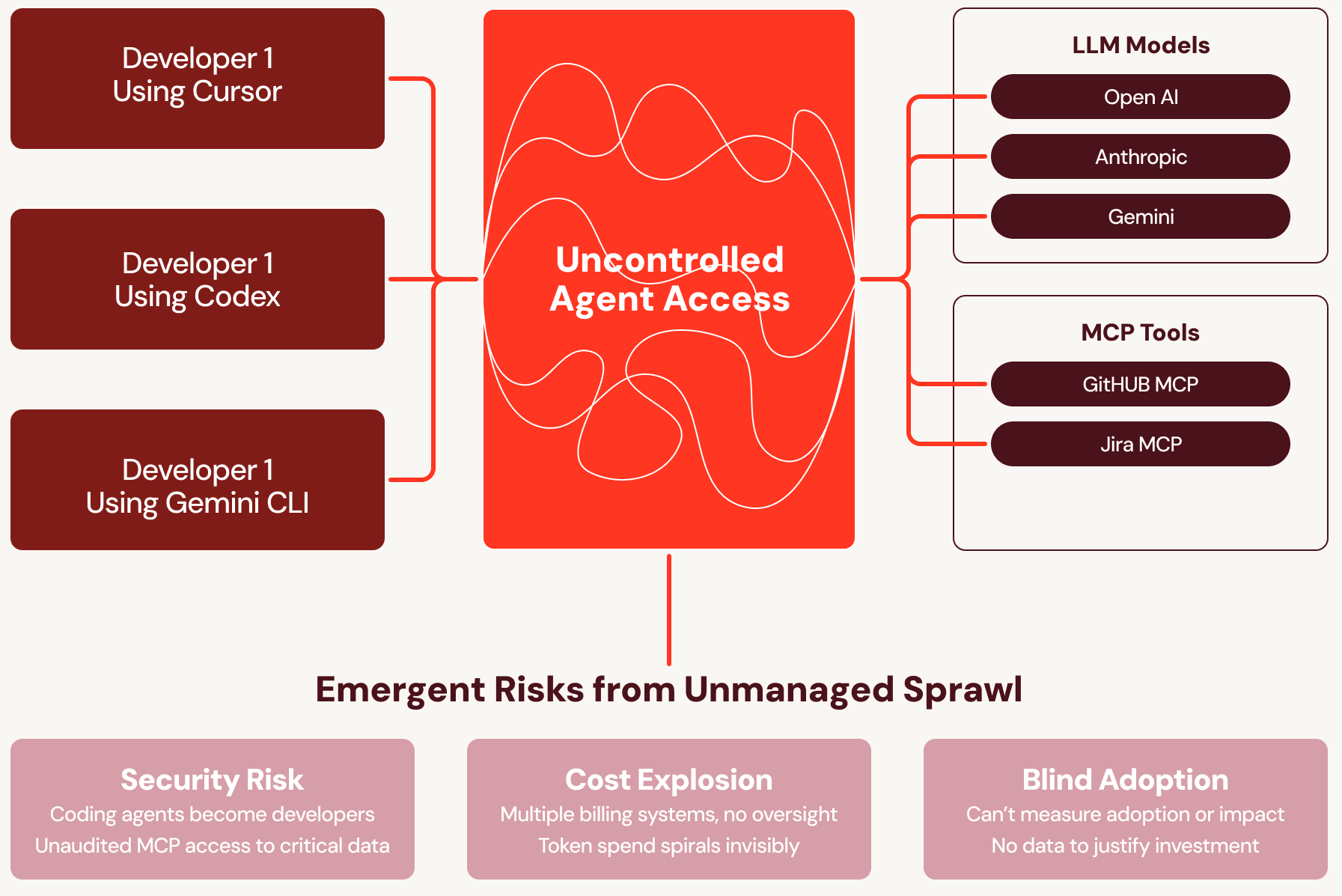
Coding agent sprawl slows AI deployment
Coding agent sprawl slows AI deployment in your org

Security, data privacy, and cost reviews for new tools can slow teams down. In addition, these AI coding tools require much stronger due diligence for several reasons:

  • Security Risk: MCPs can give agents access to sensitive data
    MCP tools are most useful when they have access to critical data within your organization, so it’s easy to accidentally make them the most privileged developer in your organization. How do organizations audit and govern agent’s access to data?
  • Cost Explosion: Agent costs are exploding
    With AI usage growing, agent costs are becoming a top R&D cost driver. Access to AI and flexibility of tools needs to be balanced with reasonable cost guardrails. How can admins ensure effective cost controls across multiple tools?
  • Visibility Gap: Executives lack visibility into tool adoption
    With the expanding capabilities of these tools, organizations are racing to adopt AI. To scale AI across an organization, measurement is critical to identify the key blockers. How can executives easily see who is using AI if everyone’s using a different tool?

So, how can organizations move fast to enable AI productivity while ensuring data privacy and cost visibility?

Introducing Coding Agent Support in Unity AI Gateway

To simplify this, we are introducing the coding agent support in Unity AI Gateway, a unified governance hub for popular coding tools like Codex, Cursor, and Gemini CLI. Our gateway unifies access controls, usage statistics, operational observability, cost management, guardrails, and inference capacity into a single platform, giving you centralized control over your AI agents.

  • Pillar 1: Centralized Security and Audit: All agent data access can be centrally governed with all audit logs in Unity Catalog with MCP servers managed in Databricks and centralized tracing with MLflow.
  • Pillar 2: Single Bill and Cost Limits: Admins can set cost limits that apply across whichever tools developers want to use. With capacity from Foundation Model API, which offers first-party inference for all popular models, admins get one all-in bill from Databricks.
  • Pillar 3: Full Observability in the Data Lakehouse: Critical data like lines of code written per user, cost per month per user, and more are all automatically ingested into your Data Lakehouse, alongside the rest of your critical data.

Security and Compliance for Coding Agent, MCP and LLM Interactions

AI Gateway unifies security governance across coding agents, LLM interactions and MCP integrations. Your development workflows run on the same trusted platform as your analytics and AI, with centralized controls

  • Data privacy: We ensure your private data stays within the Databricks security perimeter.
  • Audit-ready logging: Automatically capture traces in Unity Catalog for compliance and security reviews.
  • Single identity across all services: Developers authenticate once with Databricks credentials for all tools—GitHub, Atlassian, and others—with no separate logins per service. This securely connects agents to critical data sources while enforcing consistent governance.

By unifying all integrations, including coding agents and MCP tools, organizations can centralize logging, enforce policies, and monitor usage across the entire ecosystem, ensuring consistent security and compliance.

Simplify cost management and billing

Databricks’ Foundation Model API provides inference for OpenAI, Anthropic, and Gemini models, and the best open source coding models like Qwen in a single platform. The Gateway also lets you bring external capacity in, expanding governance to all your tokens, regardless of where they flow.

This means your coding tools can connect to the same capacity as your other agents, and costs are centralized into a single bill and observability platform! Foundation Model API offers day one launches for every frontier LLM model, so developers can use the newest, best models that are coming out immediately.

With our centralized Gateway, admins can stop switching tabs between admin consoles to control rate limits and budgets for every single coding tool. Instead, organizations can give developers a single budget across all coding tools to burn down on their agent of choice!

Unified Observability for AI Coding Tools

By treating AI coding tool usage data as a first-class citizen in Unity Catalog alongside your enterprise datasets, you gain a unified, governed framework for deep operational intelligence. This ensures all coding activity is auditable, secure, and ready for automated workflows.

With our OpenTelemetry ingestion, coding tool metrics and traces are automatically centralized to Unity Catalog-managed Delta tables.

With all the data landing in the Lakehouse, enterprises are finding creative ways to combine usage data with their business’ ontology.

  • Track adoption per org: Join AI Gateway metrics with Workday to map GenAI adoption by department, region, or seniority, helping identify where to target enablement.
  • Quantify Developer Velocity: Measure the tangible impact of AI assistance on output.

Example: "A 20% increase in token usage per developer drove a 15% reduction in pull request cycle time, directly linking AI tool usage to increased developer velocity."

  • Proactive Capacity Planning: Monitor users hitting rate limits to data-justify securing additional capacity or dedicated throughput before productivity is throttled.

What Our Customers Are Saying

We have been working to get visibility into our coding tool usage across teams. We need a centralized way to monitor spending, manage token budgets, and catch anomalies before they become costly problems. We look forward to leveraging AI Gateway’s monitoring capabilities to give us the control and transparency we need to scale AI responsibly. — George Torres, Senior Director of AI Engineering, First American
As we broaden adoption of AI coding tools to support hundreds of developers across regions, we are counting on AI Gateway to provide native support for experimental features and advanced tooling including web search and large-context models. We need a unified platform that seamlessly enables beta capabilities and provides real-time usage dashboards, so we can scale AI development with confidence while maintaining rigorous governance and compliance across our healthcare analytics organization. — Iyibo Jack , Chief Product Officer, Milliman MedInsight

Get Started

Starting today, the AI Gateway for coding tools is available for all Databricks customers. Cursor, Gemini CLI and Codex CLI support are ready for immediate use.

Check out the documentation to get started.