



惯性聚合 高效追踪和阅读你感兴趣的博客、新闻、科技资讯
阅读原文 在惯性聚合中打开

推荐订阅源

Threat Intelligence Blog | Flashpoint
K
KPMG report finds enterprise disconnect between AI and its ROI | CIO
T
Threat Research - Cisco Blogs
C
CERT Recently Published Vulnerability Notes
cs.CL updates on arXiv.org
L
Lohrmann on Cybersecurity
D
Darknet – Hacking Tools, Hacker News & Cyber Security
K
Kaspersky official blog
C
Cybersecurity and Infrastructure Security Agency CISA
C
Cisco Blogs
V
Vulnerabilities – Threatpost
L
LINUX DO - 热门话题
G
GRAHAM CLULEY
The GitHub Blog
The GitHub Blog
NISL@THU
NISL@THU
AWS News Blog
AWS News Blog
博客园 - 【当耐特】
奇客Solidot–传递最新科技情报
奇客Solidot–传递最新科技情报
freeCodeCamp Programming Tutorials: Python, JavaScript, Git & More
阮一峰的网络日志
阮一峰的网络日志
Cyberwarzone
Cyberwarzone
V
V2EX
Know Your Adversary
Know Your Adversary
P
Palo Alto Networks Blog
月光博客
月光博客
MongoDB | Blog
MongoDB | Blog
Scott Helme
Scott Helme
A
Arctic Wolf
美团技术团队
S
Schneier on Security
P
Proofpoint News Feed
G
Google Developers Blog
The Hacker News
The Hacker News
S
Securelist
Microsoft Security Blog
Project Zero
Project Zero
T
The Exploit Database - CXSecurity.com
量子位
T
Threatpost
Spread Privacy
Spread Privacy
Help Net Security
Help Net Security
B
Blog
WordPress大学
WordPress大学
B
Blog RSS Feed
J
Java Code Geeks
cs.AI updates on arXiv.org
Blog — PlanetScale
Blog — PlanetScale
Simon Willison's Weblog
Y
Y Combinator Blog
Cloudbric
Cloudbric

Databricks

Why Talent Transformation Is the Missing Focus of Enterprise AI Public Health Intelligence Shouldn't Require a Data Scientist Mean Time to Detect Is a Data Access Problem First-party audience data is the ad sales relationship now Rethinking Distributed Systems for Serverless Performance and Reliability The AI Scaling Gap Hiding in Digital Native Companies 10 trillion samples a day: Scaling beyond traditional monitoring infra at Databricks AI success starts with clean data, not just better models How nOps Rebuilt Their Cloud Optimization Platform on Databricks Lakebase, and Why Other ISVs Should Too Peril Predicts: Precision Payouts for a Volatile World The foundation of AI scalability: one team, one platform, one operating model The Federal Data Paradox: Rich in Data, Poor in Access Driving Budapest Forward: How BKK Uses Databricks to Transform City Mobility LLM Vs AI: A Practical Guide to Differences, Use Cases, and Tools Model Risk Governance Is Not the Same as Risk Intelligence Generative AI for Business: A Complete Strategy and Implementation Guide Data Science vs Data Engineering: Choosing Analysis or Infrastructure AI Applications: Tools, Use Cases, and Platforms MLOps vs DevOps: A Practical Guide for Data Scientists and IT Teams Top Data Warehouse Tools For Modern Data Analytics Unlocking SAP Business Context in Databricks with Semantic Metadata Delta Sharing The marketing activation gap has a fix: Databricks and Stitch partner to turn data infrastructure into marketing performance Alert Fatigue Is a Business Risk Backstage with Lakebase Shipping Faster isn’t Learning Faster Why Your OEE Dashboard Is Lying to You The Turbine That Tried to Tell You It Was Failing Predicting Readmissions Isn't Enough. Acting in Time Is. Clinical Trials Run Longer Than They Have To. That's a Patient Problem Network Quality Is a Revenue Problem, Not a Technical One Shelf Availability Starts with Better Demand Visibility When Predicting the Next Hit Requires More Than Intuition Approximate Answers, Exact Decisions: New Sketch Functions for Analytics Companies Winning with AI Built the Data Layer First Rethinking SQL ETL for modern data platforms Stripe data now available on Databricks via Databricks Marketplace Databricks and Stripe Projects: Infrastructure Built for Agents Agents are ready but your architecture probably isn't Interoperability Between Unity Catalog and Google BigQuery via Catalog Federation Built In, Not Bolted On: What AI-Native Actually Means in Cybersecurity Operationalizing AI for public sector fraud prevention From months to minutes: Building real-time clinical data pipelines with natural language Agentic Data Engineering with Genie Code and Lakeflow Securely send first-party conversion signals with Snapchat Conversions API on Databricks Marketplace How leading tech companies are killing the builder’s tax with Lakebase Inside one of the first production deployments of Lakebase: LangGuard's agentic workflow governance engine The next generation of Databricks Genie Model Risk Management in 2026: A Banker’s Guide to the Revised Interagency Guidance OpenAI GPT-5.5 now available on Databricks, fully-governed through Unity AI Gateway Operational databases: How they work and when to use them Databricks partners with OpenAI on GPT-5.5 Announcing the Public Preview of Lakeflow Designer Are LLM agents good at join order optimization? How conversational analytics removes the BI bottleneck How to transform document activation workflows with Genie and Agent Bricks Beyond the spreadsheet: how Databricks is delivering the modern CFO in Financial Services AI App Development: Guide To Building AI-Powered Apps IoT in Manufacturing: Strategy, Components, Use Cases, and Challenges Stop Hand-Coding Change Data Capture Pipelines Multimodal Data Integration: Production Architectures for Healthcare AI Personalization Strategies for Media Companies A Modern AI Risk Management Framework Introducing the Databricks Excel Add-in for Business Users Real-Time Decisioning for AI Agents: Why you Need a Customer Context Layer First A Practical Guide to LLM Fine Tuning AI Data Transformation Guide for Data Engineers and Data Scientists Concurrency Control in DBMS: How Locking, MVCC and Optimistic Strategies Keep Data Consistent Bridging data science and marketing: Databricks unveils Delta Sharing integration for Adobe Experience Platform and agentic marketing workflows Take Control: Customer-Managed Keys for Lakebase Postgres Get hands on with agents, vibe coding and more at Data+ AI Summit Mercedes-Benz Builds a Cross-Cloud Data Mesh with Delta Sharing and Intelligent Replication, Cutting Costs by 66% What Is a Transactional Database? Introducing Genie Agent Mode Governing coding agent sprawl with Unity AI Gateway Governing Coding Agent Sprawl with Unity AI Gateway What is pgvector? Banks Don’t Have an AI Problem – They Have a Data Platform Problem Open Platform, Unified Pipelines: Why dbt on Databricks is Accelerating Why Your Agents Can’t Read Enterprise Documents — and How to Fix It Building with Databricks Document Intelligence and Lakeflow Databricks on Google Cloud: Innovate Faster. Smarter. Together. Introducing the Databricks Connector for Google Sheets: Real-Time, Governed Lakehouse Data in the Sheets Users Love Unity AI Gateway: How to connect agents to external MCPs securely Expanding agent governance with Unity AI Gateway Agentic reasoning in practice: Making sense of structured and unstructured data Agent Bricks: The Governed Enterprise Agent Platform 8 AI and data trends shaping financial services in 2026 Building real-time product search on Databricks Lovable + Databricks: Build Data-Driven Apps at the Speed of Thought Memory scaling for AI agents Powering clinical research innovation: How TriNetX uses Databricks to accelerate drug development Database Branching in Postgres: Git-Style Workflows with Databricks Lakebase How Zalando built a unified data foundation for AI and analytics on Databricks The next era of the open lakehouse: Apache Iceberg™ v3 in Public Preview on Databricks How FSIs eliminate silos between clients, operations, and finance How MakeMyTrip achieved millisecond personalization at scale with Databricks A multi-agent approach to audience intelligence AiChemy: Next-generation agent with MCP, skills and custom data for drug discovery Accelerate business insights with Lakeflow Connect, now with a Free Tier Unlocking Next-Gen Customer Experiences with Data Intelligence for Marketing
Introducing AI Spend Controls with Unity AI Gateway
2026-05-19 · via Databricks

Today, we're announcing AI Spend Controls in Unity AI Gateway. This release extends Unity AI Gateway's existing cost visibility with proactive budget alerts to give you full control over your organization's AI spend - from the coding agents your developers use every day, to the production agents serving your customers, to the batch jobs running overnight:
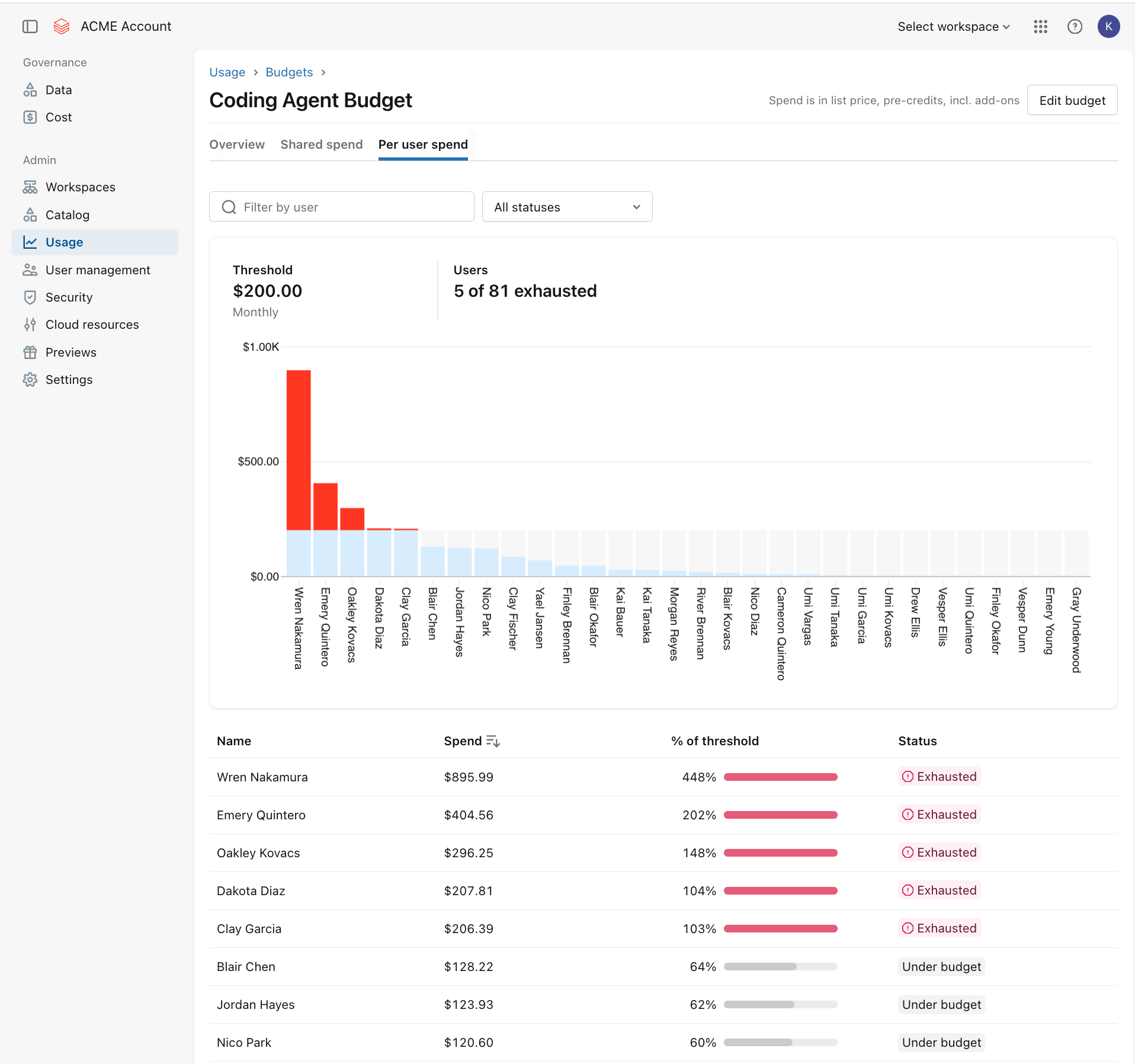
AI workloads deliver disproportionate value - but their cost profile is fundamentally more challenging to manage than your traditional cloud spend:

  • Your nightly batch job translating call transcripts may run perfectly for a month, then start failing halfway through and trigger retry logic that multiplies its cost 10x overnight.
  • Your engineering org's coding agents save thousands of developer hours a week - but the same agents make it easy for one engineer to kick off an accidental multi-agent experiment Friday night that burns through the team's monthly budget by Sunday.

Employees across engineering, support, sales, and ops are onboarding to AI faster than any technology in the last decade, unlocking net-new use cases week over week. But that adoption brings a management challenge: foundation model usage now spans dozens of teams, hundreds of users, and thousands of agents with a shifting mix of providers and model tiers. Spend controls need to apply uniformly across all AI workloads, so your organization can confidently lean into AI without worrying about surprises on the bill.

Configure Budget Alerts at Every Granularity 

While spend controls need to apply uniformly, different parts of your organization need different cost controls. A platform team cares about workspace-wide totals. A FinOps lead cares about the org-level monthly burn. An engineering manager cares about per-developer experimentation budgets. AI Spend Controls let you set them all from one place and is deeply integrated with Databricks’ existing budgets:

  • Per user: Set budgets for individual experimentation — for example, $2000 per user per month for the engineering org. Catch the developer whose agent is stuck in a loop before it shows up on the P&L.
  • Per use case: Get alerted if your organizations’ spend on coding agents like codex or claude code exceeds $1000 per user per month
  • Per workspace: Hold each unit to its own budget. Production gets $50,000/month; sandbox gets $5,000.
  • Per account: Set a top-line ceiling — say, $200,000/month across every model, every provider, every workspace — and get alerted long before you approach it.

Get Started with Unity AI Gateway Budgets Today

To track your organization’s AI spend, follow these steps:
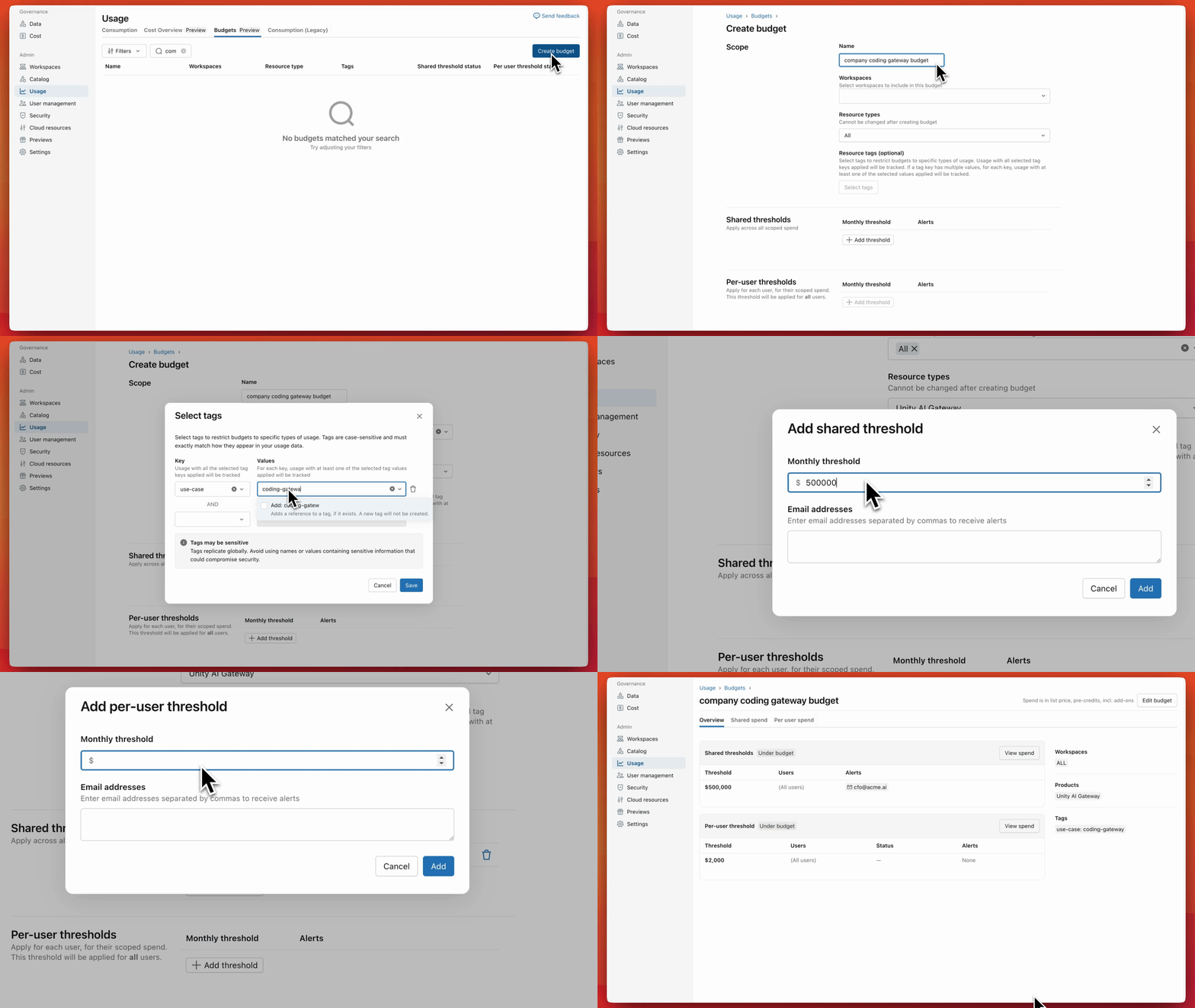
Create your Unity AI Gateway Budget

  • Open your account settings, navigate to Usage in the sidebar and open the Budgets tab
  • Create a Budget and select “Unity AI Gateway” as the Resource type
  • Optionally apply the budget only to a subset of workspaces 
  • Optionally apply “Resource tags” to configure budgets for a subset of your AI Gateway LLMs. Only AI Gateway LLMs whose tags match your budget tags will count towards the budget. This is useful to configure use-case specific budgets.
  • Configure a “Shared threshold” that sets the monthly spend limit globally across all resources in your selected workspace(s) that match the resource tags
  • Configure a “Per-user threshold” that sets a monthly spend limit per user in your account 
  • Configure email addresses that receive alerts when the thresholds are exceeded

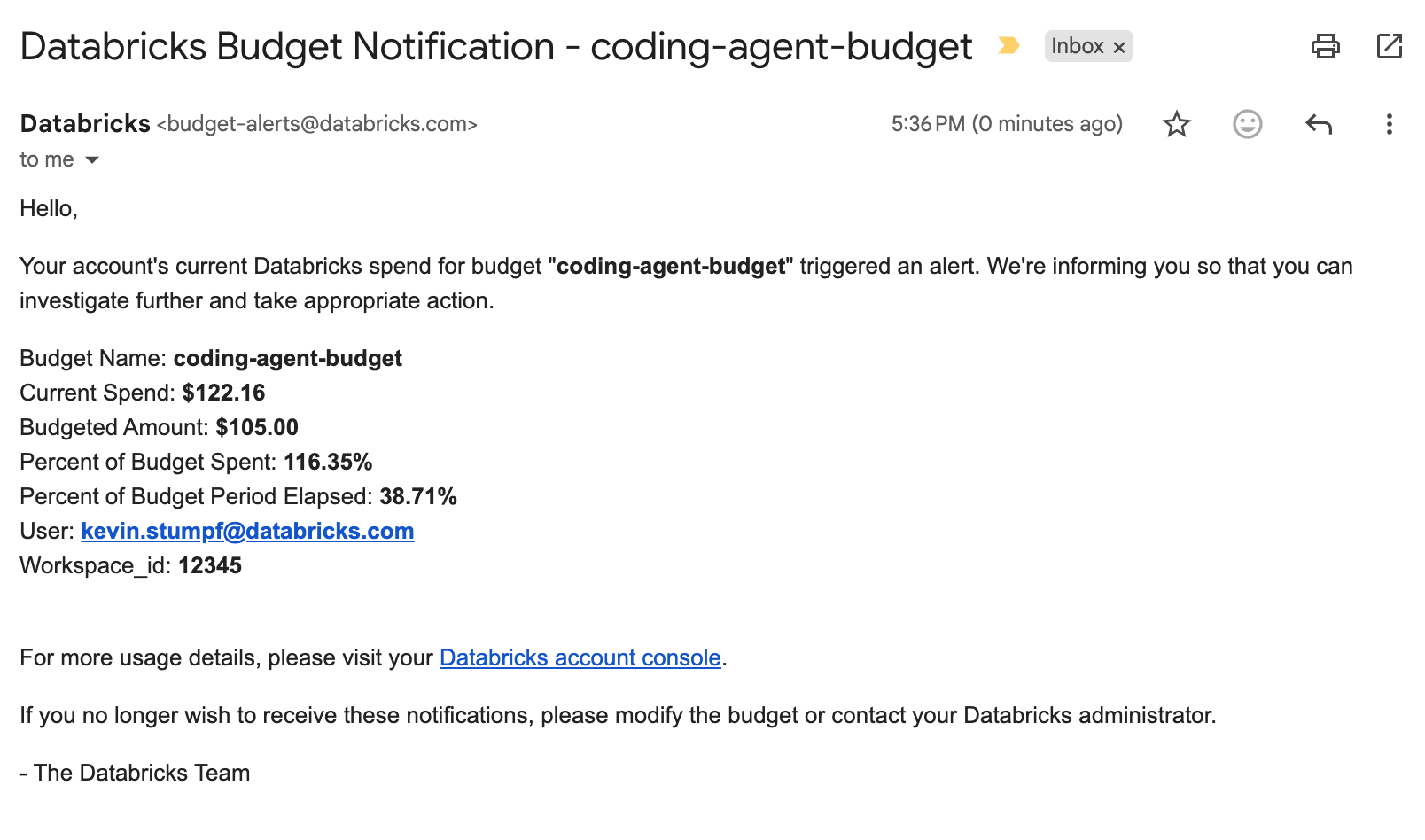
Once created, look out for budget alerts

When one of your budgets is exceeded you will receive a notification email:
Analyze your active budgets

The Cost section of your account console lets you respond to budget alert emails or proactively monitor the status of your live budgets. On the Budgets page, you see at a glance how your budgets are trending:
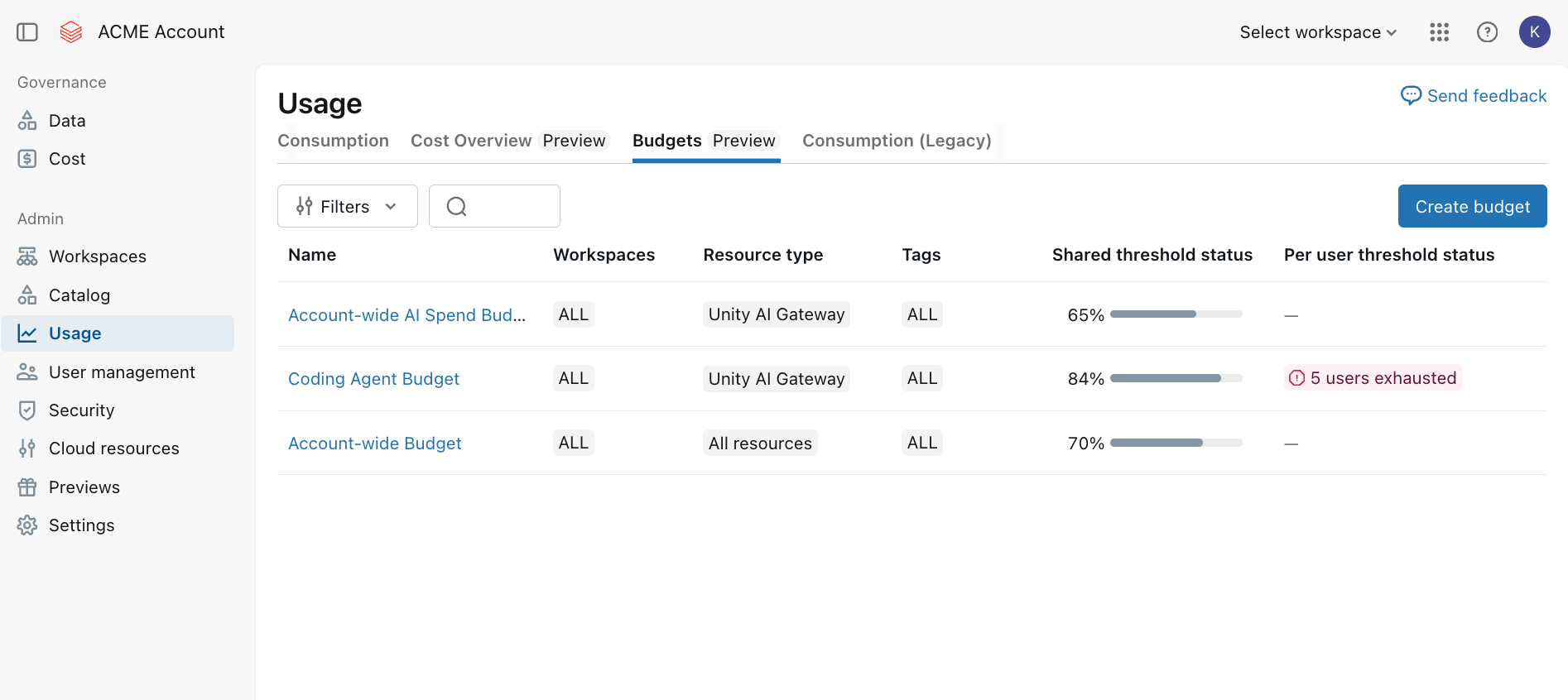
Open up any budget to see how your AI spend is trending:
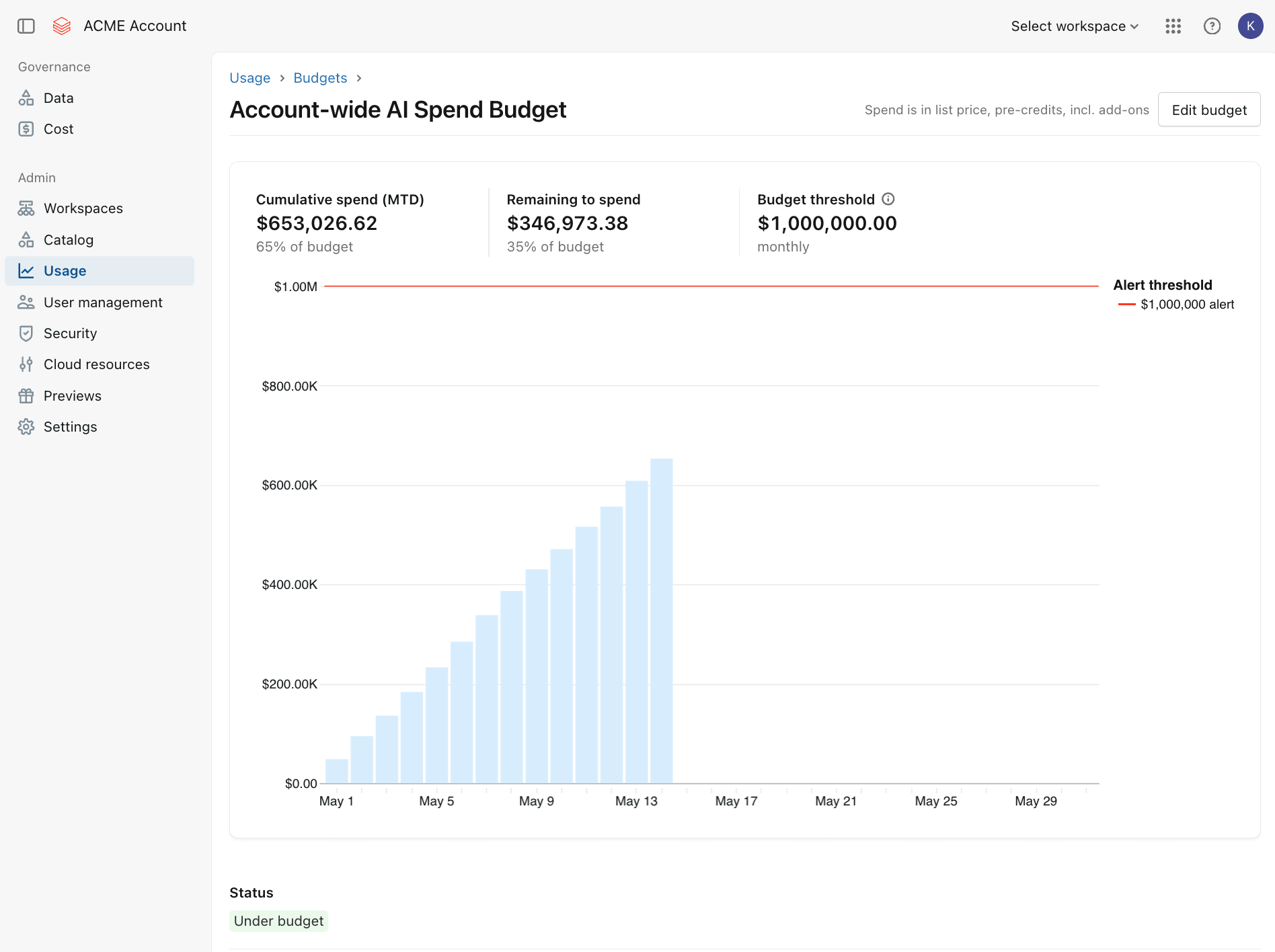
If you configured per-user level budget thresholds, the Budget detail page will show you how your organization’s users' individual AI spend is trending. When users exceed their individual threshold, their status and spend are clearly surfaced so you can act quickly:

To increase a budget’s threshold, you can simply edit the Budget and modify its spend limits.

Analyze your organization’s AI Spend in detail

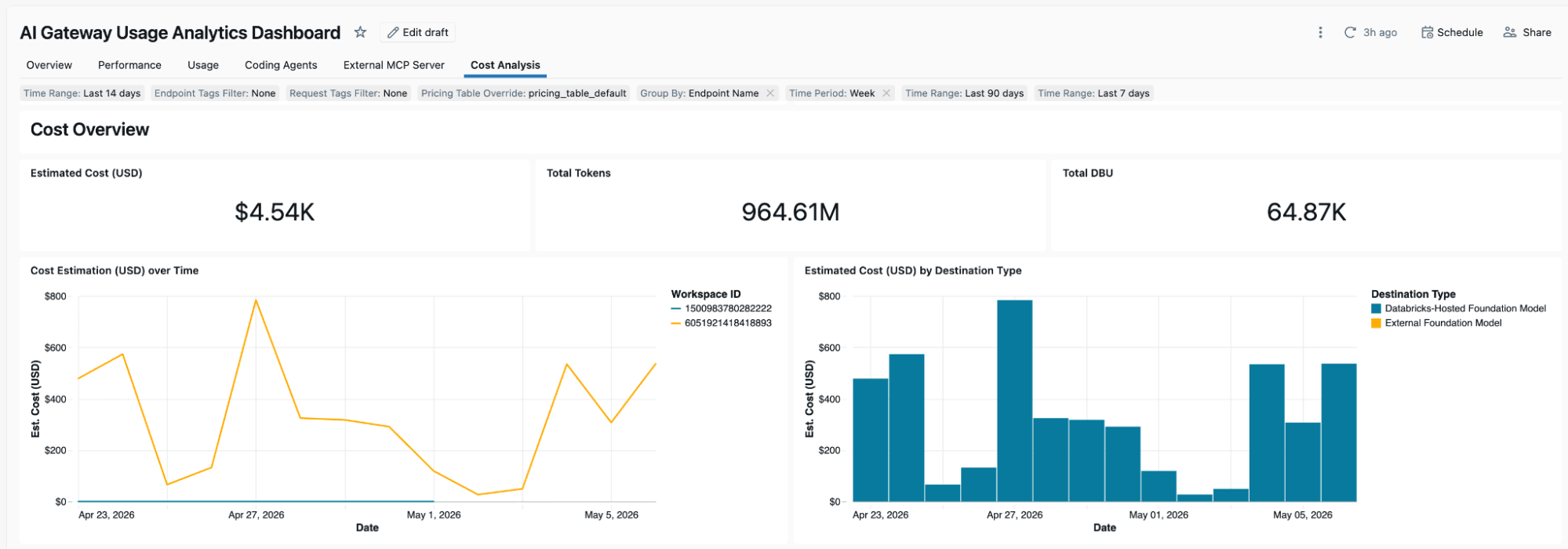
Unity AI Gateway Budgets give you a high-level overview of per-user and per-budget spend. To further analyze which users, models or use cases are driving your spend, you can use Unity AI Gateway’s existing cost tracking capabilities. Every request gets logged to Unity Catalog system tables with DBU costs and not just token counts. Provisioned throughput, uptime, pay-per-token usage, and even the token costs of external model providers are all automatically calculated. You can slice the data however your organization tracks spend:

  • Identity: Aggregate by user or service principal — map spend to the people and systems driving it.
  • Workspace, endpoint and tags: Group by team, environment, or cost center.
  • Model and provider: See which models (Opus vs. Sonnet) and providers (Anthropic vs. OpenAI vs. open source) are driving costs.
  • Request tags: Dynamic attribution for SaaS platforms proxying to end customers.

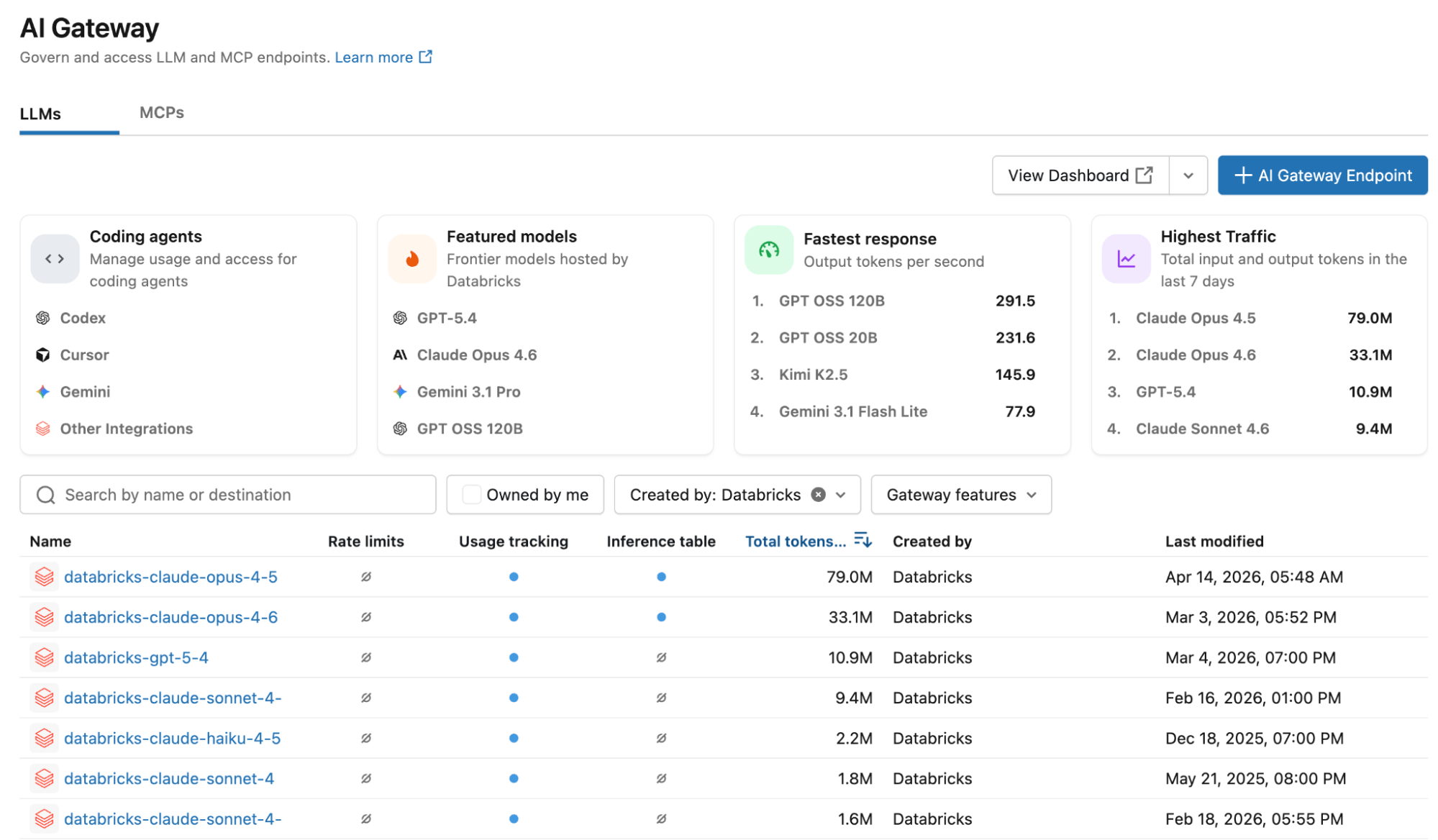
Access the Cost Analytics dashboard by navigating to the Unity AI Gateway page in your Databricks workspace and click on “View Dashboard”:
This opens up a usage & cost analytics dashboard that you can fully customize:
One platform to govern data and AI

AI Spend Controls are a natural extension of the governance capabilities you already use in Databricks:

  • Unity AI Gateway is your organization’s central AI Gateway to manage and access LLMs and MCPs.
  • Unity Catalog is your central catalog to register and discover your organization’s data and AI assets. Access permissions, audit logs and usage data all live in Unity Catalog. 
  • Databricks budgets provide the foundation for cost monitoring and alerting. With this release, Databricks budgets now allow you to configure AI-tailored budgets for your organization’s AI workloads.

Databricks provides you with a single, consistent system for governing what your agents can do, who they can do it for, and how much they can spend doing it. Get started today!