

惯性聚合 高效追踪和阅读你感兴趣的博客、新闻、科技资讯
阅读原文 在惯性聚合中打开

推荐订阅源

OSCHINA 社区最新新闻
OSCHINA 社区最新新闻
人人都是产品经理
人人都是产品经理
IT之家
IT之家
T
The Blog of Author Tim Ferriss
V
V2EX
博客园 - 聂微东
The Cloudflare Blog
Blog — PlanetScale
Blog — PlanetScale
A
About on SuperTechFans
U
Unit 42
Vercel News
Vercel News
L
LangChain Blog
博客园 - 司徒正美
H
Help Net Security
Recent Announcements
Recorded Future
Recorded Future
V
Visual Studio Blog
Jina AI
Jina AI
Microsoft Azure Blog
GbyAI
GbyAI
Y
Y Combinator Blog
C
Check Point Blog
博客园 - 三生石上(FineUI控件)
奇客Solidot–传递最新科技情报
奇客Solidot–传递最新科技情报
钛媒体:引领未来商业与生活新知
钛媒体:引领未来商业与生活新知
J
Java Code Geeks
The Register - Security
The GitHub Blog
The GitHub Blog
B
Blog RSS Feed
F
Fortinet All Blogs
B
Blog
G
Google Developers Blog
Cyber Security Advisories - MS-ISAC
云风的 BLOG
云风的 BLOG
爱范儿
爱范儿
MongoDB | Blog
MongoDB | Blog
F
Full Disclosure
有赞技术团队
有赞技术团队
罗磊的独立博客
博客园_首页
MyScale Blog
MyScale Blog
aimingoo的专栏
aimingoo的专栏
Google DeepMind News
M
MIT News - Artificial intelligence
N
Netflix TechBlog - Medium
Engineering at Meta
Engineering at Meta
量子位
I
InfoQ
小众软件
小众软件
P
Proofpoint News Feed

Databricks

How lakebase architecture delivers 5x faster Postgres writes Why Talent Transformation Is the Missing Focus of Enterprise AI Public Health Intelligence Shouldn't Require a Data Scientist Mean Time to Detect Is a Data Access Problem First-party audience data is the ad sales relationship now Rethinking Distributed Systems for Serverless Performance and Reliability The AI Scaling Gap Hiding in Digital Native Companies 10 trillion samples a day: Scaling beyond traditional monitoring infra at Databricks AI success starts with clean data, not just better models How nOps Rebuilt Their Cloud Optimization Platform on Databricks Lakebase, and Why Other ISVs Should Too Peril Predicts: Precision Payouts for a Volatile World The foundation of AI scalability: one team, one platform, one operating model The Federal Data Paradox: Rich in Data, Poor in Access Driving Budapest Forward: How BKK Uses Databricks to Transform City Mobility LLM Vs AI: A Practical Guide to Differences, Use Cases, and Tools Model Risk Governance Is Not the Same as Risk Intelligence Generative AI for Business: A Complete Strategy and Implementation Guide Data Science vs Data Engineering: Choosing Analysis or Infrastructure AI Applications: Tools, Use Cases, and Platforms MLOps vs DevOps: A Practical Guide for Data Scientists and IT Teams Top Data Warehouse Tools For Modern Data Analytics Unlocking SAP Business Context in Databricks with Semantic Metadata Delta Sharing The marketing activation gap has a fix: Databricks and Stitch partner to turn data infrastructure into marketing performance Alert Fatigue Is a Business Risk Backstage with Lakebase Shipping Faster isn’t Learning Faster Why Your OEE Dashboard Is Lying to You The Turbine That Tried to Tell You It Was Failing Predicting Readmissions Isn't Enough. Acting in Time Is. Clinical Trials Run Longer Than They Have To. That's a Patient Problem Network Quality Is a Revenue Problem, Not a Technical One Shelf Availability Starts with Better Demand Visibility When Predicting the Next Hit Requires More Than Intuition Approximate Answers, Exact Decisions: New Sketch Functions for Analytics Companies Winning with AI Built the Data Layer First Rethinking SQL ETL for modern data platforms Stripe data now available on Databricks via Databricks Marketplace Databricks and Stripe Projects: Infrastructure Built for Agents Agents are ready but your architecture probably isn't Interoperability Between Unity Catalog and Google BigQuery via Catalog Federation Built In, Not Bolted On: What AI-Native Actually Means in Cybersecurity Operationalizing AI for public sector fraud prevention From months to minutes: Building real-time clinical data pipelines with natural language Agentic Data Engineering with Genie Code and Lakeflow Securely send first-party conversion signals with Snapchat Conversions API on Databricks Marketplace How leading tech companies are killing the builder’s tax with Lakebase Inside one of the first production deployments of Lakebase: LangGuard's agentic workflow governance engine The next generation of Databricks Genie Model Risk Management in 2026: A Banker’s Guide to the Revised Interagency Guidance OpenAI GPT-5.5 now available on Databricks, fully-governed through Unity AI Gateway Operational databases: How they work and when to use them Databricks partners with OpenAI on GPT-5.5 Announcing the Public Preview of Lakeflow Designer Are LLM agents good at join order optimization? How conversational analytics removes the BI bottleneck How to transform document activation workflows with Genie and Agent Bricks Beyond the spreadsheet: how Databricks is delivering the modern CFO in Financial Services AI App Development: Guide To Building AI-Powered Apps IoT in Manufacturing: Strategy, Components, Use Cases, and Challenges Stop Hand-Coding Change Data Capture Pipelines Multimodal Data Integration: Production Architectures for Healthcare AI Personalization Strategies for Media Companies A Modern AI Risk Management Framework Introducing the Databricks Excel Add-in for Business Users Real-Time Decisioning for AI Agents: Why you Need a Customer Context Layer First A Practical Guide to LLM Fine Tuning AI Data Transformation Guide for Data Engineers and Data Scientists Concurrency Control in DBMS: How Locking, MVCC and Optimistic Strategies Keep Data Consistent Bridging data science and marketing: Databricks unveils Delta Sharing integration for Adobe Experience Platform and agentic marketing workflows Take Control: Customer-Managed Keys for Lakebase Postgres Get hands on with agents, vibe coding and more at Data+ AI Summit Mercedes-Benz Builds a Cross-Cloud Data Mesh with Delta Sharing and Intelligent Replication, Cutting Costs by 66% What Is a Transactional Database? Introducing Genie Agent Mode Governing coding agent sprawl with Unity AI Gateway Governing Coding Agent Sprawl with Unity AI Gateway What is pgvector? Banks Don’t Have an AI Problem – They Have a Data Platform Problem Open Platform, Unified Pipelines: Why dbt on Databricks is Accelerating Why Your Agents Can’t Read Enterprise Documents — and How to Fix It Building with Databricks Document Intelligence and Lakeflow Databricks on Google Cloud: Innovate Faster. Smarter. Together. Introducing the Databricks Connector for Google Sheets: Real-Time, Governed Lakehouse Data in the Sheets Users Love Unity AI Gateway: How to connect agents to external MCPs securely Expanding agent governance with Unity AI Gateway Agentic reasoning in practice: Making sense of structured and unstructured data 8 AI and data trends shaping financial services in 2026 Building real-time product search on Databricks Lovable + Databricks: Build Data-Driven Apps at the Speed of Thought Memory scaling for AI agents Powering clinical research innovation: How TriNetX uses Databricks to accelerate drug development Database Branching in Postgres: Git-Style Workflows with Databricks Lakebase How Zalando built a unified data foundation for AI and analytics on Databricks The next era of the open lakehouse: Apache Iceberg™ v3 in Public Preview on Databricks How FSIs eliminate silos between clients, operations, and finance How MakeMyTrip achieved millisecond personalization at scale with Databricks A multi-agent approach to audience intelligence AiChemy: Next-generation agent with MCP, skills and custom data for drug discovery Accelerate business insights with Lakeflow Connect, now with a Free Tier Unlocking Next-Gen Customer Experiences with Data Intelligence for Marketing
Agent Bricks: The Governed Enterprise Agent Platform
2026-04-14 · via Databricks

The basic agent pattern is familiar by now: a model connected to tools, reasoning, and taking actions. But building the loop is not the hard part. The hard part is making enterprise agents work on real business data, under real permissions, with real consequences.

The most valuable agents are defined by how deeply they connect to your business: customer records, operational systems, internal policies, and institutional knowledge. A financial services agent reviewing loan applications and applying company underwriting policies is valuable because it operates in a business context, not because of the model or framework alone. That context is what makes agents useful, and what makes them difficult to run in production. Agents need to understand what data means, operate under the right identity and permissions, and work across models without locking teams into a single vendor.

This is where most teams get stuck. Most agent products give you pieces, not a platform.

This is why we built Agent Bricks. Agent Bricks is Databricks’ enterprise agent platform for building, deploying, and governing agents that operate on your business data, end to end. It unifies model access, execution, governance, and context so teams can run agents reliably in production.
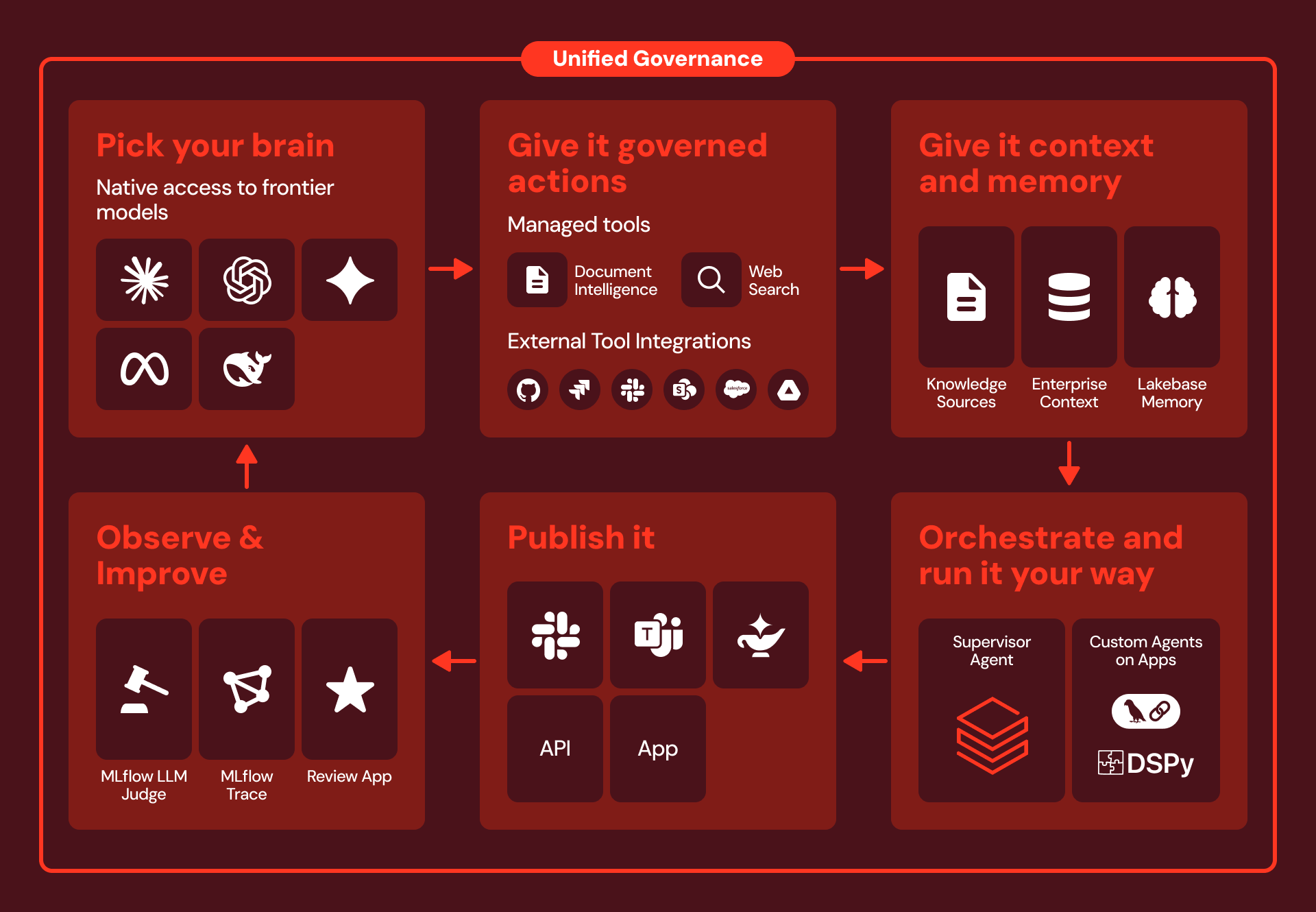
Agent Bricks: The Governed Enterprise Agent Platform

Thousands of organizations across financial services, retail, healthcare, and technology have deployed production agents at scale on Agent Bricks, including WorkdayVirgin Atlantic, Zapier, EchoStar, and AstraZeneca. Teams are building agents that deliver continuous market analysis to hundreds of analysts, orchestrate workflows across supply chain, procurement, and R&D systems, solve employee requests for complex service tasks automatically, and detect and resolve anomalies in marketing campaigns before advertising dollars are wasted.

Today, we are announcing the general availability of Document Intelligence and Custom Agents, along with new capabilities across the platform, including AI Gateway, to help you build, govern, and secure enterprise agents grounded in rich context from your data.

"With Agent Bricks, we’re not building one-off AI projects, we’re building an enterprise AI fabric. Interoperability, identity-first security and governance were designed from day one, so our agents behave like any other mission-critical system, not a science experiment." — William Acosta, Head of Agentic AI Engineering, EchoStar

The Agent Bricks platform

Running agents in production requires more than a model and tools. It requires a platform. Three things define the Agent Bricks platform:

Open and multi-AI. To build useful agents and agentic applications, teams need to work across multiple model providers and frameworks to choose the right models, use the right tools, and manage access, cost, and reliability. Agent Bricks natively supports frontier models and popular coding agents like Cursor, Codex, and Claude Code through a single API, with built-in routing, fallback, and cost optimization. It also supports building and deploying agents with major frameworks such as LangGraph and OpenAI Agents SDK. This allows teams to switch models or integrate external agents without rebuilding their systems. Today, 63% of customers route tasks across two or more model families, ensuring agents remain flexible and resilient as models evolve. 

Unified governance. Most platforms govern the agent, which tools it can call, and what permissions it holds. Agent Bricks governs the agent and everything it interacts with in a single system. With Unity Catalog and AI Gateway, access to data, models, and external MCPs is managed and observed in one place, with identity enforced end to end. Agents inherit user identity through on-behalf-of token passing, so they can only access what the user is authorized to use. Whether querying your lakehouse or calling external APIs, the same permissions, auditing, and routing apply across every interaction. This ensures every agent interaction is secure, observable, and consistent.

"Agent Bricks gives us a structured way to coordinate multiple data intelligence endpoints in a single system. Instead of hard-coding routing logic, we can guide how the agent prioritizes Genie and governed data in Unity Catalog through clear instructions. That makes it much easier to build an internal ‘ask data’ experience that’s flexible and reliable as it evolves.” — Alvaro Martin, Sr. Data Engineer, Zapier

Accurate because it understands business context. Agent accuracy depends on more than model quality. Agent Bricks uses Unity Catalog metadata, including schema, business definitions, lineage, permissions, and data quality signals, to improve how agents reason and act. This context is embedded directly into retrieval and planning, delivering 70% higher accuracy than standard RAG and a 30% improvement in multi-step workflows. For structured data, Genie Spaces leverage the semantic layer so agents reason over business definitions, not raw column names. This means agents return answers aligned to how your business actually operates, not just what the data says. This is what turns models into systems that understand your business.

What's new

Today’s releases expand what teams can build on Agent Bricks across multi-AI, governance, and enterprise context:

Multi-AI and agent orchestration

  • Custom Agents on Apps (GA). Build and deploy agent applications with any model or framework, with full lifecycle support and serverless compute. Native integration with Lakebase provides memory, conversation history, and state for long-running workflows.
  • Supervisor Agent (GA). Orchestrate multiple agents and tools into a single workflow. Define the task and connect your systems. The supervisor coordinates execution across models and tools.
  • Web Search in Foundation Model API. Ground agent responses with real-time information from the web using native provider search capabilities.

Governed access across tools, models, and data

  • AI GatewayA unified layer to manage and govern access to models, coding agents, and now MCP-connected tools. It enforces identity, permissions, and observability across every interaction, so agents operate securely across your models, tools, and APIs. Now also with guardrails to detect and mitigate risks like PII exposure, unsafe content, prompt injection, data exfiltration, and hallucinations, with customizable options for various security needs.
  • Managed OAuth MCP Connectors. Securely connect external services like GitHub, Atlassian, and Glean as governed tools. Credentials are managed centrally, so agents can access systems without exposing secrets.

Enterprise context that makes agents accurate

  • Document Intelligence (GA). Extract and structure data from unstructured documents like contracts, invoices, and reports, turning PDFs into queryable knowledge without custom pipelines.
  • Knowledge Assistant (GA). Automatically ingest enterprise documents and make them accessible to any agent, with retrieval that incorporates system context, metadata, and user constraints.
  • Agent Mode in Genie SpacesMove from single-turn Q&A to multi-step reasoning and analysis over your data, enabling agents to plan, explore, and answer complex business questions.
  • CLEARS Framework for Agent Quality with MLflow. Evaluate agents across correctness, latency, execution, adherence, relevance, and safety with a standardized framework in MLflow for production quality.

Build on Agent Bricks today

The challenge is no longer building the agent loop. It is building everything around it: identity that cannot be bypassed, credentials that do not leak, model routing that avoids lock-in, business context that makes results correct, and observability that shows what every agent did and why.

Most platforms focus on pieces of this system. Agent Bricks brings it together.

It is a multi-AI, governed platform for agents operating on enterprise data, designed to run reliably in production from day one. And we are continuing to expand that system through a growing ecosystem of integration partners, including Accenture, Atlan, Arize, CapgeminiCelebal, Collibra, Dataiku, Deloitte, EY, Glean, Infosys, LlamaIndex, Lovelytics, LTM, Monte Carlo, Omni Analytics, Qlik, Retool, Sigma Computing, SlalomTiger Analytics, Tredence, and Wipro, extending Agent Bricks across the tools and services enterprises rely on every day.